
The Empedocles Encyclopedia
By Dumas International, sharing free-open-source cultural patrimony
And Solsbury Publishing, Milan, a subsidiary of Gir0
©2026
Principal Author: Robi Arquette
All entries reviewed by Empedocles.Academy, a conglomerate of pre-Socratic scholars
This article is about the ancient Greek philosopher, Empedocles of Agrigento.
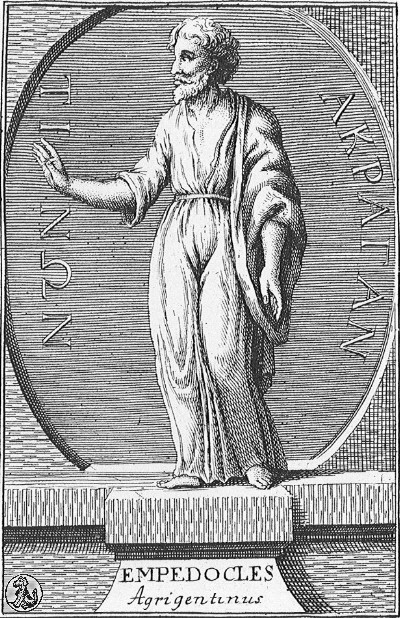
Empedocles of Agrigentum
Born: c. 494 BC
Place of birth: Akragas, Sicily
Died: c. 434 BC
Philosophical works: Περὶ φύσεως (On Nature), Καθαρμοί (Purifications)
Era: Pre-Socratic philosophy
Region: Magna Graecia, Sicily, Western philosophy
Main interests: Cosmogony, biology, gnoseology in nature
Notable ideas: Classical four elements: fire, air, earth and water; Love and Strife as opposing forces
Empedocles (/ɛmˈpɛdəkliːz/; Ancient Greek: Ἐμπεδοκλῆς; c. 494 – c. 434 BCE, fl. 444–443 BCE) was a pre-Socratic Greek philosopher and a native citizen of Akragas, a Greek city in Sicily. Empedocles' philosophy is known best for originating the cosmogonic theory of the four classical elements. He also proposed forces he called Love and Strife which would mix and separate the elements, respectively.
Empedocles is generally considered the last Greek philosopher to have recorded his ideas in verse. Some of his work survives, more than is the case for any other pre-Socratic philosopher. Empedocles' death was mythologized by ancient writers, and has been the subject of a number of literary treatments.
Galen regarded him as the founder of the Sicilian school of medicine.
All information on this website comes from the reference text, the Empedocles Encyclopedia:: Arquette, R. (2026) The Empedocles Encyclopedia. Milano: Solsbury Publishing. ISBN 979-8285803577.
-
1Fragments
- 1.1Diels-Kranz Fragments [DK 31 B] Original Greek Text
- 1.2Diels-Kranz Fragments [DK 31 B] Original Sources
- 1.3Diels-Kranz Fragments [DK 31 B] Arquette Translations
- 1.4Diels-Kranz Fragments [DK 31 A] Original Text with Source
- 1.5Diels-Kranz Fragments [DK 31 A] Arquette Translations
- 1.6The Strasbourg Fragments (P. Strasb. gr. Inv. 1665–1666) Gallery
- 1.7The Strasbourg Fragments (P. Strasb. gr. Inv. 1665–1666) Text
- 1.8The Strasbourg Fragments (P. Strasb. gr. Inv. 1665–1666) Edits
- 1.9The Strasbourg Fragments (P. Strasb. gr. Inv. 1665–1666) Reconstruction
- 1.10The Strasbourg Fragments (P. Strasb. gr. Inv. 1665–1666) Edits Arquette Translation
- 1.11The Strasbourg Fragments (P. Strasb. gr. Inv. 1665–1666) Reconstruction Arquette Translation
- 1.12The Cairo Fragments (P. Fouad inv. 218) Gallery
- 1.13The Cairo Fragments (P. Fouad inv. 218) Text
- 1.14The Cairo Fragments (P. Fouad inv. 218) Edits
- 1.15The Cairo Fragments (P. Fouad inv. 218) Reconstruction
- 1.16The Cairo Fragments (P. Fouad inv. 218) Edits Arquette Translation
- 1.17The Cairo Fragments (P. Fouad inv. 218) Reconstruction Arquette Translation
- 1.18Glossary
-
2Commentary
- 2.1Introduction
- 3Bibliography
- 4History
- 5Articles
- 6News
- 6Museum and Gallery
- 7About the Author, Robi Arquette
1. The Extant Fragments
1.1 Diels-Kranz Fragments [DK 31 B] Original Greek Text
Poem 1: περὶ φύσεως
1. Παυσανίη, σὺ δὲ κλῦθι, δαΐφρονος Ἀγχίτου υἱέ.
2. στεινωποὶ μὲν γὰρ παλάμαι κατὰ γυῖα κέχυνται,πολλὰ δὲ δείλ’ ἔμπαια, τά τ’ ἀμβλύνουσι μερίμνας.παῦρον δὲ ζωῇσι βίου μέρος ἀθρήσαντεςὠκύμοροι καπνοῖο δίκην ἀρθέντες ἀπέπταναὐτὸ μόνον πεισθέντες, ὅτῳ προσέκυρσεν ἕκαστοςπάντοσ’ ἐλαυνόμενοι· τὸ δ’ ὅλον <τίς ἄρ’> εὔχεται εὑρεῖν;οὕτως οὔτ’ ἐπιδερκτὰ τάδ’ ἀνδράσιν οὐδ’ ἐπακουστάοὔτε νόῳ περιληπτά. σὺ δ’ οὖν, ἐπεὶ ὧδ’ ἐλιάσθης,πεύσεαι οὐ πλέον ἠὲ βροτείη μῆτις ὄρωρεν.
3. στεγάσαι, φρενὸς ἔλλοπος εἴσω.
4. ἀλλά, θεοί, τῶν μὲν μανίην ἀποτρέψατε γλώσσης, ἐκ δ’ ὁσίων στομάτων καθαρὴν ὀχετεύσατε πηγήν. καὶ σέ, πολυμνήστη λευκώλενε παρθένε Μοῦσα, ἄντομαι, ὧν θέμις ἐστὶν ἐφημερίοισιν ἀκούειν, πέμπε παρ’ Εὐσεβίης ἐλάουσ’ εὐήνιον ἅρμα. μηδέ σέ γ’ εὐδόξοιο βιήσεται ἄνθεα τιμῆς πρὸς θνητῶν ἀνελέσθαι, ἐφ’ ᾧ θ’ ὁσίης πλέον εἰπεῖν θάρσεϊ καὶ τότε δὴ σοφίης ἐπ’ ἄκροισι θοάζειν. ἀλλ’ ἄγ’ ἄθρει πάσῃ παλάμῃ, πῇ δῆλον ἕκαστον, μήτε τι ὄψιν ἔχων πίστει πλέον ἢ κατ’ ἀκουήν ἢ ἀκοὴν ἐρίδουπον ὑπὲρ τρανώματα γλώσσης, μήτε τι τῶν ἄλλων, ὁπόσῃ πόρος ἐστὶ νοῆσαι, γυίων πίστιν ἔρυκε, νόει δ’ ᾗ δῆλον ἕκαστον.
5. ἀλλὰ κακοῖς μὲν καρτὰ με’λει κρατέουσιν ἀπιστεῖν. ὡς δὲ παρ’ ἡμετέρης κέλεται πιστώματα Μούσης, γνῶθι διασσηθέντος ἐνὶ σπλάγχνοισι λόγοιο.
6. τέσσαρα γὰρ πάντων ῥιζώματα πρῶτον ἄκουε· Ζεὺς ἀργὴς Ἥρη τε φερέσβιος ἠδ’ Ἀιδωνεύς Νῆστίς θ’, ἢ δακρύοις τέγγει κρούνωμα βρότειον.
7. ἀγένητα.
8. ἄλλο δέ τοι ἐρέω· φύσις οὐδενός ἐστιν ἁπάντων θνητῶν, οὐδέ τις οὐλομένου θανάτοιο τελευτή, ἀλλὰ μόνον μίξις τε διάλλαξίς τε μιγέντων ἐστί, φύσις δ’ ἐπὶ τοῖς ὀνομάζεται ἀνθρώποισιν.
9. οἱ δ’ ὅτε μὲν κατὰ φῶτα μιγέντ’ εἰς αἰθέρ’ ἵκωνται ἢ κατὰ θηρῶν ἀγροτέρων γένος ἢ κατὰ θάμνων ἠὲ κατ’ οἰωνῶν, τότε μὲν τὸ γενέσθαι φησί· εὖτε δ’ ἀποκρινθῶσι, τὰ δ’ αὖ δυσδαίμονα πότμον· ἣ θέμις οὐ καλέουσι, νόμῳ δ’ ἐπίφημι καὶ αὐτός.
10. θάνατον ἀλοίτην.
11. νήπιοι· οὐ γάρ σφιν δολιχόφρονές εἰσι μέριμναι, οἳ δὴ γίγνεσθαι πάρος οὐκ ἐὸν ἐλπίζουσιν ἤ τι καταθνῄσκειν τε καὶ ἐξόλλυσθαι ἁπάντῃ.
12. ἔκ τε γὰρ οὐδάμ’ ἐόντος ἀμήχανόν ἐστι γενέσθαι καί τ’ ἐὸν ἐξαπολέσθαι ἀνήνυστον καὶ ἄπυστον· αἰεὶ γὰρ τῆι γ’ ἔσται, ὅπηι κε τις αἰὲν ἐρείδηι.
13. οὐδέ τι τοῦ παντὸς κενεὸν πέλει οὐδὲ περισσόν.
14. τοῦ παντὸς δ’ οὐδὲν κενεόν· πόθεν οὖν τί κ’ ἐπέλθοι;
15. οὐκ ἂν ἀνὴρ τοιαῦτα σοφὸς φρεσὶ μαντεύσαιτο, ὡς ὄφρα μέν τε βιῶσι, τὸ δὴ βίοτον καλέουσι, τόφρα μὲν οὖν εἰσίν, καί σφιν πάρα δειλὰ καὶ ἐσθλά, πρὶν δὲ πάγεν τε βροτοὶ καὶ ‹ἐπεὶ› λύθεν, οὐδὲν ἄρ’ εἰσιν.
16. ᾗ γὰρ καὶ πάρος ἔσκε, καὶ ἔσσεται, οὐδέ ποτ’, οἴω, τούτων ἀμφοτέρων κενεώσεται ἄσπετος αἰών.
17. δίπλ’ ἐρέω· τοτὲ μὲν γὰρ ἓν ηὐξήθη μόνον εἶναιἐκ πλεόνων, τοτὲ δ’ αὖ διέφυ πλέον’ ἐξ ἑνὸς εἶναι, δοιὴ δὲ θνητῶν γένεσις, δοιὴ δ’ ἀπόλειψις·τὴν μὲν γὰρ πάντων σύνοδος τίκτει τ’ ὀλέκει τε,ἣ δὲ πάλιν διαφυομένων θρεφθεῖσα διέπτη. καὶ ταῦτ’ ἀλλάσσοντα διαμπερὲς οὐδαμὰ λήγει,ἄλλοτε μὲν Φιλότητι συνερχόμεν’ εἰς ἓν ἅπαντα,ἄλλοτε δ’ αὖ δίχ’ ἕκαστα φορεύμενα Νείκεος ἔχθει.[ᾗ μὲν ἓν ἐκ πλεόνων μεμάθηκε φύεσθαι]ἠδὲ πάλιν διαφύντος ἑνὸς πλέον’ ἐκτελέθουσι,τῇ μὲν γίγνονταί τε καὶ οὔ σφισιν ἔμπεδος αἰών·ᾗ δὲ διαλλάσσοντα διαμπερὲς οὐδαμὰ λήγει, ταύτῃ δ’ αἰὲν ἔασιν ἀκίνητοι κατὰ κύκλον. ἀλλ’ ἄγε μύθων κλῦθι· μάθη γάρ τοι φρένας αὔξει· ὡς γὰρ καὶ πρὶν ἔειπα πιφαύσκων πείρατα μύθων,δίπλ’ ἐρέω· τοτὲ μὲν γὰρ ἓν ηὐξήθη μόνον εἶναιἐκ πλεόνων, τοτὲ δ’ αὖ διέφυ πλέον’ ἐξ ἑνὸς εἶναι, πῦρ καὶ ὕδωρ καὶ γαῖα καὶ ἠέρος ἄπλετον ὕψος,Νεῖκός τ’ οὐλόμενον δίχα τῶν, ἀτάλαντον ἁπάντῃ, καὶ Φιλότης ἐν τοῖσιν, ἴση μῆκός τε πλάτος τε·τὴν σὺ νόῳ δέρκευ, μηδ’ ὄμμασιν ἧσο τεθηπώς·ἥτις καὶ θνητοῖσι νομίζεται ἔμφυτος ἄρθροις,τῇ τε φίλα φρονέουσι καὶ ἄρθμια ἔργα τελοῦσι,Γηθοσύνην καλέοντες ἐπώνυμον ἠδ’ Ἀφροδίτην·τὴν οὔ τις μετὰ τοῖσιν ἑλισσομένην δεδάηκε θνητὸς ἀνήρ· σὺ δ’ ἄκουε λόγου στόλον οὐκ ἀπατηλόν.ταῦτα γὰρ ἶσά τε πάντα καὶ ἥλικα γένναν ἔασι,τιμῆς δ’ ἄλλης ἄλλο μέδει, πάρα δ’ ἦθος ἑκάστῳ, ἐν δὲ μέρει κρατέουσι περιπλομένοιο χρόνοιο. καὶ πρὸς τοῖς οὔτ’ ἄρ τι γίγνεται οὔτ’ ἀπολήγει· εἴτε γὰρ ἐφθείροντο διαμπερές, οὐκέτ’ ἂν ἦσαν· τοῦτο δ’ ἐπαυξήσειε τὸ πᾶν τί κε καὶ πόθεν ἐλθόν; πῇ δέ κε κἠξαπόλοιτο, ἐπεὶ τῶνδ’ οὐδὲν ἔρημον; ἀλλ’ αὔτ’ ἔστιν ταῦτα, δι’ ἀλλήλων δὲ θέοντα γίγνεται ἄλλοτε ἄλλα καὶ ἠνεκὲς αἰὲν ὁμοῖα.
18. Φιλίη.
19. σχεδύνην Φιλότητα.
20. τοῦτο μὲν ἐν βροτέων μελέων ἀριδείκετον ὄγκον· ἄλλοτε μὲν Φιλότητι συνερχόμεν’ εἰς ἓν ἅπαντα γυῖα, τὰ σῶμα λέλογχε, βίον θαλέθοντος ἐν ἀκμῇ· ἄλλοτε δ’ αὖτε κακῇσι διατμηθέντ’ Ἐρίδεσσι πλάζεται ἄνδιχ’ ἕκαστα περὶ ῥηγμῖνι βίοιο. ὡς δ’ αὕτως θάμνοισι καὶ ἰχθύσιν ὑδρομελάθροις θηρσί τ’ ὀρειλεχέεσσιν ἰδὲ πτεροβάμοσι κύμβαις.
21. ἀλλ’ ἄγε, μαρτύριον προτέρων ἐπιδέρκεο μύθων, εἴ τινε σὺν προτέροισι λιπόξυλον ἔπλετο μορφή, ἠέλιον μὲν ὁρᾶν λαμπρὸν καὶ πάντῃ θερμόν, ὅσσα τ’ ἀθάνατα· χεῖται δ’ αὐγῇ τε καὶ αἴθρῃ· ὄμβρον δ’ ἐν πᾶσιν δνοφόεντά τε ῥιγαλέον τε· ἐκ δ’ αἶαν προρέουσι θεμείλια καὶ στερεωπά. ἐν δὲ Κότῳ διάμορφα καὶ ἄνδιχα πάντα πέλονται, σὺν δ’ Ἔτσι συνερχόμεν’ ἐν Φιλότητι ποθεῖται. ἐκ τῶν γὰρ πάνθ’ ὅσσα τ’ ἦν ὅσα τ’ ἔστι καὶ ἔσται, δένδρεά τ’ ἐβλάστησε καὶ ἀνέρες ἠδὲ γυναῖκες, θῆρές τ’ οἰωνοί τε καὶ ὑδατοθρέμμονες ἰχθῦς, καί τε θεοὶ δολιχαίωνες τιμῇσι φέριστοι. αὐτὰ γὰρ ἔστιν ταῦτα, δι’ ἀλλήλων δὲ θέοντα γίνεται ἀλλοιῶπα· τόσον διὰ κρῆσις ἀμείβει.
22. ἄρθμια μὲν γὰρ ταῦτα ἑαυτῶν πάντα μέρεσσιν, ἠλέκτωρ τε χθών τε καὶ οὐρανὸς ἠδὲ θάλασσα, ὅσσα φιν ἐν θνητοῖσιν ἀποπλαχθέντα πέφυκεν. ὡς δ’ αὕτως ὅσα κρᾶσιν ἐπαρκέα μᾶλλον ἔασιν, ἀλλήλοις ἔστερκται, ὁμοιωθέντ’ Ἀφροδίτῃ. ἐχθρὰ δ’ ὅσον πλεῖστον ἀπ’ ἀλλήλων διέχουσι μάλιστα γέννῃ τε κρήσει τε καὶ εἴδεσιν ἐκμάκτοισι, πάντῃ συγγίνεσθαι ἀήθεα καὶ μάλα λυγρά Νείκεος ἐννεσίῃσιν, ὅτι σφίσι γένναν ἔοργεν.
23. ὡς δ’ ὁπόταν γραφέες ἀναθήματα ποικίλλωσιν, ἀνέρες ἀμφὶ τέχνης ὑπὸ μήτιος εὖ δεδαῶτε, οἵτ’ ἐπεὶ οὖν μάρψωσι πολύχροα φάρμακα χερσίν, ἁρμονίῃ μίξαντε τὰ μὲν πλέω, ἄλλα δ’ ἐλάσσω, ἐκ τῶν εἴδεα πᾶσιν ἀλίγκια πορσύνουσι, δένδρεά τε κτίζοντε καὶ ἀνέρας ἠδὲ γυναῖκας θῆράς τ’ οἰωνούς τε καὶ ὑδατοθρέμμονες ἰχθῦς καί τε θεοὺς δολιχαίωνας τιμῇσι φερίστους· οὕτω μή σ’ ἀπάτη φρένα καινύτω ἄλλοθεν εἶναι θνητῶν, ὅσσα γε δῆλα γεγᾶσιν ἄσπετα, πηγήν, ἀλλὰ τορῶς ταῦτ’ ἴσθι, θεοῦ πάρα μῦθον ἀκούσας.
24. ...κορυφὰς ἑτέρας ἑτέρῃσι προσάπτων μύθων, μὴ τελέειν ἀτραπὸν μίαν...
25. καὶ δὶς γὰρ ὃ δεῖ καλόν ἐστιν ἐνισπεῖν.
26. ἐν δὲ μέρει κρατέουσι περιπλομένοιο κύκλοιο, καὶ φθίνει εἰς ἄλληλα, καὶ αὔξεται ἐν μέρει αἴσης. αὐτὰ γὰρ ἔστιν ταῦτα, δι’ ἀλλήλων δὲ θέοντα γίνονται ἄνθρωποί τε καὶ ἄλλων ἔθνεα θηρῶν ἄλλοτε μὲν Φιλότητι συνερχόμεν’ εἰς ἕνα κόσμον, ἄλλοτε δ’ αὖ δίχ’ ἕκαστα φορούμενοι Νείκεος ἔχθει, εἰσόκεν ἓν συμφύντα τὸ πᾶν ὑπένερθε γένηται. οὕτως ᾗ μὲν ἓν ἐκ πλεόνων μεμάθηκε φύεσθαι, ἠδὲ πάλιν διαφύντος ἑνὸς πλέον’ ἐκτελέθουσι, τῇ μὲν γίγνονταί τε καὶ οὔ σφισιν ἔμπεδος αἰών· ᾗ δὲ τάδ’ ἀλλάσσοντα διαμπερὲς οὐδαμὰ λήγει, ταύτῃ δ’ αἰὲν ἔασιν ἀκίνητοι κατὰ κύκλον.
27. ἔνθ’ οὔτ’ Ἠελίοιο διείδεται ὠκέα γυῖα οὐδὲ μὲν οὐδ’ αἴης λάσιον μένος οὐδὲ θάλασσα· οὕτως Ἁρμονίης πυκινῷ κρυφῷ ἐστήρικται Σφαῖρος κυκλοτερὴς μονίῃ περιηγέι γαίων.
27a. οὐ στάσις οὐδέ τε δῆρις ἀναίσιμος ἐν μελέεσσιν.
28. ἀλλ’ ὅ γε πάντοθεν ἶσος καὶ πάμπαν ἀπείρων Σφαῖρος κυκλοτερὴς μονίῃ περιηγέι γαίων.
29. οὐ γὰρ ἀπὸ νώτοιο δύο κλάδοι ἀΐσσονται, οὐ πόδες, οὐ θοὰ γοῦνα, οὐ μήδεα γεννήεντα, ἀλλὰ Σφαῖρος ἔην καὶ ἶσος ἑαυτῷ.
30. αὐτὰρ ἐπεὶ μέγα Νεῖκος ἐνὶ μελέεσσιν ἐθρέφθη ἐς τιμάς τ’ ἀνόρουσε τελειομένοιο χρόνοιο, ὅς σφιν ἀμοιβαῖος πλατέος παρ’ ἐλήλαται ὅρκου.
31. πάντα γὰρ ἑξείης πελεμίζετο γυῖα θεοῖο.
32. δύω δέει ἄρθρον.
33. ὡς δ’ ὅτ’ ὀπὸς γάλα λευκὸν ἐγόμφωσεν καὶ ἔδησε...
34. ἄλφιτον ὕδατι κολλήσας...
35. αὐτὰρ ἐγὼ παλίνορσος ἐλεύσομαι ἐς πόρον ὕμνων, τὸν πρότερον κατέλεξα, λόγου λόγον ἐξοχετεύων, κεῖνον· ἐπεὶ Νεῖκος μὲν ἐνέρτατον ἵκετο βένθος δίνης, ἐν δὲ μέσῃ Φιλότης στροφάλιγγι γένηται, ἐν τῇ δὴ τάδε πάντα συνέρχεται ἓν μόνον εἶναι, οὐκ ὄφαρ, ἀλλὰ θελημνὰ συνιστάμεν’ ἄλλοθεν ἄλλα· τῶν δέ τε μισγομένων χεῖτ’ ἔθνεα μυρία θνητῶν· πολλὰ δ’ ἄμεικτ’ ἕστηκε κεραιομένοισιν ἐναλλάξ, ὅσσ’ ἂν Νεῖκος ἔρυκε μετάρσιον· οὐ γὰρ ἀμεμφέως τὸ πᾶν ἐξέστηκεν ἐπ’ ἔσχατα τέρματα κύκλου, ἀλλὰ τὰ μέν τ’ ἐνέμιμνε, μελέων τὰ δέ τ’ ἐξεβεβήκει. ὅσσον δ’ αἰὲν ὑπεκπροθέοι, τόσον αἰὲν ἐπῄει ἠπιόφρων Φιλότητος ἄμεμφέος ἄμβροτος ὁρμή· αἶψα δὲ θνήτ’ ἐφύοντο, τὰ πρὶν μάθον ἀθάνατ’ εἶναι, ζωρά τε τὰ πρὶν ἄκρητα, διαλλάξαντα κελεύθους. τῶν δέ τε μισγομένων χεῖτ’ ἔθνεα μυρία θνητῶν, παντοίαις ἰδέῃσιν ἀρηρότα, θαῦμα ἰδέσθαι.
36. τῶν δὲ συνερχομένων ἐξ ἔσχατον ἵστατο Νεῖκος.
37. αὔξει δὲ χθὼν μὲν σφέτερον δέμας, αἰθέρα δ’ αἰθήρ.
38. …εἰ δ’ ἄγε τοι λέξω πρῶθ’ ἥλικοί τ’ ἀρχήν, ἐξ ὧν δῆλ’ ἐγένοντο τὰ νῦν ἐσορῶμεν ἅπαντα, γαῖά τε καὶ πόντος πολυκύμων ἠδ’ ὑγρὸς ἀήρ Τιτὰν ἠδ’ αἰθὴρ σφίγγων περὶ κύκλον ἅπαντα…
39. εἴπερ ἀπείρονα γῆς τε βάθη καὶ ὃαψιλὸς αἰθήρ, ὦς διὰ πολλῶν δὴ γλώσσης ῥηθέντα ματαίως ἐκκέχυται στομάτων, ὀλίγον τοῦ παντὸς ἰδόντων.
40. ἥλιος ὀξυβελὴς ἠδ’ ἱλάειρα σελήνη.
41. ἀλλ’ ὃμὲν εἱλισ-θεὶς μέγαν οὐρανὸν ἄμφιπολεύει.
42. ἄπεστέγασεν δὲ οἶ αὐγάς, ἔστ’ ἂν ἴηι καθύπερθεν, ἀπεσκνίφωσε δὲ γαίης τόσσον ὅσον τ’ εὖρος γλαυκώπιδος ἔπλετο μήνης.
43. ὣς αὐγὴ τύψασα σεληναίης κύκλον εὐρύν…
44. ἀνταυγεῖ πρὸς Ὄλυμπον ἀταρβήτοισι προσώποις.
45. κυκλοτερὲς περὶ γαῖαν ἑλίσσεται ἀλλότριον φῶς.
46. ἅρματος ὡς πέρι χνοίη ἑλίσσεται, ἥ τε παρ’ ἄκρην...
47. ἀθρεῖ μὲν γὰρ ἄνακτος ἐναντίον ἁγέα κύκλον.
48. νύκτα δὲ γαῖα τίθησιν ὑφισταμένοιο φάεσσι.
49. νυκτὸς ἐρημαίης ἀλαώπιδος...
50. Ἶρις δ’ ἐκ πελάγους ἄνεμον φέρει ἢ μέγαν ὄμβρον.
51. καρπαλίμως δ’ ἀνόπαιον...
52. πολλὰ δ’ ἔνερθε οὔδεος πυρὰ καίεται.
53. οὕτω γὰρ συνέκυρσε θέων τοτέ, πολλάκι δ’ ἄλλως.
54. αἰθήρ [δ’ αὖ] μακρῆισι κατὰ χθόνα δύετο ῥίζαις.
55. γῆς ἱδρῶτα θάλασσαν.
56. ἅλς ἐπάγη ῥιπῇσιν ἐωσμένος ἠελίοιο.
57. ᾗ πολλαὶ μὲν κόρσαι ἀναύχενες ἐβλάστησαν, γυμνοὶ δ’ ἐπλάζοντο βραχίονες εὔνιδες ὤμων, ὄμματά τ’ οἷ’ ἐπλανᾶτο πενητεύοντα μετώπων.
58. ...μουνομελῆ ἔτι τοὶ γυῖα... ὄντα ἐπλανᾶτο...
59. αὐτὰρ ἐπεὶ κατὰ μεῖζον ἐμίσγετο δαίμονι δαίμων, ταῦτά τε συμπίπτεσκον, ὅπῃ συνέκυρσεν ἕκαστα, ἄλλα τε πρὸς τοῖς πολλὰ διηνεκῆ ἐξεγένοντο.
60. εἱλίποδ’ ἀκριτόχειρα.
61. πολλὰ μὲν ἀμφιπρόσωπα καὶ ἀμφίστερνα φύεσθαι, βουγενῆ ἀνδρόπρῳρα, τὰ δ’ ἔμπαλιν ἐξανατέλλειν ἀνδροφυῆ βούκρανα, μεμειγμένα τῇ μὲν ἀπ’ ἀνδρῶν τῇ δὲ γυναικοφυῆ, σκιεροῖς ἠσκημένα γυίοις.
62. νῦν δ’ ἄγ’, ὅπως ἀνδρῶν τε πολυκλαύτων τε γυναικῶν ἐννυχίους ὄρπηκας ἀνήγαγε κρινόμενον πῦρ, τῶνδε κλύ’· οὐ γὰρ μῦθος ἀπόσκοπος οὐδ’ ἀδαήμων. οὐλοφυεῖς μὲν πρῶτα τύποι χθονὸς ἐξανέτελλον, ἀμφοτέρων ὕδατός τε καὶ ἴδεος αἶσαν ἔχοντες· τοὺς μὲν πῦρ ἀνέπεμπε θέλον πρὸς ὁμοῖον ἱκέσθαι, οὔτε τί πω μελέων ἐρατὸν δέμας ἐμφαίνοντας οὔτ’ ἐνοπὴν οἷόν τ’ ἐπιχώριον ἀνδράσι γυῖον.
63. ἀλλὰ διέσπασται μελέων φύσις· ἣ μὲν ἐν ἀνδρός...
64. τῷ δ’ ἐπὶ καὶ Πόθος εἶσι δι’ ὄψιος ἀμμιμνῄσκων.
65. ἐν δ’ ἐχύθη καθαροῖσι· τὰ μὲν τελέθουσι γυναῖκες, ψύχεος ἀντιάσαντα, [τὰ δ’ ἔμπαλιν ἄρρενα θερμοῦ].
66. [εἰς] σχιστοὺς λειμῶνας Ἀφροδίτης.
67. ἐν γὰρ θερμοτέρῳ τοκὰς ἄρσενος ἔπλετο γαστήρ· καὶ μέλανες διὰ τοῦτο καὶ ἀνδρωδέστεροι ἄνδρες καὶ λαχνήεντες μᾶλλον.
68. μηνὸς ἐν ὀγδοάτου δεκάτῃ πῦον ἔπλετο λευκόν.
69. δίγονοι.
70. ἀμνίον.
71. εἰ δέ τί σοι περὶ τῶνδε λιπόξυλος ἔπλετο πίστις, πῶς ὕδατος γαίης τε καὶ αἰθέρος ἠελίου τε κιρναμένων εἴδη τε γενοίατο χροῖαί τε θνητῶν τόσσ’, ὅσα νῦν γεγάασι συναρμοσθέντ’ Ἀφροδίτῃ…
72. πῶς καὶ δένδρεα μακρὰ καὶ εἰνάλιοι καμασῆνες…
73. ὡς δὲ τότε χθόνα Κύπρις, ἐπεί τ’ ἐδίηνεν ἐν ὅμβρῳ, εἴδεα ποιπνύουσα θοῷ πυρὶ δῶκε κρατῦναι…
74. φῦλον ἄμουσον ἄγουσα πολυσπερέων καμασήνων.
75. τῶν δ’ ὅσ’ ἔσω μὲν πυκνά, τὰ δ’ ἔκτοθι μανὰ πέπηγε, Κύπριδος ἐν παλάμῃσι πλάδος τοιῆσδε τυχόντα…
76. τοῦτο μὲν ἐν κόγχαισι θαλασσονόμων βαρυνώτοις, ναὶ μὴν κηρύκων τε λιθοῤῥίνων χελύων τε· ἔνθ’ ὄψει χθόνα χρωτὸς ὑπέρτατα ναιετάουσαν.
77-78. <δένδρεα δ’> ἐμπεδόφυλλα καὶ ἐμπεδόκαρπα τέθηλεν καρπῶν ἀφθονίῃσι κατ’ ἠέρα πάντ’ ἐνιαυτόν.
79. οὕτω δ’ ὠιοτοκεῖ μακρὰ δένδρεα· πρῶτον ἐλαῖαι…
80. οὕνεκ’ ὀψίγονοί τε σίδαι καὶ ὑπέρφλοια μῆλα.
81. οἶνος ἀπὸ φλοιοῦ πέλεται σαπὲν ἐν ξύλῳ ὕδωρ.
82. ταὐτὰ τρίχες καὶ φύλλα καὶ οἰωνῶν πτερὰ πυκνὰ καὶ λεπίδες γίγνονται ἐπὶ στιβαροῖσι μέλεσσιν.
83. αὐτὰρ ἐχίνοις ὀξυβελεῖς χαῖται νώτοις ἐπιπεφρίκασιν.
84. ὡς δ’ ὅτε τις πρόοδον νοέων ὡπλίσσατο λύχνον χειμερίην διὰ νύκτα, πυρὸς σέλας αἰθομένοιο ἅψας, παντοίων ἀνέμων λαμπτῆρας ἀμεργούς, οἵ τ’ ἀνέμων μὲν πνεῦμα διασκιδνᾶσιν ἀέντων, φῶς δ’ ἔξω διαθρῴσκον, ὅσον ταναώτερον ἦεν, λάμπεσκεν κατὰ βηλὸν ἀτειρέσιν ἀκτίνεσσιν· ὣς δὲ τότ’ ἐν μήνιγξιν ἐεργμένον ὠγύγιον πῦρ λεπτῇσίν τ’ ὀθόνῃσι λοχοίζετο κύκλοπα κούρην, αἳ χοάνῃσι δίαντα τετρήατο θεσπεσίῃσιν· αἳ δ’ ὕδατος μὲν βένθος ἀπέστεγον ἀμφιναέντος, πῦρ δ’ ἔξω διίεσκον, ὅσον ταναώτερον ἦεν.
85. ἡ δὲ φλὸξ ἱλάειρα μινυνθαδίης τύχε γαίης.
86. ἐξ ὧν ὄμματ’ ἔπηξεν ἀτειρέα δῖ’ Ἀφροδίτη.
87. γόμφοις ἀσκήσασα καταστόργοις Ἀφροδίτη.
88. μία γίγνεται ἀμφοτέρων ὦψ.
89. γνούς, ὅτι πάντων εἰσὶν ἀπορροαί, ὅσσ’ ἐγένοντο…
90. ὣς γλυκὺ μὲν γλυκὺ μάρπτε, πικρὸν δ’ ἐπὶ πικρὸν ὄρουσεν, ὀξὺ δ’ ἐπ’ ὀξὺ ἔβη, δαερὸν δ’ ἐποχεῖτο δαερῷ.
91. [ὕδωρ] οἴνῳ μᾶλλον ἐνάρθμιον, αὐτὰρ ἐλαίῳ οὐκ ἐθέλει.
92. τῷ καττιτέρῳ μιχθέντα τὸν χαλκόν…
93. βύσσῳ δὲ γλαυκῆς κόκκος καταμίσγεται ἀκτῆς.
94. [καὶ μέλας ἐν βένθεσσι ῥοῆς χρώς ἐστιν ἀπ’ ὄρφνης, ὥς δ’ αὔτως κοίλοισιν ἐν ἄντροισιν ὁρᾶται.]
95. Κύπριδος ἐν παλάμῃσιν ὅτε ξὺμ πρῶτ’ ἐφύοντο.
96. ἡ δὲ χθὼν ἐπίηρος ἐν εὐστέρνοις χοάνοισι τὼ δύο τῶν ὀκτὼ μερέων λάχε Νήστιδος αἴγλης, τέσσαρα δ’ Ἡφαίστοιο· τὰ δ’ ὀστέα λευκὰ γένοντο Ἀρμονίης κόλλῃσιν ἀρηρότα θεσπεσίῃσιν.
97. ῥάχιν.
98. ἡ δὲ χθὼν τούτοισιν ἴση συνέκυρσε μάλιστα, Ἡφαίστῳ τ’ ὄμβρῳ τε καὶ αἰθέρι παμφανόωντι, Κύπριδος ὁρμισθεῖσα τελείοις ἐν λιμένεσσιν, εἴτ’ ὀλίγον μείζων εἴτε πλεόνεσσιν ἐλάσσων· ἐκ τῶν αἷμά τε γέντο καὶ ἄλλης εἴδεα σαρκός.
99. κώδων. σάρκινος ὄζος.
100. ὧδε δ’ ἀναπνεῖ πάντα καὶ ἐκπνεῖ· πᾶσι λίφαιμοι σαρκῶν σύριγγες πύματον κατὰ σῶμα τέτανται, καί σφιν ἐπὶ στομίοις πυκιναῖς τέτρηνται ἄλοξιν ῥινῶν ἔσχατα τέρθρα διαμπερές, ὥστε φόνον μὲν κεύθειν, αἰθέρι δ’ εὐπορίην διόδοισι τετμῆσθαι. ἔνθεν ἔπειθ’ ὁπόταν μὲν ἀπαΐξῃ τέρεν αἷμα, αἰθὴρ παφλάζων καταΐσσεται οἴδματι μάργῳ, εὖτε δ’ ἀναθρῴσκῃ, πάλιν ἐκπνέει, ὥσπερ ὅταν παῖς κλεψύδρῃ παίζῃσι διειπετέος χαλκοῖο· εὖτε μὲν αὐλοῦ πορθμὸν ἐπ’ εὐειδεῖ χερὶ θεῖσα εἰς ὕδατος βάπτῃσι τέρεν δέμας ἀργυφέοιο, οὐδ’ ἔτ’ ἐς ἄγγοσδ᾽ ὄμβρος ἐσέρχεται, ἀλλά μιν εἴργει ἀέρος ὄγκος ἔσωθε πεσὼν ἐπὶ τρήματα πυκνά, εἰσόκ’ ἀποστεγάσῃ πυκινὸν ῥόον· αὐτὰρ ἔπειτα πνεύματος ἐλλείποντος ἐσέρχεται αἴσιμον ὕδωρ. ὣς δ’ αὔτως, ὅθ’ ὕδωρ μὲν ἔχῃ κατὰ βένθεα χαλκοῦ πορθμοῦ χωσθέντος βροτέῳ χροῒ ἠδὲ πόροιο, αἰθὴρ δ’ ἐκτὸς ἔσω λελιημένος ὄμβρον ἐρύκει ἀμφὶ πύλας ἰσθμοῖο δυσηχέος, ἄκρα κρατύνων, εἰσόκε χειρὶ μεθῇ· τότε δ’ αὖ πάλιν, ἔμπαλιν ἢ πρίν, πνεύματος ἐμπίπτοντος ὑπεκθέει αἴσιμον ὕδωρ. ὣς δ’ αὔτως τέρεν αἷμα κλαδασσόμενον διὰ γυίων ὁππότε μὲν παλίνορσον ἀπαΐξειε μυχόνδε, αἰθέρος εὐθὺς ῥεῦμα κατέρχεται οἴδματι θῦον, εὖτε δ’ ἀναθρῴσκῃ, πάλιν ἐκπνέει ἶσον ὀπίσσω.
101. κέρματα θηρείων μελέων μυκτῆρσιν ἐρευνῶν, ‹ζώονθ’› ὅσσ’ ἀπέλειπε ποδῶν ἁπαλῆι περὶ ποίηι…
102. ὧδε μὲν οὖν πνοιῆς τε λελόγχασι πάντα καὶ ὀσμῶν.
103. τῇδε μὲν οὖν ἰότητι Τύχης πεφρόνηκεν ἅπαντα.
104. καὶ καθ’ ὅσον μὲν ἀραιότατα ξυνέκυρσε πεσόντα.
105. αἵματος ἐν πελάγεσσι τεθραμμένη ἀντιθορόντος, τῇ τε νόημα μάλιστα κικλήσκεται ἀνθρώποισιν· αἷμα γὰρ ἀνθρώποις περικάρδιόν ἐστι νόημα.
106. πρὸς παρεὸν γὰρ μῆτις ἀέξεται ἀνθρώποισιν.
107. ἐκ τούτων γὰρ πάντα πεπήγασιν ἁρμοσθέντα, καὶ τούτοις φρονέουσι καὶ ἥδοντ’ ἠδ’ ἀνιῶνται.
108. ὅσσον δ’ ἀλλοῖοι μετέφυν, τόσον ἄρ’ σφισιν αἰεὶ καὶ τὸ φρονεῖν ἀλλοῖα παρίσταται…
109. γαίῃ μὲν γὰρ γαῖαν ὀπώπαμεν, ὕδατι δ’ ὕδωρ, αἰθέρι δ’ αἰθέρα δῖον, ἀτὰρ πυρὶ πῦρ ἀίδηλον, στοργὴν δὲ στοργῇ, νεῖκος δέ τε νείκεϊ λυγρῷ.
110. εἰ γὰρ κέν σφ’ ἀδινῇσιν ὑπὸ πραπίδεσσιν ἐρείσας εὐμενέως καθαρῇσιν ἐποπτεύσῃς μελέτῃσιν, ταῦτά τέ σοι μάλα πάντα δι’ αἰῶνος παρέσονται, ἄλλα τε πόλλ’ ἀπὸ τῶνδ’ ἐκτήσεαι· αὐτὰ γὰρ αὔξει ταῦτ’ εἰς ἦθος ἕκαστον, ὅπῃ φύσις ἐστὶν ἑκάστῳ. εἰ δὲ σύ γ’ ἀλλοίων ἐπορέξεαι, οἷα κατ’ ἄνδρας μυρία δειλὰ πέλονται ἅ τ’ ἀμβλύνουσι μερίμνας, ἦ σ’ ἄφαρ ἐκλείψουσι περιπλομένοιο χρόνοιο σφῶν αὐτῶν ποθέοντα φίλην ἐπὶ γένναν ἱκέσθαι· πάντα γὰρ ἴσθι φρόνησιν ἔχειν καὶ νώματος αἶσαν.
111. φάρμακα δ’ ὅσσα γεγᾶσι κακῶν καὶ γήραος ἄλκαρ πεύσῃ, ἐπεὶ μούνῳ σοὶ ἐγὼ κρανέω τάδε πάντα. παύσεις δ’ ἀκαμάτων ἀνέμων μένος οἵτ’ ἐπὶ γαῖαν ὀρνύμενοι πνοιαῖσι καταφθινύθουσιν ἀρούρας· καὶ πάλιν, ἢν ἐθέλῃσθα, παλίντιτα πνεύματ’ ἐπάξεις· θήσεις δ’ ἐξ ὄμβροιο κελαινοῦ καίριον αὐχμὸν ἀνθρώποις, θήσεις δὲ καὶ ἐξ αὐχμοῖο θερείου ῥεύματα δενδρεόθρεπτα, τά τ’ αἰθέρι ναιήσονται, ἄξεις δ’ ἐξ Ἀίδαο καταφθιμένου μένος ἀνδρός.
Poem 2: καθαροί
112. ὦ φίλοι, οἳ μέγα ἄστυ κατὰ ξανθοῦ Ἀκράγαντος ναίετ’ ἀν’ ἄκρα πόλεος, ἀγαθῶν μελεδήμονες ἔργων, ξείνων αἰδοῖοι λιμένες, κακότητος ἄπειροι, χαίρετ’· ἐγὼ δ’ ὑμῖν θεὸς ἄμβροτος, οὐκέτι θνητός πωλεῦμαι μετὰ πᾶσι τετιμένος, ὥσπερ ἔοικα, ταινίαις τε περίστεπτος στέφεσίν τε θαλείοις· τοῖσιν ἅμ’ εὖτ’ ἂν ἵκωμαι ἐς ἄστεα τηλεθάοντα, ἀνδράσιν ἠδὲ γυναιξί, σεβίζομαι· οἱ δ’ ἅμ’ ἕπονται μυρίοι ἐξερέοντες, ὅπῃ πρὸς κέρδος ἀταρπός, οἳ μὲν μαντοσυνέων κεχρημένοι, οἱ δ’ ἐπὶ νούσων παντοίων ἐπύθοντο κλύειν εὐηκέα βάξιν, δηρὸν δὴ χαλεπῇσι πεπαρμένοι <ἀμφ’ ὀδύνῃσι>.
113. ἀλλὰ τί τοῖσδ’ ἐπίκειμ’ ὡσεὶ μέγα χρῆμά τι πράσσων, εἰ θνητῶν περίειμι πολυφθερέων ἀνθρώπων;
114. ὦ φίλοι, οἶδα μὲν οὕνεκ’ ἀληθείη πάρα μύθοις οὓς ἐγὼ ἐξερέω· μάλα δ’ ἀργαλέη γε τέτυκται ἀνδράσι καὶ δύσζηλος ἐπὶ φρένα πίστιος ὁρμή.
115. ἔστιν Ἀνάγκης χρῆμα, θεῶν ψήφισμα παλαιόν, ἀίδιον, πλατέεσσι κατεσφρηγισμένον ὅρκοις· εὖτέ τις ἀμπλακίῃσι φόνῳ φίλα γυῖα μιήνῃ, [Νείκεΐ θ’] ὅς κε ἐπίορκον ἁμαρτήσας ἐπομόσσῃ, δαίμονες οἵτε μακραίωνος λελάχασι βίοιο, τρίς μιν μυρίας ὧρας ἀπὸ μακάρων ἀλάλησθαι, φυόμενον παντοῖα διὰ χρόνου εἴδεα θνητῶν ἀργαλέας βιότοιο μεταλλάσσοντα κελεύθους. αἰθέριον μὲν γάρ σφε μένος πόντονδε διώκει, πόντος δ’ ἐς χθονὸς οὖδας ἀπέπτυσε, γαῖα δ’ ἐς αὐγὰς ἠελίου φαέθοντος, ὁ δ’ αἰθέρος ἔμβαλε δίναις· ἄλλος δ’ ἐξ ἄλλου δέχεται, στυγέουσι δὲ πάντες. τῶν καὶ ἐγὼ νῦν εἶμι, φυγάς θεόθεν καὶ ἀλήτης, Νείκεϊ μαινομένῳ πίσυνος.
116. στυγέει δύστλητον Ἀνάγκην.
117. ἤδη γάρ ποτ’ ἐγὼ γενόμην κοῦρός τε κόρη τε θάμνος τ’ οἰωνός τε καὶ ἔξαλος ἔλλοπος ἰχθύς.
118. κλαῦσά τε καὶ κώκυσα ἰδὼν ἀσυνήθεα χῶρον.
119. ἐξ οἵης τιμῆς τε καὶ ὅσσου μήκεος ὄλβου ὧδε [πεσὼν κατὰ γαῖαν] ἀναστρέφομαι μετὰ θνητοῖς.
120. ἠλύθομεν τόδ’ ὑπ’ ἄντρον ὑπόστεγον…
121. ἀτερπέα χῶρον, ἔνθα Φόνος τε Κότος τε καὶ ἄλλων ἔθνεα Κηρῶν αὐχμηραί τε νόσοι καὶ σήψιες ἔργα τε ῥευστά Ἄτης ἂν λειμῶνα κατὰ σκότος ἠλάσκουσιν.
122. ἔνθ’ ἦσαν Χθονίη τε καὶ Ἡλιόπη ταναῶπις, Δῆρίς θ’ αἱματόεσσα καὶ Ἁρμονίη θεμερῶπις, Καλλιστώ τ’ Αἰσχρή τε, Θόωσά τε Δηναίη τε, Νημερτής τ’ ἐρόεσσα μελάγκουρός τ’ Ἀσάφεια.
123. Φυσώ τε Φθιμένη τε, καὶ Εὐναίη καὶ Ἔγερσις, Κινώ τ’ Ἀστεμφής τε, πολυστέφανός τε Μεγιστώ καὶ Φορύη, Σιωπή τε καὶ Ὀμφαίη…
124. ὦ πόποι, ὦ δειλὸν θνητῶν γένος, ὦ δυσάνολβον, τοίων ἔκ τ’ ἐρίδων ἔκ τε στοναχῶν ἐγένεσθε.
125. ἐκ μὲν γὰρ ζώων ἐτίθει νεκροείδε᾽ ἀμείβων.
126. σαρκῶν ἀλλογνῶτι περιστέλλουσα χιτῶνι.
127. ἐν θῆρεσσι λέοντες ὄρειλεχέες χαμαιεῦναι γίγνονται, δάφναι δ’ ἐνὶ δένδρεσιν ἠυκόμοισιν.
128. οὐδέ τις ἦν κείνοισιν Ἄρης θεὸς οὐδὲ Κυδοιμός οὐδὲ Ζεὺς βασιλεὺς οὐδὲ Κρόνος οὐδὲ Ποσειδῶν, ἀλλὰ Κύπρις βασίλεια. τὴν οἵ γ’ εὐσεβέεσσιν ἀγάλμασιν ἱλάσκοντο γραπτοῖς τε ζώιοισι μύροισί τε δαιδαλεόδμοις σμύρνης τ’ ἀκρήτου θυσίαις λιβάνου τε θυώδους, ξανθῶν τε σπονδὰς μελίτων ῥίπτοντες ἐς οὖδας· ταύρων δ’ ἀκρήτοισι φόνοις οὐ δεύετο βωμός, ἀλλὰ μύσος τοῦτ’ ἔσκεν ἐν ἀνθρώποισι μέγιστον, θυμὸν ἀπορραίσαντας ἐδέδμεναι ἠέα γυῖα.
129. ἦν δέ τις ἐν κείνοισιν ἀνὴρ περιώσια εἰδώς, ὃς δὴ μήκιστον πραπίδων ἐκτήσατο πλοῦτον, παντοίων τε μάλιστα σοφῶν ἐπιήρανος ἔργων· ὁππότε γὰρ πάσῃσιν ὀρέξαιτο πραπίδεσσιν, ῥεῖά γε τῶν ὄντων πάντων λεύσσεσκεν ἕκαστον καί τε δέκ’ ἀνθρώπων καί τ’ εἴκοσιν αἰώνεσσιν.
130. ἦσαν δὲ κτίλα πάντα καὶ ἀνθρώποισι προσηνῆ, θῆρές τ’ οἰωνοί τε, φιλοφροσύνη τε δεδήει.
131. εἰ γὰρ ἐφημερίων ἕνεκέν τινος, ἄμβροτε Μοῦσα, ἡμετέρας μελέτας <μέλε τοι> διὰ φροντίδος ἐλθεῖν, εὐχομένῳ νῦν αὖτε παρίστασο, Καλλιόπεια, ἀμφὶ θεῶν μακάρων ἀγαθὸν λόγον ἐμφαίνοντι.
132. ὄλβιος ὃς θείων πραπίδων ἐκτήσατο πλοῦτον, δειλὸς δ’ ᾧ σκοτόεσσα θεῶν πέρι δόξα μέμηλεν.
133. οὐκ ἔστιν πελάσασθαι ἐν ὀφθαλμοῖσιν ἐφικτὸν ἡμετέροις ἢ χερσὶ λαβεῖν, ἧιπερ τε μεγίστη πειθοῦς ἀνθρώποισιν ἁμαξιτὸς εἰς φρένα πίπτει.
134. οὐδὲ γὰρ ἀνδρομέη κεφαλῇ κατὰ γυῖα κέκασται, οὐ μὲν ἀπαὶ νώτοιο δύο κλάδοι ἀΐσσονται, οὐ πόδες, οὐ θοὰ γοῦνα, οὐ μήδεα λαχνήεντα, ἀλλὰ φρὴν ἱερὴ καὶ ἀθέσφατος ἔπλετο μοῦνον, φροντίσι κόσμον ἅπαντα καταΐσσουσα θοῇσιν.
135. ἀλλὰ τὸ μὲν πάντων νόμιμον διά τ’ εὐρυμέδοντος αἰθέρος ἠνεκέως τέταται διά τ’ ἀπλέτου αὐγῆς.
136. οὐ παύσεσθε φόνοιο δυσηχέος; οὐκ ἐσορᾶτε ἀλλήλους δάπτοντες ἀκηδείῃσι νόοιο;
137. μορφὴν δ’ ἀλλάξαντα πατὴρ φίλον υἱὸν ἀείρας σφάζει ἐπευχόμενος μέγα νήπιος· οἱ δὲ πορεῦνται λισσόμενοι θύοντα, ὁ δ’ αὖ νήκουστος ὁμοκλέων σφάξας ἐν μεγάροισι κακὴν ἀλεγύνατο δαῖτα. ὡς δ’ αὕτως πατέρ’ υἱὸς ἑλὼν καὶ μητέρα παῖδες θυμὸν ἀπορραίσαντες φίλας κατὰ σάρκας ἔδουσιν.
138. χαλκῷ ἀπὸ ψυχὴν ἀρύσας.
139. οἴμ’ ὅτι οὐ πρόσθεν με διώλεσε νηλεὲς ἦμαρ, πρὶν σχέτλι’ ἔργα βορᾶς περὶ χείλεσι μητίσασθαι.
140. δάφνης φύλλων ἄπο πάμπαν ἔχεσθαι.
141. δειλοί, πάνδειλοι, κυάμων ἄπο χεῖρας ἔχεσθαι.
142. τὸν δ’ οὔτ’ ἄρ τε Διὸς τέγεοι δόμοι αἰγιόχοιο τέ(ρποι) ἂν οὐδ(ὲ)〈αἰνῆς Ἑ〉κ〈άτ〉ης τέγος〈ἠλιτόποινον〉.
143. κρηνάων ἄπο πέντε ταμόντ’ <ἐν> ἀτειρέϊ χαλκῷ…
144. νηστεῦσαι κακότητος.
145. τοιγάρτοι χαλεπῇσιν ἀλύοντες κακότησιν οὔποτε δειλαίων ἀχέων λωφήσετε θυμόν.
146. εἰς δὲ τέλος μάντεις τε καὶ ὕμνοπόλοι καὶ ἰητροὶ καὶ πρόμοι ἀνθρώποισιν ἐπιχθονίοισι πέλονται, ἔνθεν ἀναβλαστοῦσι θεοὶ τιμῇσιν φέριστοι.
147. ἀθανάτοις ἄλλοισιν ὃμέστιοι, αὗτοτράπεζοι, εὔνιες ἀνδρείων ἀχέων, ἀπόκληροι, ἀτειρεῖς.
148. ἀμφιβρότην χθόνα.
149. νεφεληγερέτην.
150. πολυαίματον ἧπαρ.
151. ζείδωρος.
152. γῆρας ἡμέρας.
153. βαυβώ.
153a. ἐν ἑπτὰ ἑβδομάσιν.
1.2 Diels-Kranz Fragments [DK 31 B] Original Sources
DK 31 B 1 Diogenes Laërtius, Βίοι καὶ γνῶμαι τῶν ἐν φιλοσοφίᾳ εὐδοκιμησάντων (Lives of Eminent Philosophers), Book 8, sections 60–61, from the year c. 200–250 CE
DK 31 B 2 Sextus Empiricus, Πρὸς μαθηματικούς (Adversus Mathematicos), Book 7, sections 122–124, from the year c. 160–210 CE
DK 31 B 3 Sextus Empiricus, Πρὸς μαθηματικούς (Adversus Mathematicos), Book 7, sections 123–125, from the year c. 160–210 CE
DK 31 B 4 Sextus Empiricus, Πρὸς μαθηματικούς (Adversus Mathematicos), Book 7, sections 123–125, from the year c. 160–210 CE
DK 31 B 5 Sextus Empiricus, Πρὸς μαθηματικούς (Adversus Mathematicos), Book 7, sections 123–125, from the year c. 160–210 CE
DK 31 B 6 Aëtius, Placita (Opinions) 1.3.20 (via Stobaeus or Pseudo-Plutarch), from the year c. 100–150 CE
DK 31 B 7 Hesychius, Lexicon (s.v. ἀγένητα), from the year c. 5th–6th century CE
DK 31 B 8 Plutarch, Πρὸς Κωλώτην (Adversus Colotem) 10, 1111F–1112A, from the year c. 45–120 CE
DK 31 B 9 Plutarch, Πρὸς Κωλώτην (Adversus Colotem) 1113A–B, from the year c. 45–120 CE
DK 31 B 10 Plutarch, Πρὸς Κωλώτην (Adversus Colotem) 1113B, from the year c. 45–120 CE
DK 31 B 11 Plutarch, Πρὸς Κωλώτην (Adversus Colotem) 1113C, from the year c. 45–120 CE
DK 31 B 12 Philo of Alexandria, De aeternitate mundi 2 / Ps.-Aristotle, De Melisso Xenophane Gorgia 975b1–4, from the year c. 20 BCE–50 CE
DK 31 B 13 Aëtius, Placita 1.18.2 (apud Stobaeus, Anth. 1.18.1f & Theodoret, Therap. 4.14); cf. Simplicius, In Phys. 158.1–3, from the year c. 100 CE
DK 31 B 14 Ps.-Aristotle, De Melisso Xenophane Gorgia 976b25, from the year c. 1st century BCE–2nd century CE
DK 31 B 15 Plutarch, Πρὸς Κωλώτην (Adversus Colotem) 1113D, from the year c. 45–120 CE
DK 31 B 16 Hippolytus, Refutatio omnium haeresium (Haer.) VII 29.10, from the year c. 170–235 CE
DK 31 B 17 Simplicius, In Aristotelis Physica commentaria (in Phys.) pp. 157–159 / 158.1–159.4 et al., from the year c. 490–560 CE
DK 31 B 18 Simplicius, Εἰς τὰ Φυσικὰ Ἀριστοτέλους (In Aristotelis Physica commentaria) 158.1–2 Diels, from the year c. 490–560 CE
DK 31 B 19 Simplicius, in Physica 158.1–2, from the year c. 490–560 CE
DK 31 B 20 Simplicius, In Aristotelis Physica commentaria (in Phys.) p. 1124.12–18, from the year c. 490–560 CE
DK 31 B 21 Simplicius, In Aristotelis Physica commentaria (in Phys.) p. 159.13 ff., from the year c. 490–560 CE
DK 31 B 22 Simplicius, In Aristotelis Physica commentaria (in Phys. 160.26–161.7 Diels), from the year c. 490–560 CE
DK 31 B 23 Simplicius, In Aristotelis Physica commentaria (160.1–14 Diels), from the year c. 490–560 CE
DK 31 B 24 Plutarch, De defectu oraculorum 418c / De Pythiae oraculis, from the year c. 45–120 CE
DK 31 B 25 Plutarch, Non posse suaviter vivi secundum Epicurum 1103F / Schol. Plato Gorgias 498e, from the year c. 45–120 CE
DK 31 B 26 Simplicius, In Aristotelis Physica commentaria (33.18–34.3 / 160.14–26 Diels), from the year c. 490–560 CE
DK 31 B 27 Simplicius, In Aristotelis Physica commentaria (1183.28–1184.1 Diels) / Plutarch, De facie in orbe lunae 926e, from the years c. 490–560 CE / c. 46–119 CE
DK 31 B 27a Plutarch, De facie in orbe lunae 926e, from the year c. 46–119 CE
DK 31 B 28 Stobaeus, Anthologium (Eclogae physicae 1.15.2 / 1.15 p. 144 Wachsmuth), from the year c. 5th century CE
DK 31 B 29 Hippolytus, Refutatio omnium haeresium 7.29.13–14, from the year c. 170–236 CE
DK 31 B 30 Aristotle, Metaphysica B 4, 1000b12–17 / Simplicius, In Aristotelis Physica commentaria 1184.12–14 Diels, from the years c. 384–322 BCE / c. 490–560 CE
DK 31 B 31 Simplicius, In Aristotelis Physica commentaria 1184.2–4 Diels, from the year c. 490–560 CE
DK 31 B 32 Ps.-Aristotle, De lineis insecabilibus 972b29, from the year c. 3rd–1st century BCE
DK 31 B 33 Plutarch, De amicorum multitudine 95a, from the year c. 46–119 CE
DK 31 B 34 Aristotle, Meteorologica A 4, 381b31, from the year c. 384–322 BCE
DK 31 B 35 Simplicius, In Aristotelis De caelo commentaria 528.30–529.15 Heiberg / In Aristotelis Physica commentaria 32.11 ff. Diels, from the year c. 490–560 CE
DK 31 B 36 Aristotle, Τὰ μετὰ τὰ φυσικά (Metaphysics) Book Β (III) 4, 1000b2, from the year c. 384–322 BCE
DK 31 B 37 Aristotle, Περὶ γενέσεως καὶ φθορᾶς (De generatione et corruptione) Book II 6, 333b21–22; cf. Metaphysics 1000b10, from the year c. 384–322 BCE
DK 31 B 38 Clement of Alexandria, Στρωματεῖς (Stromata / Miscellanies) Book 5, section 48.3, from the year c. 150–215 CE
DK 31 B 39 Aristotle, Περὶ οὐρανοῦ (On the Heavens) Book II 295a29–32, from the year c. 384–322 BCE
DK 31 B 40 Plutarch, Περὶ τοῦ ἐμφαινομένου προσώπου τῷ κύκλῳ τῆς σελήνης (De facie in orbe lunae / On the Face in the Moon) 920C, from the year c. 45–120 CE
DK 31 B 41 Macrobius, Saturnalia Book 1, section 17, from the year c. 400–430 CE
DK 31 B 42 Plutarch, Περὶ τοῦ ἐμφαινομένου προσώπου τῷ κύκλῳ τῆς σελήνης (De facie in orbe lunae) 929C–D, from the year c. 45–120 CE
DK 31 B 43 Plutarch, Περὶ τοῦ ἐμφαινομένου προσώπου τῷ κύκλῳ τῆς σελήνης (De facie in orbe lunae) 929F, from the year c. 45–120 CE
DK 31 B 44 Plutarch, Περὶ τοῦ μὴ χρᾶν ἔμμετρα νῦν τὴν Πυθίαν (De Pythiae oraculis) 400B, from the year c. 45–120 CE
DK 31 B 45 Achilles, Εἰσαγωγὴ εἰς τὰ Ἀράτου Φαινόμενα (Isagoge in Arati Phaenomena) 16, from the year c. 200–300 CE
DK 31 B 46 Plutarch, Περὶ τοῦ ἐμφαινομένου προσώπου τῷ κύκλῳ τῆς σελήνης (De facie in orbe lunae) 925B, from the year c. 45–120 CE
DK 31 B 47 Anecdota Graeca (Bekker) I 337.16 (compiled from ancient sources), from the year c. 1814–1821 CE
DK 31 B 48 Plutarch, Πλατωνικὰ ζητήματα (Quaestiones Platonicae) 1006E, from the year c. 45–120 CE
DK 31 B 49 Plutarch, Συμποσιακὰ προβλήματα (Quaestiones convivales / Table Talk) 720E, from the year c. 45–120 CE
DK 31 B 50 Ps.-Plutarch / Aëtius, Placita 1.30.1 / Heraclitus Grammaticus, Quaestiones Homericae 27; cf. Tzetzes, Allegoriae Iliadis O 84, from the year c. 1st–2nd century CE
DK 31 B 51 Aristotle, Περὶ οὐρανοῦ (De caelo) 2.13.295a17, from the year c. 384–322 BCE
DK 31 B 52 Proclus, Εἰς τὸν Τίμαιον τοῦ Πλάτωνος (In Platonis Timaeum commentaria) III 141, from the year c. 410–485 CE
DK 31 B 53 Aristotle, Φυσικὴ ἀκρόασις (Physica) 2.4.196a22, from the year c. 384–322 BCE
DK 31 B 54 Aristotle, Περὶ γενέσεως καὶ φθορᾶς (De generatione et corruptione) 2.6.334a5, from the year c. 384–322 BCE
DK 31 B 55 Aristotle, Μετεωρολογικά (Meteorologica) 2.3.357a24–28, from the year c. 384–322 BCE
DK 31 B 56 Hephaestion, Ἐγχειρίδιον περὶ μέτρων (Enchiridion) 1, from the year c. 2nd century CE
DK 31 B 57 Simplicius, Εἰς τὸ Περὶ οὐρανοῦ Ἀριστοτέλους (In Aristotelis De caelo commentaria) 586.12–587.1, from the year c. 490–560 CE
DK 31 B 58 Simplicius, Εἰς τὸ Περὶ οὐρανοῦ Ἀριστοτέλους (In Aristotelis De caelo commentaria) 587.18, from the year c. 490–560 CE
DK 31 B 59 Simplicius, Εἰς τὸ Περὶ οὐρανοῦ Ἀριστοτέλους (In Aristotelis De caelo commentaria) 587.20, from the year c. 490–560 CE
DK 31 B 60 Plutarch, Πρὸς Κωλώτην (Adversus Colotem) 1123 B, from the year c. 45–120 CE
DK 31 B 61 Aelian, Περὶ ζῴων ἰδιότητος (De Natura Animalium) 16.29, from the year c. 175–235 CE
DK 31 B 62 Simplicius, Εἰς τὰ Φυσικὰ Ἀριστοτέλους (In Aristotelis Physica commentaria) 381.29–382.3, from the year c. 490–560 CE
DK 31 B 63 Aristotle, Περὶ ζῴων γενέσεως (De Generatione Animalium) 1.18, 722b12, from the year c. 384–322 BCE
DK 31 B 64 Plutarch, Αἰτίαι φυσικαί (Quaestiones Naturales) 917 C, from the year c. 45–120 CE
DK 31 B 65 Aristotle, Περὶ ζῴων γενέσεως (De Generatione Animalium) 1.17, 723a23–24, from the year c. 384–322 BCE
DK 31 B 66 Scholium on Euripides, Σχόλια εἰς Εὐριπίδου Φοινίσσας (Phoenissae) 18, from the year c. 4th–11th century CE
DK 31 B 67 Galen, Εἰς τὸ Ἱπποκράτους Ἐπιδημιῶν Ϛʹ (In Hippocratis Epidemiarum librum VI commentaria) 48, Kühn XVII A 1002, from the year c. 129–216 CE
DK 31 B 68 Aristotle, Περὶ ζῴων γενέσεως (De Generatione Animalium) 4.8, 777a7, from the year c. 384–322 BCE
DK 31 B 69 Proclus, Εἰς τὴν Πολιτείαν Πλάτωνος (In Platonis Rem Publicam commentarii) II 34.26, from the year c. 412–485 CE
DK 31 B 70 Rufus of Ephesus, Περὶ ὀνομασίας τῶν τοῦ ἀνθρώπου μορίων (De nominatione partium corporis humani) p. 166.11 Daremberg, from the year c. 1st–2nd century CE
DK 31 B 71 Simplicius, Εἰς τὸ Περὶ οὐρανοῦ Ἀριστοτέλους (In Aristotelis De caelo commentaria) 529.28, from the year c. 490–560 CE
DK 31 B 72 Athenaeus, Δειπνοσοφισταί (Deipnosophistae) VIII 10, 334 B, from the year c. 2nd–3rd century CE
DK 31 B 73 Simplicius, Εἰς τὸ Περὶ οὐρανοῦ Ἀριστοτέλους (In Aristotelis De caelo commentaria) 530.5, from the year c. 490–560 CE
DK 31 B 74 Plutarch, Συμποσιακὰ προβλήματα (Quaestiones Convivales) 685 F, from the year c. 45–120 CE
DK 31 B 75 Simplicius, Εἰς τὸ Περὶ οὐρανοῦ Ἀριστοτέλους (In Aristotelis De caelo commentaria) 530.7, from the year c. 490–560 CE
DK 31 B 76 Plutarch, Συμποσιακὰ προβλήματα (Quaestiones Convivales) 618 B, from the year c. 45–120 CE
DK 31 B 77-78 Theophrastus, Περὶ φυτῶν αἰτιῶν (De causis plantarum) 1.13.2, from the year c. 371–287 BCE
DK 31 B 79 Aristotle, Περὶ ζῴων γενέσεως (De generatione animalium) 731a1, from the year c. 384–322 BCE
DK 31 B 80 Plutarch, Συμποσιακὰ προβλήματα (Quaestiones Convivales / Symposiaka problemata) Book 5, Question 8, section 2 (Moralia 683D), from the year c. 46–120 CE
DK 31 B 81 Plutarch, Αἴτια φυσικά (Quaestiones Naturales / Aitia physika) 2 (Moralia 912C); also partly Aristotle, Τοπικά (Topica) 4.5, 127a17, from the years c. 46–120 CE / c. 384–322 BCE
DK 31 B 82 Aristotle, Μετεωρολογικά (Meteorologica) 4.9, 387b4, from the year c. 384–322 BCE
DK 31 B 83 Plutarch, Περὶ τύχης (De fortuna / Peri tychēs) 3 (Moralia 98D), from the year c. 46–120 CE
DK 31 B 84 Aristotle, Περὶ αἰσθήσεως καὶ αἰσθητῶν (De sensu / Peri aisthēseōs kai aisthētōn) 2, 437b23–438a5, from the year c. 384–322 BCE
DK 31 B 85 Simplicius, In Aristotelis Physicorum libros commentaria (Commentary on Aristotle’s Physics) 331.3, from the year c. 490–560 CE
DK 31 B 86 Simplicius, In Aristotelis De caelo commentaria (Commentary on Aristotle’s On the Heavens) 529.23, from the year c. 490–560 CE
DK 31 B 87 Simplicius, In Aristotelis De caelo commentaria (Commentary on Aristotle’s On the Heavens) 529.25, from the year c. 490–560 CE
DK 31 B 88 Aristotle, Περὶ ποιητικῆς (Poetics / Peri poiētikēs) 21, 1458a4; also Strabo, Geographica 8.3.30 (from Apollodorus), from the years c. 384–322 BCE / c. 64 BCE–24 CE
DK 31 B 89 Plutarch, Αἴτια φυσικά (Quaestiones Naturales / Aitia physika) 19 (Moralia 916D), from the year c. 46–120 CE
DK 31 B 90 Plutarch, Συμποσιακὰ προβλήματα (Quaestiones Convivales / Symposiaka problemata) 4.1.3 (Moralia 663A); also Macrobius, Saturnalia 7.5, from the years c. 46–120 CE / c. 400 CE
DK 31 B 91 Alexander of Aphrodisias, Quaestiones 2.23, from the year c. 200 CE
DK 31 B 92 Aristotle, Περὶ ζῴων γενέσεως (De generatione animalium / Peri zōiōn geneseōs) 2.8, 747a34, from the year c. 384–322 BCE
DK 31 B 93 Plutarch, Περὶ τῶν ἐκλελοιπότων χρηστηρίων (De defectu oraculorum / Peri tōn ekleloipotōn chrēstēriōn) 41 (Moralia 433B), from the year c. 46–120 CE
DK 31 B 94 Plutarch, Αἴτια φυσικά (Quaestiones Naturales / Aitia physika) 39, from the year c. 46–120 CE
DK 31 B 95 Simplicius, In Aristotelis De caelo commentaria (Commentary on Aristotle’s On the Heavens) 529.26, from the year c. 490–560 CE
DK 31 B 96 Simplicius, In Aristotelis Physicorum libros commentaria (Commentary on Aristotle’s Physics) 300.21–24; also Aristotle, Περὶ ψυχῆς (De anima / Peri psychēs) 1.5, 410a1–6, from the years c. 490–560 CE / c. 384–322 BCE
DK 31 B 97 Aristotle, Περὶ ζῴων μορίων (De partibus animalium / Peri zōiōn moriōn) 1.1, 640a18, from the year c. 384–322 BCE
DK 31 B 98 Simplicius, In Aristotelis Physicorum libros commentaria (Commentary on Aristotle’s Physics) 32.6–10, from the year c. 490–560 CE
DK 31 B 99 Theophrastus, Περὶ αἰσθήσεων (De sensibus / Peri aisthēseōn) 9, from the year c. 371–287 BCE
DK 31 B 100 Aristotle, Περὶ ἀναπνοῆς (De respiratione / Peri anapnoēs) 473b9–474a16, from the year c. 384–322 BCE
DK 31 B 101 Plutarch, Αἰτίαι φυσικαί (Quaestiones naturales / Aitiai physikai) 917E, from the year c. 46–120 CE
DK 31 B 102 Theophrastus, Περὶ αἰσθήσεων (De sensibus / Peri aisthēseōn) 22, from the year c. 371–287 BCE
DK 31 B 103 Simplicius, In Aristotelis Physicorum libros commentaria (Commentary on Aristotle’s Physics) 331.10, from the year c. 490–560 CE
DK 31 B 104 Simplicius, In Aristotelis Physicorum libros commentaria (Commentary on Aristotle’s Physics) 331.13, from the year c. 490–560 CE
DK 31 B 105 Porphyry, Περὶ Στυγός (De Styge / Peri Stygos), ap. Stobaeus, Ἀνθολόγιον (Anthologium) 1.49.53, from the years c. 234–305 CE (Porphyry) / c. 5th century CE (Stobaeus)
DK 31 B 106 Aristotle, Περὶ ψυχῆς (De anima / Peri psychēs) 3.3, 427a21–23, from the year c. 384–322 BCE
DK 31 B 107 Theophrastus, Περὶ αἰσθήσεων (De sensibus / Peri aisthēseōn) 10, from the year c. 371–287 BCE
DK 31 B 108 Aristotle, Τὰ μετὰ τὰ φυσικά (Metaphysics / Ta meta ta physika) Γ 5, 1009b17–20, from the year c. 384–322 BCE
DK 31 B 109 Aristotle, Περὶ ψυχῆς (De anima / Peri psychēs) 1.2, 404b11–15, from the year c. 384–322 BCE
DK 31 B 110 Hippolytus, Κατὰ πασῶν αἱρέσεων ἔλεγχος (Refutatio omnium haeresium / Kata pasōn haireseōn elenchos) 7.29.26, from the year c. 170–235 CE
DK 31 B 111 Diogenes Laertius, Βίοι καὶ γνῶμαι τῶν ἐν φιλοσοφίᾳ εὐδοκιμησάντων (Lives of the Eminent Philosophers / Bioi kai gnōmai tōn en philosophiai eudokimēsantōn) 8.59, from the year c. 180–240 CE
DK 31 B 112 Diogenes Laertius, Βίοι καὶ γνῶμαι τῶν ἐν φιλοσοφίᾳ εὐδοκιμησάντων (Lives of the Eminent Philosophers / Bioi kai gnōmai tōn en philosophiai eudokimēsantōn) 8.61–62, from the year c. 180–240 CE
DK 31 B 113 Sextus Empiricus, Πρὸς μαθηματικούς (Adversus Mathematicos / Pros mathēmatikous) 1.302, from the year c. 160–210 CE
DK 31 B 114 Clement of Alexandria, Στρωματεῖς (Stromata / Stromateis) 5.9, from the year c. 150–215 CE
DK 31 B 115 Plutarch, Περὶ φυγῆς (De exilio / On Exile) 607C + Hippolytus, Κατὰ πασῶν αἱρέσεων ἔλεγχος (Refutatio omnium haeresium / Refutation of All Heresies) 7.29.14–23, from the years c. 45–120 CE / c. 170–235 CE
DK 31 B 116 Plutarch, Συμποσιακά (Quaestiones Convivales / Table Talk) 745C–D, from the year c. 45–120 CE
DK 31 B 117 Diogenes Laertius, Βίοι καὶ γνῶμαι τῶν ἐν φιλοσοφίᾳ εὐδοκιμησάντων (Vitae philosophorum / Lives of the Eminent Philosophers) 8.77, from the year c. 200–250 CE
DK 31 B 118 Clement of Alexandria, Στρωματεῖς (Stromata / Stromateis) 3.14, from the year c. 150–215 CE
DK 31 B 119 Clement of Alexandria, Στρωματεῖς (Stromata / Stromateis) 4.13, from the year c. 150–215 CE
DK 31 B 120 Porphyry, Περὶ τοῦ ἐν Ὀδυσσείᾳ τῶν Νυμφῶν ἄντρου (De antro nympharum / On the Cave of the Nymphs) 8, from the year c. 234–305 CE
DK 31 B 121 Hierocles of Alexandria, Εἰς τὰ χρυσᾶ ἔπη (In Carmen aureum / Commentary on the Golden Verses), from the year c. 400–450 CE
DK 31 B 122 Hierocles of Alexandria, Εἰς τὰ χρυσᾶ ἔπη (In Carmen aureum / Commentary on the Golden Verses), from the year c. 400–450 CE
DK 31 B 123 Hierocles of Alexandria, Εἰς τὰ χρυσᾶ ἔπη (In Carmen aureum / Commentary on the Golden Verses), from the year c. 400–450 CE
DK 31 B 124 Clement of Alexandria, Στρωματεῖς (Stromata / Stromateis) 3.14.2, from the year c. 150–215 CE
DK 31 B 125 Clement of Alexandria, Στρωματεῖς (Stromata / Stromateis) 3.14.2, from the year c. 150–215 CE
DK 31 B 126 Plutarch, Περὶ σαρκοφαγίας (De esu carnium / On the Eating of Flesh) 2.4, 998C, from the year c. 45–120 CE
DK 31 B 127 Aelian, Περὶ ζῴων ἰδιότητος (De natura animalium / On the Nature of Animals) 12.7, from the year c. 175–235 CE
DK 31 B 128 Porphyry, Περὶ ἀποχῆς ἐμψύχων (De abstinentia / On Abstinence from Animal Food) 2.20–27, from the year c. 234–305 CE
DK 31 B 129 Porphyry, Πυθαγόρου βίος (Vita Pythagorae / Life of Pythagoras) 30, from the year c. 234–305 CE
DK 31 B 130 Scholiast on Nicander, Θηριακά (Theriaca) 452 (scholia vetera) — multi-layered compilation; earliest material possibly Hellenistic/early Imperial (1st century BCE–2nd/3rd century CE), surviving form late-antique/Byzantine (roughly 4th–10th century CE); exact dating of this entry not possible
DK 31 B 131 Clement of Alexandria, Στρωματεῖς (Stromata / Miscellanies) Book 5, section 14.138.1, from the year c. 150–215 CE
DK 31 B 132 Clement of Alexandria, Stromata 5.14.140, from the year c. 150–215 CE
DK 31 B 133 Clement of Alexandria, Stromata 5.12.81 / 5.14.133, from the year c. 150–215 CE
DK 31 B 134 Ammonius, In Aristotelis De interpretatione commentarius 249.1–11 Busse, from the year c. 435–517 CE
DK 31 B 135 Aristotle, Rhetorica 1.13, 1373b14–17, from the year c. 384–322 BCE
DK 31 B 136 Sextus Empiricus, Adversus mathematicos 9.127, from the year c. 160–210 CE
DK 31 B 137 Sextus Empiricus, Adversus mathematicos 9.129, from the year c. 160–210 CE
DK 31 B 138 Aristotle, Poetica 21, 1457b13–14, from the year c. 384–322 BCE
DK 31 B 139 Porphyry, De abstinentia 2.31, from the year c. 234–305 CE
DK 31 B 140 Plutarch, De esu carnium 2.3 / 998a, from the year c. 45–120 CE
DK 31 B 141 Aulus Gellius, Noctes Atticae 4.11.9 / Diogenes Laërtius, Lives 8.53 / Porphyry, De abstinentia 2.27, from the year c. 125–180 CE
DK 31 B 142 Papyrus Herculanensis 1012 (Demetrius Laco, Opus incertum) column 18 / alternate collection VII folio 15, from the year c. 100 BCE – 50 CE
DK 31 B 143 Theon of Smyrna, De utilitate mathematicae 15.7–9 Hiller, from the year c. 70–135 CE
DK 31 B 144 Plutarch, De superstitione 171c, from the year c. 45–120 CE
DK 31 B 145 Clement of Alexandria, Protrepticus 2.27.3, from the year c. 150–215 CE
DK 31 B 146 Clement of Alexandria, Stromata 4.23.150, from the year c. 150–215 CE
DK 31 B 147 Clement of Alexandria, Stromata 5.14.122 / Eusebius, Praeparatio evangelica 13.13.49, from the years c. 150–215 CE / c. 260–340 CE
DK 31 B 148 Plutarch, Quaestiones Convivales / Table Talk 683 E, from the year c. 46–119 CE
DK 31 B 149 Plutarch, Quaestiones Convivales / Table Talk 683 E, from the year c. 46–119 CE
DK 31 B 150 Plutarch, Quaestiones Convivales / Table Talk 683 E, from the year c. 46–119 CE
DK 31 B 151 Plutarch, Quaestiones Convivales / Table Talk 683 E, from the year c. 46–119 CE
DK 31 B 152 Plutarch, Quaestiones Convivales / Table Talk 683 E, from the year c. 46–119 CE
DK 31 B 153 Hesychius, Lexicon (s.v. βαυβώ), from the year c. 5th–6th century CE
DK 31 B 153a Theo of Smyrna (Theon Smyrnaeus), On Mathematics Useful for the Understanding of Plato (p. 104 Hiller), from the year c. 70–135 CE
1.3 Diels-Kranz Fragments [DK 31 B] Translations
Poem 1: On Nature
1. You however listen , Pausanias, son of wise-minded Anchitus.
2. For narrow-passages are spread like palms throughout the limbs; and many wretched blows [fall upon them] which blunt keen-cares. Having glimpsed only a small portion of their own biological-life’s spiritual-life, swift-doomed like smoke, having risen up, they drift away, convinced of that-alone which each has encountered, driven everywhere-in-all-directions; yet each boasts that he has found the All. But thuswise these things are neither visible to men nor audible, nor graspable by the mind. But you, since you have come here, will learn more than mortal wisdom has-been-able-to-reach.
3. To shelter inside the mute breast.
4. But gods, turn-away from my tongue the madness of those-men, and from righteous mouths channel a pure spring. And you, much-remembered white-armed maiden Muse, I entreat : send what is Themis for ephemeral-beings to hear, [gracefully] driving the well-reined chariot beside Piety. And the flowers of illustrious fame, may they not tempt you to accept them from mortals in exchange for speaking more than is holy with boldness, and then indeed [proudly] enthroning-yourself at the summits of wisdom. But come, observe with every palm, in-what-way each-thing is clear, neither relying in trust on any sight more than hearing, nor resounding hearing above the perforated-pores of the tongue, nor withhold faith from any of the other limbs by which there-is a pore to understand, but grasp each thing in the way it is clear.
5. But for the base it greatly concerns them to disbelieve the mighty. Yet just as the promises from our Muse are proclaimed, know [it] when the word has been sifted within your heart.
6. First, hear the four roots of all things: Bright Zeus, life-bearing Hera, Aidoneus, and Nestis, who moistens the brosial fountain with tears.
7. The ungenerated [ones].
8. Another thing I will tell you: of all mortal-things there-is no birth nor any end in baneful death. There-is only mixture and interchange of what-has-been-mixed —but birth is only so-named by humans.
9. But when they [the first-roots], having-been-mixed into [the form of] a man, come into the aether, or as the genus of wild beasts, or as bushes, or as birds, then [men say that] they have come-into-being; but when they are separated-apart, then again they call-it wretched doom; which is not Themis but [rather] convention, even I myself agree.
10. Death…the roaming-destroyer.
11. Fools! For their mental-efforts are not far-seeing, those who suppose that what previously did not exist can come-into-being, or that something that exists can utterly-perish and be destroyed completely.
12. For it is unfeasible that what-is can come-into-being from what-is-not-at-all, and it is impossible and unheard-of that what-is should utterly-perish. For it will always be-there, wherever someone eternally fixes it.
13. Nor is there anything of the All that-is void, nor in overflow.
14. Of the All, nothing is void. From-where, then, could anything enter?
15. A wiseman would not divine such things in his mind: that as long as brosial-beings are alive —what men call life —during-that-time they really are, and to-them there-are-present dreadful and excellent things. But before they were compacted-together into brosial-beings and [after] they are dissolved, they are nothing-at-all.
16. For it was that-way even previously, and it-will-be, and never, I think, will boundless eternity be emptied of these twain.
17. I will speak twofold. For at-one-time it grew to be One-Alone out of many, and at-another-time again it separated so that there were many out of One — twofold is the genesis of mortal-things and twofold their perishing. For on the one hand the coming-together of-all-things bears [One] and destroys [the many], while-on-the-other-hand, [the One] once-nourished, again flies-apart as-[the-many]-get-separated. And these things, alternating without-interruption, never cease, but in-this-way they are forever fixed in a cycle: at one-time all coming-together into One through Love, at another-time again each carried apart by the alienness of Strife. Thus, insofar as One out of many has learned to spring-into-life, and again, [as] the One divides [while] the many come-forth, in this way they [the One and the many] come-into-being and have no lasting eternity. But insofar as they never cease their continual alternating, in this way they are forever unmoved in a cycle. But come, listen to my stories — for learning augments your mind: For as I said before when declaring the limits of my stories, I will speak twofold: at one time it grew to be One-Alone out of many, and at another time again it grew-apart so that there were many out of One —Fire and Water and Earth and the boundless expanse of Air, and destructive Strife apart from-these in equipoise, and Love among-them, equal both in length and breadth. Gaze on her with your mind, and do not sit with bewildered eyes: She is considered-by-law as inborn in the limbs of mortals too. Through her they think loving-things and bring-to-completion harmonious works, calling her by name Delight and Aphrodite. No mortal man has perceived her whirling among them. But you, listen to the undeceiving march of my words. For these things are all equal and coeval in origin, but each governs in a different domain and has its own character. And in turn they prevail as the temporal-time revolves. And besides these, nothing comes-to-be nor perishes. For if they were continually perishing, they would no longer exist. And what could increase this All, and from where would it come? How could these-things perish, since nothing is empty of them? But these very things are, and coursing through one-another they become now this, now that, yet forever continuously the same.
18. Love.
19. Bonding Lovingness.
20. This then is the clearly-visible mass of ambrosial limbs: qt one time, coming-together through Love into One, all the limbs which the body has obtained as its share in the blooming prime of life; at another time again, torn apart by the evil daemons-of-turmoil. Each one wanders separate-and-divided about the ruptured-cleft of life. And in the same way [this happens] among shrubs and water-dwelling fish, and among mountain-lair beasts and winged birds.
21. But come, look upon the testimony of my former mythos, if anywhere, together-with the former[-storyline], any form was left-incomplete: the sun —bright to look-at and radiating-with-heat everywhere —and all the immortal-things that pour-forth in a ray-of-light, and through the pure-sky; also rain —in all-things dark and cold —and from earth streams-forth foundations and solid-things. In violent-Kotos all-things become distinctly-shaped and separated-out, but together-with Kinsmanship, they synergize-together in Love and desire. For from these, all-things, as-many-as were, so too they are and so too they will-be: trees sprouted and men and women, beasts and birds and fishes hydro-nourished, and long-lived gods highest in honours. For these-same-things are through one-another, and in running they become diverse-in-appearance; so-much through blending alters [them].
22. For these are all harmoniously-fitted-together with their-own parts: the amber-sun and earth and sky and sea, whatever has been scattered in the mortal-world has grown. In the same-way those that are more suitable for blending are beloved by one-another, having-been-made-like-that by Aphrodite. But more hostile to-the-degree-that they stand-apart from one-another, especially in genesis and blend and molded shapes, in every way unaccustomed to come-together and most miserable through the counsels, of Strife, because for them he has fathered their genesis.
23. And just as when painters decorate-with-variegation votive-tablets, well-skilled men, two-sided in craft in-and-through wisdom, who, when they take polychrome potions in their hands, having mixed them in harmony, some more, others less, [the-two-painters] draw-out from these shapes resemblances to all-things, [the-two-artists] creating trees and men and women and beasts and birds and hydro-nourished fishes and long-lived gods most excellent in honours: so let not deception illude your mind that from-elsewhere of mortal-things, as many as have come-into-being, visible and innumerable, there-is a source, but know these things clearly, having heard the mythos of a god.
24. ...Weaving different summits of mythos to different-ones, not pursuing-to-the-end a single shortcut...
25. And for that-which ought[-to-be-said], it-is worthwhile to say twice.
26. And in turn they rule [as] a revolving cycle, and [they] waste-away into one-another and augment in turn by destiny. For these-very-things are, and rushing through one-another they become men and the tribes of other wild-animals [;] at-one-time, on the one hand, self-gathering into one cosmos with Love, at-another-time again each carried apart by the enmity of Strife, until, having-grown-together, the underlying All comes-to-be One. In this way insofar-as the One is accustomed to grow-into-being from many, and again, the One, dividing, many come-forth, in this way indeed they come-into-being and have no lasting eternity; but insofar-as these never cease continuously alternating, in-this-way they are forever unmoved according to a cycle.
27. There neither the swift limbs of Helios are discerned nor the hairy strength of earth nor the sea: thuswise in the dense secret-recess of Harmony the rounded Sphairos is held-fast, rejoicing in surrounding solitude.
27a. Nor faction nor improper contention in [its] limbs.
28. But it, indeed from all-sides equal and pan-expansively infinite, [is] the rounded Sphere, rejoicing in surrounding solitude.
29. For from its back two branches do not shoot-forth, nor feet, nor agile knees, nor reproductive organs, but it-was a Sphere and equal to itself.
30. But when mighty Strife had waxen in the limbs and leapt-up to its honours, its time being fulfilled, which has been ordained for them, alternating-in-turn by a broad oath.
31. For all the limbs of God were shaken one-after-another.
32. The joint binds two.
33. But just as when the fig-juice has curdled the white milk, it also binds-like-glue...
34. Having glued meal with water...
35. But I return-back to the path of songs, the one I recounted earlier, drawing-out word from word. When Strife had reached the lowest depth of the vortex, and Love had self-become in the middle of the eddy, in her indeed all these-things coalesce-together to be One alone, not all-at-once, but willingly meeting-each-other from-other-places; and by self-mixing, countless tribes of mortals poured-forth. Yet among-those-that-were-being-blended many-things remained unmixed, alternatingly, as-long-as Strife would hold-itself-with-self-restraint aloft; for [Strife] had not [yet] irreproachably withdrawn to the outermost edges of the circle [of] the All, but some remained-within the body-parts and some had gone-out. And as-much-as it always would-slip-forward-from-beneath, so-much-so the gentle-minded ambrosial desire of blameless Love was always advancing [upon it]. And quickly those-things that before had learned to be immortal came-to-be mortal, and those-things-that before were unmixed came-to-be mixed, having exchanged their paths. And being-mixed, countless tribes of mortals poured-forth, fitted with all kinds of forms, a wonder to behold.
36. And [in spite] of those assembling-together, Strife took-its-stand outside-at the outermost verge.
37. And soil augments its own physical-form, and aether, aether.
38. …Come, I will tell you first the origin from which all the things that we now see came-to-be visible: the earth and the many-waved sea and moist air and Titan aether binding all-things around the globe…
39. If-indeed both the depths of earth and the abundant aether are infinite, as has been said by the tongues of many and idly has-been-poured-out of [babbling-]mouths of those who have seen little of the All.
40. Sharp-darting Helios and gentle Selene.
41. But he while revolving, rotates-around the mighty heaven.
42. And he [Helios] exposed the rays to her [Selene] until she [Selene] would go over [Helios] and cast-a-shadow-over as much of the earth as the breadth of the blue-eyed moon.
43. As a sunray striking the broad disk of Selene…
44. She [Selene] reflects-back toward Olympus with undaunted faces.
45. A round, borrowed light revolves-itself around the earth.
46. As a chariot’s nave revolves-itself along the extremity…
47. For indeed she [Selene] gazes at the sacred disk [the sun], face-to-face with her lord [Helios].
48. But earth makes night by obstructing the sunrays.
49. Of the lonely, blind-eyed night…
50. And Iris carries wind or mighty rain from the ocean.
51. And swiftly upward...
52. Many fires burn beneath the ground.
53. For thus it [aether] fell-together as it rushed-along at one time [so], but often otherwise.
54. Aether, deep-stretching [its] roots, sank down-into the ground.
55. Sea, the sweat of the earth.
56. The salt grew-solid, pressed by flares of Helios.
57. Where many heads without-necks sprouted and bare arms wandered deprived of shoulders and solitary eyes wandered wanting foreheads.
58. …The single-body-parts, still being limbs, wandered [about]…
59. But when daemon was mixed to a greater-degree with daemon, these-things kept-falling-together in-whatever-way each happened-to-meet, and besides these, many others were successively generated.
60. With trailing-feet and with hands-mixed-together-without-separation.
61. Many indeed, grow with double-faces and double-chests, ox-natured with human-fronts, and some on the contrary, spring-up human-natured but ox-headed, intermingled, in one part men and in another part female-natured, equipped with secret-shadowy limbs.
62. But come, hear how the self-sundering fire brought-up-[into-life] the nocturnal shoots of [these] much-pitied men and women; for the mythos is not aimless nor without knowledge. Whole-natured-ones first sprang-up from the earth, possessing a portion of both water and heat; fire sent[-them]-up, wishing to reach its like, not yet showing body-parts of a desirable physique nor a voice nor a limb native to men.
63. But the birth of the limbs is divided; the one in a man’s…
64. And the god-of-Desire also comes to him, reminding through sight.
65. Poured into pure [wombs], those encountering cold turn-out-as women, (and those [encountering] the opposite, the hot, [turn-out-as] males.)
66. [Into] the cloven meadows of Aphrodite.
67. For in the warmer [scenario], the womb became the bearer of the male; and because-of this, men are dark and more manly and hairy.
68. On the tenth [day] of the eighth month the white milk came-into-being.
69. Twice bearing.
70. Amnionic sac.
71. But if, for you, any faith has been left-incomplete concerning these things, how from the mixing of water and earth and aether and sun, the forms and colours of mortals self-become, as-many-as now have-come-into-being, harmonized-together by Aphrodite...
72. How even tall trees and sea-dwelling fishes...
73. But then as Kypris, when she had moistened earth with rain, busily-working[-it] into shapes , gave[-them] to swift fire to make[-them]-firm...
74. Leading the songless shoal of widely-spawning fishes.
75. But of those which settle dense inside and sparse outside, having-met-with such moisture in the palms of Kypris...
76. This on the one hand in the sea-dwelling, heavy-backed shells, and aye indeed of the trumpet-shell-fish and stony-hided turtles; there you-will-see earthen-crust dwelling on the outermost-surface of the skin.
77-78.
79. In this way lofty trees are oviparous; first-of-all olive[-trees]...
80. On-account-of-which both the late-ripening pomegranates and exceedingly-succulent apples.
81. Wine issuing-out-of the bark comes-from water that has fermented in wood.
82. The same-stuff as hairs and leaves and thick plumes of birds and scales come-to-be on sturdy body-parts.
83. But on hedgehogs sharp-darting hairs have-bristled-upon their backs.
84. As when someone planning a journey prepares a lamp for the wintry night, kindling a blaze of burning fire, lanterns, warding-off all-kinds-of winds which scatter the breath of the blowing winds, and the light leaping-through, outward, as-much-as is finer and shone across the threshold with unwearied rays, so then the ancient fire, enclosed in membranes and fine linen-like-veils, lay-hidden in the round pupil, which had-been-pierced straight-through with divine funnels, which indeed kept-off the depth of water flowing-around, while they let the fire pass-through outward, as-much-as is finer.
85. The delicate flame chanced-to-get a small-portion of earth.
86. From these, divine Aphrodite molded the unwearied eyes.
87. Thus Aphrodite artfully-fashioning [them] with bolts full-of-affection.
88. One vision comes-to-be of both [eyes].
89. Knowing that there-are Effluvia of-all-things, as-many-as self-generated…
90. In this way on the one hand sweet seized sweet, and bitter rushed upon bitter, and sharp advanced upon sharp, and hot rode upon hot.
91. [Water is] more compatible with wine, however wills not oil.
92. With-the tin mixed the copper...
93. The berry of the blue-green elder-tree is blended with flax.
94. And the black color in the depths of the river-flow is from shade, and for-that-same-reason it is seen in hollow caves.
95. When they first self-grew together in the palms of Kypris.
96. Gracious earth in ample-breasted melting-pots got-as-share the two of the eight portions of the radiance of Nestis and four of Hephaestus; and white bones came-into-being, joined with the divine glues of Harmony.
97. Spine.
98. And the clay-of-the-earth met-together with these-things [which were] mostly equal-in-measure, with Hephaestus and rain and all-splendorous aether, having anchored in the terminal harbors of Kypris, whether a little greater by-a-few-degrees or less; out of these, blood and the shapes of other flesh came-into-being.
99. [The ear is] a bell, a bodily shoot.
100. And in-this-way all-things breathe-in and breathe-out. For in all, bloodless tubes of flesh are stretched throughout the body, and for them, at their outlets they are pierced clean-through with close-set channels of the nostrils, the outermost tips, so to keep-concealed on the one hand the blood but for the aether a clear-passage pierced through the openings. Then whenever on the one hand the delicate blood darts-away, the aether rushes-down bubbling with raging swell; and when it leaps-up again, it breathes-out just-as when a child plays with a water-clock of gleaming bronze. When, on the one hand, having placed her fair hand against the opening of the pipe, she dips the soft body into the silvery water, and the liquid no longer self-enters the vessel, but it holds-back the mass of air interiorly, having-fallen upon the close-set perforations, until she uncovers the dense flow; but-then afterwards, lacking breath, the allotted water self-enters. And thus in-the-same-way, when, on the other hand, she holds the water in the depths and the outlet of the bronze’s passage is blocked by the mortal skin, the aether outside, longing inward, holds-back the rain around the gates of the harsh-sounding narrow-neck, controlling the extremities until she lets go with her hand; and then again back, the reverse of before, the breath, falling-in, the destined water runs-out-from-under. And thus in-the-same-way the soft blood, tossing through the limbs, whenever, on the one hand, it should backwardly back-rush inward, at-once a flow of aether comes-down seething with a swell; and when it leaps-up again, it breathes-out in-equal-measure behind.
101. Searching with nostrils the traces of body-parts of wild-beasts, as-many-as ‹the living-ones › left-behind by their feet over the tender herbage...
102. In this way all-things have-obtained-a-share of breath and smells.
103. Thus, on the one hand, by the wish of the goddess of Chance all-things have-come-to-consciousness.
104. And to-the-extent-that the most-subtle-things, at-their-falling, encounter-each-other.
105. [The diaphragm-of-the-mind], nourished in the oceans of blood, back-leaping [unto it], [is where] that-which gets-called by men thought especially [unfolds]; because for men the blood around-the-heart is thought
106. For intelligence augments-itself for men according-to presence.
107. For out of these, by being-fit-together-in-harmony, all-things have been assembled and through-these they contemplate and they rejoice, and they are grieved.
108. And in-as-much-as they transform into-a-diverse-nature, to-that-degree, accordingly, diverse consciousness always presents-itself to them...
109. For on the one hand by earth we have seen earth, and by water water, and by aether divine aether, and-furthermore by fire devouring fire, to affection with affection, and to ruinous strife with strife.
110. For if hypothetically fixing them inside the mind, dense-in-wisdom, and you be-watching-[them]-over kindly with pure affections, all these-things will be exceedingly present to you throughout eternity, and you will acquire many others from these; for they-themselves augment into each character in whatever way birth is for each. But if you reach-out for other-things such as the countless wretched-things that exist among men and blunt the cares, truly they will abandon you immediately with the revolving of time, longing to reach their-own intimately-beloved genesis; for know that all-things have thought and a share of mind.
111. And you will learn-by-inquiry the drugs, as many as exist, a defense against evils and old age since with you alone I will accomplish all these-things. You will calm the might of tireless winds that, rushing upon the earth, wither-down the fields with their blasts-of-breath; and again, if you be-willing, you will send-forth compensating breaths. And you will make from black rain a timely drought for men, and you will make from summer drought tree-nourishing streams, which will self-inhabit the aether, and you will lead out of Hades the life-force of a man having-been-wasted-away.
Poem 2: Purifications
112. O friends, you-all inhabit the great city down-by the golden Acragas on the heights-of-the-citadel, stewards of good works, venerable harbors of strangers, unacquainted-with evil, greetings; but I, among-you-all, an ambrosial god no-longer mortal, seem honoured in-the-midst-of everyone, wreathed with headbands and flowering garlands. Whenever I would be-coming to flourishing cities with these-things, I am revered by men and women; and they follow together, countless, asking where-is the profit, some on the one hand being-in-need-of prophecies, others sought-out to hear a healing utterance against all-kinds of diseases, indeed long pierced-through
113. But why do I insist on-these-things as if I were accomplishing some great affair if I am transcendent of mortal men who-perish-many-times?
114. O friends, I know indeed that truth is present in the stories that I will tell; but the desire of belief upon the mind indeed is-self-fashioned-to-be by men exceedingly troublesome and begrudging.
115. There is a decree of Ananke, an ancient resolution of the gods, eternal, being-sealed-down with broad oaths: whenever someone through sins defiles his cherished limbs with bloodshed, or swears a false oath, having-erred, the daemons who-both have-obtained-as-their-lot long-aged life, to wander thrice countless seasons away-from the blessed-ones, self-growing into-all-kinds of shapes of mortal-things through time, exchanging grievous paths of life. For on the one hand the force of aether drives them to the sea, the sea spat-out onto the surface of the ground, the earth into the rays of the shining sun, and he casts [them] into the whirls of aether; one receives [them] from another, and all hate [them]. Of these I too am now, a fugitive from the gods and a vagabond, trusting in mad Strife.
116. [Charis] abhors hard-to-bear Ananke.
117. For by now I have come-into-being [as] a boy and a girl and a bush and a bird and a mute fish from-the-sea.
118. I wept and wailed [upon] seeing the unfamiliar place.
119. From what honour and what-great height of bliss, [having fallen down to the earth ], I roam-about among mortals here.
120. We came under this roofed cave…
121. A joyless land where Phonos and Kótos and the tribes of other Keres, and shriveled diseases and putrefactions and corruptible works wander across the meadow of Ate through the darkness.
122. There were both Chthonie and far-seeing Heliope, both bloody Battle and grave-eyed Harmonia, both Callisto and Ugliness, both Thoosa and the Long-Lived, both lovely Nemertes and black-haired Uncertainty.
123. Both Physó and Perishing, both Sleep and Rousal, both Movement and Steadfastness, both much-garlanded Majesty and Filth, both Silence and Divine-Voice…
124. O alas! O wretched, ill-fated race of mortals! Out of such quarrels and out of [such] groanings you came-into-being.
125. For, on the one hand, out of living-beings he made the cadaverous, exchanging [their forms]…
126. Wrapping-around an unfamiliar tunic of flesh.
127. Among wild-animals they become mountain-lying, ground-sleeping lions, and among trees, bay-laurels with fair-foliage.
128. Nor was-there among-them any god Ares nor Kydoimos nor king Zeus nor Kronos nor Poseidon, but-rather queen Kypris.Her indeed they propitiated with pious images and painted living-creatures and subtlety-fragrant perfumes and sacrifices of both pure myrrh and sweet-smelling frankincense, casting onto the floor libations of golden honey; the altar was not wet with the pure blood of bulls, but-rather this was the greatest abomination among men, tearing-out the life, even to eat the noble limbs.
129. There-was among them a man of exceeding knowing, who indeed self-acquired the greatest wealth of heart, a master of-all-kinds of wise works; for whenever he stretched-out-in-desire with-all-his-heart, he could-see easily each-one of all the existing-things, and [he saw] through ten and even twenty ages of men.
130. All-things were tame and gentle to men, both beasts and birds, while loving-conscientiousness was-blazing.
131. If for the-sake of any ephemeral-things, ambrosial Muse,
132. Blessed [is he] who has self-obtained the wealth of divine understanding but wretched [is he] whose care [is a] shadowy opinion about the gods.
133. It-is not attainable to bring-near in our eyes or to grasp with hands: the broadest highway by-which persuasion falls into the mind for men.
134. For [it-is] not equipped with a human head over its limbs, indeed no two arms shoot-forth from its-back, no feet, no swift knees, no tufted genitals, but it is a sacred and ineffable mind alone, darting-through the whole cosmos with swift thoughts.
135. But, on the one hand, the law of all-things extends-itself continuously through the wide-ruling aether and through the boundless radiance.
136. Will you not cease from harsh-sounding slaughter? Do you not see the devouring of one-another in the carelessness of the intellect?
137. The father, praying, lifting-up the son, slaughters him, having-changed form, great fool; and they go begging, sacrificing, but he, deaf to the cries, having-slaughtered [him] in his halls, prepares an evil feast. In-the-same-way son seizing father and children mother, and having-torn-out the spirit they eat the cherished flesh.
138. Having-drawn away the soul by-means-of the bronze [vessel].
139. Woe-is-me that the pitiless day did not destroy me before having-devised with my lips the cruel deeds of eating.
140. To keep-oneself completely away-from the leaves of the laurel.
141. Wretched, altogether-wretched, keep your hands away-from beans!
142. And moreover neither the roofed halls of aegis-bearing Zeus would delight him, nor the house of vengeful Hecate that punishes-sin.
143. Drawing-out [water] from five fountains [made]
144. To abstain from evil.
145. Therefore, roaming-in-distress in harsh evils, you-all will never lighten the heart from wretched anguishes.
146. And at the fulfillment there-arise seers and hymn-singers and healers and leaders among ground-dwelling men, from-which they spring-forth-into-new-growth as gods most-excellent in honours.
147. In-front-of-the-fireplace, sharing-the-same-table with the other immortals, [being] free-from human distresses, forever-unwearied.
148. Man-enveloping earthen-ground.
149. Cloud-gatherer.
150. Blood-rich liver.
151. Life-giving.
152. Senescence of the day.
153. Womb.
153a. In seven weeks.
1.4 Diels-Kranz Fragments [DK 31 A] Original Text
DK 31 A 1 Source: Diogenes Laërtius, Βίοι καὶ γνῶμαι τῶν ἐν φιλοσοφίᾳ εὐδοκιμησάντων (Lives of Eminent Philosophers), Book 8, sections 51–77, from the year c. 200–250 CE Ἐμπεδοκλῆς, ὡς φησιν Ἱππόβοτος, Μέτωνος ἦν υἱὸς τοῦ Ἐμπεδοκλέους Ἀκραγαντῖνος. τὸ δ’ αὐτὸ καὶ Τίμαιος ἐν τῆι πεντεκαιδεκάτηι τῶν ἱστοριῶν [FHG I 215 fr. 93] (προιστορῶν) ἐπίσημον ἄνδρα γεγονέναι τὸν Ἐμπεδοκλέα τὸν πάππον τοῦ ποιητοῦ. ἀλλὰ καὶ Ἕρμιππος [FHG III 42 fr. 27] τὰ αὐτὰ τούτωι φησίν. ὁμοίως Ἡρακλείδης ἐν τῶι Περὶ νόσων [fr. 74 Voss], ὅτι λαμπρᾶς ἦν οἰκίας ἱπποτροφηκότος τοῦ πάππου. λέγει δὲ καὶ Ἐρατοσθένης ἐν τοῖς Ὀλυμπιονίκαις τὴν πρώτην καὶ ἑβδομηκοστὴν ὀλυμπιάδα [496] νενικηκέναι τὸν τοῦ Μέτωνος πατέρα, μάρτυρι χρώμενος Ἀριστοτέλει [fr. 71]. (52) Ἀπολλόδωρος δ’ ὁ γραμματικὸς ἐν τοῖς Χρονικοῖς [fr. 43 Jacoby] φησιν ὡς ἦν μὲν Μέτωνος υἱός, εἰς δὲ Θουρίους αὐτὸν νεωστὶ παντελῶς ἐκτισμένους 〈ὁ〉 Γλαῦκος [FHG II 24 fr. 6] ἐλθεῖν φησιν. εἶθ’ ὑποβάς· οἱ δ’ ἱστοροῦντες, ὡς πεφευγὼς οἴκοθεν εἰς τὰς Συρακούσας μετ’ ἐκείνων ἐπολέμει πρὸς Ἀθηναίους, ἔμοιγε τελέως ἀγνοεῖν δοκοῦσιν· ἡ γὰρ οὐκέτ’ ἦν ἢ παντελῶς ὑπεργεγηρακώς, ὅπερ οὐχὶ φαίνεται. Ἀριστοτέλης [fr. 71, vgl. § 74] γὰρ αὐτόν, ἔτι τε Ἡρακλείδης, ἑξήκοντα ἐτῶν φησι τετελευτηκέναι. ὁ δὲ 〈τὴν〉 μίαν καὶ ἑβδομηκοστὴν ὀλυμπιάδα νενικηκὼς κέλητι τούτου πάππος ἦν ὁμώνυμος, ὥσθ’ ἅμα καὶ τὸν χρόνον ὑπὸ τοῦ Ἀπολλοδώρου σημαίνεσθαι. (53) Σάτυρος δὲ ἐν τοῖς Βίοις [FHG III 162 fr. 11] φησίν, ὅτι Ἐμπεδοκλῆς υἱὸς μὲν ἦν Ἐξαινέτου, κατέλιπε δὲ καὶ αὐτὸς υἱὸν Ἐξαίνετον· ἐπί τε τῆς αὐτῆς ὀλυμπιάδος τὸν μὲν ἵππωι κέλητι νενικηκέναι, τὸν δὲ υἱὸν αὐτοῦ πάλῃ ἢ, ὡς Ἡρακλείδης ἐν τῆι Ἐπιτομῆι [FHG III 169 fr. 6], δρόμωι. ἐγὼ δὲ εὗρον ἐν τοῖς ὑπομνήμασι Φαβωρίνου, ὅτι καὶ βοῦν ἔθυσε τοῖς θεωροῖς ὁ Ἐμπεδοκλῆς ἐκ μέλιτος καὶ ἀλφίτων, καὶ ἀδελφὸν ἔσχε Καλλικρατίδην. Τηλαύγης δ’ ὁ Πυθαγόρου παῖς ἐν τῆι πρὸς Φιλόλαον ἐπιστολῆι [vgl. Z. 26. u. 153, 28] φησι τὸν Ἐμπεδοκλέα Ἀρχινόμου εἶναι υἱόν. (54) ὅτι δ’ ἦν Ἀκραγαντῖνος ἐκ Σικελίας, αὐτὸς ἐναρχόμενος τῶν Καθαρμῶν φησιν· ‘ὦ — πόλεος’ [B 112]. καὶ τὰ μὲν περὶ τοῦ γένους αὐτοῦ τάδε. ἀκοῦσαι δ’ αὐτὸν Πυθαγόρου Τίμαιος διὰ τῆς ἐνάτης [FHG I 211 fr. 81] ἱστορεῖ, λέγων ὅτι καταγνωσθεὶς ἐπὶ λογοκλοπίαι τότε (καθὰ καὶ Πλάτων) τῶν λόγων ἐκωλύθη μετέχειν. μεμνῆσθαι δὲ καὶ αὐτὸν Πυθαγόρου λέγοντα· ‘ἦν — πλοῦτον’ [B 129]. οἱ δὲ τοῦτο εἰς Παρμενίδην αὐτὸν λέγειν ἀναφέροντα. (55) φησὶ δὲ Νεάνθης [FHG III 6 fr. 20] ὅτι μέχρι Φιλολάου καὶ Ἐμπεδοκλέους ἐκοινώνουν οἱ Πυθαγορικοὶ τῶν λόγων. ἐπεὶ δ’ αὐτὸς διὰ τῆς ποιήσεως ἐδημοσίωσεν αὐτά, νόμον ἔθεντο μηδενὶ μεταδώσειν ἐποποιῶι (τὸ δ’ αὐτὸ καὶ Πλάτωνα παθεῖν φησι· καὶ γὰρ τοῦτον κωλυθῆναι). τίνος μέντοι γε αὐτῶν ἤκουσεν ὁ Ἐμπεδοκλῆς, οὐκ εἶπε· τὴν γὰρ περιφερομένην ὡς Τηλαύγους ἐπιστολὴν ὅτι τε μετέσχεν Ἱππάσου καὶ Βροτίνου, μὴ εἶναι ἀξιόπιστον. ὁ δὲ Θεόφραστος [Phys. op. fr. 3. D. 477, 18 not.] Παρμενίδου φησὶ ζηλωτὴν αὐτὸν γενέσθαι καὶ μιμητὴν ἐν τοῖς ποιήμασι· καὶ γὰρ ἐκεῖνον ἐν ἔπεσι τὸν περὶ φύσεως ἐξενεγκεῖν λόγον. (56) Ἕρμιππος [FHG III 42 fr. 27] δὲ οὐ Παρμενίδου, Ξενοφάνους δὲ γεγονέναι ζηλωτήν, ὧι καὶ συνδιατρῖψαι καὶ μιμήσασθαι τὴν ἐποποιίαν· ὕστερον δὲ τοῖς Πυθαγορικοῖς ἐντυχεῖν. Ἀλκιδάμας δ’ ἐν τῶι Φυσικῶι [OA II 156b 6 Sauppe] φησι κατὰ τοὺς αὐτοὺς χρόνους Ζήνωνα καὶ Ἐμπεδοκλέα ἀκοῦσαι Παρμενίδου, εἶθ’ ὕστερον ἀποχωρῆσαι, καὶ τὸν μὲν Ζήνωνα κατ’ ἰδίαν φιλοσοφῆσαι, τὸν δὲ Ἀναξαγόρου διακοῦσαι καὶ Πυθαγόρου· καὶ τοῦ μὲν τὴν σεμνότητα ζηλῶσαι τοῦ τε βίου καὶ τοῦ σχήματος, τοῦ δὲ τὴν φυσιολογίαν. (57) Ἀριστοτέλης δὲ ἐν τῶι Σοφιστῆι [fr. 65; vgl. A 19] φησι πρῶτον Ἐμπεδοκλέα ῥητορικὴν εὑρεῖν, Ζήνωνα δὲ διαλεκτικήν. ἐν δὲ τῶι Περὶ ποιητῶν [fr. 70] φησιν ὅτι καὶ Ὁμηρικὸς ὁ Ἐμπεδοκλῆς καὶ δεινὸς περὶ τὴν φράσιν γέγονεν, μεταφορητικός τε ὢν καὶ τοῖς ἄλλοις τοῖς περὶ ποιητικὴν ἐπιτεύγμασι χρώμενος· καὶ διότι γράψαντος αὐτοῦ καὶ ἄλλα ποιήματα τὴν τε Ξέρξου διάβασιν καὶ προοίμιον εἰς Ἀπόλλωνα, ταῦθ’ ὕστερον κατέκαυσεν ἀδελφή τις αὐτοῦ (ἢ θυγάτηρ, ὡς φησιν Ἱερώνυμος [fr. 24 Hiller]), τὸ μὲν προοίμιον ἄκουσα, τὰ δὲ Περσικὰ βουληθεῖσα διὰ τὸ ἀτελέωτα εἶναι. (58) καθόλου δέ φησι καὶ τραγωιδίας αὐτὸν γράψαι καὶ πολιτικούς· Ἡρακλείδης δὲ ὁ τοῦ Σαραπίωνος ἑτέρου φησὶν εἶναι τὰς τραγωιδίας. Ἱερώνυμος δὲ τρεῖς καὶ τετταράκοντα φησιν ἐντετυχηκέναι, Νεάνθης [FHG III 6 fr. 21] δὲ νέον ὄντα γεγραφέναι τὰς τραγωιδίας καὶ αὐτῶν ἑπτὰ ἐντετυχηκέναι. φησὶ δὲ Σάτυρος ἐν τοῖς Βίοις [FHG III 162 fr. 12], ὅτι καὶ ἰατρὸς ἦν καὶ ῥήτωρ ἄριστος. Γοργίαν γοῦν τὸν Λεοντῖνον [76 A 3] αὐτοῦ γενέσθαι μαθητήν, ἄνδρα ὑπερέχοντα ἐν ῥητορικῆι καὶ τέχνην ἀπολελοιπότα· ὃν φησιν Ἀπολλόδωρος ἐν Χρονικοῖς [fr. 39 Jac.] ἐννέα πρὸς τοῖς ἑκατὸν ἔτη βιῶναι. (59) τοῦτόν φησιν ὁ Σάτυρος λέγειν, ὡς αὐτὸς παρείη τῶι Ἐμπεδοκλεῖ γοητεύοντι. ἀλλὰ καὶ αὐτὸν διὰ τῶν ποιημάτων ἐπαγγέλλεσθαι τοῦτό τε καὶ ἄλλα πλείω, δι’ ὧν φησι· ‘φάρμακα — ἀνδρός’ [B 111]. (60) φησὶ δὲ καὶ Τίμαιος ἐν τῆι ὀκτωκαιδεκάτηι [FHG I 215 fr. 94] κατὰ πολλοὺς τρόπους τεθαυμάσθαι τὸν ἄνδρα. καὶ γὰρ ἐτησίων ποτὲ σφοδρῶς πνευσάντων ὡς τοὺς καρποὺς λυμῆναι, κελεύσας ὄνους ἐκδαρῆναι καὶ ἀσκοὺς ποιῆσαι περὶ τοὺς λόφους καὶ τὰς ἀκρωρείας διέτεινε πρὸς τὸ συλλαβεῖν τὸ πνεῦμα· λήξαντος δὲ κυκλωσανέμαν κληθῆναι. Ἡρακλείδης τε ἐν τῶι Περὶ νόσων [fr. 75 Voss] φησὶ καὶ Παυσανίαν ὑφηγήσασθαι αὐτὸν τὰ περὶ τὴν ἄπνουν. ἦν δ’ ὁ Παυσανίας, ὡς φησιν Ἀρίστιππος καὶ Σάτυρος ἐρώμενος αὐτοῦ, ὧι δὴ καὶ Περὶ φύσεως προσπεφώνηκεν οὕτως ‘Παυσανίη — υἱέ’ [B 1]. ἀλλὰ καὶ ἐπίγραμμα εἰς αὐτὸν ἐποίησεν· (61) ‘Παυσανίην — ἀδύτων’ [B 156]. τὴν γοῦν ἄπνουν ὁ Ἡρακλείδης [fr. 72 Voss] φησὶ τοιοῦτόν τι εἶναι, ὡς τριάκοντα ἡμέρας συντηρεῖν ἄπνουν καὶ ἄφυκτον τὸ σῶμα· ὅθεν εἶπεν αὐτὸν καὶ ἰητρὸν καὶ μάντιν, λαμβάνων ἅμα καὶ ἀπὸ τούτων τῶν στίχων· (62) ‘ὦ φίλοι — βάειν’ [B 112]. (63) μέγαν δὲ τὸν Ἀκράγαντα εἶπεν φησι [ποταμὸν ἄλλα], ἐπεὶ μυριάδες αὐτὸν κατῴκουν ὀγδοήκοντα· ὅθεν τὸν Ἐμπεδοκλέα εἰπεῖν τρυφώντων αὐτῶν· ‘Ἀκραγαντῖνοι τρυφῶσι μὲν ὡς αὔριον ἀποθανούμενοι, οἰκίας δὲ κατασκευάζονται ὡς πάντα τὸν χρόνον βιωσόμενοι’. αὐτοὺς δὲ τούτους τοὺς Καθαρμοὺς 〈ἐν〉 Ὀλυμπίασι ῥαψωιδῆσαι λέγεται Κλεομένην τὸν ῥαψωιδόν, ὡς καὶ Φαβωρῖνος ἐν Ἀπομνημονεύμασι. φησὶ δ’ αὐτὸν καὶ Ἀριστοτέλης [fr. 66] ἐλεύθερον γεγονέναι καὶ πάσης ἀρχῆς ἀλλότριον, εἴ γε τὴν βασιλείαν αὐτῶι διδομένην παρηιτήσατο, καθάπερ Ξάνθος ἐν τοῖς περὶ αὐτοῦ λέγει, τὴν λιτότητα δηλονότι πλέον ἀγαπήσας. (64) τὰ δ’ αὐτὰ καὶ Τίμαιος [FHG I 214 fr. 88a] εἴρηκε, τὴν αἰτίαν ἅμα παρατιθέμενος τοῦ δημοτικὸν εἶναι τὸν ἄνδρα. φησὶ γὰρ ὅτι κληθεὶς ὑπό τινος τῶν ἀρχόντων, ὡς προβαίνοντος τοῦ δείπνου οὐ ποτὸν οὐκ εἰσεφέρετο, τῶν [δ’] ἄλλων ἡσυχαζόντων, μισοπονήρως διατεθεὶς ἐκέλευσεν εἰσφέρειν· ὁ δὲ κεκληκὼς ἀναμένειν ἔφη τὸν τῆς βουλῆς ὑπηρέτην. ὡς δὲ παρεγένετο, ἐγενήθη συμποσίαρχος, τοῦ κεκληκότος δηλονότι καταστήσαντος, ὃς ὑπεγράφετο τυραννίδος ἀρχήν· ἐκέλευσε γὰρ ἢ πίνειν ἢ καταχεῖσθαι τῆς κεφαλῆς. τότε μὲν οὖν ὁ Ἐμπεδοκλῆς ἡσύχασε· τῆι δ’ ὑστεραίαι εἰσαγαγὼν εἰς δικαστήριον ἀπέκτεινε καταδικάσας ἀμφοτέρους, τόν τε κλήτορα καὶ τὸν συμποσίαρχον. ἀρχὴ μὲν οὖν αὐτῶι τῆς πολιτείας ἥδε. (65) πάλιν δὲ Ἄκρωνος τοῦ ἰατροῦ τόπον αἰτοῦντος παρὰ τῆς βουλῆς εἰς κατασκευὴν πατρώιου μνήματος διὰ τὴν ἐν τοῖς ἰατροῖς ἀκρότητα παρελθὼν ὁ Ἐμπεδοκλῆς ἐκώλυσε, τά τε ἄλλα περὶ ἰσότητος διαλεχθεὶς καί τι καὶ τοιοῦτον ἐρωτήσας· τί δὲ ἐπιγράψωμεν ἐλεγεῖον; ἢ τοῦτο· ‘ἄκρον — ἀκροτάτης’ [fr. 157]’; τινὲς δὲ τὸν δεύτερον στίχον οὕτω προφέρονται· ‘ἀκροτάτης κορυφῆς τύμβος ἄκρος κατέχει.’ τοῦτό τινες Σιμωνίδου φασὶν εἶναι. (66) ὕστερον δ’ ὁ Ἐμπεδοκλῆς καὶ τὸ τῶν χιλίων ἄθροισμα κατέλυσε συνεστὼς ἐπὶ ἔτη τρία, ὥστε οὐ μόνον ἦν τῶν πλουσίων, ἀλλὰ καὶ τῶν τὰ δημοτικὰ φρονούντων. ὃ γέ τοι Τίμαιος ἐν τῆι ιᾱ καὶ ιβ [fehlt FHG] (πολλάκις γὰρ αὐτοῦ μνημονεύει) φησὶν ἐναντίαν ἐσχηκέναι γνώμην αὐτὸν 〈ἔν〉 τε τῆι πολιτείαι (καὶ ἐν τῆι ποιήσει· ὅπου μὲν γὰρ μέτριον καὶ ἐπιεικῆ) φαίνεσθαι, ὅπου δὲ ἀλαζόνα καὶ φίλαυτον [ἐν τῆι ποιήσει]· φησὶ γοῦν· ‘χαῖρετ’ — πωλεῦμαι’ καὶ τὰ ἑξῆς [B 112, 4. 5]. καθ’ ὃν δὲ χρόνον ἐπεδήμει Ὀλυμπίασιν, ἐπιστροφῆς ἠξιοῦτο πλείονος, ὥστε μηδενὸς ἑτέρου μνείαν γίγνεσθαι ἐν ταῖς ὁμιλίαις τοσαύτην ὅσην Ἐμπεδοκλέους. (67) ὕστερον μέντοι τοῦ Ἀκράγαντος οἰκιζομένου[?] ἀντέστησαν αὐτοῦ τῆι καθόδωι οἱ τῶν ἐχθρῶν ἀπόγονοι· διόπερ εἰς Πελοπόννησον ἀποχωρήσας ἐτελεύτησεν. οὐ παρῆκε δ’ οὐδὲ τοῦτον ὁ Τίμων [fr. 42 Diels; vgl. 21 A 43], ἀλλ’ ὡς’ αὐτοῦ καθάπτεται λέγων· ‘καὶ Ἐμπεδοκλῆς ἀγοραίων ληκητὴς ἐπέων· ὅσα δ’ ἔσθενε, τοσσάδ’ ἔειπεν ἄρχειν, ἃς διέθηκ’ ἀρχὰς ἐπιδευέας ἄλλων’. περὶ δὲ τοῦ θανάτου διάφορός ἐστιν αὐτοῦ λόγος· Ἡρακλείδης [fr. 76 Voss] μὲν γὰρ τὰ περὶ τῆς ἄπνου διηγησάμενος, ὡς ἐδόξασθη Ἐμπεδοκλῆς ἀποστείλας τὴν νεκρὰν ἄνθρωπον ζῶσαν, φησὶν ὅτι θυσίαν συνετέλει πρὸς τῶι Πεισιάνακτος ἀγρῶι. συνεκέκληντο δὲ τῶν φίλων τινές, ἐν οἷς καὶ Παυσανίας. (68) εἶτα μετὰ τὴν εὐωχίαν οἱ μὲν ἄλλοι χωρισθέντες ἀνεπαύοντο, οἱ μὲν ὑπὸ τοῖς δένδροις ὡς ἀγροῦ παρακειμένου, οἱ δ’ ὅπηι βούλοιντο, αὐτὸς δὲ ἔμεινεν ἐπὶ τοῦ τόπου ἐφ’ οὕπερ κατακέκλιτο. ὡς δὲ ἡμέρας γενομένης ἐξανέστησαν, οὐχ ηὑρέθη μόνος. ζητουμένου δὲ καὶ τῶν οἰκετῶν ἀνακρινομένων καὶ φασκόντων μὴ εἰδέναι, εἴς τις ἔφη μέσων νυκτῶν φωνῆς ὑπερμεγέθους ἀκοῦσαι προσκαλουμένης Ἐμπεδοκλέα, εἶτα ἐξαναστὰς ἑωρακέναι φῶς οὐράνιον καὶ λαμπάδων φέγγος, ἄλλο δὲ μηδέν· τῶν δὲ ἐπὶ τῶι γενομένωι ἐκπλαγέντων, καταβὰς ὁ Παυσανίας ἔπεμψέ τινας ζητήσοντας. ὕστερον δὲ ἐκώλυεν πολυπραγμονεῖν, φάσκων εὐχῆς ἄξια συμβεβηκέναι καὶ θύειν αὐτῶι δεῖν καθαπερεὶ γεγονότι θεῶι. (69) Ἕρμιππος [FHG III 42 fr. 27] δέ φησι Πάνθειάν τινα Ἀκραγαντίνην ἀπηλπισμένην ὑπὸ τῶν ἰατρῶν θεραπεῦσαι αὐτὸν καὶ διὰ τοῦτο τὴν θυσίαν ἐπιτελεῖν· τοὺς δὲ κληθέντας εἶναι πρὸς τοὺς ὀγδοήκοντα. Ἱππόβοτος [Heraclides fr. 77 Voss] δέ φησιν ἐξαναστάντα αὐτὸν ὡδευκέναι ὡς ἐπὶ τὴν Αἴτνην, εἶτα παραγενόμενον ἐπὶ τοὺς κρατῆρας τοῦ πυρὸς ἐναλέσθαι καὶ ἀφανισθῆναι, βουλόμενον τὴν περὶ αὐτοῦ φήμην βεβαιῶσαι ὅτι γεγονὼς θεός, ὕστερον δὲ γνωσθῆναι, ἀναρριφθείσης αὐτοῦ μιᾶς τῶν κρηπίδων· χαλκᾶς γὰρ εἴθιστο ὑποδεῖσθαι. πρὸς τοῦθ’ ὁ Παυσανίας ἀντέλεγε. (70) (Διόδωρος δ’ ὁ Ἐφέσιος περὶ Ἀναξιμάνδρου γράφων φησὶν ὅτι τοῦτον ἐζηλώκει, τραγικὸν ἀσκῶν τῦφον καὶ σεμνὴν ἀναλαβὼν ἐσθῆτα). τοῖς Σελινουντίοις ἐμπεσόντος λοιμοῦ διὰ τὰς ἀπὸ τοῦ παρακειμένου ποταμοῦ δυσωδίας, ὥστε καὶ αὐτοὺς φθείρεσθαι καὶ τὰς γυναῖκας δυστοκεῖν, ἐπινοῆσαι τὸν Ἐμπεδοκλέα καὶ δύο τινὰς ποταμοὺς τῶν σύνεγγυς ἐπαγαγεῖν ἰδίαις δαπάναις· καὶ καταμίξαντα γλυκῆναι τὰ ῥεύματα. οὕτω δὴ λήξαντος τοῦ λοιμοῦ καὶ τῶν Σελινουντίων εὐωχουμένων ποτὲ παρὰ τῶι ποταμῶι, ἐπιφανῆναι τὸν Ἐμπεδοκλέα· τοὺς δ’ ἐξαναστάντας προσκυνεῖν καὶ προσεύχεσθαι καθαπερεὶ θεῶι. ταύτην οὖν θέλοντα βεβαιῶσαι τὴν διάληψιν εἰς τὸ πῦρ ἐναλέσθαι. (71) τούτοις δ’ ἐναντιοῦται Τίμαιος [FHG I 218 fr. 98] ῥητῶς λέγων ὡς ἐξεχώρησεν εἰς Πελοπόννησον καὶ τὸ σύνολον οὐκ ἐπανῆλθεν· ὅθεν αὐτοῦ καὶ τὴν τελευτὴν ἄδηλον εἶναι. πρὸς δὲ τὸν Ἡρακλείδην καὶ ἐξ ὀνόματος ποιεῖται τὴν ἀντίρρησιν ἐν τῆι ιδ· Συρακόσιόν τε γὰρ εἶναι τὸν Πεισιάνακτα καὶ ἀγρὸν οὐκ ἔχειν ἐν Ἀκράγαντι· Παυσανίαν τε μνημεῖον 〈ἂν〉 πεποιηκέναι τοῦ φίλου, τοιούτου διαδοθέντος λόγου, ἢ ἀγαλμάτιόν τι ἢ σηκὸν οἷα θεοῦ· καὶ γὰρ πλούσιον εἶναι. ‘πῶς οὖν, φησίν, εἰς τοὺς κρατῆρας ἥλατο ὧν σύνεγγυς ὄντων οὐδὲ μνείαν ποτὲ ἐπεποίητο; τετελεύτηκεν οὖν ἐν Πελοποννήσωι.’ (72) οὐδὲν δὲ παράδοξον τάφον αὐτοῦ μὴ φαίνεσθαι· μηδὲ γὰρ ἄλλων πολλῶν. τοιαῦτά τινα εἰπὼν ὁ Τίμαιος ἐπιφέρει· ‘ἀλλὰ διὰ παντός ἐστιν Ἡρακλείδης τοιοῦτος παραδοξολόγος καὶ ἐκ τῆς σελήνης πεπτωκέναι ἄνθρωπον λέγων.’ Ἱππόβοτος δέ φησιν ὅτι ἀνδριὰς ἐγκεκαλυμμένος Ἐμπεδοκλέους ἔκειτο πρότερον μὲν ἐν Ἀκράγαντι, ὕστερον δὲ πρὸ τοῦ Ῥωμαίων βουλευτηρίου ἀκάλυπτος, δηλονότι μεταθέντων αὐτὸν ἐκεῖ Ῥωμαίων. γραπταὶ μὲν γὰρ εἰκόνες καὶ νῦν περιφέρονται. Νεάνθης δ’ ὁ Κυζικηνὸς ὁ καὶ περὶ τῶν Πυθαγορικῶν εἰπὼν φησι [FHG III 6 fr. 22] Μέτωνος τελευτήσαντος τυραννίδος ἀρχὴν ὑποφύεσθαι· εἶτα τὸν Ἐμπεδοκλέα πεῖσαι τοὺς Ἀκραγαντίνους παύσασθαι μὲν τῶν στάσεων, ἰσότητα δὲ πολιτικὴν ἀσκεῖν. (73) ἔτι τε πολλὰς τῶν πολιτῶν ἀπροίκους ὑπαρχούσας αὐτὸν προικίσαι διὰ τὸν παρόντα πλοῦτον· διὸ δὴ πορφύραν τε ἀναλαβεῖν αὐτὸν καὶ στρόφιον ἐπιθέσθαι χρυσοῦν, ὡς Φαβωρῖνος ἐν Ἀπομνημονεύμασιν, ἔτι τ’ ἐμβάτας χαλκᾶς καὶ στέμμα Δελφικόν. κόμη τε ἦν αὐτῶι βαθεῖα καὶ παῖδες ἀκόλουθοι· καὶ αὐτὸς ἀεὶ σκυθρωπὸς ἐφ’ ἑνὸς σχήματος ἦν. τοιοῦτος δὴ προήιει, τῶν πολιτῶν ἐντυγχόντων καὶ τοῦτο ἀξιωσάντων οἰονεὶ βασιλείας τινὸς παράσημον. ὕστερον δὲ διά τινα πανήγυριν πορευόμενον ἐπ’ ἁμάξης ὡς εἰς Μεσσήνην πεσεῖν καὶ τὸν μηρὸν κλάσαι· νοσήσαντα δ’ ἐκ τούτου τελευτῆσαι ἐτῶν ἑπτὰ καὶ ἑβδομήκοντα. εἶναι δὲ αὐτοῦ καὶ τάφον ἐν Μεγάροις. (74) περὶ δὲ τῶν ἐτῶν Ἀριστοτέλης διαφέρεται· φησὶ γὰρ ἐκεῖνος ἑξήκοντα ἐτῶν αὐτὸν τελευτῆσαι· οἱ δὲ ἐννέα καὶ ἑκατόν [vgl. § 58]. ἤκμαζε δὲ κατὰ τὴν τετάρτην καὶ ὀγδοηκοστὴν ὀλυμπιάδα [444/1]. Δημήτριος δ’ ὁ Τροιζήνιος ἐν τῶι Κατὰ σοφιστῶν βιβλίωι [FHG IV 383] φησιν αὐτὸν καθ’ Ὅμηρον [λ 278] ἀψάμενον βρόχον αἰπὺν ἀφ’ ὑψηλοῖο κρανείης αὐχέν’ ἀποκρεμάσαι, ψυχὴν δ’ Ἀΐδόσδε κατελθεῖν. ἐν δὲ τῶι προειρημένωι [§ 53, 55] Τηλαύγους ἐπιστολίωι λέγεται αὐτὸν εἰς θάλατταν ὑπὸ γήρως ὀλισθόντα τελευτῆσαι. καὶ ταῦτα μὲν περὶ τοῦ θανάτου καὶ τοσαῦτα. [Folgen zwei Epigramme des Diogenes.] (76) ἐδόκει δ’ αὐτῶι τάδε· στοιχεῖα μὲν εἶναι τέτταρα, πῦρ, ὕδωρ, γῆν, ἀέρα· Φιλίαν τε ἧι συγκρίνεται καὶ Νεῖκος ὧι διακρίνεται. φησὶ δ’ οὕτω· ‘Ζεὺς — βρότειον’ [B 6, 2. 3], Δία μὲν τὸ πῦρ λέγων, Ἥρην δὲ τὴν γῆν, Ἀϊδωνέα δὲ τὸν ἀέρα, Νῆστιν δὲ τὸ ὕδωρ. ‘καὶ ταῦτα, φησίν, ἀλλάττοντα — λήγει’ [B 17, 6], ὡς ἂν διὰ τοῦ τῆς τοιαύτης διακοσμήσεως οὔσης· ἐπιφέρει γοῦν· ‘ἄλλοτε — ἔχθει’ [B 17, 7. 8]. (77) καὶ τὸν μὲν ἥλιον φησι πυρὸς ἄθροισμα μέγα καὶ τῆς σελήνης μείζω· τὴν δὲ σελήνην δισκοειδῆ, αὐτὸν δὲ τὸν οὐρανὸν κρυσταλλοειδῆ. καὶ τὴν ψυχὴν παντοῖα εἴδη ζώιων καὶ φυτῶν ἐνδύεσθαι· φησὶ γοῦν· ‘ἤδη — ἰχθύς’ [B 117]. τὰ μὲν οὖν Περὶ φύσεως αὐτῶι καὶ οἱ Καθαρμοὶ εἰς ἔπη τείνουσι πεντακισχίλια[?], ὁ δὲ ἰατρικὸς λόγος εἰς ἔπη ἑξακόσια. περὶ δὲ τῶν τραγωιδιῶν προειρήκαμεν [§ 58].
DK 31 A 2 Source: Suda (Suidas), s.v. Ἐμπεδοκλῆς, from the year c. 10th century CE (compiling earlier sources) Ἐμπεδοκλῆς Μέτωνος, οἱ δὲ Ἀρχινόμου [aus Hesych], οἱ δ’ Ἐξαινέτου. καὶ ἀδελφὸν ἔσχε Καλλικρατίδην [aus A 1 § 53]. ἠκροάσατο δὲ πρώτου Παρμενίδου, οὕτως, ὡς φησι Πορφύριος ἐν Φιλοσόφωι ἱστορίαι [fr. 8 Nauck], ἐγένετο παιδικά. οἱ δὲ ἔφασαν μαθητὴν Τηλαύγους, τοῦ Πυθαγόρου υἱοῦ, τὸν Ἐμπεδοκλέα γενέσθαι. Ἀκραγαντῖνος δὲ φιλόσοφος φυσικὸς καὶ ἐποποιός [aus Hesych]. οὗτος ὁ Ἐ. στέμμα ἔχων ἐπὶ τῆς κεφαλῆς χρυσοῦν καὶ ἀμπύκλας ἐν τοῖς ποσὶ χαλκᾶς καὶ στέμματα Δελφικὰ ἐν ταῖς χερσὶν ἐπήιει τὰς πόλεις, δόξαν περὶ αὐτοῦ κατασχεῖν ὡς περὶ θεοῦ βουλόμενος. ἐπειδὴ δὲ γηραιὸς ἐγένετο, νύκτωρ ἔρριψεν ἑαυτὸν εἰς κρατῆρα πυρός, ὥστε μὴ φανῆναι αὐτοῦ τὸ σῶμα. καὶ οὕτως ἀπώλετο τοῦ σανδαλίου αὐτοῦ ἐκβρασθέντος ὑπὸ τοῦ πυρός. ἐπεκλήθη δὲ καὶ κωλυσανέμας διὰ τὸ ἀνέμου πολλοῦ ἐπιθεμένου τῆι Ἀκράγαντι ἐξελάσαι αὐτὸν δορὰς ὄνων περιθέντα τῆι πόλει [aus Porph., vgl. A 16]. γέγονε δὲ τούτου μαθητὴς Γοργίας ὁ ῥήτωρ ὁ Λεοντῖνος [aus A 1 § 53]. καὶ ἔγραψε δι’ ἐπῶν Περὶ φύσεως τῶν ὄντων βιβλία β̄ (καὶ ἔστιν ἔπη ὡς δισχίλια), Ἰατρικὰ καταλογάδην καὶ ἄλλα πολλά [aus Hes.].
DK 31 A 3 Source: Pliny the Elder, Naturalis Historia XXIX 1, 5, from the year c. 77 CE alia factio (ab experimentis cognominant empiricen) coepit in Sicilia, Acrone Agragantino Empedoclis physici auctoritate commendato. Source: Suda s.v. Ἄκρων; Plutarch, De Iside et Osiride 79 p. 383 D, from the year c. 45–120 CE Ἀκραγαντῖνος υἱὸς Ξένωνος. ἐσοφίστευσεν ἐν ταῖς Ἀθήναις ἅμα Ἐμπεδοκλεῖ. ἔστιν οὖν πρεσβύτερος Ἱπποκράτους. ἔγραψε Περὶ ἰατρικῆς δωρίδι διαλέκτωι, Περὶ τροφῆς ὑγιεινῶν βιβλίον ᾱ. ἔστι δὲ καὶ οὗτος τῶν τινα πνεύματα σημειωσαμένων. εἰς τοῦτον ἐποίησεν Ἐ. τωθαστικὸν ἐπίγραμμα [B 157]. Source: Plutarch, De Iside et Osiride 79 p. 383 D, from the year c. 45–120 CE Ἄκρωνα γοῦν τὸν ἰατρὸν ἐν Ἀθήναις ὑπὸ τὸν μέγαν λοιμὸν εὐδοκιμῆσαι λέγουσι πῦρ κελεύοντα παρακαίειν τοῖς νοσοῦσιν. Source: Galen, Methodus medendi I 1, from the year c. 129–216 CE καὶ πρόσθεν μὲν ἔρις ἦν οὐ σμικρὰ νικῆσαι τῶι πλήθει τῶν εὑρημάτων ἀλλήλους ὁριγνωμένων τῶν ἐν Κῶι καὶ Κνίδωι· διττὸν γὰρ ἔτι τοῦτο τὸ γένος ἦν τῶν ἐπὶ τῆς Ἀσίας Ἀσκληπιαδῶν ἐκλιπόντος τοῦ κατὰ Ῥόδον· ἤριζον δ’ αὐτοῖς τὴν ἀγαθὴν ἔριν ἐκείνην, ἣν Ἡσίοδος ἐπῆνει, καὶ οἱ ἐκ τῆς Ἰταλίας ἰατροί, Φιλιστίων τε καὶ Ἐμπεδοκλῆς καὶ Παυσανίας καὶ οἱ τούτων ἑταῖροι.
DK 31 A 4 Source: Aristotle, De anima A 2. 405b 1, from the year c. 384–322 BCE τῶν δὲ φορτικωτέρων καὶ ὕδωρ τινὲς ἀπεφήναντο καθάπερ Ἵππων· πεισθῆναι δ’ ἐοίκασιν ἐκ τῆς γονῆς ὅτι πάντων ὑγρά· καὶ γὰρ ἐλέγχει τοὺς αἷμα φάσκοντας τὴν ψυχήν, ὅτι ἡ γονὴ οὐκ αἷμα.
DK 31 A 5 Source: Suda s.v. Ζήνων, from the year c. 10th century CE …ἔγραψεν Ἐριδας, Ἐξήγησιν τῶν Ἐμπεδοκλέους, Πρὸς τοὺς φιλοσόφους περὶ φύσεως. — τοῦτόν φασιν εὑρετὴν εἶναι τῆς διαλεκτικῆς, ὡς Ἐμπεδοκλέα ῥητορικῆς.
DK 31 A 6 Source: Aristotle, Metaphysica A 3. 984a 11, from the year c. 384–322 BCE Ἀναξαγόρας δὲ ὁ Κλαζομένιος τῆι μὲν ἡλικίαι πρότερος ὢν. τούτου [als Emped.], τοῖς δ’ ἔργοις ὕστερος ἀπείρους εἶναι φησι τὰς ἀρχάς.
DK 31 A 7 Source: Simplicius, In Aristotelis Physica commentaria 25, 19 (from Theophrastus, Physicorum opiniones fr. 3), from the year c. 490–560 CE Ἐμπεδοκλῆς ὁ Ἀκραγαντῖνος οὐ πολὺ κατόπιν τοῦ Ἀναξαγόρου γεγονώς, Παρμενίδου δὲ ζηλωτὴς καὶ πλησιαστὴς καὶ ἔτι μᾶλλον τῶν Πυθαγορείων.
DK 31 A 8 Source: Eusebius, Praeparatio Evangelica X 14, 15, from the year c. 260–340 CE Τηλαύγους δὲ Ἐ. ἀκουστὴς γίνεται, καθ’ ὃν Ἡράκλειτος ὁ σκοτεινὸς ἐγνωρίζετο (d. h. Ol. 69 [504—1] nach d. Chron.).
DK 31 A 9 Source: Eusebius, Chronicon ol. 81, 1 (456 BCE) Ἐ. καὶ Παρμενίδης φυσικοὶ φιλόσοφοι ἐγνωρίζοντο. Source: Aulus Gellius, Noctes Atticae XVII 21, 14, from the year c. 125–180 CE [vermutlich aus Nepos’ Chronik] iuxta ea tempora E. Agrigentinus in philosophiae naturalis studio floruit.
DK 31 A 10 Source: Eusebius, Chronicon ol. 86, 1 (436 BCE) Plutarch, Πρὸς Κωλώτην (Adversus Colotem) 1113B, from the year c. 45–120 CE
DK 31 A 11 Source: Athenaeus, Deipnosophistae I 5 E, from the year c. 2nd–3rd century CE Ἐ. δ’ ὁ Ἀκραγαντῖνος ἵπποις Ὀλύμπια νικήσας Πυθαγορικὸς ὢν καὶ ἐμψύχων ἀπεχόμενος ἐκ σμύρνης καὶ λιβανωτοῦ καὶ τῶν πολυτελεστάτων ἀρωμάτων βοῦν ἀναπλάσας διένειμε τοῖς εἰς τὴν πανήγυριν ἀπαντήσασιν. (Vgl. A 1 § 51. 53.)
DK 31 A 12 Source: Athenaeus, Deipnosophistae XIV 620 D, from the year c. 2nd–3rd century CE τοὺς δ’ Ἐμπεδοκλέους Καθαρμοὺς ἐραψώιδησεν Ὀλυμπίασι Κλεομένης ὁ ῥαψωιδός, ὡς φησιν Δικαίαρχος ἐν τῶι Ὀλυμπικῶι [FHG II 249 fr. 47].
DK 31 A 13 Source: Nicomachus (reconstructed from Porphyry, Vita Pythagorae 29 and Iamblichus, De vita Pythagorica 135), from the year c. 60–120 CE ὧν μεταλαβόντας Ἐμπεδοκλέα τε τὸν Ἀκραγαντῖνον καὶ Ἐπιμενίδην τὸν Κρῆτα καὶ Ἄβαριν τὸν Ὑπερβόρειον πολλαχῆι καὶ αὐτοὺς τοιαῦτά τινα ἐπιτετελεκέναι. δῆλα δ’ αὐτῶν τὰ ποιήματα ὑπάρχει, ἄλλως τε καὶ ἀλεξανέμας μὲν ὂν τὸ ἐπώνυμον Ἐμπεδοκλέους, καθαρτὴς δὲ τὸ Ἐπιμενίδου, αἰθροβάτης δὲ τὸ Ἀβάριδος.
DK 31 A 14 Source: Plutarch, De curiositate 1 p. 515 C; Philostratus, Vita Apollonii VIII 7, 8, from the year c. 170–250 CE ὁ δὲ φυσικὸς Ἐμπεδοκλῆς ὄρους τινὰ διαφράξας βαρὺν καὶ νοσώδη κατὰ τῶν πεδίων τὸν νότον ἐμπνέουσαν ἐμφράξας λοιμὸν ἔδοξεν ἐκκλεῖσαι τῆς χώρας. Source: Adversus Colotem 32, 4 p. 1126 B, from the year c. 45–120 CE Ἐ. δὲ τοὺς τε πρώτους τῶν πολιτῶν ὑβρίζοντας καὶ διαφοροῦντας τὰ κοινὰ ἐξελέγξας (τὴν πόλιν ἠλευθέρωσε) τὴν τε χώραν ἀπήλλαξεν ἀκαρπίας καὶ λοιμοῦ διαφράξας ὄρους ἀποτειχίσας δι’ ὧν ὁ νότος εἰς τὸ πεδίον ὑπερέβαλλε. Source: Clement of Alexandria, Stromata VI 30, from the year c. 150–215 CE Ἐ. τε ὁ Ἀκραγαντῖνος κωλυσανέμας ἐπεκλήθη. λέγεται οὖν ἀπὸ τοῦ Ἀκράγαντος ὄρους πνέοντός ποτε ἀνέμου βαρὺ καὶ νοσῶδες τοῖς ἐγχωρίοις, ἀλλὰ καὶ ταῖς γυναιξὶν αὐτῶν ἀγονίας αἰτίου γινομένου παῦσαι τὸν ἄνεμον. Source: Philostratus, Vita Apollonii VIII 7, 8, from the year c. 170–250 CE τίς δ’ ἂν σοφὸς ἐκλιπεῖν σοι δοκεῖ τὸν ὑπὲρ πόλεως τοιαύτης ἀγῶνα, ἐνθυμηθεὶς μὲν Δημόκριτον ἐλευθερώσαντα λοιμοῦ ποτε Ἀβδηρίτας, ἐννοήσας δὲ Σοφοκλέα τὸν Ἀθηναῖον, ὃς λέγεται καὶ ἀνέμους θέλξαι τῆς ὥρας ὑπερπνεύσαντας, ἀκηκοὼς δὲ τὰ Ἐμπεδοκλέους ὃς νεφέλης ἀνέσχε φορὰν ἐπ’ Ἀκραγαντίνους βαρείσης; vgl. I 2 Ἐ. τε γὰρ καὶ Πυθαγόρας αὐτὸς καὶ Δημόκριτος ὁμιλήσαντες μάγοις καὶ πολλὰ δαιμόνια εἰπόντες οὕτω ὑπήχθησαν τῆι τέχνηι. Source: Pliny the Elder, Naturalis Historia XXX 1, 9, from the year c. 77 CE certe Pythagoras, E., Democritus, Plato ad hanc [sc. magicen] discendam navigavere exsiliis verius quam peregrinationibus susceptis. hanc reversi praedicavere, hanc in arcanis habuere.
DK 31 A 15 Source: Iamblichus, De vita Pythagorica 113 (from Nicomachus), from the year c. 245–325 CE Ἐ. δὲ σπασαμένου τὸ ξίφος ἤδη νεανίου τινὸς ἐπὶ τὸν αὐτοῦ ξενοδόχον Ἄγχιτον [vgl. B 1], ἐπεὶ δικάσας δημοσίαι τὸν τοῦ νεανίου πατέρα ἐθανάτωσε καὶ δίξαντος, ὡς εἶχε συγχύσεως καὶ θυμοῦ, εἰσῆιει παῖσαι τὸν τοῦ πατρὸς καταδικαστὴν ὡσανεὶ φονέα Ἄγχιτον, μεθαρμοσάμενος ὡς εἶχε τὴν λύραν καὶ πεπαντικὸν τι μέλος καὶ κατασταλτικὸν μεταχειρισάμενος εὐθὺς ἀνεκρούσατο τὸ ‘νηπενθὲς ἄχολόν τε κακῶν ἐπίληθες ἁπάντων’ κατὰ τὸν ποιητήν [δ 221], καὶ τόν τε ἑαυτοῦ ξενοδόχον Ἄγχιτον θανάτου ἐρρύσατο καὶ τὸν νεανίαν ἀνδροφονίας. ἱστορεῖται δ’ οὗτος τῶν Ἐμπεδοκλέους γνωρίμων ὁ δοκιμώτατος ἔκτοτε γενέσθαι.
DK 31 A 16 Source: Strabo, Geographica p. 274, from the year c. 64 BCE–24 CE νομίζειν δ’ ἐκ τῆς τοιαύτης ὄψεως [Aetna] πολλὰ μυθεύεσθαι καὶ μάλιστα οἷά φασί τινες περὶ Ἐμπεδοκλέους, ὅτι καθάλοιτο εἰς τὸν κρατῆρα καὶ καταλίποι τοῦ πάθους ἴχνος τῶν ἐμβάδων τὴν ἑτέραν ἃς ἐφόρει χαλκᾶς. εὑρεθῆναι γὰρ ἔξω μικρὸν ἄπωθεν τοῦ χείλους τοῦ κρατῆρος ὡς ἀνεριμμένην ὑπὸ τῆς βίας τοῦ πυρός [vgl. p. 276]. Source: Horace, Ars Poetica 463–466, from the year c. 19 BCE si veluti merulis intentus decidit auceps in puteum foveamve, licet ‘succurrite’ longum clamet ‘io cives!’ non sit qui tollere curet. si curet quis opem ferre et demittere funem ‘qui scis, an prudens huc se deiecerit atque servari nolit?’ dicam, Siculique poetae narrabo interitum. deus immortalis haberi dum cupit Empedocles, ardentem frigidus Aetnam insiluit. sit ius liceatque perire poetis: invitum qui servat, idem facit occidenti.
DK 31 A 17 Source: Pseudo-Aristotle, Problemata 30, 1 p. 953a 26, from the year c. 3rd–1st century BCE τῶν δὲ ὕστερον Ἐ. καὶ Πλάτων καὶ Σωκράτης καὶ ἕτεροι συχνοὶ γνωρίμων (waren Melancholiker)
DK 31 A 18 Source: Aelian, Varia Historia XII 32, from the year c. 175–235 CE Ἐμπεδοκλῆς δὲ ὁ Ἀκραγαντῖνος ἁλουργεῖ ἐχρήσατο καὶ ὑποδήμασι χαλκοῖς. [Vgl. A 1 § 73.] Source: Philostratus, Vita Apollonii VIII 7, from the year c. 170–250 CE Ἐ. μὲν γὰρ καὶ στρόφιον τῶν ἁλουργοτάτων περὶ αὐτὴν [sc. τὴν κόμην] ἁρμόσας ἐσόβει περὶ τὰς τῶν Ἑλλήνων ἀγυιὰς ὕμνους ξυντιθείς, ὡς θεὸς ἐξ ἀνθρώπου ἔσοιτο. [Vgl. B 112, 6 ff.]
DK 31 A 19 Source: Sextus Empiricus, Adversus mathematicos VII 6, from the year c. 160–210 CE Ἐμπεδοκλέα μὲν γὰρ ὁ Ἀριστοτέλης (im Sophistes vgl. A 1 § 57) φησὶ πρῶτον ῥητορικὴν κεκινηκέναι. Source: Quintilian, Institutio oratoria III 1, 8, from the year c. 35–100 CE nam primus post eos quos poetae tradiderunt movisse aliqua circa rhetoricen E. dicitur. artium autem scriptores antiquissimi Corax et Tisias Siculi, quos insecutus est vir eiusdem insulae Gorgias Leontinus, Empedoclis, ut traditur, discipulus. Source: Aristotle, Sophistici elenchi 33 p. 183b 31, from the year c. 384–322 BCE οἱ δὲ νῦν εὐδοκιμοῦντες [sc. ῥήτορες] παραλαβόντες παρὰ πολλῶν οἷον ἐκ διαδοχῆς κατὰ μέρος προαγαγόντων οὕτως ηὐξήκασι Τεισίας μὲν μετὰ τοὺς πρώτους [Redner bei Homer], Θρασύμαχος δὲ μετὰ Τεισίαν κτλ. Source: Scholia on Iamblichus, De vita Pythagorica p. 198 Nauck ὅτι καὶ ὁ Παρμενίδης ὁ ἐξ Ἐλέας Πυθαγόρειος ἦν· ἐξ οὗ δῆλον ὅτι καὶ Ζήνων ὁ ‘ἀμφοτερογλώσσος’ ὁ καὶ τὰς ἀρχὰς τῆς διαλεκτικῆς παραδούς. ὥστε ἐκ Πυθαγόρου ἤρξατο ἡ διαλεκτική, ὡσαύτως δὲ ἡ ῥητορική· Τισίας γὰρ καὶ Γοργίας καὶ Πῶλος Ἐμπεδοκλέους τοῦ Πυθαγορείου μαθηταί.
DK 31 A 20 Source: Gnomologium Parisinum n. 153 and 158 (Academia Cracoviensis XX 152), Byzantine compilation Ἐμπεδοκλῆς ἐρωτηθείς, διὰ τί σφόδρα ἀγανακτεῖ κακῶς ἀκούων ἔφη· ‘ὅτι οὐδὲ ἐπαινούμενος ἡσθήσομαι, εἰ μὴ κακῶς ἀκούων λυπηθήσομαι;’ [Vgl. 19 A 1 S. 127, 7]. 158 Ἐ. πρὸς τὸν λέγοντα, ὅτι οὐδένα σοφὸν εὑρεῖν δύναμαι, ‘κατὰ λόγον’ εἶπε· ‘τὸν γὰρ ζητοῦντα σοφὸν αὐτὸν πρῶτον εἶναι δεῖ σοφόν’.
DK 31 A 21 Source: Lucretius, De rerum natura I 714–733, from the year c. 99–55 BCE et qui quattuor ex rebus posse omnia rentur 715 ex igni terra atque anima procrescere et imbri, quorum Acragantinus cum primis Empedocles est, insula quem triquetris terrarum gessit in oris, quam fluitans circum magnis anfractibus aequor Ionium glaucis aspargit virus ab undis 720 angustoque fretu rapidum mare dividit undans Italiae terrarum oras a finibus eius. hic est vasta Charybdis, et hic Aetnaea minantur murmura flammarum rursum se colligere iras, faucibus eruptos iterum vis ut vomit ignis 725 ad caelumque ferat flammai fulgura rursum. quae cum magna modis multis miranda videtur gentibus humanis regio visendaque fertur, rebus opima bonis, multa munita virum vi, nil tamen hoc habuisse viro praeclarius in se 730 nec sanctum magis et mirum carumque videtur, carmina quin etiam divini pectoris eius vociferantur et exponunt praeclara reperta, ut vix humana videatur stirpe creatus.
DK 31 A 22 Source: Aristotle, Poetica 1. 1447b 17, from the year c. 384–322 BCE οὐδὲν δὲ κοινόν ἐστιν Ὁμήρωι καὶ Ἐμπεδοκλεῖ πλὴν τὸ μέτρον· διὸ τὸν μὲν ποιητὴν δίκαιον καλεῖν, τὸν δὲ φυσιολόγον μᾶλλον ἢ ποιητήν.
DK 31 A 23 Source: Menander Rhetor (Genethlius), I 2,2 and 5,2, from the year c. 3rd century CE φυσικοὶ [sc. ὕμνοι] δ’ ὁποῖους οἱ περὶ Παρμενίδην καὶ Ἐμπεδοκλέα ἐποίησαν, τίς ἡ τοῦ Ἀπόλλωνος φύσις [vgl. 1 A 1 § 57 u. Ammon. 21 B 134], τίς ἡ τοῦ Διὸς [B 6, 2] παρατιθέμενοι. καὶ οἱ πολλοὶ τῶν Ὀρφέως τούτου τοῦ τρόπου. Ebenda 5, 2 εἰσὶν δὲ τοιοῦτοι, ὅταν Ἀπόλλωνος ὕμνον λέγοντες ἥλιον αὐτὸν εἶναι φάσκωμεν καὶ περὶ τοῦ ἡλίου τῆς φύσεως διαλεγώμεθα καὶ περὶ Ἥρας ὅτι ἀὴρ καὶ Ζεὺς τὸ θερμόν [B 6, 2]. οἱ γὰρ τοιοῦτοι ὕμνοι φυσιολογικοί. καὶ χρῶνται δὲ τῶι τοιούτωι τρόπωι Παρμενίδης καὶ Ἐ. ... Παρμενίδης μὲν γὰρ καὶ Ἐ. ἐξηγοῦνται, Πλάτων δὲ ἐν βραχυτάτοις ἀναμιμνήσκει.
DK 31 A 24 Source: Lactantius, Institutiones divinae II 12, 4, from the year c. 250–325 CE Empedocles, quem nescias utrumne inter poetas an inter philosophos numeres, quia de rerum natura versibus scripsit ut apud Romanos Lucretius et Varro, quattuor elementa constituit. Source: Quintilian, Institutio oratoria I 4, 4, from the year c. 35–100 CE propter Empedoclea in Graecis, Varronem ac Lucretium in Latinis, qui praecepta sapientiae versibus tradiderunt.
DK 31 A 25 Source: Scholia on Dionysius Thrax p. 168, 8 and 166, 13 Hilgard ποιητὴς δὲ κεκόσμηται τοῖς τέσσαρσι τούτοις· μέτρωι, μύθωι, ἱστορίαι καὶ ποιᾶι λέξει, καὶ πᾶν ποίημα μὴ μετέχον τούτων οὐκ ἔστι ποίημα, εἰ καὶ μέτρωι κέχρηται. ἀμέλει τὸν Ἐμπεδοκλέα καὶ Τυρταῖον [?] καὶ τοὺς περὶ ἀστρολογίας εἰπόντας οὐ καλοῦμεν ποιητάς, εἰ καὶ μέτρωι ἐχρήσαντο διὰ τὸ μὴ χρῆσθαι αὐτοὺς τοῖς τῶν ποιητῶν χαρακτηριστικοῖς. 166, 13 οὐκ ἔστι ποιητὴς ὁ μέτρωι μόνωι χρώμενος· οὐδὲ γὰρ Ἐμπεδοκλῆς ὁ τὰ Φυσικὰ γράψας οὐδ’ οἱ περὶ ἀστρολογίας εἰπόντες οὐδὲ ὁ Πύθιος ἐμμέτρως χρησμωιδῶν. Source: Plutarch, Quomodo adolescens poetas audire debeat 2 p. 16 C, from the year c. 45–120 CE Source: Aristotle, Rhetorica Γ 5. 1407a 31, from the year c. 384–322 BCE δεύτερον δὲ τοῖς ἰδίοις ὀνόμασι λέγειν ..., τρίτον μὴ ἀμφιβόλοις· ταῦτα δέ, ἂν μὴ τἀναντία προαιρῆται, ὅπερ ποιοῦσιν ὅταν μηθὲν μὲν ἔχωσι λέγειν τροποιοῦνται δὲ τι λέγειν. οἱ γὰρ τοιοῦτοι ἐν ποιήσει τε ποιοῦσιν ταῦτα οἷον Ἐμπεδοκλῆς. φενακίζει γὰρ τὸ κύκλωι πολὺ ὄν, καὶ πάσχουσιν οἱ ἀκροαταὶ ὅπερ οἱ πολλοὶ παρὰ τοῖς μάντεσιν. ὅταν γὰρ λέγωσιν ἀμφίβολα, συμπαρανεύουσιν ‘Κροῖσος Ἅλυν διαβὰς μεγάλην ἀρχὴν καταλύσει’. Source: Aristotle, Meteorologica B 3. 357a 24, from the year c. 384–322 BCE ὁμοίως δὲ γελοῖον καὶ εἴ τις εἰπὼν ἱδρῶτα τῆς γῆς εἶναι τὴν θάλατταν οἴεται τι σαφὲς εἰρηκέναι, καθάπερ Ἐ. [B 55]· πρὸς ποίησιν μὲν γὰρ οὕτως εἰπὼν ἴσως εἴρηκεν ἱκανῶς (ἡ γὰρ μεταφορὰ ποιητικόν), πρὸς δὲ τὸ γνῶναι τὴν φύσιν οὐχ ἱκανῶς. Source: Cicero, De oratore I 50, 217, from the year c. 55 BCE liceat ista ratione dicamus pila bene et duodecim scriptis ludere proprium esse iuris civilis, quoniam utrumque eorum P. Mucius optime fecerit; eademque ratione dicantur ei quos φυσικούς Graeci nominant, eidem poetae, quoniam Empedocles physicus egregium poema fecerit.
DK 31 A 26 Source: Dionysius of Halicarnassus, De compositione verborum 22, from the year c. 60–7 BCE ταύτης δὲ τῆς ἁρμονίας [nämlich τῆς αὐστηρᾶς] πολλοὶ μὲν ἐγένοντο ζηλωταὶ κατά τε ποίησιν καὶ ἱστορίαν καὶ λόγους πολιτικούς, διαφέροντες δὲ τῶν ἄλλων ἐν μὲν ἐπικῆι ποιήσει ὁ τε Κολοφώνιος Ἀντίμαχος καὶ Ἐμπεδοκλῆς ὁ φυσικός, ἐν δὲ μελοποιίαι Πίνδαρος, ἐν δὲ τραγωιδίαι Αἰσχύλος.
DK 31 A 27 Source: Cicero, Ad Quintum fratrem II 9, 3, from the year c. 54 BCE Lucretii poemata ut scribis ita sunt: multis luminibus ingenii, multae etiam artis; sed (cum veneris) virum te putabo, si Sallustii Empedoclea legeris, hominem non putabo.
DK 31 A 28 Source: Simplicius, In Aristotelis Physica commentaria 25, 21 (from Theophrastus), from the year c. 490–560 CE οὗτος δὲ τὰ μὲν σωματικὰ στοιχεῖα ποιεῖ τέτταρα, πῦρ καὶ ἀέρα καὶ ὕδωρ καὶ γῆν, ἀίδια μὲν ὄντα πλήθει καὶ ὀλιγότητι, μεταβάλλοντα δὲ κατὰ τὴν σύγκρισιν καὶ διάκρισιν, τὰς δὲ κυρίως ἀρχάς, ὑφ’ ὧν κινεῖται ταῦτα, Φιλίαν καὶ Νεῖκος. δεῖ γὰρ διατελεῖν ἐναλλὰξ κινούμενα τὰ στοιχεῖα, ποτὲ μὲν ὑπὸ τῆς Φιλίας συγκρινόμενα, ποτὲ δὲ ὑπὸ τοῦ Νείκους διακρινόμενα· ὥστε καὶ ἓξ εἶναι κατ’ αὐτὸν τὰς ἀρχάς. καὶ γὰρ ὅπου ποιητικὴν δίδωσι δύναμιν τῶι Νείκει καὶ τῆι Φιλίαι ὅταν λέγηι ‘ἄλλοτε — ἔχθει’ [B 17, 7. 8], ποτὲ δὲ τοῖς τέτταρσιν ὡς ἰσόστοιχα συντάττει καὶ ταῦτα, ὅταν λέγηι ‘τοτὲ — πλάτος τε’ [B 17, 17—20].
DK 31 A 29 Source: Plato, Sophista 242 C–D, from the year c. 428–348 BCE μῦθόν τινα ἕκαστος φαίνεταί μοι διηγεῖσθαι παισὶν ὡς οὖσιν ἡμῖν, ὁ μὲν ὡς τρία τὰ ὄντα, πολεμεῖ δὲ ἀλλήλοις ἐνίοτε αὐτῶν ἄττα πηι, τοτὲ δὲ καὶ φίλα γιγνόμενα γάμους τε καὶ τόκους καὶ τροφὰς τῶν ἐκγόνων παρέχεται [vgl. 71 A 8—11, B 1 ff.]. δύο δὲ ἕτερος εἰπών, ὑγρὸν καὶ ἐηρὸν ἢ θερμὸν καὶ ψυχρόν, συνοικίζει τε αὐτὰ καὶ ἐκδίδωσι [vgl. 47 A 2?]. τὸ δὲ παρ’ ἡμῶν Ἐλεατικὸν ἔθνος, ἀπὸ Ξενοφάνους τε καὶ ἔτι πρόσθεν ἀρξάμενον [vgl. 66 B 6], ὡς ἑνὸς ὄντος τῶν πάντων καλουμένων οὕτω διεξέρχεται τοῖς μύθοις. Ἰάδες δέ τινες καὶ Σικελαί τινες ὕστερον Μοῦσαι [Heraklit und Empedokles] συνενόησαν, ὅτι συμπλέκειν ἀσφαλέστατον ἀμφότερα καὶ λέγειν, ὡς τὸ ὂν πολλά τε καὶ ἓν ἐστιν, ἔχθραι δὲ καὶ φιλίαι συνέχεται. ‘διαφερόμενον γὰρ ἀεὶ ξυμφέρεται’, φασὶν αἱ συντονώτεραι τῶν Μουσῶν [12 B 10], αἱ δὲ μαλακώτεραι τὸ μὲν ἀεὶ ταῦθ’ οὕτως ἔχειν ἐχάλασαν, ἐν μέρει δὲ τοτὲ μὲν ἓν εἶναι φασι τὸ πᾶν καὶ φίλον ὑπ’ Ἀφροδίτης, τοτὲ δὲ πολλὰ καὶ πολέμιον αὐτὸ αὑτῶι διὰ Νεῖκός τι [21 B 17].
DK 31 A 30 Source: Pseudo-Plutarch, Stromata apud Eusebius, Praeparatio Evangelica I 8, 10 (from Theophrastus), from the year c. 260–340 CE Ἐ. ὁ Ἀκραγαντῖνος στοιχεῖα τέσσαρα, πῦρ ὕδωρ αἰθέρα γαῖαν. αἰτίαν δὲ τούτων Φιλίαν καὶ Νεῖκος. ἐκ πρώτης φησὶ τῆς τῶν στοιχείων κράσεως ἀποκριθέντα τὸν ἀέρα περιχυθῆναι κύκλωι· μετὰ δὲ τὸν ἀέρα τὸ πῦρ ἐκδραμὸν καὶ οὐκ ἔχον ἑτέραν χώραν ἄνω ἐκτρέχειν ὑπὸ τοῦ περὶ τὸν ἀέρα πάγου. εἶναι δὲ κύκλωι περὶ τὴν γῆν φερόμενα δύο ἡμισφαίρια τὸ μὲν καθόλου πυρός, τὸ δὲ μικτὸν ἐξ ἀέρος καὶ ὀλίγου πυρός, ὅπερ οἴεται τὴν νύκτα εἶναι. τὴν δὲ ἀρχὴν τῆς κινήσεως συμβῆναι ἀπὸ τοῦ τετυχηκέναι κατά 〈τι〉 τὸν ἀθροισμὸν ἐπιβρίσαντος τοῦ πυρός. ὁ δὲ ἥλιος τὴν φύσιν οὐκ ἔστι πῦρ, ἀλλὰ τοῦ πυρὸς ἀντανάκλασις ὁμοία τῆι ἀφ’ ὕδατος γινομένηι. σελήνην δέ φησιν συστῆναι καθ’ ἑαυτὴν ἐκ τοῦ ἀποληφθέντος ἀέρος ὑπὸ τοῦ πυρός. τοῦτον γὰρ παγῆναι καθάπερ καὶ τὴν χάλαζαν. τὸ δὲ φῶς αὐτὴν ἔχειν ἀπὸ τοῦ ἡλίου. τὸ δὲ ἡγεμονικὸν οὔτε ἐν κεφαλῆι οὔτε ἐν θώρακι, ἀλλ’ ἐν αἵματι. ὅθεν καθ’ ὅτι ἂν μέρος τοῦ σώματος πλεῖον ἦι παρεσπαρμένον (τὸ ἡγεμονικὸν οἴεται), κατ’ ἐκεῖνο προτερεῖν τοὺς ἀνθρώπους.
DK 31 A 31 Source: Hippolytus, Refutatio omnium haeresium I 3, from the year c. 170–235 CE (1) Ἐ. δὲ μετὰ τούτους [Pythagoreer] γενόμενος καὶ περὶ δαιμόνων φύσεως εἶπε πολλά, ὡς ἀναστρέφονται διοικοῦντες τὰ κατὰ τὴν γῆν, ὅντες πλεῖστοι. οὗτος τὴν τοῦ παντὸς ἀρχὴν Νεῖκος καὶ Φιλίαν ἔφη καὶ τὸ τῆς μονάδος νοερὸν πῦρ τὸν θεὸν καὶ συνεστάναι ἐκ πυρὸς τὰ πάντα καὶ εἰς πῦρ ἀναλυθήσεσθαι. ὧι σχεδὸν καὶ οἱ Στωικοὶ συντίθενται δόγματι ἐκπύρωσιν προσδοκῶντες. (2) μάλιστα δὲ πάντων συγκατατίθεται τῆι μετενσωματώσει οὕτως εἰπών ‘ἤτοι — ἰχθύς’ [B 117]. (3) οὗτος πάσας εἰς πάντα τὰ ζώια μεταλλάττειν εἶπε τὰς ψυχάς. καὶ γὰρ ὁ τούτων διδάσκαλος Πυθαγόρας ἔφη ἑαυτὸν Εὔφορβον γεγονέναι τὸν ἐπὶ Ἴλιον στρατεύσαντα φάσκων ἐπιγινώσκειν τὴν ἀσπίδα.
DK 31 A 32 Source: Aëtius, Placita I 7, 28 (Doxographi Graeci 303; cf. Stobaeus I 35, 17), from the year c. 100 CE 〈Ἐμπεδοκλῆς σφαιροειδῆ καὶ ἄιδιον καὶ ἀκίνητον τὸ ἓν〉 καὶ τὸ μὲν ἓν τὴν ἀνάγκην, ὕλην δὲ αὐτῆς τὰ τέτταρα στοιχεῖα, εἴδη δὲ τὸ Νεῖκος καὶ τὴν Φιλίαν. λέγει δὲ καὶ τὰ στοιχεῖα θεοὺς καὶ τὸ μῖγμα τούτων τὸν κόσμον καὶ πρὸς τούτοις τὸν Σφαῖρον, εἰς ὃν πάντα 〈ταῦτ’〉 ἀναλυθήσεται, τὸ μονοειδές. καὶ θείας μὲν οἴεται τὰς ψυχάς, θείους δὲ καὶ τοὺς μετέχοντας αὐτῶν καθαροὺς καθαρῶς.
DK 31 A 33 Source: Aëtius, Placita I 3, 20 (Doxographi Graeci 286); Stobaeus, Eclogae I 10, 11b; Hippolytus, Refutatio VII 29, from the year c. 100 CE Ἐ. Μέτωνος Ἀκραγαντῖνος τέτταρα μὲν λέγει στοιχεῖα, πῦρ ἀέρα ὕδωρ γῆν, δύο δὲ ἀρχικὰς δυνάμεις, Φιλίαν τε καὶ Νεῖκος, ὧν ἡ μέν ἐστιν ἑνωτική, τὸ δὲ διαιρετικόν. φησὶ δὲ οὕτως· ‘τέσσαρα — βρότειον’ [B 6]. Δία μὲν γὰρ λέγει τὴν ζέσιν καὶ τὸν αἰθέρα, Ἥρην δὲ φερέσβιον τὸν ἀέρα, τὴν δὲ γῆν τὸν Ἀιδωνέα· Νῆστιν δὲ καὶ κρούνωμα βρότειον οἰονεὶ τὸ σπέρμα καὶ τὸ ὕδωρ. Source: Stobaeus, Eclogae I 10, 11b p. 121 Wachsmuth (Allegorical Homeric writer, possibly Plutarch), from the year c. 5th century CE Ἐ. Δία μὲν λέγει τὴν ζέσιν 〈καὶ〉 τὸν αἰθέρα, Ἥρην δὲ φερέσβιον τὴν γῆν, ἀέρα δὲ τὸν Ἀιδωνέα, ἐπειδὴ φῶς οἰκεῖον οὐκ ἔχει, ἀλλὰ ὑπὸ ἡλίου καὶ σελήνης καὶ ἄστρων καταλάμπεται, Νῆστιν δὲ καὶ κρούνωμα βρότειον τὸ σπέρμα καὶ τὸ ὕδωρ. ἐκ τεσσάρων οὖν στοιχείων τὸ πᾶν, τῆς τούτων φύσεως ἐξ ἐναντίων συνεστώσης, ξηρότητός τε καὶ ὑγρότητος καὶ θερμότητος καὶ ψυχρότητος, ὑπὸ τῆς πρὸς ἄλληλα ἀναλογίας καὶ κράσεως ἀναπεπταζομένης τὸ πᾶν καὶ μεταβαλλὸν καὶ μερικῶς ὑπομενούσης, τοῦ δὲ παντὸς λύσιν μὴ ἐπιδεχομένης. λέγει γὰρ οὕτως ‘ἄλλοτε — ἔχθει’ [fr. 17, 7. 8]. Source: Hippolytus, Refutatio VII 29, from the year c. 170–235 CE Ζεὺς ἐστὶ τὸ πῦρ, Ἥρη δὲ φερέσβιος ἡ γῆ ἡ φέρουσα τοὺς πρὸς τὸν βίον καρπούς, Ἀιδωνεὺς δὲ ὁ ἀήρ, ὅτι πάντα δι’ αὐτοῦ βλέποντες μόνον αὐτὸν οὐ καθορώμεν, Νῆστις δὲ τὸ ὕδωρ· μόνον γὰρ τοῦτο ὄχημα τροφῆς αἴτιον γινόμενον πᾶσι τοῖς τρεφομένοις, αὐτὸ καθ’ αὐτὸ τρέφειν οὐ δυνάμενον τὰ τρεφόμενα. εἰ γὰρ ἔτρεφε, φησίν, οὐκ ἂν ποτε λιμῶι κατειλήφθη τὰ ζώια, ὕδατος ἐν τῶι κόσμωι πλεονάζοντος ἀεί. διὰ τοῦτο Νῆστιν καλεῖ τὸ ὕδωρ ὅτι τροφῆς αἴτιον γινόμενον τρέφειν οὐκ εὐτονεῖ τὰ τρεφόμενα.
DK 31 A 34 Source: Galen, In Hippocratis De natura hominis XV 32 K., from the year c. 129–216 CE Ἐ. ἐξ ἀμεταβλήτων τῶν τεττάρων στοιχείων ἡγεῖτο γίγνεσθαι τὴν τῶν συνθέτων σωμάτων φύσιν, οὕτως ἀναμεμειγμένων ἀλλήλοις τῶν πρώτων, ὡς εἴ τις λειώσας ἀκριβῶς καὶ κονώδη ποιήσας ἴον καὶ χαλκῖτιν καὶ καδμίαν καὶ μίσυ μείξειεν, ὡς μηδὲν ἐξ αὐτῶν δύνασθαι μεταχειρίσασθαι χωρὶς ἑτέρου.
DK 31 A 35 Source: Aëtius, Placita II 7, 6 (Doxographi Graeci 336); Achilles, from the year c. 100 CE Ἐ. ἔλεγε μὴ διὰ παντὸς ἐστῶτας εἶναι μηδ’ ὡρισμένους τοὺς τόπους τῶν στοιχείων, ἀλλὰ πάντα τοὺς [?] ἀλλήλων μεταλαμβάνειν Source: Achilles, Isagoge 4 p. 34, 20 Maass, from the year c. 200–300 CE ὁ δὲ Ἐ. οὐ δίδωσι τοῖς στοιχείοις ὡρισμένους τόπους, ἀλλ’ ἀντιπαραχωρεῖν ἀλλήλοις φησίν, ὥστε τὴν γῆν μετέωρον φέρεσθαι καὶ τὸ πῦρ ταπεινότερον.
DK 31 A 36 Source: Aristotle, De generatione et corruptione B 3. 330b 19, from the year c. 384–322 BCE ἔνιοι δ’ εὐθὺς τέτταρα λέγουσιν οἷον Ἐ. συνάγει δὲ καὶ οὗτος εἰς τὰ δύο· τῶι γὰρ πυρὶ τὰ ἄλλα πάντα ἀντιτίθησιν.
DK 31 A 37 Source: Aristotle, Metaphysica A 4. 985a 21, from the year c. 384–322 BCE καὶ Ἐ. ἐπὶ πλέον μὲν χρήται τούτου [als Anaxagoras] τοῖς αἰτίοις, οὐ μὴν οὐδ’ ἱκανῶς οὔτ’ ἐν τούτοις εὑρίσκει τὸ ὁμολογούμενον· πολλαχοῦ γοῦν αὐτῶι ἡ μὲν Φιλία διακρίνει, τὸ δὲ Νεῖκος συγκρίνει. ὅταν μὲν γὰρ εἰς τὰ στοιχεῖα διίστηται τὸ πᾶν ὑπὸ τοῦ Νείκους, τό τε πῦρ εἰς ἓν συγκρίνεται καὶ τῶν ἄλλων στοιχείων ἕκαστον· ὅταν δὲ πάλιν ὑπὸ τῆς Φιλίας συνίωσιν εἰς τὸ ἕν, ἀναγκαῖον ἐξ ἑκάστου τὰ μόρια διακρίνεσθαι πάλιν. Ἐ. μὲν οὖν παρὰ τοὺς πρότερον πρῶτος τὸ τὴν αἰτίαν διελεῖν εἰσήνεγκεν, οὐ μίαν ποιήσας τὴν τῆς κινήσεως ἀρχὴν ἀλλ’ ἑτέρας τε καὶ ἐναντίας. ἔτι δὲ τὰ ὡς ἐν ὕλης εἴδει λεγόμενα στοιχεῖα τέτταρα πρῶτος εἶπεν. οὐ μὴν χρῆταί γε τέτταρσιν, ἀλλ’ ὡς δυσὶν οὖσι μόνοις, πυρὶ μὲν καθ’ αὐτό, τοῖς δ’ ἀντικειμένοις ὡς μιᾶι φύσει, γῆι τε καὶ ἀέρι καὶ ὕδατι. λάβοι δ’ ἄν τις αὐτὸ θεωρῶν ἐκ τῶν ἐπῶν.
DK 31 A 38 Source: Aristotle, Physica Θ 1. 252a 7, from the year c. 384–322 BCE ἔοικεν Ἐ. ἂν εἰπεῖν ὡς τὸ κρατεῖν καὶ κινεῖν ἐν μέρει τὴν Φιλίαν καὶ τὸ Νεῖκος ὑπάρχει τοῖς πράγμασιν ἐξ ἀνάγκης, ἠρεμεῖν δὲ τὸν μεταξὺ χρόνον.
DK 31 A 39 Source: Aristotle, Metaphysica A 4. 984b 32, from the year c. 384–322 BCE ἐπεὶ δὲ καὶ τἀναντία τοῖς ἀγαθοῖς ἐόντα ἐφαίνετο ἐν τῆι φύσει, καὶ οὐ μόνον τάξις καὶ τὸ καλὸν ἀλλὰ καὶ ἀταξία καὶ τὸ αἰσχρόν, καὶ πλείω τὰ κακὰ τῶν ἀγαθῶν καὶ τὰ φαῦλα τῶν καλῶν, οὕτως ἄλλος τις Φιλίαν εἰσήνεγκε καὶ Νεῖκος, ἑκάτερον ἑκατέρων αἴτιον τούτων. εἴ γάρ τις ἀκολουθοίη καὶ λαμβάνοι πρὸς τὴν διάνοιαν καὶ μὴ πρὸς ἃ ψελλίζεται λέγων Ἐ., εὑρήσει τὴν μὲν Φιλίαν αἰτίαν οὖσαν τῶν ἀγαθῶν, τὸ δὲ Νεῖκος τῶν κακῶν· ὥστ’ εἴ τις φαίη τρόπον τινὰ καὶ λέγειν καὶ πρῶτον λέγειν τὸ κακὸν καὶ τὸ ἀγαθὸν ἀρχὰς Ἐμπεδοκλέα, τάχ’ ἂν λέγοι καλῶς, εἴπερ τὸ τῶν ἀγαθῶν ἁπάντων αἴτιον αὐτὸ τἀγαθόν ἐστι [καὶ τῶν κακῶν τὸ κακόν].
DK 31 A 40 Source: Aristotle, De generatione et corruptione B 6. 333b 20, from the year c. 384–322 BCE καίτοι τά γε στοιχεῖα διακρίνει οὐ τὸ Νεῖκος ἀλλ’ ἡ Φιλία, τὰ φύσει πρότερα τοῦ θεοῦ· θεοὶ δὲ καὶ ταῦτα.
DK 31 A 41 Source: Philoponus, In Aristotelis De generatione et corruptione 19, 3 Vitelli, from the year c. 490–570 CE πρὸς μὲν γὰρ τὰ φαινόμενα ἐναντία λέγει ἀναιρῶν τὴν ἀλλοίωσιν ἐναργῆ οὖσαν, πρὸς ἑαυτὸν δὲ διότι λέγει μὲν ἀμετάβλητα τὰ στοιχεῖα, καὶ αὐτὰ μὲν μὴ γίνεσθαι ἐξ ἀλλήλων τὰ δὲ ἄλλα ἐκ τούτων. πάλιν δὲ φησι τῆς Φιλίας κρατούσης τὰ πάντα ἐν γίνεσθαι καὶ τὸν Σφαῖρον ἀποτελεῖν ἄποιον ὑπάρχοντα, ὡς μηκέτι μήτε τὴν τοῦ πυρὸς μήτε τῶν ἄλλων τινὸς σώιζεσθαι ἐν αὐτῶι ἰδιότητα, ἀποβάλλοντος ἑκάστου τῶν στοιχείων τὸ οἰκεῖον εἶδος.
DK 31 A 42 Source: Aristotle, De caelo Γ 2. 301a 14, from the year c. 384–322 BCE ἐκ διεστώτων δὲ καὶ κινουμένων οὐκ εὔλογον ποιεῖν τὴν γένεσιν. διὸ καὶ Ἐ. παραλείπει τὴν ἐπὶ τῆς Φιλότητος· οὐ γὰρ ἂν ἠδύνατο συστήσαι τὸν οὐρανὸν ἐκ κεχωρισμένων μὲν κατασκευάζων, σύγκρισιν δὲ ποιῶν διὰ τὴν Φιλότητα· ἐκ διακεκριμένων γὰρ συνέστηκεν ὁ κόσμος τῶν στοιχείων. ὥστ’ ἀναγκαῖον γίνεσθαι ἐξ ἑνὸς καὶ συγκεκρημένου.
DK 31 A 43 Source: Aëtius, Placita I 13, 1 and 17, 3 (Doxographi Graeci 312, 315), from the year c. 100 CE Ἐμπεδοκλῆς ἔφη πρὸ τῶν τεττάρων στοιχείων θραύσματα ἐλάχιστα οἰονεὶ στοιχεῖα πρὸ τῶν στοιχείων ὁμοιομερῆ. 17, 3 (D. 315) Ἐ. καὶ Ξενοκράτης ἐκ μικροτέρων ὄγκων τὰ στοιχεῖα συγκρίνει, ἅπερ ἐστὶν ἐλάχιστα καὶ οἰονεὶ στοιχεῖα στοιχείων. Source: Galen, In Hippocratis De natura hominis XV 49 K., from the year c. 129–216 CE κἀκεῖνος γὰρ [Emp.] ἐκ μὲν τῶν αὐτῶν στοιχείων, ὧν καὶ Ἱπποκράτης, γεγονέναι φησὶν ἡμᾶς τε καὶ τὰ ἄλλα σώματα πάντα τὰ περὶ τὴν γῆν, οὐ μὴν κεκραμένων γε δι’ ἀλλήλων, ἀλλὰ κατὰ μικρὰ μόρια παρακειμένων τε καὶ ψαυόντων [vgl. IV 762 κατὰ σμικρὰ μόρια καταθραυομένων].
DK 31 A 44 Source: Aëtius, Placita I 24, 2 (Doxographi Graeci 320), from the year c. 100 CE Ἐ., Ἀναξαγόρας, Δημόκριτος, Ἐπίκουρος καὶ πάντες ὅσοι κατὰ συναθροισμὸν τῶν λεπτομερῶν σωμάτων κοσμοποιοῦσι, συγκρίσεις μὲν καὶ διακρίσεις εἰσάγουσι, γενέσεις δὲ καὶ φθορὰς οὐ κυρίως· οὐ γὰρ κατὰ τὸ ποιὸν ἐξ ἀλλοιώσεως, κατὰ δὲ τὸ ποσὸν ἐκ συναθροισμοῦ ταύτας γίνεσθαι.
DK 31 A 45 Source: Aëtius, Placita I 26, 1 (Doxographi Graeci 321), from the year c. 100 CE Ἐ. οὐσίαν ἀνάγκης αἰτίαν χρηστικὴν τῶν ἀρχῶν καὶ τῶν στοιχείων. Source: Plutarch, De animae procreatione in Timaeo 27, 2 p. 1026 B, from the year c. 45–120 CE ἀνάγκην, ἣν εἱμαρμένην οἱ πολλοὶ καλοῦσιν, Ἐ. δὲ Φιλίαν ὁμοῦ καὶ Νεῖκος.
DK 31 A 46 Source: Aristotle, Physica A 4. 187a 20, from the year c. 384–322 BCE οἱ δ’ ἐκ τοῦ ἑνὸς ἐνούσας τὰς ἐναντιότητας ἐκκρίνεσθαι, ὥσπερ Ἀναξίμανδρός φησι καὶ ὅσοι δ’ ἓν καὶ πολλὰ φασιν εἶναι, ὥσπερ Ἐ. καὶ Ἀναξαγόρας. ἐκ τοῦ μείγματος γὰρ καὶ οὗτοι ἐκκρίνουσι τἆλλα. διαφέρουσι δ’ ἀλλήλων τῶι τὸν μὲν [Emp.] περίοδον ποιεῖν τούτων, τὸν δ’ [Anaxag.] ἅπαξ, καὶ τὸν μὲν ἄπειρα τά τε ὁμοιομερῆ καὶ τἀναντία, τὸν δὲ τὰ καλούμενα στοιχεῖα.
DK 31 A 47 Source: Aëtius, Placita I 5, 2 (Doxographi Graeci 291), from the year c. 100 CE Ἐμπεδοκλῆς δὲ κόσμον μὲν ἕνα, οὐ μέντοι τὸ πᾶν εἶναι τὸν κόσμον, ἀλλὰ ὀλίγον τι τοῦ παντὸς μέρος, τὸ δὲ λοιπὸν ἀργὴν ὕλην.
DK 31 A 48 Source: Plato, Leges X 889 B, from the year c. 428–348 BCE πῦρ καὶ ὕδωρ καὶ γῆν καὶ ἀέρα φύσει πάντα εἶναι καὶ τύχηι φασὶ [Anhänger des Empedokles], τέχνηι δὲ οὐδὲν τούτων, καὶ τὰ μετὰ ταῦτα αὖ σώματα, γῆς τε καὶ ἡλίου καὶ σελήνης ἄστρων τε πέρι, διὰ τούτων γεγονέναι παντελῶς ὄντων ἀψύχων. τύχηι δὲ φερόμενα τῆι τῆς δυνάμεως ἕκαστα ἑκάστων ἧι ξυμπέπτωκεν ἁρμόττοντα οἰκείως πως, θερμὰ ψυχροῖς ἢ ξηρὰ πρὸς ὑγρὰ καὶ μαλακὰ πρὸς σκληρά, καὶ πάντα ὁπόσα τῆι τῶν ἐναντίων κράσει κατὰ τύχην ἐξ ἀνάγκης συνεκεράσθη, ταύτηι καὶ κατὰ ταῦτα οὕτω γεγεννηκέναι τόν τε οὐρανὸν ὅλον καὶ πάντα ὁπόσα κατ’ οὐρανόν, καὶ ζῶια αὖ καὶ φυτὰ ξύμπαντα, ὡρῶν πασῶν ἐκ τούτων γενομένων, οὐ διὰ νοῦν, φασίν, οὐδὲ διὰ τινα θεὸν οὐδὲ διὰ τέχνην, ἀλλὰ ὃ λέγομεν, φύσει καὶ τύχηι.
DK 31 A 49 Source: Philo of Alexandria, De providentia II 60, from the year c. 20 BCE–50 CE eodem modo etiam mundi partes confici videntur, ut dicit Empedocles. postquam enim secretus est aether (d. i. μετὰ τὸ διακριθῆναι τὸν αἰθέρα), aer et ignis sursum volaverunt et caelum formatum quod in latissimo spatio circumferetur. ignis autem qui caelo paulo inferior manserat, ipse quoque in radios solis coacervatus est. terra vero in unum concurrens et necessitate quadam concreta (πληθεῖσα) in medio apparens consedit. porro circa eam undique aether, quia multo levior erat, volvitur neque umquam desistit. quietis autem inde causa per deum [?], non vero per sphaeras multas super se invicem positas, quarum circumrotationes poliverint figuram, quia circa eam [sc. terram] compressa fuit sphaera ignis mirabilis (magnae enim et multiplicis theoriae [?] vim habet), ideo nec huc nec illuc cadit ista. Source: Aëtius, Placita II 6, 3 (Doxographi Graeci 334), from the year c. 100 CE Ἐ. τὸν μὲν αἰθέρα πρῶτον διακριθῆναι, δεύτερον δὲ τὸ πῦρ, ἐφ’ ὧι τὴν γῆν, ἐξ ἧς ἄγαν περισφιγγομένης τῆι ῥύμηι τῆς περιφορᾶς ἀναβλύσαι τὸ ὕδωρ· ἐξ οὗ θυμιασθῆναι τὸν ἀέρα, καὶ γενέσθαι τὸν μὲν οὐρανὸν ἐκ τοῦ αἰθέρος, τὸν δὲ ἥλιον ἐκ τοῦ πυρός, πιληθῆναι δὲ ἐκ τῶν ἄλλων τὰ περίγεια.
DK 31 A 50 Source: Aëtius, Placita II 31, 4; II 1, 4; II 10, 2 (Doxographi Graeci 363, 328, 339), from the year c. 100 CE Ἐ. τοῦ ὕψους τοῦ ἀπὸ τῆς γῆς εἰς τὸν οὐρανὸν, ἥτις ἐστὶν ἀφ’ ἡμῶν ἀνάτασις, πλείονα εἶναι τὴν κατὰ τὸ πλάτος διάστασιν κατὰ τοῦτο τοῦ οὐρανοῦ μᾶλλον ἀναπεπταμένου διὰ τὸ ὠιῶι παραπλησίως τὸν κόσμον κεῖσθαι. 1, 4 (D. 328) Ἐ. τὸν τοῦ ἡλίου περίδρομον εἶναι περιγραφὴν τοῦ πέρατος τοῦ κόσμου. 10, 2 (D. 339) Ἐ. δεξιὰ μὲν αὐτοῦ [sc. τοῦ κόσμου] τὰ κατὰ τὸν θερινὸν τροπικόν, ἀριστερὰ δὲ τὰ κατὰ τὸν χειμερινόν.
DK 31 A 51 Source: Aëtius, Placita II 11, 2 (Doxographi Graeci 339), from the year c. 100 CE Ἐ. στερέμνιον εἶναι τὸν οὐρανὸν ἐξ ἀέρος συμπαγέντος ὑπὸ πυρὸς κρυσταλλοειδῶς, τὸ πυρῶδες καὶ τὸ ἀερῶδες ἐν ἑκατέρωι τῶν ἡμισφαιρίων περιέχοντα. Source: Lactantius, De opificio Dei 17, 6, from the year c. 250–325 CE an si mihi quispiam dixerit aeneum esse caelum aut vitreum aut, ut Empedocles ait, aerem glaciatum, statimne assentiar? [aus Varros Tubero vgl. § 5. Dox. 1981].
DK 31 A 52 Source: Aëtius, Placita II 4, 8 (Doxographi Graeci 331), from the year c. 100 CE Ἐ. τὸν κόσμον φθείρεσθαι κατὰ τὴν ἀντεπικράτειαν τοῦ Νείκους καὶ τῆς Φιλίας. Source: Simplicius, In Aristotelis De caelo 293, 18 and 305, 21, c. 490–560 CE οἱ δὲ ἐναλλὰξ γίνεσθαι καὶ φθείρεσθαι τὸν αὐτὸν καὶ πάλιν γενόμενον πάλιν φθείρεσθαι [sc. τὸν κόσμον] λέγουσι, καὶ ἀίδιον εἶναι τὴν τοιαύτην διαδοχήν, ὥσπερ Ἐ. τὴν Φιλίαν λέγων καὶ τὸ Νεῖκος παρὰ μέρος ἐπικρατοῦντα τὴν μὲν συνάγειν τὰ πάντα εἰς ἓν καὶ φθείρειν τὸν τοῦ Νείκους κόσμον καὶ ποιεῖν ἐξ αὐτοῦ τὸν Σφαῖρον, τὸ δὲ Νεῖκος διακρίνειν πάλιν τὰ στοιχεῖα καὶ ποιεῖν τὸν τοιοῦτον κόσμον [dann folgt B 17, 7—13]. 305, 21 Πλάτων καὶ Ἐ. καὶ Ἀναξαγόρας καὶ οἱ ἄλλοι φυσικοὶ τὴν τῶν συνθέτων ἀπὸ τῶν ἁπλῶν γένεσιν κατὰ τὸν ἐξ ὑποθέσεως τοῦτον τρόπον [d. h. διδασκαλίας χάριν 304, 5] φαίνονται παραδιδόντες… ὡσεὶ καὶ προϋπῆρχον τῶι χρόνωι τὰ ἐξ ὧν γίνεται τὰ γινόμενα. Source: Aristotle, Metaphysica B 4. 1000b 18, from the year c. 384–322 BCE οὐ γὰρ τὰ μὲν φθαρτὰ, τὰ δ’ ἄφθαρτα ποιεῖ τῶν ὄντων, ἀλλ’ ἅπαντα φθαρτὰ πλὴν τῶν στοιχείων.
DK 31 A 53 Source: Aëtius, Placita II 13, 2 (Doxographi Graeci 341), from the year c. 100 CE Ἐ. πύρινα [sc. εἶναι τὰ ἄστρα] ἐκ τοῦ πυρώδους, ὅπερ ὁ ἀὴρ ἐν ἑαυτῶι περιέχων ἐξανέθλιψε κατὰ τὴν πρώτην διάκρισιν.
DK 31 A 54 Source: Aëtius, Placita II 13, 11 (Doxographi Graeci 342), from the year c. 100 CE Ἐ. τοὺς μὲν ἀπλανεῖς ἀστέρας συνδεδέσθαι τῶι κρυστάλλωι, τοὺς δὲ πλανήτας ἀνείσθαι.
DK 31 A 55 Source: Achilles, In Arati Phaenomena 16 p. 43, 2 Maass, from the year c. 200–300 CE εἰσὶ δὲ οἱ πρῶτον τὸν ἥλιον λέγουσιν, δευτέραν δὲ τὴν σελήνην, τρίτον δὲ τὸν Κρόνον. ἡ δὲ πλείων δόξα πρώτην τὴν σελήνην, ἐπεὶ καὶ ἀπόσπασμα τοῦ ἡλίου λέγουσιν αὐτήν. ὡς καὶ Ἐ. ‘κυκλοτερὲς — φῶς’ [B 45].
DK 31 A 56 Source: Aëtius, Placita II 20, 13 and 21, 2 (Doxographi Graeci 350–351), from the year c. 100 CE Ἐ. δύο ἡλίους· τὸν μὲν ἀρχέτυπον, πῦρ ὂν ἐν τῶι ἑτέρωι ἡμισφαιρίωι τοῦ κόσμου, πεπληρωκὸς τὸ ἡμισφαίριον, ἀεὶ κατ’ ἀντικρὺ τῆι ἀνταυγείαι ἑαυτοῦ τεταγμένον· τὸν δὲ φαινόμενον, ἀνταύγειαν ἐν τῶι ἑτέρωι ἡμισφαιρίωι τῶι τοῦ ἀέρος τοῦ θερμομίγους πεπληρωμένωι, ἀπὸ κυκλοτεροῦς τῆς γῆς κατ’ ἀνάκλασιν γιγνομένην [vgl. Plut. zu B 44] εἰς τὸν ἥλιον τὸν κρυσταλλοειδῆ, συμπεριεικομένην δὲ τῆι κινήσει τοῦ πυρίνου. ὡς δὲ βραχέως εἰρῆσθαι [συντεμόντα], ἀνταύγειαν εἶναι τοῦ περὶ τὴν γῆν πυρὸς τὸν ἥλιον. 21, 2 (D. 351) ἴσον τῆι γῆι τὸν κατὰ τὴν ἀνταύγειαν.
DK 31 A 57 Source: Aristotle, De anima B 6. 418b 20, from the year c. 384–322 BCE οὐκ ὀρθῶς Ἐ. οὐδ’ εἴ τις ἄλλος οὕτως εἴρηκεν, ὡς φερομένου τοῦ φωτὸς καὶ γιγνομένου ποτὲ μεταξὺ τῆς γῆς καὶ τοῦ περιέχοντος, ἡμᾶς δὲ λανθάνοντος … ἐν μικρῶι μὲν γὰρ διαστήματι λάθοι ἄν, ἀπ’ ἀνατολῆς δ’ ἐπὶ δυσμὰς τὸ λανθάνειν μέγα λίαν τὸ αἴτημα. Source: Aristotle, De sensu 6. 446a 26, from the year c. 384–322 BCE καθάπερ καὶ Ἐ. φησιν ἀφικνεῖσθαι πρότερον τὸ ἀπὸ τοῦ ἡλίου φῶς εἰς τὸ μεταξύ, πρὶν πρὸς τὴν ὄψιν ἢ ἐπὶ τὴν γῆν. Source: Philoponus, In Aristotelis De anima 344, 34, from the year c. 490–570 CE Ἐ. ὃς ἔλεγεν ἀπορρέον τὸ φῶς σῶμα ὂν ἐκ τοῦ φωτίζοντος σώματος γίνεσθαι πρῶτον ἐν τῶι μεταξὺ τόπωι τῆς τε γῆς καὶ τοῦ οὐρανοῦ, εἶτα ἀφικνεῖσθαι πρὸς ἡμᾶς, λανθάνειν δὲ τὴν τοιαύτην αὐτοῦ κίνησιν διὰ τὴν ταχυτῆτα.
DK 31 A 58 Source: Aëtius, Placita II 8, 2 and 23, 3 (Doxographi Graeci 338, 353), from the year c. 100 CE Ἐ. τοῦ ἀέρος εἴξαντος τῆι τοῦ ἡλίου ὁρμῆι ἐπικλιθῆναι τὰς ἄρκτους, καὶ τὰ μὲν βόρεια ὑψωθῆναι, τὰ δὲ νότια ταπεινωθῆναι, καθ’ ὃ καὶ τὸν ὅλον κόσμον. 23, 3 (D. 353) Ἐ. ὑπὸ τῆς περιεχούσης αὐτὸν σφαίρας κωλυόμενον ἄχρι παντὸς εὐθυπορεῖν καὶ ὑπὸ τῶν τροπικῶν κύκλων [sc. τὸν ἥλιον τρέπεσθαι].
DK 31 A 59 Source: Aëtius, Placita II 24, 7 (Doxographi Graeci 354), from the year c. 100 CE σελήνης αὐτὸν ὑπερχομένης [sc. ἥλιον ἐκλείπειν].
DK 31 A 60 Source: Aëtius, Placita II 25, 15 (Doxographi Graeci 357), from the year c. 100 CE Ἐ. ἀέρα συνεστραμμένον, νεφοειδῆ, πεπηγότα ὑπὸ πυρός, ὥστε σύμμικτον [sc. τὴν σελήνην]. Source: Plutarch, De facie in orbe lunae 5, 6 p. 922 C , from the year c. 45–120 CE καὶ γὰρ Ἐμπεδοκλεῖ δυσκολαίνουσι πάγον ἀέρος χαλαζώδη ποιοῦντι τὴν σελήνην ὑπὸ τῆς τοῦ πυρὸς σφαίρας περιεχόμενον. Source: Aëtius, Placita II 27, 3 (Doxographi Graeci 358), from the year c. 100 CE δισκοειδῆ. Source: Plutarch, Quaestiones Romanae 101 p. 288 B, from the year c. 45–120 CE τὸ γὰρ φαινόμενον σχῆμα τῆς σελήνης, ὅταν ᾖ διχόμηνος, οὐ σφαιροειδὲς ἀλλὰ φακοειδὲς ἐστι καὶ δισκοειδές, ὡς δ’ Ἐ. οἴεται, καὶ τὸ ὑποκείμενον. Source: Aëtius, Placita II 28, 5 (Doxographi Graeci 358), from the year c. 100 CE Θαλῆς πρῶτος ἔφη ὑπὸ τοῦ ἡλίου φωτίζεσθαι. Πυθαγόρας, Παρμενίδης, Ἐ. … ὁμοίως.
DK 31 A 61 Source: Aëtius, Placita II 31, 1 (Doxographi Graeci 362), from the year c. 100 CE Ἐ. διπλάσιον ἀπέχειν τὴν σελήνην ἀπὸ τοῦ ἡλίου ἤπερ ἀπὸ τῆς γῆς (Plut.): διπλ. ἀπ. τῆς σελήνης ἀπὸ τῆς ἥπερ ἀπὸ τοῦ ἡλίου (Stob.) [sollte heißen: διπλ. ἀπέχειν τὸν ἥλιον ἀπὸ τῆς γῆς ἤπερ τὴν σελήνην].
DK 31 A 62 Source: Hippolytus, Refutatio omnium haeresium I 4, 3, from the year c. 170–235 CE ὥσπερ ὁ Ἐ. πάντα τὸν καθ’ ἡμᾶς τόπον ἔφη κακῶν μεστὸν εἶναι καὶ μέχρι μὲν σελήνης τὰ κακὰ φθάνειν ἐκ τοῦ περὶ γῆν τόπου ταθέντα, περαιτέρω δὲ μὴ χωρεῖν, ἅτε καθαρωτέρου τοῦ ὑπὲρ τὴν σελήνην παντὸς ὄντος τόπου· οὕτω καὶ τῶι Ἡρακλείτωι ἔδοξεν.
DK 31 A 63 Source: Aristotle, Meteorologica B 9. 369b 12, from the year c. 384–322 BCE τινὲς λέγουσιν ὡς ἐν τοῖς νέφεσιν ἐγγίνεται πῦρ. τοῦτο δ’ Ἐ. μέν φησιν εἶναι τὸ ἐμπεριλαμβανόμενον τῶν τοῦ ἡλίου ἀκτίνων. Source: Aëtius, Placita III 3, 7 (Doxographi Graeci 368), from the year c. 100 CE Ἐ. ἔμπτωσιν φωτὸς εἰς νέφος ἐξείργοντος τὸν ἀνθεστῶτα ἀέρα, οὗ τὴν μὲν σβέσιν [?] καὶ τὴν θραῦσιν κτύπον ἀπεργάζεσθαι, τὴν δὲ λάμψιν ἀστραπήν, κεραυνὸν δὲ τὸν τῆς ἀστραπῆς τόνον.
DK 31 A 64 Source: Olympiodorus, In Aristotelis Meteorologica A 13 p. 102, 1 Stüve, from the year c. 495–570 CE τί τὸ κινοῦν αὐτοὺς [Winde] λοιπὴν κίνησιν; ὅτι οὐ τὸ γεῶδες καὶ τὸ πυρῶδες τὴν ἐναντίαν κινούμενα κίνησιν, ὡς Ἐ. ᾤετο, ἀλλ’ ὁ κύκλωι κινούμενος ἀήρ.
DK 31 A 65 Source: Aëtius, Placita III 8, 1 (Doxographi Graeci 375), from the year c. 100 CE Ἐ. καὶ οἱ Στωικοὶ χειμῶνα μὲν γίνεσθαι τοῦ ἀέρος ἐπικρατοῦντος τῆι πυκνώσει εἰς τὰ ἀνωτέρω βιαζομένου, θερείαν δὲ τοῦ πυρός, ὅταν εἰς τὰ κατωτέρω βιάζηται.
DK 31 A 66 Source: Philo of Alexandria, De providentia II 61, from the year c. 20 BCE–50 CE deinde ratiocinatus [sc. Empedocles] de mari ait: postquam concretum est id quod erat in extremitate orae maxime grandinis more [vgl. A 30 S. 158, 37], aqua limosa 〈facta est〉. quidquid enim in terra humidi est, in demissis depressisque eius locis a ventis certatim flantibus nexibus quam fortissimis undique comprimi solebat. Source: Aëtius, Placita III 16, 3 (Doxographi Graeci 381), from the year c. 100 CE Ἐ. ἱδρῶτα τῆς γῆς ἐκκαιομένης ὑπὸ τοῦ ἡλίου διὰ τὴν ἐπὶ τὸ πλεῖον πίλησιν [vgl. II 6, 3 u. B 55]. Source: Aelian, De natura animalium IX 64, from the year c. 175–235 CE λέγει δὲ Ἀριστοτέλης καὶ Δημόκριτος πρὸ ἐκείνου, Θεόφραστός τε ἐκ τρίτων καὶ αὐτός φησι μὴ τῶι ἁλμυρῶι ὕδατι τρέφεσθαι τοὺς ἰχθῦς, ἀλλὰ τῶι παρακειμένωι τῆι θαλάττηι γλυκεῖ ὕδατι [cf. caus. pl. VI 10, 2]. καὶ ἐπεὶ δοκεῖ πως ἄπιστον, δι’ αὐτῶν τῶν ἔργων βεβαιῶσαι βουληθεὶς τὸ λεγθὲν ὁ τοῦ Νικομάχου λέγει [Hist. anim. Θ 2. 590a 24] εἶναι τι πότιμον ὕδωρ ἐν πάσηι θαλάττηι, καὶ ἐλέγχεσθαι τούτωι· εἴ τις ἀγγεῖον ἐκ κηροῦ ποιήσας κοῖλον καὶ λεπτὸν καθείη κενὸν ἐς τὴν θάλατταν, ἐξάψας ποθὲν ὥστε ἀνημᾶσθαι δύνασθαι, νυκτὸς δὲ διελθούσης καὶ ἡμέρας ἀρύεται πεπλησμένον, γλυκέος τε καὶ ποτίμου ὕδατος μεστὸν αὐτό· καὶ Ἐ. δὲ ὁ Ἀκραγαντῖνος λέγει τι εἶναι γλυκὺ ἐν τῆι θαλάττηι ὕδωρ οὐ πᾶσι δῆλον, τρόφιμον δὲ τῶν ἰχθύων. καὶ τὴν αἰτίαν τοῦδε τοῦ ἐν τῆι ἅλμηι γλυκαινομένου λέγει φυσικήν, ἣν ἐκεῖθεν εἴσεσθε.
DK 31 A 67 Source: Aristotle, De caelo B 13. 295a 13, from the year c. 384–322 BCE διὸ δὴ καὶ τὴν γῆν πάντες ὅσοι τὸν οὐρανὸν γεννῶσιν ἐπὶ τὸ μέσον συνελθεῖν φασιν. ὅτι δὲ μένει, ζητοῦσι τὴν αἰτίαν καὶ λέγουσιν οἱ μὲν τοῦτον τὸν τρόπον, ὅτι τὸ πλάτος καὶ τὸ μέγεθος αὐτῆς αἴτιον, οἱ δ’ ὥσπερ Ἐ. τὴν τοῦ οὐρανοῦ φορὰν κύκλωι περιιθοῦσαν καὶ θᾶττον φερομένην τὴν τῆς γῆς φορὰν κωλύειν καθάπερ τὸ ἐν τοῖς κυάθοις ὕδωρ· καὶ γὰρ τοῦτο κύκλωι τοῦ κυάθου φερομένου πολλάκις κάτω τοῦ χαλκοῦ γινόμενον ὅμως οὐ φέρεται κάτω πεφυκὸς φέρεσθαι διὰ τὴν αὐτὴν αἰτίαν.
DK 31 A 68 Source: Seneca, Naturales quaestiones III 24, 1, from the year c. 4 BCE–65 CE E. existimat ignibus, quos multis locis terra opertos tegit, aquam calescere, si subiecti sunt ei solo, per quod aquis transcursus est. facere solemus dracones et miliaria et complures formas, in quibus aere tenui fistulas struimus per declive circumdatas, ut saepe eundem ignem ambiens aqua per tantum fluat spatii quantum efficiendo calori sat est; frigida itaque intrat, effluit calida. idem sub terra E. existimat fieri.
DK 31 A 69 Source: Pseudo-Aristotle, Problemata 24, 11. 937a 11, from the year c. 3rd–1st century BCE διὰ τί ὑπὸ τῶν θερμῶν ὑδάτων μᾶλλον ἢ ὑπὸ τῶν ψυχρῶν πήγνυνται λίθοι; πότερον ὅτι τῆι τοῦ ὑγροῦ ἐκλείψει γίνεται λίθος, μᾶλλον δὲ ὑπὸ τοῦ θερμοῦ ἢ τοῦ ψυχροῦ ἐκλείπει τὸ ὑγρόν· καὶ ἀπολιθοῦται δὴ διὰ τὸ θερμόν, καθάπερ καὶ Ἐ. φησι τάς τε πέτρας καὶ τοὺς λίθους καὶ τὰ θερμὰ τῶν ὑδάτων γίνεσθαι [vgl. 55 A 164]. Source: Preller, De lapidibus p. 38 Bernard, from the year c. 1035–1123 CE (modern edition) τούτων δὲ τῶν παρὰ τοῖς λίθοις δυνάμει γλυκεῖς αἰτίας πολλοὶ ἐθάρησαν ἀποδοῦναι, τῶν μὲν ἀρχαιοτέρων σοφῶν Ἀναξαγόρας καὶ Ἐ. καὶ Δημόκριτος, τῶν δὲ οὐ πολὺ πρὸ ἡμῶν(!) ὁ ἐκ τῆς Ἀφροδισίας Ἀλέξανδρος. Source: Plutarch, De primo frigido 19, 4 p. 953 E, from the years c. 45–120 CE ταυτὶ δὲ τὰ ἐμφανῆ κρημνοὺς καὶ σκοπέλους καὶ πέτρας Ἐ. μὲν ὑπὸ τοῦ πυρὸς οἴεται τοῦ ἐν βάθει τῆς γῆς ἑστάναι καὶ ἀνέχεσθαι διερειδόμενα φλεγμαίνοντος.
DK 31 A 70 Source: Aëtius, Placita V 26, 4 (Doxographi Graeci 438), from the years c. 100 CE Ἐ. πρῶτα τὰ δένδρα τῶν ζώιων ἐκ τῆς ἀναφυῆναί φησι, πρὶν τὸν ἥλιον περιπλωθῆναι καὶ πρὶν ἡμέραν καὶ νύκτα διακριθῆναι· διὰ δὲ συμμετρίας τῆς κράσεως τὸν τοῦ ἄρρενος καὶ τοῦ θήλεος περιέχειν λόγον. αὔξεσθαι δὲ ὑπὸ τοῦ ἐν τῆι γῆι θερμοῦ διαιρόμενα, ὥστε τῆς εἶναι μέρη καθάπερ καὶ τὰ ἔμβρυα τὰ ἐν τῆι γαστρὶ τῆς μήτρας μέρη· τοὺς δὲ καρποὺς περιττώματα εἶναι τοῦ ἐν τοῖς φυτοῖς ὕδατος καὶ πυρός· καὶ τὰ μὲν ἐλλιπὲς ἔχοντα τὸ ὑγρὸν ἐκικμαζομένου αὐτοῦ τῶι θέρει φυλλορροεῖν, τὰ δὲ πλεῖον, παραμένειν [vgl. B 77. 78] ὥσπερ ἐπὶ τῆς δάφνης καὶ τῆς ἐλαίας καὶ τοῦ φοίνικος· τὰς δὲ διαφορὰς τῶν χυμῶν 〈παρὰ〉 παραλλαγὰς τῆς 〈τῆς〉 πολυμερείας καὶ τῶν φυτῶν γίνεσθαι διαφόρως ἑλκόντων τὰς ἀπὸ τοῦ τρέφοντος ὁμοιομερείας ὥσπερ ἐπὶ τῶν ἀμπέλων· οὐ γὰρ αἱ διαφοραὶ τούτων χρηστὸν τὸν οἶνον ποιοῦσιν, ἀλλ’ αἱ τοῦ τρέφοντος ἐδάφους. Source: Theophrastus, De causis plantarum I 12, 5, from the years c. 371–287 BCE ἐν γάρ τι τὸ γεννῶν οὐχ ὥσπερ Ἐ. διαιρεῖ καὶ μερίζει τὴν μὲν γῆν εἰς τὰς ῥίζας, τὸν δ’ αἰθέρα εἰς τοὺς βλαστοὺς ὡς ἑκάτερον ἑκάτερον χωριζόμενον, ἀλλ’ ἐκ μιᾶς ὕλης καὶ ὑφ’ ἑνὸς αἰτίου γεννῶντος. Source: Aristotle, De anima B 4. 415b 28, from the years c. 384–322 BCE Ἐ. δ’ οὐ καλῶς εἴρηκε τοῦτο προστιθεὶς τὴν αὔξησιν συμβαίνειν τοῖς φυτοῖς κάτω μὲν συρριζουμένοις διὰ τὸ τὴν γῆν οὕτω φέρεσθαι κατὰ φύσιν, ἄνω δὲ διὰ τὸ πῦρ ὡσαύτως. Source: Plutarch, Quaestiones convivales VI 22, 6 p. 688 A, from the year c. 45–120 CE τηρεῖται δὲ [sc. ἡ φύσις] τοῖς μὲν φυτοῖς ἀναισθήτως ἐκ τοῦ περιέχοντος, ὡς φησιν Ἐ., ὑδρευομένοις τὸ πρόσφορον. Source: Pseudo-Aristotle (Nicolaus of Damascus), De plantis A 1, from the year c. 3rd–1st century BCE Anaxagoras autem et Abrucalis [i. e. Empedocles] desiderio eas [plantas] moveri dicunt, sentire quoque et tristari delectarique asserunt … Abr. autem sexum in his permixtum opinatus est. b16 [p. 6, 17 M.] Anaxagoras autem et Democritus et Abr. illas intellectum intellegentiamque habere dicebant. 817a 1 [p. 10, 7 M.] quod dixit Abr. videlicet si invenitur in plantis sexus femineus et sexus masculinus sive species commixta ex his duobus sexibus. 817b 35 [p. 13, 2 M.] dixitque Abr. quod plantae habent generationem, mundo tamen diminuto et non perfecto in complemento suo; et eo completo generabatur animal [vgl. B 79].
DK 31 A 71 Source: Hippocrates, De prisca medicina 20, from the year c. 5th–4th century BCE λέγουσι δέ τινες ἰητροὶ καὶ σοφισταί, ὡς οὐκ εἴη δυνατὸν ἰητρικὴν εἰδέναι ὅστις μὴ οἶδεν ὅ τί ἐστιν ἄνθρωπος, ἀλλὰ τοῦτο δεῖ καταμαθεῖν τὸν μέλλοντα ὀρθῶς θεραπεύσειν τοὺς ἀνθρώπους. τείνει δὲ αὐτοῖς ὁ λόγος ἐς φιλοσοφίην καθάπερ Ἐ. ἢ ἄλλοι, οἱ περὶ φύσιος γεγράφασιν, 〈φασίν〉, ἐξ ἀρχῆς ὅ τί ἐστιν ἄνθρωπος καὶ ὅπως ἐγένετο πρῶτον καὶ ὁπόθεν συνεπάγη· ἐγὼ δὲ τοῦτο μέν, ὅσα τινὶ εἴρηται ἢ σοφιστῆι ἢ ἰητρῶι ἢ γέγραπται περὶ φύσιος, ἧσσον νομίζω τῆι ἰητρικῆι τέχνηι προσήκειν ἢ τῆι γραφικῆι. νομίζω δὲ περὶ φύσιος γνῶναι τι σαφὲς οὐδαμόθεν ἄλλοθεν εἶναι ἢ ἐξ ἰητρικῆς.
DK 31 A 72 Source: Aëtius, Placita V 19, 5 (Doxographi Graeci 430), from the year c. 100 CE Ἐ. τὰς πρώτας γενέσεις τῶν ζώιων καὶ φυτῶν μηδαμῶς ὁλοκλήρους γενέσθαι, ἀσυμφυέσι δὲ τοῖς μορίοις διεζευγμένας, τὰς δὲ δευτέρας συμφυομένων τῶν μερῶν εἰδωλοφανεῖς, τὰς δὲ τρίτας τῶν ὁλοφυῶν, τὰς δὲ τετάρτας οὐκέτι ἐκ τῶν ὁμοίων [?] οἷον ἐκ γῆς καὶ ὕδατος, ἀλλὰ δι’ ἀλλήλων ἤδη, τοῖς μὲν πυκνωθείσης τῆς τροφῆς, τοῖς δὲ καὶ τῆς εὐμορφίας τῶν γυναικῶν ἐπερεθισμὸν τοῦ σπερματικοῦ κινήματος ἐμποιησάσης· τῶν δὲ ζώιων πάντων τὴν γένην διακριθῆναι διὰ τὰς ποιὰς κράσεις· τὰ μὲν οἰκειότερα [?] εἰς τὸ ὕδωρ τὴν ὁρμὴν ἔχειν, τὰ δὲ εἰς ἀέρα ἀναπνεῖν [?] ὅσ’ ἂν πυρῶδες ἔχηι τὸ πλέον, τὰ δὲ βαρύτερα ἐπὶ τὴν γῆν, τὰ δὲ ἰσόμοιρα τῆι κράσει πᾶσι τοῖς θώραξι πεφωνηκέναι[?] vgl. Philo de gig. 7 ff. [II 43 W.]. Source: Censorinus, De die natali 4, 7, from the year c. 238 CE E. autem egregio suo carmine … tale quiddam confirmat. primo membra singula ex terra quasi praegnate passim edita, deinde coisse et effecisse solidi hominis materiam igni simul et umori permixtam [vgl. 18 A 51]. Source: Varro, Eumenides fr. 27 Bücheler, from the year c. 116–27 BCE E. natos homines ex terra ait ut bitium.
DK 31 A 73 Source: Aristotle, De respiratione 14. 477a 32 (cf. De partibus animalium B 2. 648a 5), from the year c. 384–322 BCE Ἐ. δ’ οὐ καλῶς τοῦτ’ εἴρηκε φάσκων τὰ θερμότατα καὶ πῦρ ἔχοντα πλεῖστον τῶν ζώιων ἔνυδρα εἶναι φεύγοντα τὴν ὑπερβολὴν τῆς ἐν τῆι φύσει θερμότητος. de part. anim. B 2. 648a 5 [S. 112, 40] Source: Theophrastus, De causis plantarum I 21, 5, from the year c. 371–287 BCE ὥσπερ καὶ Ἐ. λέγει περὶ τῶν ζώιων· τὰ γὰρ ὑπέρπυρα τὴν φύσιν ἄγειν εἰς τὸ ὑγρόν [vgl. 22, 2].
DK 31 A 74 Source: Aëtius, Placita IV 22, 1 (Doxographi Graeci 411), from the year c. 100 CE Ἐ. τὴν πρώτην ἀναπνοὴν τοῦ πρώτου ζώιου [in seiner Kosmogonie, vgl. V 7, 1] γενέσθαι τῆς 〈μὲν〉 ἐν τοῖς βρέφεσιν ὑγρασίας ἀποχώρησιν λαμβανούσης, πρὸς δὲ τὸ παρακενωθὲν ἐπεισόδου [τῆς ἔξωθεν] τοῦ ἐκτὸς ἀερώδους γινομένης εἰς τὰ παρανοιχθέντα τῶν ἀγγείων· τὸ δὲ μετὰ τοῦτο ἤδη τοῦ ἐμφύτου θερμοῦ τῆι πρὸς τὸ ἐκτὸς ὁρμῆι τὸ ἀερῶδες ὑπαναθλίβοντος τὴν ἐκπνοήν, τῆι δ’ εἰς τὸ ἐντὸς ἀνθυποχωρήσει τῶι ἀερώδει τὴν ἀντεπείσοδον παρεχομένου τὴν εἰσπνοήν. τὴν δὲ νῦν κατέχουσαν φερομένου τοῦ αἵματος ὡς πρὸς τὴν ἐπιφάνειαν καὶ τὸ ἀερῶδες διὰ τῶν ῥινῶν ταῖς ἑαυτοῦ ἐπιρροίαις ἀναθλίβοντος κατὰ τὴν ἐκχώρησιν αὐτοῦ γίνεσθαι τὴν ἐκπνοήν, παλινδρομοῦντος δὲ καὶ τοῦ ἀέρος ἀντεπεισιόντος εἰς τὰ διὰ τοῦ αἵματος ἀραιώματα τὴν εἰσπνοήν· ὑπομιμνήσκει δὲ τὸ ἐπὶ τῆς κλεψύδρας [B 100, 9]. Schlechter V 15, 3 (D. 425).
DK 31 A 75 Source: Aëtius, Placita V 18, 1 (Doxographi Graeci 427), from the year c. 100 CE 〈διὰ τί τὰ ἑπταμηνιαῖα γόνιμα〉 Ἐ. ὅτε ἐγεννᾶτο τὸ τῶν ἀνθρώπων γένος ἐκ τῆς γῆς, τοσαύτην γενέσθαι τῶι μήκει τοῦ χρόνου διὰ τὸ βραδυπορεῖν τὸν ἥλιον τὴν ἡμέραν, ὁπόση νῦν ἐστιν ἡ δεκάμηνος· προϊόντος δὲ τοῦ χρόνου, τοσαύτην γενέσθαι τὴν ἡμέραν, ὁπόση νῦν ἐστιν ἡ ἑπτάμηνος· διὰ τοῦτο καὶ τὰ δεκάμηνα καὶ τὰ ἑπτάμηνα, τῆς φύσεως τοῦ κόσμου οὕτω μεμελετηκυίας, αὔξεσθαι ἐν μιᾶι ἡμέραι ἢ τίθεται νυκτὶ [?] τὸ βρέφος.
DK 31 A 76 Source: Plato, Phaedo 96 A–B, from the year c. 428–348 BCE ἐγὼ γάρ, ἔφη [Sokrates], ὦ Κέβης, νέος ὢν θαυμαστῶς ὡς ἐπεθύμησα ταύτης τῆς σοφίας, ἣν δὴ καλοῦσι περὶ φύσεως ἱστορίαν. ὑπερήφανος γάρ μοι ἐδόκει εἶναι εἰδέναι τὰς αἰτίας ἑκάστου, διὰ τί γίγνεται ἕκαστον καὶ διὰ τί ἀπόλλυται καὶ διὰ τί ἔστιν. καὶ πολλάκις ἐμαυτὸν ἄνω κάτω μετέβαλλον σκοπῶν πρῶτον τὰ τοιάδε· ἆρ’ ἐπειδὰν τὸ θερμὸν καὶ ψυχρὸν σηπεδόνα τινὰ λάβηι, ὥς τινες [Empedokles, Archelaos] ἔλεγον, τότε δὴ τὰ ζῶια συντρέφεται; καὶ πότερον τὸ αἷμά ἐστιν ὧι φρονοῦμεν [Empedokles] ἢ ὁ ἀὴρ [Anaximenes, Diogenes] ἢ τὸ πῦρ; [Heraklit] ἢ τούτων μὲν οὐδέν, ὁ δ’ ἐγκέφαλος ἐστιν; [Alkmaion] κτλ.
DK 31 A 77 Source: Aëtius, Placita V 27, 1 (Doxographi Graeci 440), from the year c. 100 CE Ἐ. τρέφεσθαι μὲν τὰ ζῶια διὰ τὴν ὑπόστασιν τοῦ ὑγροῦ, αὔξεσθαι δὲ διὰ τὴν παρουσίαν τοῦ θερμοῦ, μειοῦσθαι δὲ καὶ φθίνειν διὰ τὴν ἔκλειψιν ἑκατέρων. τοὺς δὲ νῦν ἀνθρώπους τοῖς πρώτοις συμβαλλομένους βρεφῶν ἐπέχειν τάξιν. Source: Pseudo-Galen, Definitiones medicae 99, from the year c. 129–216 CE πῶς Ἱπποκράτης καὶ Ἐρασίστρατος καὶ Ἐ. καὶ Ἀσκληπιάδης τὰς πέψεις τῆς τροφῆς φασι γίνεσθαι … Ἐ. δὲ σήψει. Vgl. B 68. 81.
DK 31 A 78 Source: Aëtius, Placita V 22, 1 (Doxographi Graeci 434), from the year c. 100 CE Ἐ. τὰς μὲν σάρκας γεννᾶσθαι ἐκ τῶν ἴσων τῆι κράσει τεττάρων στοιχείων, τὰ δὲ νεῦρα πυρὸς καὶ γῆς ὕδατι διπλασίονι μιγέντων, τοὺς δὲ ὄνυχας τοῖς ζώιοις γεννᾶσθαι τῶν νεύρων καθ’ ὃ τῶι ἀέρι συνέτυχε περιψυχθέντων, ὀστᾶ δὲ δυσὶν μὲν ὕδατος καὶ γῆς, τεττάρων δὲ πυρός, ἕως τῆς τούτων συγκραθέντων μερῶν. ἱδρῶτα 〈δὲ〉 καὶ δάκρυον γίνεσθαι τοῦ αἵματος τηκομένου καὶ παρὰ τὸ λεπτύνεσθαι διαχεομένου. Source: Aristotle, De partibus animalium A 1. 642a 17, from the year c. 384–322 BCE ἀρχὴ γὰρ ἡ φύσις μᾶλλον τῆς ὕλης, ἐνιαχοῦ δέ που αὐτῆι καὶ Ἐ. περιπίπτει, ἀγόμενος ὑπ’ αὐτῆς τῆς ἀληθείας, καὶ τὴν οὐσίαν καὶ τὴν φύσιν ἀναγκάζεται φάνασι τὸν λόγον εἶναι, οἷον ὀστοῦν ἀποδιδοὺς τί ἐστιν· οὔτε γὰρ ἓν τι τῶν στοιχείων λέγει αὐτὸ οὔτε δύο ἢ τρία οὔτε πάντα, ἀλλὰ λόγον τῆς μίξεως αὐτῶν. Source: Aristotle, De anima A 4. 408a 13, from the year c. 384–322 BCE ὁμοίως δὲ ἄτοπον καὶ 〈τὸ〉 τὸν λόγον τῆς μίξεως εἶναι τὴν ψυχήν· οὐ γὰρ τὸν αὐτὸν ἔχει λόγον ἡ μίξις τῶν στοιχείων καθ’ ἣν σὰρξ καὶ καθ’ ἣν ὀστοῦν· συμβήσεται οὖν πολλάς τε ψυχὰς ἔχειν καὶ κατὰ πᾶν τὸ σῶμα, εἴπερ πάντα ἦν ἐκ τῶν στοιχείων μεμειγμένων, ὁ δὲ τῆς μίξεως λόγος ἁρμονία καὶ ψυχή. ἀπαιτήσειε δ’ ἄν τις τοῦτό γε καὶ παρ’ Ἐμπεδοκλέους· ἕκαστον γὰρ αὐτῶν λόγωι τινί φησιν εἶναι· πότερον οὖν ὁ λόγος ἐστὶν ἡ ψυχή, ἢ μᾶλλον ἕτερόν τι οὖσα ἐγγίνεται τοῖς μέλεσι; ἔτι δὲ πότερον ἡ Φιλία τῆς τυχούσης αἰτία μίξεως ἢ τῆς κατὰ τὸν λόγον; καὶ αὐτὴ πότερον ὁ λόγος ἐστὶν ἢ παρὰ τὸν λόγον ἕτερόν τι; vgl. Metaph. A 10. 993a 15. Source: Pseudo-Aristotle, De spiritu 9. 485b 26, from the year c. 3rd–1st century BCE Ἐ. αἰτίαν ἀπλοῦς τὴν τοῦ ὀστοῦ φύσιν. 〈ἔτι δὲ〉 εἴπερ ἅπαντα τὸν αὐτὸν λόγον ἔχει τῆς μίξεως, ἀδιάφορα ἐχρῆν ἵππου καὶ λέοντος καὶ ἀνθρώπου εἶναι. Source: Plutarch, Quaestiones naturales 20, 2 p. 917 A, from the years c. 45–120 CE ἔνιοι δέ φασιν ὥσπερ γάλακτος ὀρρὸν τοῦ αἵματος ταραχθέντος ἐκκρούεσθαι τὸ δάκρυον, ὡς Ἐ.
DK 31 A 79 Source: Soranus, Gynaecia I 57 p. 225, 16 Rose, from the year c. 1st–2nd century CE συγκέκριται δ’ ἐκ τεττάρων τὸν ἀριθμὸν ἀγγείων, δύο φλεβωδῶν καὶ δύο ἀρτηριωδῶν, δι’ ὧν εἰς θρέψιν ὕλη αἱματικὴ καὶ πνευματικὴ παρακομίζεται τοῖς ἐμβρύοις. ἐμφύεσθαι δὲ ταῦτα Ἐμπεδοκλῆς μὲν εἰς τὸ ἧπαρ οἴεται, Φαῖδρος δὲ εἰς τὴν καρδίαν.
DK 31 A 80 Source: Soranus, Gynaecia I 21 p. 185, 18 Rose, from the year c. 1st–2nd century CE ἔστι γὰρ ὅτε καὶ προπαραλαμβάνει τινὰς ἡμέρας ἢ ἐφυστερεῖ. τοῦτο δὲ ἐν ἑκάστηι κατὰ τὴν ἰδίαν ἀπαντᾶι προθεσμίαν καὶ οὐ〈κ ἀεὶ〉 κατὰ τὰς αὐτὰς 〈περιόδους〉 ὥσπερ ὁ Διοκλῆς [FGΑ I 197 fr. 171 Wellmann] 〈φησι〉 πάσαις, καὶ πάλιν Ἐ., ἐλαττουμένου τοῦ φωτὸς τῆς σελήνης. αἱ μὲν γὰρ πρὸ εἰκάδος αἱ δὲ ἐν εἰκάδι καθαίρονται, καὶ πάλιν αἱ μὲν αὐξανομένου τοῦ φωτὸς τῆς σελήνης αἱ δὲ μειουμένου. [Vgl. Ar. de anim. hist. H 2. 582a 34].
DK 31 A 81 Source: Aristotle, De generatione animalium Δ 1. 764a 1 and 765b 8, from the year c. 384–322 BCE οἱ δ’ ἐν τῆι μήτραι καθάπερ Ἐ.· τὰ μὲν γὰρ εἰς θερμὴν ἐλθόντα τὴν ὑστέραν ἄρρενα γίνεσθαί φησι, τὰ δ’ εἰς ψυχρὰν θήλεα, τῆς δὲ θερμότητος καὶ τῆς ψυχρότητος τὴν τῶν καταμηνίων αἰτίαν εἶναι ῥύσιν ἢ ψυχροτέραν οὖσαν ἢ θερμοτέραν καὶ ἢ παλαιοτέραν ἢ προσφατωτέραν· … τοῦτο γὰρ ὡς ἀληθῶς Ἐ. ῥαιδυμότερον ὑπέλαβεν οἰόμενος ψυχρότητι καὶ θερμότητι διαφέρειν μόνον ἀλλήλων, ὁρῶν ὅλα τὰ μόρια μεγάλην ἔχοντα διαφορὰν τήν τε τῶν αἰδοίων καὶ τὴν τῆς ὑστέρας. Ebenda 765b 8 ἀναγκαῖον ἀπαντᾶν καὶ πρὸς τὸν Ἐμπεδοκλέους λόγον, ὃς διορίζει τὸ θῆλυ πρὸς τὸ ἄρρεν θερμότητι καὶ ψυχρότητι τῆς ὑστέρας. Source: Aëtius, Placita V 7, 1; V 8, 1; V 10, 1; V 11, 1; V 12, 2 (Doxographi Graeci 419–423), from the year c. 100 CE Ἐ. ἄρρενα καὶ θήλεα γίνεσθαι παρὰ θερμότητα καὶ ψυχρότητα· ὅθεν ἱστορεῖται τοὺς μὲν πρώτους ἄρρενας πρὸς ἀνατολὴν καὶ μεσημβρίαν γεγενῆσθαι μᾶλλον ἐκ τῆς γῆς, τὰς δὲ θηλείας πρὸς ταῖς ἄρκτοις. 8, 1 (D. 420) Ἐ. τέρατα γίνεσθαι παρὰ πλεονασμὸν σπέρματος ἢ παρ’ ἔλλειψιν ἢ παρὰ τὴν τῆς κινήσεως ταραχὴν ἢ παρὰ τὴν εἰς πλείω διαίρεσιν ἢ παρὰ τὸ ἀπονεύειν. οὕτω προειληφὼς φαίνεται σχεδόν τι πάσας τὰς αἰτιολογίας. 10, 1 (D. 421) Ἐ. δίδυμα καὶ τρίδυμα γίνεσθαι κατὰ πλεονασμὸν καὶ περιοχισμὸν τοῦ σπέρματος. 11, 1 (D. 422) πόθεν γίνονται τῶν γονέων αἱ ὁμοιώσεις καὶ τῶν προγόνων; Ἐ. ὁμοιότητας γίνεσθαι κτλ ἐπικράτειαν τῶν σπερματικῶν γόνων, ἀνομοιότητας δὲ τῆς ἐν τῶι σπέρματι θερμασίας ἐξατμισθείσης. [Vgl. Hipp. de genit. 8. VII 480 L.]. 12, 2 (D. 423) πῶς ἄλλοις γίνονται ὅμοιοι οἱ γεννώμενοι καὶ οὐ τοῖς γονεῦσιν; Ἐ. τῆι κατὰ τὴν σύλληψιν φαντασίαι τῆς γυναικὸς μορφοῦσθαι τὰ βρέφη· πολλάκις γὰρ ἀνδριάντων καὶ εἰκόνων ἠράσθησαν γυναῖκες καὶ ὅμοια τούτοις ἀπέτεκον [vgl. Soran. p. 204, 18 Rose; [Gal.] XIV 263; Dionye. de imit. p. 17, 18 Usen.]. Source: Censorinus, De die natali 5, 4; 6, 6; 6, 9–10, from the year c. 238 CE 6, 6 ex dextris partibus profuso semine mares gigni, at e laevis feminas Anaxagoras Empedoclesque consentiunt. quorum opiniones, ut de hac specie congruae, ita de similitudine liberorum dispariles; super qua re Empedoclis, disputata ratione, talis profertur. si par calor in parentium seminibus fuit, patri similem marem procreari; si frigus, feminam matri similem. quodsi patris calidius erit et frigidius matris, puerum fore qui matris vultus repraesentet: at si calidius matris, patris autem fuerit frigidius, puellam futuram quae patris reddat similitudinem. 6, 9. 10 sequitur de geminis, qui ut aliquando nascantur modo seminis fieri Hippon ratus 〈est〉: id enim cum amplius est quam uni satis fuit, bifariam deduci. id ipsum ferme E. videtur sensisse: nam causas quidem cur divideretur non posuit; partiri tantum modo ait et si utrumque sedes aeque calidas occupaverit, utrumque marem nasci, si frigidas aeque, utrumque feminam, si vero alterum calidiorem, alterum frigidioram, dispari sexu partum futurum.
DK 31 A 82 Source: Aristotle, De generatione animalium B 8. 747a 24, from the year c. 384–322 BCE τὸ δὲ τῶν ἡμιόνων γένος ὅλον ἄγονον ἐστιν. περὶ δὲ τῆς αἰτίας, ὡς μὲν λέγουσιν Ἐ. καὶ Δημόκριτος, λέγων ὁ μὲν οὐ σαφῶς, Δημόκριτος δὲ γνωρίμως μᾶλλον, οὐ καλῶς εἴρηκασιν. λέγουσι γὰρ ἐπὶ πάντων ὁμοίως τὴν ἀπόδειξιν τῶν παρὰ τὴν συγγένειαν συνδυαζομένων … Ἐ. δ’ αἰτιᾶται κτλ. [Vgl. B 92. Source: Aëtius, Placita V 14, 2 (Doxographi Graeci 425), from the year c. 100 CE Ἐ. [?] διὰ τὴν σμικρότητα καὶ ταπεινότητα καὶ στενότητα τῆς μήτρας κατεστραμμένως προσπεφυκυίας τῆι γαστρὶ μήτε τοῦ σπέρματος εὐθυβολοῦντος εἰς αὐτὴν μήτε, εἰ καὶ φθάσειεν, αὐτῆς ἐκδεχομένης.
DK 31 A 83 Source: Aëtius, Placita V 21, 1 (Doxographi Graeci 433), from the year c. 100 CE Ἐ. ἐπὶ μὲν τῶν ἀνθρώπων ἄρχεσθαι τῆς διαρθρώσεως ἀπὸ ἕκτης καὶ τριακοστῆς, τελειοῦσθαι δὲ τοῖς μορίοις ἀπὸ πεντηκοστῆς μιᾶς δεούσης. Source: Oribasius (from Athenaeus) III 78, 13, from the year c. 4th century CE περὶ δὲ τὰς τέσσαρας ἐννεάδας ὁρᾶται πρῶτον διακεκριμένον ὅλον τὸ σῶμα ἢ τὸ τελευταῖον μιᾶς προστεθείσης τετράδος περὶ τὴν τεσσαρακοστάδα. συμφωνεῖ δὲ τοῖς χρόνοις τῆς παντελοῦς τῶν ἐμβρύων διακρίσεως καὶ ὁ φυσικὸς Ἐ. καί φησιν, ὅτι θᾶσσον διαμορφοῦται τὸ ἄρρεν τοῦ θήλεος καὶ τὰ ἐν τοῖς δεξιοῖς τῶν ἐν τοῖς εὐωνύμοις. Source: Censorinus, De die natali 7, 5, from the year c. 238 CE septimo mense parere mulierem posse plurimi adfirmant ut … Empedocles, Epigenes multique praeterea.
DK 31 A 84 Source: Censorinus, De die natali 6, 1, from the year c. 238 CE E., quem in hoc Aristoteles secutus est, ante omnia cor iudicavit increscere, quod hominis vitam maxime contineat.
DK 31 A 85 Source: Aëtius, Placita V 24, 2 and 25, 4 (Doxographi Graeci 435, 437), from the year c. 100 CE Ἐ. τὸν μὲν ὕπνον καταψύξει τοῦ ἐν τῶι αἵματι θερμοῦ συμμέτρωι γίνεσθαι, τῆι δὲ παντελεῖ θάνατον. 25, 4 (D. 437) Ἐ. τὸν θάνατον γίγνεσθαι διαχωρισμῶι τοῦ πυρώδους 〈καὶ ἀερώδους καὶ ὑδατώδους καὶ γεώδους〉, ἐξ ὧν ἡ σύγκρισις τῶι ἀνθρώπωι συνεστάθη· ὥστε κατὰ τοῦτο κοινὸν εἶναι τὸν θάνατον σώματος καὶ ψυχῆς· ὕπνον δὲ γίνεσθαι διαχωρισμῶι τοῦ πυρώδους.
DK 31 A 86 Source: Theophrastus, De sensu 1–24 (Doxographi Graeci 499–500), from the year c. 371–287 BCE (1) Παρμενίδης μὲν καὶ Ἐ. καὶ Πλάτων τῶι ὁμοίωι [sc. ποιοῦσι τὴν αἴσθησιν], οἱ δὲ περὶ Ἀναξαγόραν καὶ Ἡράκλειτον τῶι ἐναντίωι … (2) περὶ ἑκάστης δὲ τῶν κατὰ μέρος οἱ μὲν ἄλλοι σχεδὸν ἀπολείπουσιν, Ἐ. δὲ πειρᾶται καὶ ταύτας ἀνάγειν εἰς τὴν ὁμοιότητα. (D. 500) (7) Ἐ. δὲ περὶ ἁπασῶν ὁμοίως λέγει καί φησι τῶι ἐναρμόττειν εἰς τοὺς πόρους τοὺς ἑκάστης αἰσθάνεσθαι· διὸ καὶ οὐ δύνασθαι τὰ ἀλλήλων κρίνειν, ὅτι τῶν μὲν εὐρύτεροι πως, τῶν δὲ στενώτεροι τυγχάνουσιν οἱ πόροι πρὸς τὸ αἰσθητόν, ὡς τὰ μὲν οὐχ ἁπτόμενα διεντονεῖν τὰ δ’ ὅλως εἰσελθεῖν οὐ δύνασθαι. πειρᾶται δὲ καὶ τὴν ὄψιν λέγειν, ποία τις ἐστί· καί φησι τὸ μὲν ἐντὸς αὐτῆς εἶναι πῦρ [vgl. B 84. 85], τὸ δὲ περὶ αὐτὸ 〈ὕδωρ καὶ〉 γῆν καὶ ἀέρα δι’ ὧν διιέναι λεπτὸν ὂν καθάπερ τὸ ἐν τοῖς λαμπτῆρσι φῶς. τοὺς δὲ πόρους ἐναλλὰξ κεῖσθαι τοῦ τε πυρὸς καὶ τοῦ ὕδατος, ὧν τοῖς μὲν τοῦ πυρὸς τὰ λευκά, τοῖς δὲ τοῦ ὕδατος τὰ μέλανα γνωρίζειν· ἐναρμόττειν γὰρ ἑκατέροις ἑκάτερα. φέρεσθαι δὲ τὰ χρώματα πρὸς τὴν ὄψιν διὰ τὴν ἀπορροήν. (8) συγκείσθαι δ’ οὐχ ὁμοίως, 〈ἀλλὰ τὰς μὲν ἐκ τῶν ὁμοίων〉, τὰς δ’ ἐκ τῶν ἀντικειμένων· καὶ ταῖς μὲν ἐν μέσωι, ταῖς δ’ ἐκτὸς εἶναι τὸ πῦρ· διὸ καὶ τῶν ζώιων τὰ μὲν ἐν ἡμέραι, τὰ δὲ νύκτωρ μᾶλλον ὀξυωπεῖν· ὅσα μὲν πυρὸς ἔλαττον ἔχει, μεθ’ ἡμέραν· ἐπανισοῦσθαι γὰρ αὐτοῖς τὸ ἐντὸς φῶς ὑπὸ τοῦ ἐκτός· ὅσα δὲ τοῦ ἐναντίου, νύκτωρ· ἐπαναπληροῦσθαι γὰρ καὶ τούτοις τὸ ἐνδεές· ἐν δὲ τοῖς ἐναντίοις 〈ἐναντίως〉 ἑκάτερον. ἀμβλυωπεῖν μὲν γὰρ καὶ οἷς ὑπερέχει τὸ πῦρ· ἐπαυξηθὲν 〈γὰρ〉 ἔτι μεθ’ ἡμέραν ἐπιπλάττειν καὶ καταλαμβάνειν τοὺς τοῦ ὕδατος πόρους· οἷς δὲ τὸ ὕδωρ, ταὐτὸ τοῦτο γίνεσθαι νύκτωρ· καταλαμβάνεσθαι γὰρ τὸ πῦρ ὑπὸ τοῦ ὕδατος. 〈γίνεσθαι δὲ ταῦτα〉, ἕως ἂν τοῖς μὲν ὑπὸ τοῦ ἔξωθεν φωτὸς ἀποκριθῆι τὸ ὕδωρ, τοῖς δ’ ὑπὸ τοῦ ἀέρος τὸ πῦρ. ἑκατέρων γὰρ ἴσον εἶναι τὸ ἐναντίον. ἄριστα δὲ κεκρᾶσθαι καὶ βελτίστην εἶναι τὴν ἐξ ἀμφοῖν ἴσων συγκειμένην. καὶ περὶ μὲν ὄψεως σχεδὸν ταῦτα λέγει. (9) τὴν δ’ ἀκοὴν ἀπὸ τῶν ἔσωθεν γίνεσθαι ψόφων, ὅταν ὁ ἀὴρ ὑπὸ τῆς φωνῆς κινηθεὶς ἠχῆι ἐντός. ὥσπερ γὰρ εἶναι κώδωνα τῶν ἴσων [?] ἤχων τὴν ἀκοήν, ἣν προσαγορεύει σάρκινον ὄζον [B 99]· κινουμένην δὲ παίειν τὸν ἀέρα πρὸς τὰ στερεὰ καὶ ποιεῖν ἦχον. ὄσφρησιν δὲ γίνεσθαι τῆι ἀναπνοῆι. διὸ καὶ μάλιστα ὀσφραίνεσθαι τούτοις, οἷς σφοδροτάτη τοῦ ἄσθματος ἡ κίνησις· ὀσμὴν δὲ πλείστην ἀπὸ τῶν λεπτῶν καὶ τῶν κούφων ἀπορρεῖν. περὶ δὲ γεύσεως καὶ ἁφῆς οὐ διορίζεται καθ’ ἑκατέραν οὔτε πῶς οὔτε δι’ ἃ γίγνονται, πλὴν τὸ κοινὸν ὅτι τῶι ἐναρμόττειν τοῖς πόροις αἴσθησίς ἐστιν· ἥδεσθαι δὲ τοῖς ὁμοίοις κατά τε 〈τὰ〉 μόρια καὶ τὴν κρᾶσιν, λυπεῖσθαι δὲ τοῖς ἐναντίοις. ὡσαύτως δὲ λέγει καὶ περὶ φρονήσεως καὶ ἀγνοίας. (10) τὸ μὲν γὰρ φρονεῖν εἶναι τοῖς ὁμοίοις, τὸ δ’ ἀγνοεῖν τοῖς ἀνομοίοις, ὡς ἢ ταὐτὸν ἢ παραπλήσιον ὂν τῆι αἰσθήσει τὴν φρόνησιν. διαριθμησάμενος γάρ, ὡς ἕκαστον ἑκάστωι γνωρίζομεν, ἐπὶ τέλει προσέθηκεν ὡς ‘ἐκ τούτων — ἀνιῶνται’ [B 107]. διὸ καὶ τῶι αἵματι μάλιστα φρονεῖν· ἐν τούτωι γὰρ μάλιστα κεκρᾶσθαι [ἐστὶ] τὰ στοιχεῖα τῶν μερῶν. (11) ὅσοις μὲν οὖν ἴσα καὶ παραπλήσια μέμεικται καὶ μὴ διὰ πολλοῦ μηδ’ αὖ μικρὰ μηδ’ ὑπερβάλλοντα τῶι μεγέθει, τούτους φρονιμωτάτους εἶναι καὶ κατὰ τὰς αἰσθήσεις ἀκριβεστάτους, κατὰ λόγον δὲ καὶ τοὺς ἐγγυτάτω τούτων, ὅσοις δ’ ἐναντίως, ἀφρονεστάτους. καὶ ὧν μὲν μανὰ καὶ ἀραιὰ κεῖται τὰ στοιχεῖα, νωθροὺς καὶ ἐπιπόνους· ὧν δὲ πυκνὰ καὶ κατὰ μικρὰ τεθραυσμένα, τοὺς δὲ τοιούτους ὀξεῖς φερομένους καὶ πολλοῖς ἐπιβαλλομένους ὀλίγα ἐπιτελεῖν διὰ τὴν ὀξύτητα τῆς τοῦ αἵματος φορᾶς. οἷς δὲ καθ’ ἕν τι μόριον ἡ μέση κρᾶσίς ἐστι, ταύτηι σοφοὺς ἑκάστους εἶναι· διὸ τοὺς μὲν ῥήτορας ἀγαθούς, τοὺς δὲ τεχνίτας, ὡς τοῖς μὲν ἐν ταῖς χερσί, τοῖς δὲ ἐν τῆι γλώττηι τὴν κρᾶσιν οὖσαν· ὁμοίως δ’ ἔχειν καὶ κατὰ τὰς ἄλλας δυνάμεις. (12) Ἐ. μὲν οὖν οὕτως οἴεται καὶ τὴν αἴσθησιν γίνεσθαι καὶ τὸ φρονεῖν, ἀπορήσειε δ’ ἄν τις ἐξ ὧν λέγει πρῶτον μέν, τί διοίσει τὰ ἔμψυχα πρὸς τὸ αἰσθάνεσθαι τῶν ἄλλων. ἐναρμόττει γὰρ καὶ τοῖς τῶν ἀψύχων πόροις· ὅλως γὰρ ποιεῖ τὴν μίξιν τῆι συμμετρίαι τῶν πόρων· διόπερ ἔλαιον μὲν καὶ ὕδωρ οὐ μείγνυσθαι, τὰ δὲ ἄλλα ὑγρὰ καὶ περὶ ὅσων δὴ καταριθμεῖται τὰς ἰδίας κράσεις. ὥστε πάντα τε αἰσθήσεται καὶ ταὐτὸν ἔσται μίξις καὶ αἴσθησις καὶ αὔξησις· πάντα γὰρ ποιεῖ τῆι συμμετρίαι τῶν πόρων, ἐὰν μὴ προσθῆι τινα διαφοράν. (13) ἔπειτα ἐν αὐτοῖς τοῖς ἐμψύχοις τί μᾶλλον αἰσθήσεται τὸ ἐν τῶι ζώιωι πῦρ ἢ τὸ ἐκτός, εἴπερ ἐναρμόττουσιν ἀλλήλοις; ὑπάρχει γὰρ καὶ ἡ συμμετρία καὶ τὸ ὅμοιον. ἔτι δὲ ἀνάγκη διαφοράν τινα ἔχειν, εἴπερ αὐτὸ μὲν ἂν δύναται συμπληροῦν τοὺς πόρους, τὸ δ’ ἔξωθεν ἐπεισιόν· ὥστ’ εἰ ὅμοιον ἦν πάντηι καὶ πάντως, οὐκ ἂν ἦν αἴσθησις. ἔτι δὲ πότερον οἱ πόροι κενοὶ ἢ πλήρεις; εἰ μὲν γὰρ κενοί, συμβαίνει διαφωνεῖν ἑαυτῶι. φησὶ γὰρ ὅλως οὐκ εἶναι κενόν· εἰ δὲ πλήρεις, πῶς ἂν αἰσθάνοιτο τὰ ζῶια; δῆλον γὰρ ὡς ἐναρμόττει, καθάπερ φησί, τὸ ὅμοιον. (14) καίτοι κἂν αὐτὸ τοῦτό τις διαπορήσειεν, εἰ δυνατόν ἐστι τηλικαῦτα μεγέθη γενέσθαι τῶν ἑτερογενῶν, ὥστ’ ἐναρμόττειν, ἄλλως τε κἂν συμβαίνηι, καθάπερ φησί, τὰς ὄψεις ὧν ἀσύμμετρος ἡ κρᾶσις ὁτὲ μὲν ὑπὸ τοῦ πυρός, ὁτὲ δὲ ὑπὸ τοῦ ἀέρος ἐμπιλαττομένων τῶν πόρων ἀμαυροῦσθαι. εἰ δ’ οὖν ἔστι καὶ τούτων συμμετρία καὶ πλήρεις οἱ πόροι τῶν μὴ συγγενῶν, πῶς, ὅταν αἰσθάνηται, καὶ ποῦ ταῦτα ὑπεξέρχεται; δεῖ γάρ τινα ἀποδοῦναι μεταβολήν. ὥστε πάντως ἔχει δυσκολίαν· ἢ γὰρ κενὸν ἀνάγκη ποιεῖν, ἢ ἀεὶ τὰ ζῶια αἰσθάνεσθαι πάντων, ἢ τὸ μὴ συγγενὲς ἁρμόττειν οὐ ποιοῦν αἴσθησιν οὐδ’ ἔχον μεταβολὴν οἰκείαν τοῖς ἐμποιοῦσιν. (15) ἔτι δέ, εἰ καὶ μὴ ἐναρμόττοι τὸ ὅμοιον, ἀλλὰ μόνον ἅπτοιτο, καθ’ ὁτιοῦν εὔλογον αἴσθησιν γίνεσθαι· δυσὶν γὰρ τούτων ἀποδίδωσι τὴν γνῶσιν τῶι τε ὁμοίωι καὶ τῆι ἁφῆι· διὸ καὶ τὸ ‘ἁρμόττειν’ εἴρηκεν. ὥστ’ εἰ τὸ ἔλαττον ἅψαιτο τῶν μειζόνων, εἴη ἂν αἴσθησις. ὅλως τε κατά γε ἐκεῖνον ἀφαιρεῖται καὶ τὸ ὅμοιον, ἀλλὰ ἡ συμμετρία μόνον ἱκανόν. διὰ τοῦτο γὰρ οὐκ αἰσθάνεσθαι φησιν ἀλλήλων, ὅτι τοὺς πόρους ἀσυμμέτρους ἔχουσιν· εἰ δ’ ὅμοιον ἢ ἀνόμοιον τὸ ἀπορρέον, οὐδὲν ἔτι προσαφώρισεν. ὥστε ἢ οὐ τῶι ὁμοίωι ἡ αἴσθησις ἢ οὐ διά τινα ἀσυμμετρίαν οὐ κρίνονται, ἁπάσας 〈τ’〉 ἀνάγκη τὰς αἰσθήσεις καὶ πάντα τὰ αἰσθητὰ τὴν αὐτὴν ἔχειν φύσιν. (16) ἀλλὰ μὴν οὐδὲ τὴν ἡδονὴν καὶ λύπην ὁμολογουμένως ἀποδίδωσιν ἥδεσθαι μὲν ποιῶν τοῖς ὁμοίοις, λυπεῖσθαι δὲ τοῖς ἐναντίοις· ‘ἐχθρὰ’ γὰρ εἶναι, διότι ‘πλεῖστον — ἐκμακτοῖσιν’ [B 22, 6. 7]. αἰσθήσεις γάρ τινας ἢ μετ’ αἰσθήσεως ποιοῦσι [Empedokles und Anaxagoras nach § 17?] τὴν ἡδονὴν καὶ τὴν λύπην, ὥστε οὐχ ἅπασι γίνεται τοῖς ὁμοίοις. ἔτι εἰ τὰ συγγενῆ μάλιστα ποιεῖ τὴν ἡδονήν ἐν τῆι ἁφῆι, καθάπερ φησί, τὸ σύμφυτα μάλιστ’ ἂν ἥδοιτο καὶ ὅλως αἰσθάνοιτο· διὰ τῶν αὐτῶν γὰρ ποιεῖ τὴν αἴσθησιν καὶ τὴν ἡδονήν. (17) καίτοι πολλάκις αἰσθανόμενοι λυπούμεθα κατ’ αὐτὴν τὴν αἴσθησιν, ὡς 〈δ’〉 Ἀναξαγόρας φησίν, ἀεί· πᾶσαν γὰρ αἴσθησιν εἶναι μετὰ λύπης. ἔτι δ’ ἐν ταῖς κατὰ μέρος· συμβαίνει γὰρ τῶι ὁμοίωι γίνεσθαι τὴν γνῶσιν· τὴν γὰρ ὄψιν ὅταν ἐκ πυρὸς καὶ τοῦ ἐναντίου συστῆι, τὸ μὲν λευκὸν καὶ τὸ μέλαν δύναιτ’ ἂν τοῖς ὁμοίοις γνωρίζειν, τὸ δὲ φαιὸν καὶ τἆλλα χρώματα τὰ μεικτὰ πῶς; οὔτε γὰρ τοῖς τοῦ πυρὸς οὔτε τοῖς τοῦ ὕδατος πόροις οὔτ’ ἄλλοις ποιεῖ κοινοῖς ἐξ ἀμφοῖν· ὁρῶμεν δ’ οὐδὲν ἧττον ταῦτα τῶν ἁπλῶν. (18) ἀτόπως δὲ καὶ ὅτι τὰ μὲν ἡμέρας, τὰ δὲ νύκτωρ μᾶλλον ὁρᾶι. τὸ γὰρ ἔλαττον πῦρ ὑπὸ τοῦ πλείονος φθείρεται, διὸ καὶ πρὸς τὸν ἥλιον καὶ ὅλως τὸ καθαρὸν οὐ δυνάμεθ’ ἀντιβλέπειν. ὥστε ὅσοις ἐνδεέστερον τὸ φῶς, ἧττον ἐχρῆν ὁρᾶν μεθ’ ἡμέραν· ἢ εἴπερ τὸ ὅμοιον συναύξει, καθάπερ φησί, τὸ δὲ ἐναντίον φθείρει καὶ κωλύει, τὰ μὲν λευκὰ μᾶλλον ἐχρῆν ὁρᾶν ἅπαντας μεθ’ ἡμέραν καὶ ὅσοις ἔλαττον καὶ ὅσοις πλεῖον τὸ φῶς, τὰ δὲ μέλανα νύκτωρ. νῦν δὲ πάντες ἅπαντα μεθ’ ἡμέραν μᾶλλον ὁρῶσι πλὴν ὀλίγων ζώιων. τούτοις δ’ εὔλογον τοῦτ’ ἰσχύειν τὸ οἰκεῖον πῦρ, ὥσπερ ἔνια καὶ τῆι χρόαι διαλάμπει μᾶλλον τῆς νυκτός. (19) ἔτι δ’ οἷς ἡ κρᾶσις ἐξ ἴσων, ἀνάγκη συναύξεσθαι κατὰ μέρος ἑκάτερον· ὥστ’ εἰ πλεονάζον κωλύει θάτερον ὁρᾶν, ἁπάντων ἂν εἴη παραπλησία πως ἡ διάθεσις. ἀλλὰ τὰ μὲν τῆς ὄψεως πάθη χαλεπώτερον ἔσται διελεῖν. τὰ δὲ περὶ τὰς ἄλλας αἰσθήσεις πῶς κρίνωμεν τῶι ὁμοίωι; τὸ γὰρ ὅμοιον ἀόριστον. οὔτε γὰρ ψόφωι τὸν ψόφον οὔτ’ ὀσμῆι τὴν ὀσμὴν οὔτε τοῖς ἄλλοις τοῖς ὁμογενέσιν, ἀλλὰ μᾶλλον ὡς εἰπεῖν τοῖς ἐναντίοις. ἀπαθῆ γὰρ δεῖ τὴν αἴσθησιν προσάγειν· ἤχου δὲ ἐνόντος ἐν ὠσὶν ἢ χυλῶν ἐν γεύσει καὶ ὀσμῆς ἐν ὀσφρήσει κωφότεραι πᾶσαι γίνονται 〈καὶ〉 μᾶλλον ὅσωι ἂν πλήρεις ὦσι τῶν ὁμοίων, εἰ μή τις λεχθείη περὶ τούτων διορισμός. (20) ἔτι δὲ τὸ περὶ τὴν ἀπορροήν, καίπερ οὐχ ἱκανῶς λεγόμενον περὶ μὲν τὰς ἄλλας ὅμως ἔστι πως ὑπολαβεῖν, περὶ δὲ τὴν ἁφὴν καὶ γεῦσιν οὐ ῥάιδιον. πῶς γὰρ τῆι ἀπορροῆι κρίνωμεν ἢ πῶς ἐναρμόττον τοῖς πόροις τὸ τραχὺ καὶ τὸ λεῖον; μόνου γὰρ δοκεῖ τῶν στοιχείων τοῦ πυρὸς ἀπορρεῖν, ἀπὸ δὲ τῶν ἄλλων οὐδενός. ἔτι δ’ εἰ ἡ φθίσις διὰ τὴν ἀπορροήν, ὥσπερ χρῆται κοινοτάτωι σημείωι, συμβαίνει δὲ καὶ τὰς ὀσμὰς ἀπορροῆι γίνεσθαι, τὰ πλείστην ἔχοντα ὀσμὴν τάχιστ’ ἐχρῆν φθείρεσθαι. νῦν δὲ σχεδὸν ἐναντίως ἔχει· τὰ γὰρ ὀσμωδέστατα τῶν φυτῶν καὶ τῶν ἄλλων ἐστὶ χρονιώτατα. συμβαίνει δὲ καὶ ἐπὶ τῆς Φιλίας ὅλως μὴ εἶναι αἴσθησιν ἢ ἧττον διὰ τὸ συγκρίνεσθαι τότε καὶ μὴ ἀπορρεῖν. (21) ἀλλὰ περὶ μὲν τὴν ἀκοὴν ὅταν ἀποδῶι τοῖς ἔσωθεν γίνεσθαι ψόφοις, ἄτοπον τὸ οἴεσθαι δῆλον εἶναι πῶς ἀκούουσιν, ἔνδον ποιήσαντα ψόφον ὥσπερ κώδωνος. τῶν μὲν γὰρ ἔξω δι’ ἐκείνων ἀκούομεν, ἐκείνου δὲ ψοφοῦντος διὰ τί; τοῦτο γὰρ αὐτὸ λείπεται ζητεῖν. ἀτόπως δὲ καὶ τὸ περὶ τὴν ὄσφρησιν εἴρηκεν. πρῶτον μὲν γὰρ οὐ κοινὴν αἰτίαν ἀπέδωκεν· ἔνια μὲν γὰρ ὅλως οὐδ’ ἀναπνέει τῶν ὀσφραινομένων. ἔπειτα τὸ μάλιστα ὀσφραίνεσθαι τοὺς πλεῖστον ἐπισπωμένους εὔηθες· οὐδὲν γὰρ ὄφελος καὶ ὑγιαινούσης ἢ μὴ ἀνεωιγμένης πως τῆς αἰσθήσεως. πολλοῖς δὲ συμβαίνει πεπηρῶσθαι καὶ ὅλως μηδὲν αἰσθάνεσθαι. πρὸς δὲ τούτοις οἱ δύσπνοοι καὶ οἱ πονοῦντες καὶ οἱ καθεύδοντες μᾶλλον ἂν αἰσθάνοιντο τῶν ὀσμῶν· τὸν πλεῖστον γὰρ ἕλκουσιν ἀέρα. νῦν δὲ συμβαίνει τοὐναντίον. (22) οὐ γὰρ ἴσως καθ’ αὐτὸ τὸ ἀναπνεῖν αἴτιον τῆς ὀσφρήσεως, ἀλλὰ κατὰ συμβεβηκός, ὡς ἔκ τε τῶν ἄλλων ζώιων μαρτυρεῖται καὶ διὰ τῶν εἰρημένων παθῶν· ὁ δ’ ὡς ταύτης οὔσης τῆς αἰτίας καὶ ἐπὶ τέλει πάλιν εἴρηκεν ὥσπερ ἐπισημαινόμενος ‘ὧδε — ὀσμῶν’ [B 102]. οὐκ ἀληθὲς 〈δὲ〉 οὐδὲ τὸ μάλιστα ὀσφραίνεσθαι τῶν κούφων, ἀλλὰ δεῖ καὶ ὀσμὴν ἐνυπάρχειν. ὁ γὰρ ἀὴρ καὶ τὸ πῦρ κουφότατα μέν, οὐ ποιοῦσι δὲ αἴσθησιν ὀσμῆς. (23) ὡσαύτως δ’ ἄν τις καὶ περὶ τὴν φρόνησιν ἀπορήσειεν, εἰ γὰρ τῶν αὐτῶν ποιεῖ καὶ τὴν αἴσθησιν. καὶ γὰρ ἅπαντα μεθέξει τοῦ φρονεῖν. καὶ ἅμα πῶς ἐνδέχεται καὶ ἐν ἀλλοιώσει καὶ ὑπὸ τοῦ ὁμοίου γίνεσθαι τὸ φρονεῖν· τὸ γὰρ ὅμοιον οὐκ ἀλλοιοῦται τῶι ὁμοίωι. τὸ δὲ δὴ τῶι αἵματι φρονεῖν καὶ παντελῶς ἄτοπον· πολλὰ γὰρ τῶν ζώιων ἄναιμα. τῶν δὲ ἐναίμων τὰ περὶ τὰς αἰσθήσεις ἀναιμότατα τῶν μερῶν. ἔτι καὶ ὀστοῦν καὶ θρὶξ αἰσθάνοιτ’ ἄν, ἐπεὶ οὖν ἐξ ἁπάντων ἐστὶ τῶν στοιχείων. καὶ συμβαίνει ταὐτὸν εἶναι τὸ φρονεῖν καὶ αἰσθάνεσθαι καὶ ἥδεσθαι καὶ 〈τὸ〉 λυπεῖσθαι καὶ [τὸ] ἀγνοεῖν· ἅμα γὰρ ποιεῖ τοῖς ἀνομοίοις. ὥσθ’ ἅμα τῶι μὲν ἀγνοεῖν ἔδει γίνεσθαι λύπην, τῶι δὲ φρονεῖν ἡδονήν. (24) ἄτοπον δὲ καὶ τὸ τὰς δυνάμεις ἑκάστοις ἐγγίνεσθαι διὰ τὴν ἐν τοῖς μορίοις τοῦ αἵματος σύγκρασιν, ὡς ἢ τὴν γλῶτταν αἰτίαν τοῦ εὖ λέγειν 〈οὖσαν ἢ〉 τὰς χεῖρας τοῦ δημιουργεῖν, ἀλλ’ οὐκ ὀργάνου τάξιν ἔχοντα. διὸ καὶ μᾶλλον ἄν τις ἀποδοίη τῆι μορφῆι τὴν αἰτίαν ἢ τῆι κράσει τοῦ αἵματος, ἢ χωρὶς διανοίας ἐστίν· οὕτως γὰρ ἔχει καὶ ἐπὶ τῶν ἄλλων ζώιων. Ἐ. μὲν οὖν ἔοικεν ἐν πολλοῖς διαμαρτάνειν.
DK 31 A 87 Source: Aristotle, De generatione et corruptione A 8. 324b 26, from the year c. 384–322 BCE τοῖς μὲν οὖν δοκεῖ πάσχειν ἕκαστον διὰ τινων πόρων εἰσιόντος τοῦ ποιοῦντος ἐσχάτου καὶ κυριωτάτου, καὶ τοῦτον τὸν τρόπον καὶ ὁρᾶν καὶ ἀκούειν ἡμᾶς φασι καὶ τὰς ἄλλας αἰσθήσεις αἰσθάνεσθαι πάσας. ἔτι δὲ ὁρᾶσθαι διὰ τε ἀέρος καὶ ὕδατος καὶ τῶν διαφανῶν, διὰ τὸ πόρους ἔχειν ἀοράτους μὲν διὰ μικρότητα, πυκνοὺς δὲ καὶ κατὰ στοῖχον, καὶ μᾶλλον ἔχειν τὰ διαφανῆ μᾶλλον. οἱ μὲν οὖν ἐπί τινων οὕτω διώρισαν, ὥσπερ καὶ Ἐ., οὐ μόνον ἐπὶ τῶν ποιούντων καὶ πασχόντων, ἀλλὰ καὶ μείγνυσθαί φησιν, ὅσων οἱ πόροι σύμμετροι πρὸς ἀλλήλους εἰσίν. Source: Philoponus, In Aristotelis De generatione et corruptione p. 160, 3; 178, 2; 154, 5 Vitelli, from the year c. 490–570 CE ἀναγκαῖον, φησί, τῶι Ἐμπεδοκλεῖ λέγειν εἶναι τινα στερεὰ καὶ ἀδιαίρετα διὰ τὸ μὴ εἶναι πάντηι τοῦ σώματος πόρους συνεχείς. τοῦτο γὰρ ἀδύνατον· πόρος γὰρ ἂν εἴη τὸ πᾶν σῶμα καὶ κενόν. ὥστε εἰ τοῦτο ἄτοπον, ἀνάγκη τὰ μὲν ἁπτόμενα μόρια τοῦ σώματος στερεὰ εἶναι ἀδιαίρετα, τὰ δὲ μεταξὺ αὐτῶν κενά, οὓς Ἐ. πόρους ἐκάλεσεν. ib. 178, 2 ἴσμεν δὲ ὅτι οἱ τοὺς πόρους ὑποτιθέμενοι οὐ κενοὺς ὑπετίθεντο τούτοις, ἀλλὰ πεπληρωμένους λεπτομερεστέρου τοῦ σώματος οἷον ἀέρος. ταύτηι γὰρ διέφερον τῶν τὸ κενὸν ὑποτιθεμένων. 154, 5 διαφέρουσι δὲ τοῦ κενοῦ οἱ πόροι, διότι οἱ τοὺς πόρους εἰσάγοντες κενὸν εἶναι ἔλεγον.
DK 31 A 88 Source: Aëtius, Placita IV 14, 1 (Doxographi Graeci 405), from the year c. 100 CE Ἐ. κατ’ ἀπορροίας τὰς συνισταμένας μὲν ἐπὶ τῆς ἐπιφανείας τοῦ κατόπτρου, πιλουμένας δ’ ὑπὸ τοῦ ἐκκρινομένου ἐκ τοῦ κατόπτρου πυρώδους καὶ τὸν προκείμενον ἀέρα, εἰς ὃν φέρεται τὰ ῥεύματα, συμμεταφέροντος.
DK 31 A 89 Source: Alexander of Aphrodisias, Quaestiones II 23 p. 72, 9 Bruns (from Theophrastus), from the year c. 200 CE περὶ τῆς Ἡρακλείας λίθου διὰ τί ἕλκει τὸν σίδηρον. Ἐ. μὲν ταῖς ἀπορροίαις ταῖς ἀπ’ ἀμφοτέρων καὶ τοῖς πόροις τοῖς τῆς λίθου συμμέτροις οὖσιν ταῖς ἀπὸ τοῦ σιδήρου τὸν σίδηρον φέρεσθαι λέγει πρὸς τὴν λίθον· αἱ μὲν γὰρ τούτου ἀπόρροιαι τὸν ἀέρα τὸν ἐπὶ τοῖς τοῦ σιδήρου πόροις ἀπωθοῦσί τε καὶ κινοῦσι τὸν ἐπιπωματίζοντα αὐτούς· τούτου δὲ χωρισθέντος ἀθρόαι ἀπόρροιαι ῥεούσηι τὸν σίδηρον ἕπεσθαι· φερομένων δὲ τῶν ἀπ’ αὐτοῦ ἀπορροῶν ἐπὶ τοὺς τῆς λίθου πόρους, διὰ τὸ συμμέτρους τε αὐτοῖς εἶναι καὶ ἐναρμόζειν καὶ τὸν σίδηρον σὺν ταῖς ἀπορροίαις ἕπεσθαι τε καὶ φέρεσθαι. ἐπιζητῆσαι δ’ ἄν τις, εἰ καὶ συγχωρηθείη τὸ τῶν ἀπορροῶν, τί δήποτε ὁ λίθος οὐχ ἕπεται ταῖς ἰδίαις ἀπορροίαις, κινεῖται δὲ πρὸς τὸν σίδηρον. οὐδὲν γὰρ μᾶλλον ἐκ τῶν εἰρημένων ἡ λίθος πρὸς τὸν σίδηρον ἢ ὁ σίδηρος κινηθήσεται πρὸς τὴν λίθον. ἔτι διὰ τί οὐ καὶ χωρὶς τῆς λίθου κινηθήσεταί ποτε σίδηρος ἐπ’ ἄλλο τι τῶν ἀπ’ αὐτοῦ ἀπορροῶν ἀθρόων φερομένων. διὰ τί γὰρ μόναι αἱ ἀπὸ τῆς λίθου ἀπόρροιαι κινεῖν δύνανται τὸν ἐπιπωματίζοντα τοὺς τοῦ σιδήρου πόρους ἀέρα καὶ ἐπέχοντα τὰς ἀπορροίας; ἔτι διὰ τί ἄλλο οὐδὲν πρὸς ἄλλο τι οὕτω φέρεται, καίτοι πολλὰ λέγεται ὑπ’ αὐτοῦ συμμέτρους τοὺς πόρους πρὸς ἀλλήλας ταῖς ἀπορροίαις ἔχειν; λέγει γοῦν [Emp.]· ὕδωρ κτλ. [B 91].
DK 31 A 90 Source: Aëtius, Placita IV 13, 4 (Doxographi Graeci 403), from the year c. 100 CE Ἐ. καὶ πρὸς τὸ διὰ τῶν ἀκτίνων καὶ πρὸς τὸ διὰ τῶν εἰδώλων ἐκδοχὰς παρέχεται [näml. τῶν ὁρατῶν]. πλείους δὲ πρὸς 〈τὸ〉 δεύτερον· τὰς γὰρ ἀπορροίας ἀποδέχεται. 9, 6 [18 A 47].
DK 31 A 91 Source: Aristotle, De sensu 2. 437b 9, from the year c. 384–322 BCE ἐκείνως δ’ αὐτὸς αὑτὸν ὁρᾶι ὁ ὀφθαλμός, ὥσπερ καὶ ἐν τῆι ἀνακλάσει, ἐπεὶ εἴ γε πῦρ ἦν, καθάπερ Ἐ. φησι καὶ ἐν τῶι Τιμαίωι [68 A] γέγραπται, καὶ συνέβαινε τὸ ὁρᾶν ἐξιόντος ὥσπερ ἐκ λαμπτῆρος τοῦ φωτός [21 B 84, 3], διὰ τί οὐ καὶ ἐν τῶι σκότει ἑώρα ἂν ἡ ὄψις; Source: Aristotle, De generatione animalium E 1. 779b 15, from the year c. 384–322 BCE τὸ μὲν οὖν ὑπολαμβάνειν τὰ μὲν γλαυκὰ [sc. ὄμματα] πυρώδη, καθάπερ Ἐ. φησιν, τὰ δὲ μέλανα πλεῖον ὕδατος ἔχειν ἢ πυρός, καὶ διὰ τοῦτο τὰ μὲν ἡμέρας οὐκ ὀξὺ βλέπειν, τὰ γλαυκά, δι’ ἔνδειαν ὕδατος, θάτερα δὲ νύκτωρ δι’ ἔνδειαν πυρός, οὐ λέγεται καλῶς, εἴπερ μὴ πυρὸς τὴν ὄψιν θετέον, ἀλλ’ ὕδατος πᾶσιν.
DK 31 A 92 Source: Plato, Meno 76 C, from the year c. 428–348 BCE Βούλει οὖν σοι κατὰ Γοργίαν ἀποκρίνωμαι ἢι ἂν σὺ μάλιστα ἀκολουθήσαις; — Βούλομαι· πῶς γὰρ οὔ. — Οὐκοῦν λέγετε ἀπορροάς τινας τῶν ὄντων κατὰ Ἐμπεδοκλέα; — Σφόδρα γε. — Καὶ πόρους εἰς οὓς καὶ δι’ ὧν αἱ ἀπόρροιαι πορεύονται; — Πάνυ γε. — Καὶ τῶν ἀπορροῶν τὰς μὲν ἁρμόττειν ἐνίοις τῶν πόρων, τὰς δὲ ἐλάττους ἢ μείζους εἶναι; — Ἔστι ταῦτα. — Οὐκοῦν καὶ ὄψιν καλεῖς τι; — Ἔγωγε. — Ἐκ τούτων δὴ ‘σύνες ὅ τοι λέγω’ ἔφη Πίνδαρος, ἔστιν γὰρ χρόα ἀπορροὴ σωμάτων ὄψει σύμμετρος καὶ αἰσθητός. Source: Aëtius, Placita I 15, 3 (Doxographi Graeci 313), from the year c. 100 CE Ἐ. χρόα εἶναι ἀπεφαίνετο τὸ τοῖς πόροις τῆς ὄψεως ἐναρμόττον. τέτταρα δὲ τοῖς στοιχείοις ἰσάριθμα, λευκὸν μέλαν ἐρυθρὸν ὠχρόν.
DK 31 A 93 Source: Aëtius, Placita IV 16, 1 (Doxographi Graeci 406), from the year c. 100 CE Ἐ. τὴν ἀκοὴν γίνεσθαι κατὰ πρόσπτωσιν πνεύματος τῶι χονδρώδει, ὅπερ φησὶν ἐξηρτῆσθαι ἐντὸς τοῦ ὠτὸς κώδωνος δίκην αἰωρούμενον καὶ τυπτόμενον [vgl. fr. 99].
DK 31 A 94 Source: Aëtius, Placita IV 17, 2 (Doxographi Graeci 407), from the year c. 100 CE Ἐ. ταῖς ἀναπνοαῖς τὰς ἀπὸ τοῦ πνεύμονος συνεισκρίνεσθαι τὴν ὀσμήν· ὅταν γοῦν ἡ ἀναπνοὴ βαρεῖα γένηται, κατὰ τραχύτητα μὴ συναίσθάνεσθαι, ὡς ἐπὶ τῶν ῥευματιζομένων. Source: Aristotle, De sensu 4. 441a 3, from the year c. 384–322 BCE ἡ δὲ γεῦσις ἁφή τίς ἐστιν. ἡ μὲν οὖν τοῦ ὕδατος φύσις βούλεται ἄχυμος εἶναι. ἀνάγκη δ’ ἢ ἐν αὐτῶι τὸ ὕδωρ ἔχειν τὰ γένη τῶν χυμῶν ἀναίσθητα διὰ μικρότητα, καθάπερ Ἐ. φησιν, ἢ κτλ.
DK 31 A 95 Source: Aëtius, Placita IV 9, 14–15 and V 28 (Doxographi Graeci 398, 440), from the year c. 100 CE Παρμενίδης, Ἐ. ἐλλείψει τροφῆς τὴν ὄρεξιν. 15. Ἐ. τὰς ἡδονὰς γίνεσθαι τοῖς μὲν ὁμοίοις 〈ἐκ〉 τῶν ὁμοίων, κατὰ δὲ τὸ ἐλλιπὸν πρὸς τὴν ἀναπλήρωσιν, ὥστε τῶι ἐλλείποντι ἡ ὄρεξις τοῦ ὁμοίου. τὰς δ’ ἀλγηδόνας τοῖς ἐναντίοις· ἠλλοτριῶσθαι γὰρ πρὸς ἄλληλα ὅσα διαφέρει κατά τε τὴν σύγκρισιν καὶ τὴν τῶν στοιχείων κρᾶσιν. V 28 (D. 440) Ἐ. τὰς μὲν ὀρέξεις γίνεσθαι τοῖς ζώιοις κατὰ τὰς ἐλλείψεις τῶν ἀποτελούντων ἕκαστον στοιχείων, τὰς δὲ ἡδονὰς ἐξ οἰκείου κατὰ τὰς τῶν συγγενῶν καὶ ὁμοίων κράσεις, τὰς δὲ ὀχλήσεις καὶ τὰς 〈ἀλγηδόνας ἐξ ἀνοικείου〉.
DK 31 A 96 Source: Aëtius, Placita IV 5, 12 (Doxographi Graeci 392), from the year c. 100 CE Παρμενίδης καὶ Ἐ. καὶ Δημόκριτος ταὐτὸν νοῦν καὶ ψυχήν, καθ’ οὓς οὐδὲν ἂν εἴη ζῶιον ἄλογον κυρίως.
DK 31 A 97 Source: Aëtius, Placita IV 5, 8 (Doxographi Graeci 391), from the year c. 100 CE Ἐ. ἐν τῆι τοῦ αἵματος συστάσει [sc. τὸ ἡγεμονικὸν εἶναι] Source: Theodoret, from the year c. 393–466 CE Ἐ. … τὴν καρδίαν ἀπεκλήρωσαν τούτωι. καὶ τούτων δ’ αὖ πάλιν οἱ μὲν ἐν τῆι κοιλίαι τῆς καρδίας, οἱ δὲ ἐν τῶι αἵματι.
DK 31 A 98 Source: Caelius Aurelianus, De morbis chronicis I 5 p. 25 Sichard, from the year c. 5th century CE Empedoclem sequentes alium dicunt ex animi purgamento fieri, alium alienatione mentis ex corporis causa sive iniquitate, de quo nunc scripturi sumus; quem Graeci, siquidem magnam faciat anxietatem, [quam] appellant μανίαν.
1.5 Diels-Kranz Fragments [DK 31 A] Original Text Arquette Translation
DK 31 A 1 Source: Diogenes Laërtius, Βίοι καὶ γνῶμαι τῶν ἐν φιλοσοφίᾳ εὐδοκιμησάντων (Lives of Eminent Philosophers), Book 8, sections 51–77, from the year c. 200–250 CE Empedocles, according to Hippobotus, was the son of Meton, son of Empedocles, of Acragas. Timaeus also says the same thing in the fifteenth book of his Histories, relating that Empedocles the grandfather of the poet was a distinguished man. Hermippus likewise says the same. Heraclides in his On Diseases says that he came of a distinguished family, his grandfather having kept race-horses. Eratosthenes in his Olympic Victors says that the father of Meton was victorious in the seventy-first Olympiad [496 BCE], citing Aristotle as his authority. (52) Apollodorus the grammarian in his Chronicles says that he was the son of Meton, and that Glaucus says he went to Thurii when the city was newly founded. Then further on: “Those who say that, having fled from his home, he went to Syracuse and fought with them against the Athenians seem to me completely ignorant; for by that time he was either no longer alive or already extremely old, which is not apparent. For Aristotle and Heraclides say that he died at the age of sixty. The man who won the horse-race in the seventy-first Olympiad was his grandfather of the same name, so that the chronology is also indicated by Apollodorus.” (53) Satyrus in his Lives says that Empedocles was the son of Exaenetus and left a son of the same name; and that in the same Olympiad the father was victorious with a race-horse and the son in wrestling, or, according to Heraclides in his Epitome, in the foot-race. I myself found in the Memoirs of Favorinus that Empedocles also sacrificed an ox made of honey and barley-meal for the spectators, and that he had a brother named Callicratides. Telauges, the son of Pythagoras, in the letter to Philolaus says that Empedocles was the son of Archinomus. (54) That he was of Acragas in Sicily he himself says at the beginning of the Purifications: “O friends…” [B 112]. So much concerning his family. Timaeus in the ninth book relates that he was a pupil of Pythagoras, saying that he was later debarred from the discussions (just as Plato was) because he was convicted of stealing doctrines. He himself mentions Pythagoras when he says: “There was among them a man…” [B 129]. Others say that he is referring to Parmenides. (55) Neanthes says that until the time of Philolaus and Empedocles the Pythagoreans shared their doctrines, but that when Empedocles published them in his poetry they made a law that no one who was a writer of poetry should be admitted (and he says Plato suffered the same fate). He does not say, however, of which of them Empedocles was a pupil; for the letter circulating under the name of Telauges, which claims that he associated with Hippasus and Brontinus, is not trustworthy. Theophrastus says that he was an emulator and imitator of Parmenides in his poetry, for the latter also published his treatise On Nature in verse. (56) Hermippus says that he was not an emulator of Parmenides but of Xenophanes, with whom he associated and whose epic style he imitated; later he fell in with the Pythagoreans. Alcidamas in his Physics says that Zeno and Empedocles were pupils of Parmenides at the same time, and that later they left him; Zeno pursued philosophy independently, while Empedocles became a pupil of Anaxagoras and Pythagoras, and that he imitated the solemnity of the latter’s life and bearing, and the physical theories of the former. (57) Aristotle in the Sophist says that Empedocles was the first to invent rhetoric, and Zeno dialectic. In the On Poets he says that Empedocles was Homeric and skilled in expression, being metaphorical and making use of the other devices of poetry; and that although he also wrote other poems (the Crossing of Xerxes and a Prelude to Apollo), a sister of his (or a daughter, according to Hieronymus) later burned them: the Prelude unintentionally, the Persian poem deliberately because it was unfinished. (58) In general he says that he also wrote tragedies and political works. Heraclides, son of Serapion, says the tragedies belong to someone else. Hieronymus says he came across forty-three of them, while Neanthes says he wrote them when young and that he himself came across seven. Satyrus in his Lives says that he was also a physician and an excellent orator. Gorgias of Leontini, at any rate, was his pupil, a man outstanding in rhetoric who left a treatise on the art; Apollodorus in his Chronicles says he lived to be one hundred and nine. (59) Satyrus says that Gorgias himself claimed to have been present when Empedocles performed magic. And Empedocles himself in his poetry promises this and many other things, saying: “You shall learn drugs…” [B 111]. (60) Timaeus in the eighteenth book says that the man was admired in many ways. For once when the etesian winds were blowing so violently that they damaged the crops, he ordered asses to be flayed and the skins made into bags, which he stretched around the hills and ridges to catch the wind; when it stopped he was called “wind-stayer.” Heraclides in On Diseases says that he also instructed Pausanias about the case of the woman who stopped breathing. Pausanias, according to Aristippus and Satyrus, was his beloved, and to him he dedicated On Nature with the words: “Pausanias, son…” [B 1]. He also composed an epigram on him: (61) “Pausanias…” [B 156]. Heraclides says that the woman who stopped breathing was such that he kept her body without breath or pulse for thirty days; for this reason he called him both physician and seer, taking the phrase also from these lines: (62) “O friends…” [B 112]. (63) He called Acragas great because eighty thousand people lived there; hence Empedocles said of their luxury: “The Acragantines live luxuriously as if they were going to die tomorrow, but build their houses as if they were going to live forever.” These same Purifications are said to have been recited at Olympia by the rhapsode Cleomenes, as Favorinus also relates in his Memoirs. Aristotle says that he was free and a stranger to every kind of rule, if indeed he declined the kingship that was offered to him, as Xanthus says in his work about him, clearly preferring simplicity. (64) Timaeus says the same, adding the reason why he was democratic. He says that when he was invited by one of the magistrates, and as the dinner progressed no wine was brought in while the others kept quiet, he became indignant at the wrongdoing and ordered it to be brought; the host said they were waiting for the attendant of the council. When the man arrived he was made master of the symposium by the host, who was clearly aiming at tyranny; for he ordered them either to drink or to have the wine poured over their heads. At the time Empedocles kept quiet; the next day he brought them both into court and had them condemned to death — both the host and the master of the symposium. This was the beginning of his political activity. (65) Again, when the physician Acron asked the council for a site to build a family monument because of his eminence among physicians, Empedocles came forward and opposed it, speaking about equality in general and also asking: “What epitaph shall we put on it? Or this one: ‘Acron…’” [B 157]? Some give the second line as: “The highest peak holds the highest tomb.” Some say this is by Simonides. (66) Later Empedocles also dissolved the assembly of the Thousand, which had lasted three years, so that he was not only one of the rich but also one of those who favored the people. Timaeus in books 11 and 12 (for he often mentions him) says that he held opposite views in politics and in his poetry: in the former he appears moderate and reasonable, in the latter boastful and self-loving. At any rate he says: “Hail…” [B 112.4–5]. When he was present at Olympia he attracted more attention than anyone else, so that no one else was mentioned as much in conversation as Empedocles. (67) Later, however, when Acragas was being resettled, the descendants of his enemies opposed his return; therefore he withdrew to the Peloponnese and died there. Timon did not spare him either, but attacked him saying: “And Empedocles, bawler of market-place verses; as much as he could, so much he said about ruling, setting up principles that need others.” Concerning his death there is disagreement. Heraclides, after relating the story of the woman who stopped breathing and how Empedocles gained a reputation by sending away a dead woman alive, says that he was performing a sacrifice in the field of Peisianax. Some of his friends had been invited, including Pausanias. (68) After the feast the others went away to rest, some under the trees as there was a field nearby, others wherever they wished, but he remained on the spot where he had reclined. When day came they got up and he alone was not found. When they searched and questioned the servants, who said they did not know, one of them said that in the middle of the night he heard a very loud voice calling Empedocles, and then, getting up, he saw a light in the sky and the gleam of torches, but nothing else. Those present were amazed at what had happened; Pausanias went down and sent some people to search. Later he forbade them to busy themselves further, saying that things worthy of prayer had occurred and that they ought to sacrifice to him as to one who had become a god. (69) Hermippus says that he cured a certain Pantheia of Acragas who had been given up by the physicians, and that for this reason he performed the sacrifice; the guests numbered about eighty. Hippobotus says that he got up and went toward Etna, and when he reached the craters of fire he leapt in and disappeared, wishing to confirm the report about himself that he had become a god; later this was discovered when one of his sandals was thrown up — for he used to wear bronze ones. Pausanias contradicted this. (70) (Diodorus of Ephesus, writing about Anaximander, says that Empedocles imitated him, affecting a tragic pomp and adopting solemn dress.) When a plague fell upon the people of Selinus because of the foul smell from the neighboring river, so that both the people themselves were dying and the women were having difficult births, Empedocles thought of a plan and at his own expense brought two of the neighboring rivers and mixed their streams, sweetening the water. When the plague ceased and the people of Selinus were once feasting by the river, Empedocles appeared; they rose up, worshipped him, and prayed to him as to a god. Wishing therefore to confirm this belief, he leapt into the fire. (71) Timaeus expressly contradicts these stories, saying that he withdrew to the Peloponnese and never returned at all; therefore his death is unknown. He also makes a personal attack on Heraclides in book 14: Peisianax was a Syracusan and had no field in Acragas; and Pausanias would have set up a memorial to his friend if such a story had been current — either a small statue or a sacred enclosure as for a god; for he was rich. “How then,” he says, “did he leap into the craters when he had never even mentioned them although they were nearby? Therefore he died in the Peloponnese.” (72) It is not surprising that his tomb is not visible; neither are those of many others. After saying such things Timaeus adds: “But Heraclides is always a teller of marvels, saying that a man fell from the moon.” Hippobotus says that a statue of Empedocles with a covering over its head formerly stood in Acragas, but later stood uncovered in front of the Roman senate-house, the Romans having clearly transferred it there. Painted portraits of him are still in circulation. Neanthes of Cyzicus, who also wrote about the Pythagoreans, says that after the death of Meton a tyranny began to grow; then Empedocles persuaded the Acragantines to stop their factions and practice political equality. (73) He also dowered many of the citizens’ daughters who had no dowry because of his existing wealth; for this reason he wore purple and a golden headband, as Favorinus says in his Memoirs, and also bronze shoes and a Delphic wreath. He had long hair and was attended by boys; he himself always looked serious and kept the same expression. In this way he used to walk about, the citizens meeting him and regarding this as a kind of mark of royalty. Later, while going to a festival in a carriage toward Messene, he fell and broke his thigh; from this he fell ill and died at the age of seventy-seven. His tomb is said to be in Megara. (74) About his age Aristotle disagrees; he says he died at sixty, while others say one hundred and nine. He flourished in the eighty-fourth Olympiad [444–441 BCE]. Demetrius of Troezen in his book Against the Sophists says that, in the words of Homer, “he fastened a noose high from a tall cornel tree and hung his neck, and his soul went down to Hades.” In the aforementioned letter of Telauges it is said that he slipped into the sea in old age and died. So much concerning his death. [There follow two epigrams by Diogenes.] (76) His opinions were as follows: there are four elements — fire, water, earth, and air — and Love by which they are combined and Strife by which they are separated. He speaks thus: “Zeus… mortal spring” [B 6.2–3], calling fire Zeus, earth Hera, air Aidoneus, and water Nestis. “And these,” he says, “never cease…” [B 17.6], as if this arrangement continues; he adds: “At one time… by Strife” [B 17.7–8]. (77) He says the sun is a great mass of fire and larger than the moon; the moon is disk-shaped, and the heaven itself is crystal-like. The soul takes on all kinds of forms of animals and plants; at any rate he says: “For I have already been…” [B 117]. His On Nature and the Purifications amount to about five thousand verses, and his medical treatise to six hundred. About the tragedies we have already spoken.
DK 31 A 2 Source: Suda (Suidas), s.v. Ἐμπεδοκλῆς, from the year c. 10th century CE (compiling earlier sources) Empedocles, son of Meton; some say of Archinomus, others of Exaenetus. He also had a brother named Callicratides. He was first a pupil of Parmenides, and according to Porphyry in his Philosophical History he became his favourite. Others said that Empedocles was a pupil of Telauges, the son of Pythagoras. He was an Acragantine, a natural philosopher and epic poet. This Empedocles used to go about the cities wearing a golden crown on his head, bronze shoes on his feet, and Delphic wreaths in his hands, wishing to create the impression that he was a god. When he grew old, he threw himself by night into a crater of fire so that his body would not be found. And so he perished, one of his sandals being thrown up by the fire. He was also called “wind-stayer” because when a strong wind attacked Acragas he drove it away by stretching donkey-skins around the city. Gorgias the rhetorician of Leontini was his pupil. He wrote in verse two books On the Nature of Things (amounting to about two thousand lines), medical works in prose, and many other things.
DK 31 A 3 Source: Pliny the Elder, Naturalis Historia XXIX 1, 5, from the year c. 77 CE Another school (called Empiric from its reliance on experience) began in Sicily, recommended by the authority of Acron of Agrigentum, a follower of the natural philosopher Empedocles. Source: Suda s.v. Ἄκρων; Plutarch, De Iside et Osiride 79 p. 383 D, from the year c. 45–120 CE Acron of Acragas, son of Xenon. He practised as a sophist in Athens at the same time as Empedocles. He is therefore older than Hippocrates. He wrote On Medicine in the Doric dialect and one book On Healthy Diet. He was also one of those who noted the significance of certain winds. Empedocles composed a mocking epigram on him [B 157]. Source: Plutarch, De Iside et Osiride 79 p. 383 D, from the year c. 45–120 CE They say that the physician Acron gained a reputation in Athens during the great plague by ordering fires to be kept burning beside the sick. Source: Galen, Methodus medendi I 1, from the year c. 129–216 CE Previously there was no small rivalry among those in Cos and Cnidus to surpass one another in the number of discoveries; for this was still a double lineage of the Asclepiads in Asia after the extinction of the one in Rhodes. And the physicians from Italy also competed with them in that good rivalry which Hesiod praised — Philistion, Empedocles, Pausanias, and their companions.
DK 31 A 4 Source: Aristotle, De anima A 2. 405b 1, from the year c. 384–322 BCE Some of the more vulgar thinkers declared the soul to be water, like Hippon. They seem to have been persuaded by the fact that the seed of all things is moist; for he also refutes those who say the soul is blood, on the ground that the seed is not blood.
DK 31 A 5 Source: Suda s.v. Ζήνων, from the year c. 10th century CE …He wrote Disputes, Explanation of the Works of Empedocles, Against the Philosophers on Nature. — They say he was the inventor of dialectic, just as Empedocles was of rhetoric.
DK 31 A 6 Source: Aristotle, Metaphysica A 3. 984a 11, from the year c. 384–322 BCE Anaxagoras of Clazomenae, who was older than Empedocles in age but later in his works, says that the principles are infinite in number.
DK 31 A 7 Source: Simplicius, In Aristotelis Physica commentaria 25, 19 (from Theophrastus, Physicorum opiniones fr. 3), from the year c. 490–560 CE Empedocles of Acragas, who was not much later than Anaxagoras, was an emulator and associate of Parmenides and still more of the Pythagoreans.
DK 31 A 8 Source: Eusebius, Praeparatio Evangelica X 14, 15, from the year c. 260–340 CE Empedocles became a pupil of Telauges, at the time when Heraclitus the Obscure was known (i.e., Olympiad 69 [504–501 BCE] according to the Chronicle).
DK 31 A 9 Source: Eusebius, Chronicon ol. 81, 1 (456 BCE) Empedocles and Parmenides, natural philosophers, were known. Source: Aulus Gellius, Noctes Atticae XVII 21, 14, from the year c. 125–180 CE [vermutlich aus Nepos’ Chronik] About those times Empedocles of Agrigentum flourished in the study of natural philosophy.
DK 31 A 10 Source: Eusebius, Chronicon ol. 86, 1 (436 BCE) Plutarch, Πρὸς Κωλώτην (Adversus Colotem) 1113B, from the year c. 45–120 CE
DK 31 A 11 Source: Athenaeus, Deipnosophistae I 5 E, from the year c. 2nd–3rd century CE Empedocles of Acragas, after winning at Olympia with race-horses, being a Pythagorean and abstaining from animal food, made an ox out of myrrh, frankincense and the most expensive spices and distributed it to those who attended the festival.
DK 31 A 12 Source: Athenaeus, Deipnosophistae XIV 620 D, from the year c. 2nd–3rd century CE The rhapsode Cleomenes recited the Purifications of Empedocles at Olympia, as Dicaearchus says in his Olympic Festival.
DK 31 A 13 Source: Nicomachus (reconstructed from Porphyry, Vita Pythagorae 29 and Iamblichus, De vita Pythagorica 135), from the year c. 60–120 CE Those who shared in these things — Empedocles of Acragas, Epimenides of Crete, and Abaris the Hyperborean — themselves also performed such feats in many places. Their poems make this clear, and in particular Empedocles was surnamed “wind-averter,” Epimenides “purifier,” and Abaris “air-walker.”
DK 31 A 14 Source: Plutarch, De curiositate 1 p. 515 C; Philostratus, Vita Apollonii VIII 7, 8, from the year c. 170–250 CE The natural philosopher Empedocles, by blocking a certain mountain gorge through which the south wind blew heavily and pestilentially onto the plains, was thought to have shut the plague out of the country. Source: Adversus Colotem 32, 4 p. 1126 B, from the year c. 45–120 CE Empedocles, by exposing the leading citizens who were committing outrages and plundering public property, freed the city, and by blocking the mountain passes through which the south wind used to pour over the plain he delivered the country from barrenness and plague. Source: Clement of Alexandria, Stromata VI 30, from the year c. 150–215 CE Empedocles of Acragas was called “wind-stayer.” It is said that once when a heavy and pestilential wind was blowing from the mountain of Acragas upon the inhabitants and was also causing barrenness in their women, he stopped the wind. Source: Philostratus, Vita Apollonii VIII 7, 8, from the year c. 170–250 CE What wise man would think it right to abandon the contest for such a city, when he remembers Democritus who once freed the Abderites from plague, or thinks of Sophocles the Athenian who is said to have charmed the winds when they blew out of season, or has heard of the deeds of Empedocles who checked the onset of a cloud that was bearing down heavily upon the Acragantines? Source: Pliny the Elder, Naturalis Historia XXX 1, 9, from the year c. 77 CE Certainly Pythagoras, Empedocles, Democritus and Plato sailed to learn this art [magic], undertaking what were really periods of exile rather than journeys. On their return they preached it and kept it among their secret doctrines.
DK 31 A 15 Source: Iamblichus, De vita Pythagorica 113 (from Nicomachus), from the year c. 245–325 CE When a young man had already drawn his sword against Empedocles’ host Anchitus, because the latter had publicly condemned the young man’s father to death and the youth, in the confusion and rage he was in, was rushing in to strike Anchitus as if he were the murderer of his father, Empedocles changed the tuning of his lyre, struck up a soft and calming melody, and at once played the line “soother of anger, forgetful of all ills” according to the poet [Od. 4.221], and so saved both his host Anchitus from death and the young man from committing murder. This man is said to have become from that time the most distinguished of Empedocles’ associates.
DK 31 A 16 Source: Strabo, Geographica p. 274, from the year c. 64 BCE–24 CE From such a sight [of Etna] many myths are believed to have arisen, and especially the stories some tell about Empedocles: that he leapt into the crater and left behind as a trace of the event one of the bronze sandals he used to wear. For it was found a little outside the rim of the crater, as if it had been thrown up by the force of the fire. Source: Horace, Ars Poetica 463–466, from the year c. 19 BCE If, like a bird-catcher intent on blackbirds, a man falls into a well or a pit, even if he cries for a long time “Help, citizens!”, let there be no one who cares to pull him out. If someone does care to bring help and lower a rope, I shall say: “How do you know whether he threw himself in deliberately and does not want to be saved?” I shall tell the story of the death of the Sicilian poet. Empedocles, longing to be regarded as an immortal god, leapt cold into burning Etna. Let poets have the right and permission to die: he who saves a man against his will does the same as one who kills him.
DK 31 A 17 Source: Pseudo-Aristotle, Problemata 30, 1 p. 953a 26, from the year c. 3rd–1st century BCE Of those who came later, Empedocles, Plato, Socrates and many other well-known men were melancholics.
DK 31 A 18 Source: Aelian, Varia Historia XII 32, from the year c. 175–235 CE Empedocles of Acragas used purple clothing and bronze shoes. Source: Philostratus, Vita Apollonii VIII 7, from the year c. 170–250 CE Empedocles used to fasten a band of the deepest purple around his hair and go about the streets of the Greeks composing hymns, as if he were going to become a god from a man.
DK 31 A 19 Source: Sextus Empiricus, Adversus mathematicos VII 6, from the year c. 160–210 CE Aristotle says that Empedocles was the first to set rhetoric in motion. Source: Quintilian, Institutio oratoria III 1, 8, from the year c. 35–100 CE For Empedocles is said to have been the first after those whom the poets handed down to have moved anything concerning rhetoric. The most ancient writers of the arts, however, were the Sicilians Corax and Tisias, who were followed by Gorgias of Leontini, a man of the same island and, as tradition has it, a pupil of Empedocles. Source: Aristotle, Sophistici elenchi 33 p. 183b 31, from the year c. 384–322 BCE Those who are now held in high repute [as rhetoricians], having received the art from many predecessors who advanced it bit by bit as if by succession, have in this way enlarged it: Tisias after the first [speakers in Homer], Thrasymachus after Tisias, and so on. Source: Scholia on Iamblichus, De vita Pythagorica p. 198 Nauck That Parmenides of Elea was also a Pythagorean; from which it is clear that Zeno too, “the double-tongued,” who handed down the principles of dialectic, was one. So dialectic began from Pythagoras, and likewise rhetoric; for Tisias, Gorgias and Polus were pupils of the Pythagorean Empedocles.
DK 31 A 20 Source: Gnomologium Parisinum n. 153 and 158 (Academia Cracoviensis XX 152), Byzantine compilation When Empedocles was asked why he was so greatly annoyed at being spoken of badly, he said: “Because I shall not be pleased even when I am praised, if I am not pained when I am spoken of badly.” 158. When someone said to Empedocles that he could find no wise man, Empedocles replied: “That is reasonable; for the one who is looking for a wise man must first be wise himself.”
DK 31 A 21 Source: Lucretius, De rerum natura I 714–733, from the year c. 99–55 BCE And those who hold that all things can grow from four elements — from fire, earth, air and water — of whom Empedocles of Acragas is the foremost, whom the three-cornered island of the lands bore on its shores, which the Ionian sea, flowing around with great windings, sprinkles with its grey-green brine, and the rushing sea, divided by a narrow strait, separates the coasts of Italy from its borders. Here is vast Charybdis, and here the rumblings of Etna threaten to gather again the wrath of the flames, so that once more the force may belch forth the fires that burst from its jaws and carry the flashes of flame again to the sky. Although this region seems in many ways marvellous to the peoples of mankind and is said to be worth seeing, rich in good things and fortified by the strength of many men, yet it seems to have possessed nothing more glorious than this man, nor more holy, wonderful and dear. Indeed the poems of his divine mind proclaim and set forth his glorious discoveries, so that he scarcely seems to have been created of human stock.
DK 31 A 22 Source: Aristotle, Poetica 1. 1447b 17, from the year c. 384–322 BCE There is nothing in common between Homer and Empedocles except the metre; therefore it is right to call the one a poet and the other a natural philosopher rather than a poet.
DK 31 A 23 Source: Menander Rhetor (Genethlius), I 2,2 and 5,2, from the year c. 3rd century CE Physical hymns are such as those composed by the circle of Parmenides and Empedocles, setting out what the nature of Apollo is, what the nature of Zeus is. Most of the hymns of Orpheus are also of this kind. Ibid. 5, 2: They are of this sort when, in singing a hymn to Apollo, we say that he is the sun and discuss the nature of the sun, and about Hera that she is air, and Zeus the hot. For such hymns are physical. Parmenides and Empedocles use this manner… For Parmenides and Empedocles explain at length, while Plato recalls the matter only briefly.
DK 31 A 24 Source: Lactantius, Institutiones divinae II 12, 4, from the year c. 250–325 CE Empedocles, of whom you may not know whether to number him among the poets or among the philosophers, because he wrote about the nature of things in verse, as Lucretius and Varro did among the Romans, established four elements. Source: Quintilian, Institutio oratoria I 4, 4, from the year c. 35–100 CE …because of the Empedoclean works among the Greeks, and Varro and Lucretius among the Latins, who handed down the precepts of wisdom in verse.
DK 31 A 25 Source: Scholia on Dionysius Thrax p. 168, 8 and 166, 13 Hilgard A poet is adorned with these four things: metre, myth, history and a certain kind of diction; and every poem that does not share in these is not a poem, even if it uses metre. For this reason we do not call Empedocles and Tyrtaeus and those who have written about astronomy poets, even though they used metre, because they do not use the characteristic features of poets. 166, 13: He who uses metre alone is not a poet; for neither is Empedocles who wrote the Physics, nor those who have written about astronomy, nor the Pythian god when he gives oracles in metre. Source: Plutarch, Quomodo adolescens poetas audire debeat 2 p. 16 C, from the year c. 45–120 CE Source: Aristotle, Rhetorica Γ 5. 1407a 31, from the year c. 384–322 BCE Second, to use proper names… third, not to use ambiguous ones. These things apply unless one deliberately chooses the opposite, which people do when they have nothing to say and yet pretend to say something. Such people produce this effect in poetry as well, for example Empedocles. For the long circumlocution deceives, and the hearers suffer the same thing as most people do with the oracles. When they say ambiguous things, people nod in agreement: “Croesus, by crossing the Halys, will destroy a great empire.” Source: Aristotle, Meteorologica B 3. 357a 24, from the year c. 384–322 BCE It is equally ridiculous if someone, by saying that the sea is the sweat of the earth, thinks he has said something clear, as Empedocles does [B 55]. For the purpose of poetry such a statement is perhaps adequate (for metaphor is poetic), but for understanding nature it is not adequate. Source: Cicero, De oratore I 50, 217, from the year c. 55 BCE By that reasoning we might say that playing ball and the game of twelve lines well is proper to civil law, because Publius Mucius did both excellently; and by the same reasoning those whom the Greeks call natural philosophers might also be called poets, because the natural philosopher Empedocles composed an outstanding poem.
DK 31 A 26 Source: Dionysius of Halicarnassus, De compositione verborum 22, from the year c. 60–7 BCE Of this harmony [namely the austere] many became emulators in poetry, history and political speeches, but those who surpassed the others were, in epic poetry, Antimachus of Colophon and the natural philosopher Empedocles; in lyric poetry, Pindar; and in tragedy, Aeschylus.
DK 31 A 27 Source: Cicero, Ad Quintum fratrem II 9, 3, from the year c. 54 BCE The poems of Lucretius are, as you write, marked by many flashes of genius and also by much art; but (when you come) I shall think you a man if you have read the Empedoclea of Sallust, and I shall not think you a human being.
DK 31 A 28 Source: Simplicius, In Aristotelis Physica commentaria 25, 21 (from Theophrastus), from the year c. 490–560 CE This man makes the bodily elements four — fire, air, water and earth — eternal in quantity and smallness, but changing by combination and separation; and the principles properly so called, by which these are moved, Love and Strife. For the elements must continually be moved alternately, sometimes being combined by Love, sometimes being separated by Strife; so that according to him the principles are six. For sometimes he assigns a productive power to Strife and Love when he says “At one time… by Strife” [B 17.7–8], and at other times he ranks these also as equal in rank with the four, when he says “At one time… and breadth” [B 17.17–20].
DK 31 A 29 Source: Plato, Sophista 242 C–D, from the year c. 428–348 BCE Each of them seems to me to tell us a story, as if we were children. One says that there are three things that are, and that some of them sometimes wage war with one another, and at other times become friends and provide marriages and births and nurturings of their offspring. Another, saying that there are two — the wet and the dry, or the hot and the cold — marries them and gives them in marriage. The Eleatic tribe among us, beginning from Xenophanes and even earlier, tells its stories as if what is called “all things” is one. Certain later Ionian and Sicilian Muses [Heraclitus and Empedocles] thought it safer to weave both together and to say that what is is both many and one, and is held together by enmity and friendship. “For it is always being drawn apart and brought together,” say the stricter of the Muses; while the milder ones relaxed the requirement that this is always so, and say that in turn the whole is sometimes one and friendly under Aphrodite, and sometimes many and at war with itself because of a certain Strife.
DK 31 A 30 Source: Pseudo-Plutarch, Stromata apud Eusebius, Praeparatio Evangelica I 8, 10 (from Theophrastus), from the year c. 260–340 CE Empedocles of Acragas posits four elements: fire, water, aether and earth. The causes of these are Love and Strife. He says that from the first mixture of the elements the air was separated out and spread around in a circle; after the air, fire, running out and having no other place, ran upwards under the solid mass that surrounds the air. There are two hemispheres moving in a circle around the earth, the one entirely of fire, the other mixed of air and a little fire, which he thinks is night. The beginning of motion occurred when the accumulation of fire happened by chance to weigh down at some point. The sun is not fire in its nature, but a reflection of fire similar to that which occurs from water. He says the moon was formed by itself from air that was cut off by the fire; for this air solidified like hail. It has its light from the sun. The ruling part is neither in the head nor in the chest, but in the blood. Therefore, according to whichever part of the body it is more widely distributed, in that part he thinks men excel.
DK 31 A 31 Source: Hippolytus, Refutatio omnium haeresium I 3, from the year c. 170–235 CE (1) Empedocles, coming after these [the Pythagoreans], also said many things about the nature of daemons, how they turn about administering the affairs of the earth, being very numerous. He said that the principle of the universe is Strife and Love, and that the intelligent fire of the Monad is God, and that all things are composed of fire and will be resolved into fire. To this doctrine the Stoics also almost agree, expecting a conflagration. (2) Most of all he agrees with the doctrine of transmigration, speaking thus: “For I have already been…” [B 117]. (3) He said that all souls change into all living creatures. For their teacher Pythagoras also said that he himself had been Euphorbus who fought at Troy, claiming that he recognised the shield.
DK 31 A 32 Source: Aëtius, Placita I 7, 28 (Doxographi Graeci 303; cf. Stobaeus I 35, 17), from the year c. 100 CE 〈Empedocles held that the One is spherical and eternal and unmoved〉 and that the One is Necessity, its matter the four elements, and its forms Strife and Love. He also calls the elements gods, and the mixture of them the cosmos, and in addition the Sphere, into which all these things will be resolved, the uniform one. He thinks that the souls are divine, and that those who share in them purely are also divine.
DK 31 A 33 Source: Aëtius, Placita I 3, 20 (Doxographi Graeci 286); Stobaeus, Eclogae I 10, 11b; Hippolytus, Refutatio VII 29, from the year c. 100 CE Empedocles, son of Meton, of Acragas, says that there are four elements — fire, air, water, earth — and two ruling powers, Love and Strife, of which the one is unifying and the other dividing. He speaks thus: “Hear first the four…” [B 6]. For by Zeus he means the seething and the aether, by life-bearing Hera the air, by Aidoneus the earth, and by Nestis and the mortal spring the seed and the water, as it were. Source: Stobaeus, Eclogae I 10, 11b p. 121 Wachsmuth (Allegorical Homeric writer, possibly Plutarch), from the year c. 5th century CE Empedocles says that Zeus is the seething 〈and〉 the aether, life-bearing Hera the earth, Aidoneus the air, because it has no light of its own but is illuminated by the sun and moon and stars, and Nestis and the mortal spring the seed and the water. The universe, therefore, is from four elements, whose nature consists of opposites — dryness and wetness, heat and cold — and is unfolded by their mutual proportion and mixture, changing and partially enduring, while the whole admits no dissolution. For he says thus: “At one time… by Strife” [B 17.7–8]. Source: Hippolytus, Refutatio VII 29, from the year c. 170–235 CE Zeus is fire, life-bearing Hera the earth that brings the fruits for life, Aidoneus the air, because while we see everything through it we alone do not see it, and Nestis the water; for this alone becomes a vehicle of nourishment for all that is nourished, while being unable by itself to nourish the things that are nourished. For if it did nourish, he says, living creatures would never have been seized by hunger, since water is always abundant in the cosmos. For this reason he calls water Nestis, because while becoming a cause of nourishment it is not strong enough to nourish the things that are nourished.
DK 31 A 34 Source: Galen, In Hippocratis De natura hominis XV 32 K., from the year c. 129–216 CE Empedocles thought that the nature of composite bodies comes into being from the four elements remaining unchanged, the primary ones being mixed with one another in such a way as if someone, after finely grinding and making into powder iris, chalcopyrite, cadmium and misy, should mix them so that none of them could be handled separately from another.
DK 31 A 35 Source: Aëtius, Placita II 7, 6 (Doxographi Graeci 336); Achilles, from the year c. 100 CE Empedocles said that the places of the elements are not fixed throughout nor defined, but that all exchange places with one another. Source: Achilles, Isagoge 4 p. 34, 20 Maass, from the year c. 200–300 CE Empedocles does not assign defined places to the elements, but says that they yield to one another in turn, so that the earth is carried aloft and the fire is lower.
DK 31 A 36 Source: Aristotle, De generatione et corruptione B 3. 330b 19, from the year c. 384–322 BCE Some immediately speak of four, as Empedocles does; and he too reduces them to two, for he opposes all the others to fire.
DK 31 A 37 Source: Aristotle, Metaphysica A 4. 985a 21, from the year c. 384–322 BCE Empedocles uses the causes more than Anaxagoras, yet neither sufficiently nor consistently finds what is agreed upon in them; for in many places Love separates and Strife combines. For whenever the whole is separated into the elements by Strife, fire is combined into one and each of the other elements; and whenever they come together again into the One under Love, the parts must again be separated from each. Empedocles, therefore, was the first among his predecessors to introduce the division of the cause, making not one principle of motion but different and opposite ones. Further, he was the first to say that the elements spoken of in the form of matter are four. Yet he does not use four, but treats them as only two, fire by itself and the opposites as one nature — earth, air and water. One may grasp this by examining it from the verses.
DK 31 A 38 Source: Aristotle, Physica Θ 1. 252a 7, from the year c. 384–322 BCE Empedocles seems to say that Love and Strife rule and move in turn among things by necessity, and that there is rest in the intervening time.
DK 31 A 39 Source: Aristotle, Metaphysica A 4. 984b 32, from the year c. 384–322 BCE Since the opposites of the good things also appeared in nature, and not only order and the beautiful but also disorder and the ugly, and the bad things are more numerous than the good and the base than the beautiful, someone else introduced Love and Strife, each the cause of each of these. For if one follows and takes him according to his thought and not according to what he stammers in speaking, one will find that Love is the cause of the good things and Strife of the bad; so that if someone were to say that in a way Empedocles also speaks and is the first to speak of the bad and the good as principles, he would perhaps speak rightly, if the cause of all good things is the good itself [and of the bad the bad].
DK 31 A 40 Source: Aristotle, De generatione et corruptione B 6. 333b 20, from the year c. 384–322 BCE And yet it is not Strife that separates the elements but Love, the things that are by nature prior to the god; and these too are gods.
DK 31 A 41 Source: Philoponus, In Aristotelis De generatione et corruptione 19, 3 Vitelli, from the year c. 490–570 CE For on the one hand he speaks contrary to the phenomena by abolishing alteration which is evident, and on the other hand contrary to himself because he says that the elements are unchangeable and that they themselves do not come into being from one another but the other things from them. Yet again he says that when Love prevails all things become one and produce the Sphere which is without quality, so that neither the peculiarity of fire nor of any of the others is any longer preserved in it, each of the elements casting off its own form.
DK 31 A 42 Source: Aristotle, De caelo Γ 2. 301a 14, from the year c. 384–322 BCE It is not reasonable to make generation from things that are separate and in motion. Therefore Empedocles also omits the generation under Love; for he could not have constructed the heaven by constructing it from things that had been separated and making combination through Love; for the cosmos is composed of elements that have been separated. So it is necessary that it come into being from one and from something that has been mixed.
DK 31 A 43 Source: Aëtius, Placita I 13, 1 and 17, 3 (Doxographi Graeci 312, 315), from the year c. 100 CE Empedocles said that before the four elements there are very small fragments, like elements before the elements, which are like-parted. 17, 3: Empedocles and Xenocrates combine the elements from smaller masses, which are the smallest and like elements of elements. Source: Galen, In Hippocratis De natura hominis XV 49 K., from the year c. 129–216 CE For he too [Empedocles] says that we and all the other bodies around the earth have come into being from the same elements as Hippocrates, yet not mixed through one another, but lying side by side and touching in small particles.
DK 31 A 44 Source: Aëtius, Placita I 24, 2 (Doxographi Graeci 320), from the year c. 100 CE Empedocles, Anaxagoras, Democritus, Epicurus and all who construct the cosmos by the aggregation of fine-parted bodies introduce combinations and separations, but not generations and destructions in the strict sense; for these do not come about by qualitative alteration but by quantitative aggregation.
DK 31 A 45 Source: Aëtius, Placita I 26, 1 (Doxographi Graeci 321), from the year c. 100 CE Empedocles [calls] the substance of Necessity a use-causing cause of the principles and of the elements. Source: Plutarch, De animae procreatione in Timaeo 27, 2 p. 1026 B, from the year c. 45–120 CE Necessity, which most people call Fate, Empedocles calls Love together with Strife.
DK 31 A 46 Source: Aristotle, Physica A 4. 187a 20, from the year c. 384–322 BCE Others say that the opposites are present in the One and are separated out, as Anaximander says, and those who say that there is both one and many, such as Empedocles and Anaxagoras. For these also separate the other things out of the mixture. They differ from one another in that the one [Empedocles] makes a cycle of these, the other [Anaxagoras] does it once, and the one makes the like-parted things and the opposites infinite, while the other makes the so-called elements.
DK 31 A 47 Source: Aëtius, Placita I 5, 2 (Doxographi Graeci 291), from the year c. 100 CE Empedocles says that there is one cosmos, yet the cosmos is not the whole, but a small part of the whole, and the rest is inactive matter.
DK 31 A 48 Source: Plato, Leges X 889 B, from the year c. 428–348 BCE They say [followers of Empedocles] that fire and water and earth and air all exist by nature and by chance, and none of these by art, and that the bodies that come after these — those of the earth and the sun and the moon and the stars — have come into being through these things that are entirely without soul. And as each is carried by chance according to the power with which it happens to fit appropriately — hot things with cold, or dry with wet, and soft with hard, and all things that by the mixture of opposites have been blended by chance according to necessity — in this way and according to these things the whole heaven and everything in the heaven have been generated, and animals again and all plants, all the seasons having come into being from these, not through intelligence, they say, nor through any god nor through art, but, as we say, by nature and chance.
DK 31 A 49 Source: Philo of Alexandria, De providentia II 60, from the year c. 20 BCE–50 CE In the same way the parts of the world also appear to have been finished, as Empedocles says. For after the aether was separated, air and fire flew upwards and the heaven was formed, which is carried around in the widest space. The fire that remained a little lower than the heaven was itself also gathered into the rays of the sun. The earth, however, running together into one and solidified by a certain necessity, appeared and settled in the middle. Moreover around it on all sides the aether, because it was much lighter, revolves and never ceases. The cause of its rest is from God [?], not from many spheres placed one upon another whose rotations polished the figure, because around it [the earth] a sphere of fire was compressed that is marvellous (for it has the force of a great and manifold theory [?]), and therefore it falls neither this way nor that. Source: Aëtius, Placita II 6, 3 (Doxographi Graeci 334), from the year c. 100 CE Empedocles says that the aether was first separated, second the fire, after which the earth, from which, when it was excessively compressed by the force of the revolution, the water gushed forth; from this the air was exhaled, and the heaven came into being from the aether, the sun from the fire, and the things around the earth were condensed from the rest.
DK 31 A 50 Source: Aëtius, Placita II 31, 4; II 1, 4; II 10, 2 (Doxographi Graeci 363, 328, 339), from the year c. 100 CE Empedocles says that the height from the earth to the heaven, which is the upward extension from us, is less than the distance in breadth, the heaven being more spread out in this direction because the cosmos lies like an egg. 1, 4: Empedocles says that the circuit of the sun is the limit of the boundary of the cosmos 10, 2: Empedocles says that the right side of it [the cosmos] is the parts towards the summer tropic, the left the parts towards the winter tropic. 1, 4 (D. 328) Ἐ. τὸν τοῦ ἡλίου περίδρομον εἶναι περιγραφὴν τοῦ πέρατος τοῦ κόσμου. 10, 2 (D. 339) Ἐ. δεξιὰ μὲν αὐτοῦ [sc. τοῦ κόσμου] τὰ κατὰ τὸν θερινὸν τροπικόν, ἀριστερὰ δὲ τὰ κατὰ τὸν χειμερινόν.
DK 31 A 51 Source: Aëtius, Placita II 11, 2 (Doxographi Graeci 339), from the year c. 100 CE Empedocles says that the heaven is solid, formed from air solidified by fire in a crystal-like manner, containing the fiery and the airy in each of the two hemispheres. Source: Lactantius, De opificio Dei 17, 6, from the year c. 250–325 CE Or if someone tells me that the heaven is of bronze or of glass or, as Empedocles says, frozen air, am I to agree at once?
DK 31 A 52 Source: Aëtius, Placita II 4, 8 (Doxographi Graeci 331), from the year c. 100 CE Empedocles says that the cosmos is destroyed according to the alternating predominance of Strife and Love. Source: Simplicius, In Aristotelis De caelo 293, 18 and 305, 21, c. 490–560 CE Others say that the same cosmos comes into being and is destroyed alternately and, having come into being again, is destroyed again, and that such a succession is eternal, as Empedocles, saying that Love and Strife prevail in turn, the one gathering all things into one and destroying the cosmos of Strife and making from it the Sphere, while Strife again separates the elements and makes this cosmos [then follows B 17.7–13]. 305, 21: Plato and Empedocles and Anaxagoras and the other natural philosophers appear to hand down the generation of composites from simples in this hypothetical manner [i.e., for the sake of teaching]… as if the things from which the generated things come into being already existed in time. Source: Aristotle, Metaphysica B 4. 1000b 18, from the year c. 384–322 BCE For he does not make some of the things that are perishable and others imperishable, but all perishable except the elements.
DK 31 A 53 Source: Aëtius, Placita II 13, 2 (Doxographi Graeci 341), from the year c. 100 CE Empedocles [says that the stars are] fiery, from the fiery element which the air, containing it within itself, squeezed out at the first separation.
DK 31 A 54 Source: Aëtius, Placita II 13, 11 (Doxographi Graeci 342), from the year c. 100 CE Empedocles [says that] the fixed stars are bound to the crystal, while the planets are free.
DK 31 A 55 Source: Achilles, In Arati Phaenomena 16 p. 43, 2 Maass, from the year c. 200–300 CE There are those who say first the sun, second the moon, third Saturn. The majority opinion is that the moon is first, since they also say it is a fragment of the sun, as Empedocles too: “circular… light” [B 45]
DK 31 A 56 Source: Aëtius, Placita II 20, 13 and 21, 2 (Doxographi Graeci 350–351), from the year c. 100 CE Empedocles [posits] two suns: the one the archetype, being fire in the other hemisphere of the cosmos, filling the hemisphere, always arranged opposite to its own reflection; the other the apparent one, a reflection in the other hemisphere which is filled with the warm-mixed air, arising by reflection from the circular earth onto the crystal-like sun, and carried around with the motion of the fiery one. To speak briefly, the sun is a reflection of the fire around the earth. 21, 2: Equal to the earth is the one according to the reflection.
DK 31 A 57 Source: Aristotle, De anima B 6. 418b 20, from the year c. 384–322 BCE Empedocles is not right, nor anyone else who has spoken thus, that light is carried and comes into being at some time between the earth and the surrounding, escaping our notice… For in a small distance it might escape notice, but from east to west the assumption that it escapes notice is far too great. Source: Aristotle, De sensu 6. 446a 26, from the year c. 384–322 BCE As Empedocles also says that the light from the sun arrives earlier in the intermediate space before it reaches the sight or the earth. Source: Philoponus, In Aristotelis De anima 344, 34, from the year c. 490–570 CE Empedocles, who said that the light, being a body flowing out from the illuminating body, first comes into being in the intermediate place between the earth and the heaven, then arrives at us, but that such motion of it escapes notice because of its speed.
DK 31 A 58 Source: Aëtius, Placita II 8, 2 and 23, 3 (Doxographi Graeci 338, 353), from the year c. 100 CE Empedocles [says that] when the air yielded to the impulse of the sun the poles were tilted, and the northern parts were raised and the southern lowered, and in accordance with this the whole cosmos also. 23, 3: Empedocles [says that the sun is turned] being prevented by the sphere that surrounds it from going straight on to the end, and by the tropical circles.
DK 31 A 59 Source: Aëtius, Placita II 24, 7 (Doxographi Graeci 354), from the year c. 100 CE [The sun is eclipsed] when the moon comes over it.
DK 31 A 60 Source: Aëtius, Placita II 25, 15 (Doxographi Graeci 357), from the year c. 100 CE Empedocles [says that the moon is] air that has been twisted together, cloud-like, solidified by fire, so as to be mixed. Source: Plutarch, De facie in orbe lunae 5, 6 p. 922 C , from the year c. 45–120 CE For they also find fault with Empedocles for making the moon a hail-like solidification of air enclosed by the sphere of fire. Source: Aëtius, Placita II 27, 3 (Doxographi Graeci 358), from the year c. 100 CE δισκοειδῆ. Source: Plutarch, Quaestiones Romanae 101 p. 288 B, from the year c. 45–120 CE For the apparent shape of the moon, when it is at the half, is not spherical but lentil-shaped and disk-shaped, and as Empedocles thinks, so also is the underlying substance. Source: Aëtius, Placita II 28, 5 (Doxographi Graeci 358), from the year c. 100 CE Thales first said that it is illuminated by the sun. Pythagoras, Parmenides, Empedocles…likewise.
DK 31 A 61 Source: Aëtius, Placita II 31, 1 (Doxographi Graeci 362), from the year c. 100 CE Empedocles [says that] the moon is twice as far from the sun as from the earth (Plutarch); twice as far is the moon from the sun as from the earth (Stobaeus) [it should read: the sun is twice as far from the earth as the moon is].
DK 31 A 62 Source: Hippolytus, Refutatio omnium haeresium I 4, 3, from the year c. 170–235 CE Just as Empedocles said that all the region around us is full of evils and that the evils reach as far as the moon, stretching from the region around the earth, but do not go further, since the whole region above the moon is purer; so also it seemed to Heraclitus.
DK 31 A 63 Source: Aristotle, Meteorologica B 9. 369b 12, from the year c. 384–322 BCE Some say that fire is generated in the clouds. Empedocles says that this is the rays of the sun enclosed within them. Source: Aëtius, Placita III 3, 7 (Doxographi Graeci 368), from the year c. 100 CE Empedocles [says that thunder and lightning come from] the impact of light into a cloud that forces out the opposing air, the quenching and the breaking of which produces the noise, the flash the lightning, and the tension of the lightning the thunderbolt.
DK 31 A 64 Source: Olympiodorus, In Aristotelis Meteorologica A 13 p. 102, 1 Stüve, from the year c. 495–570 CE What is it that moves them [the winds] with the remaining motion? Not the earthy and the fiery moving with opposite motions, as Empedocles thought, but the air moving in a circle.
DK 31 A 65 Source: Aëtius, Placita III 8, 1 (Doxographi Graeci 375), from the year c. 100 CE Empedocles and the Stoics [say that] winter comes about when the air prevails by being condensed and forced into the upper regions, summer when the fire [prevails], whenever it is forced into the lower regions.
DK 31 A 66 Source: Philo of Alexandria, De providentia II 61, from the year c. 20 BCE–50 CE Then, having reasoned about the sea, he [Empedocles] says: after that which was at the extremity of the shore solidified most of all in the manner of hail, the water became muddy. For whatever moisture is in the earth used to be compressed from all sides by the strongest bonds by the winds blowing competitively into its low and depressed places. Source: Aëtius, Placita III 16, 3 (Doxographi Graeci 381), from the year c. 100 CE Empedocles [says that the sea is] the sweat of the earth burnt by the sun because of the greater condensation. Source: Aelian, De natura animalium IX 64, from the year c. 175–235 CE Aristotle and Democritus before him, and Theophrastus third, also say that fish are not nourished by the salty water but by the fresh water that lies beside the sea. And since this seems somehow incredible, wishing to confirm what was said by the very facts, the son of Nicomachus says that there is some drinkable water in every sea, and this is proved by the following: if one makes a vessel of wax, hollow and thin, and lowers it empty into the sea, fastening it somehow so that it can be drawn up, after a night and a day have passed one draws it up full, filled with sweet and drinkable water. And Empedocles of Acragas also says that there is some sweet water in the sea, not evident to all, but nourishing for the fish. And he gives a natural cause of this sweetening in the brine, which you will learn from there.
DK 31 A 67 Source: Aristotle, De caelo B 13. 295a 13, from the year c. 384–322 BCE διὸ δὴ καὶ τὴν γῆν πάντες ὅσοι τὸν οὐρανὸν γεννῶσιν ἐπὶ τὸ μέσον συνελθεῖν φασιν. ὅτι δὲ μένει, ζητοῦσι τὴν αἰτίαν καὶ λέγουσιν οἱ μὲν τοῦτον τὸν τρόπον, ὅτι τὸ πλάτος καὶ τὸ μέγεθος αὐτῆς αἴτιον, οἱ δ’ ὥσπερ Ἐ. τὴν τοῦ οὐρανοῦ φορὰν κύκλωι περιιθοῦσαν καὶ θᾶττον φερομένην τὴν τῆς γῆς φορὰν κωλύειν καθάπερ τὸ ἐν τοῖς κυάθοις ὕδωρ· καὶ γὰρ τοῦτο κύκλωι τοῦ κυάθου φερομένου πολλάκις κάτω τοῦ χαλκοῦ γινόμενον ὅμως οὐ φέρεται κάτω πεφυκὸς φέρεσθαι διὰ τὴν αὐτὴν αἰτίαν.
DK 31 A 68 Source: Seneca, Naturales quaestiones III 24, 1, from the year c. 4 BCE–65 CE Empedocles thinks that water is heated by fires which the earth covers over in many places, if they lie under the ground through which the water has its passage. We are accustomed to make dragons and boilers and many shapes in which we construct pipes of thin bronze carried around on a slope, so that the water, going around the same fire often, flows through as much space as is enough for producing heat; thus cold water enters and hot flows out. Empedocles thinks the same thing happens under the earth.
DK 31 A 69 Source: Pseudo-Aristotle, Problemata 24, 11. 937a 11, from the year c. 3rd–1st century BCE Why are stones more solidified by hot waters than by cold? Is it because a stone comes into being by the departure of the moist, and the moist departs more under the hot than under the cold; and so it is turned to stone by the hot, just as Empedocles also says that both the rocks and the stones and the hot waters come into being. Source: Preller, De lapidibus p. 38 Bernard, from the year c. 1035–1123 CE (modern edition) Many have dared to give causes of the sweet powers that are among the stones, among the more ancient wise men Anaxagoras and Empedocles and Democritus, and among those not long before us Alexander of Aphrodisias. Source: Plutarch, De primo frigido 19, 4 p. 953 E, from the years c. 45–120 CE These visible cliffs and peaks and rocks Empedocles thinks stand and are held up by the fire in the depths of the earth, being braced against it as it flares up.
DK 31 A 70 Source: Aëtius, Placita V 26, 4 (Doxographi Graeci 438), from the years c. 100 CE Empedocles says that trees first of living things grew up from the earth, before the sun was spread around and before day and night were distinguished; and because of the symmetry of the mixture they contain the formula of male and female. They grow by being raised up by the heat in the earth, so that they are parts of the earth just as embryos in the womb are parts of the mother; the fruits are excesses of the water and fire in the plants; and those that have deficient moisture shed their leaves when it is evaporated in summer, while those that have more retain them, as in the case of the laurel and the olive and the date-palm; and the differences of the juices come about through variations in the multiplicity of the parts and of the plants drawing the like-parted substances from the nourisher differently, as in the case of vines; for it is not the differences of these that make the wine good, but those of the nourishing soil. Source: Theophrastus, De causis plantarum I 12, 5, from the years c. 371–287 BCE For that which generates is one thing, not as Empedocles divides and separates the earth into the roots and the aether into the shoots as if each were separated for each, but generating from one matter and under one cause. Source: Aristotle, De anima B 4. 415b 28, from the years c. 384–322 BCE Empedocles has not spoken well in adding that the growth of plants occurs downwards by their taking root because the earth is carried naturally in this way, and upwards because of the fire likewise. Source: Plutarch, Quaestiones convivales VI 22, 6 p. 688 A, from the year c. 45–120 CE It is preserved for plants without sensation from the surrounding, as Empedocles says, by their drawing the suitable moisture. Source: Pseudo-Aristotle (Nicolaus of Damascus), De plantis A 1, from the year c. 3rd–1st century BCE Anaxagoras and Abrucalis [i.e. Empedocles] say that they [plants] are moved by desire, and assert that they also perceive and feel pain and pleasure… Abrucalis thought that sex is mixed in them. b16: Anaxagoras and Democritus and Abrucalis said that they have intellect and intelligence. 817a 1: What Abrucalis said, namely whether there is found in plants a female sex and a male sex or a species mixed from these two sexes. 817b 35: And Abrucalis said that plants have generation, yet when the world was still incomplete and not perfect in its completion; and when it was completed the animal was generated.
DK 31 A 71 Source: Hippocrates, De prisca medicina 20, from the year c. 5th–4th century BCE Some physicians and sophists say that it is not possible to know medicine if one does not know what a human being is, but that the one who is going to treat human beings correctly must learn this. Their argument tends towards philosophy, as Empedocles or others who have written about nature say, from the beginning what a human being is and how he first came into being and from what he was put together. But I think that whatever has been said or written about nature by a sophist or a physician is less appropriate to the art of medicine than to painting. I think that clear knowledge about nature is to be gained from nowhere else than from medicine.
DK 31 A 72 Source: Aëtius, Placita V 19, 5 (Doxographi Graeci 430), from the year c. 100 CE Empedocles [says that] the first generations of animals and plants were in no way complete, but were separated with parts that did not grow together; the second, when the parts grew together, were like phantoms; the third of whole-natured forms; and the fourth no longer from the similar, for example from earth and water, but already through one another, in some cases the nourishment having been condensed, in others the beauty of the women also producing stimulation of the seminal motion. And the kinds of all animals were distinguished by the qualitative mixtures; some having a more appropriate impulse towards water, others breathing into air as many as have more of the fiery, the heavier ones upon the earth, and those equal in mixture able to sound with all their chests. ###?vgl. Philo de gig. 7 ff. [II 43 W.]. Source: Censorinus, De die natali 4, 7, from the year c. 238 CE Empedocles, however, in his outstanding poem confirms something of this sort. First single limbs were produced here and there from the earth as if pregnant, then they came together and produced the material of a solid human being mixed with fire and moisture at the same time. Source: Varro, Eumenides fr. 27 Bücheler, from the year c. 116–27 BCE Empedocles says that human beings were born from the earth like a mushroom.
DK 31 A 73 Source: Aristotle, De respiratione 14. 477a 32 (cf. De partibus animalium B 2. 648a 5), from the year c. 384–322 BCE Empedocles has not spoken well in saying that the hottest animals and those that have most fire are aquatic, fleeing the excess of the heat in their nature. ###?de part. anim. B 2. 648a 5 [S. 112, 40] Source: Theophrastus, De causis plantarum I 21, 5, from the year c. 371–287 BCE Just as Empedocles also says about animals; for those that are excessively fiery in nature he leads into the moist. [vgl. 22, 2].
DK 31 A 74 Source: Aëtius, Placita IV 22, 1 (Doxographi Graeci 411), from the year c. 100 CE Empedocles [says that] the first respiration of the first animal came about when the moisture in the embryos retreated, and an entry of the external airy substance took place into the vessels that had been opened towards the emptied space; and after this, when the innate heat by its impulse towards the outside pressed out the airy substance, producing the exhalation, and by its retreat inwards provided the counter-entry of the airy substance, producing the inhalation. And the respiration that now prevails comes about when the blood is carried towards the surface and by its own flows presses out the airy substance through the nostrils in its departure, producing the exhalation, and when it runs back and the air enters in turn into the rarefactions left by the blood, producing the inhalation; and he reminds one of the clepsydra. [B 100, 9]. Schlechter V 15, 3 (D. 425).
DK 31 A 75 Source: Aëtius, Placita V 18, 1 (Doxographi Graeci 427), from the year c. 100 CE 〈Why seven-month children are viable〉 Empedocles [says that] when the race of human beings was generated from the earth, the day became so long because of the slow progress of the sun, as long as the ten-month period is now; and as time advanced the day became as long as the seven-month period is now; for this reason both the ten-month and the seven-month children grow, the nature of the cosmos having so arranged it, in one day or what is set as a night the embryo.
DK 31 A 76 Source: Plato, Phaedo 96 A–B, from the year c. 428–348 BCE For I, said Socrates, when I was young, was marvellously eager for that wisdom which they call inquiry about nature. For it seemed to me a magnificent thing to know the causes of each thing, why each comes into being and why it perishes and why it is. And I often turned myself up and down examining first such things as these: whether, when the hot and the cold receive a certain putrefaction, as some [Empedocles, Archelaus] said, then living creatures are nourished together; and whether it is the blood with which we think, or the air, or the fire; or none of these, but the brain…
DK 31 A 77 Source: Aëtius, Placita V 27, 1 (Doxographi Graeci 440), from the year c. 100 CE Empedocles [says that] animals are nourished by the residual moisture, grow by the presence of the hot, and diminish and waste away by the lack of both. And the human beings of the present day, when compared with the first ones, hold the rank of infants. Source: Pseudo-Galen, Definitiones medicae 99, from the year c. 129–216 CE How Hippocrates and Erasistratus and Empedocles and Asclepiades say that the digestions of food take place… Empedocles by putrefaction. Vgl. B 68. 81.
DK 31 A 78 Source: Aëtius, Placita V 22, 1 (Doxographi Graeci 434), from the year c. 100 CE Empedocles [says that] the flesh is generated from the four elements equal in mixture, the sinews from fire and earth mixed with double water, the nails of animals are generated from the sinews where they happened to meet the air and were cooled, and bones from two parts of water and earth and four of fire, as far as the parts of these that were mixed together. Sweat and tears come into being when the blood is melted and, by becoming thin, is diffused. Source: Aristotle, De partibus animalium A 1. 642a 17, from the year c. 384–322 BCE For nature is more a principle than matter, and in some places Empedocles too falls in with this, led by the truth itself, and is compelled to say that the substance and the nature are the formula, for example when he gives an account of what a bone is; for he says it is neither one of the elements nor two or three nor all, but the formula of their mixture. Source: Aristotle, De anima A 4. 408a 13, from the year c. 384–322 BCE It is equally absurd that the formula of the mixture should be the soul; for the mixture of the elements does not have the same formula in the case of flesh and in the case of bone; so it will turn out that there are many souls and throughout the whole body, if everything was mixed from the elements and the formula of the mixture is harmony and soul. One might also demand this from Empedocles; for he says that each of them is by a certain formula; is the formula then the soul, or rather something else that comes to be present in the limbs? Further, is Love the cause of any chance mixture or of the mixture according to the formula? And is Love itself the formula or something else besides the formula? vgl. Metaph. A 10. 993a 15. Source: Pseudo-Aristotle, De spiritu 9. 485b 26, from the year c. 3rd–1st century BCE Empedocles [gives] a simple cause of the nature of bone. 〈Further〉 if all things have the same formula of mixture, the bones of a horse and a lion and a human being ought to be undifferentiated. Source: Plutarch, Quaestiones naturales 20, 2 p. 917 A, from the years c. 45–120 CE Some say that the tear is struck out like the whey of milk when the blood is disturbed, as Empedocles [says].
DK 31 A 79 Source: Soranus, Gynaecia I 57 p. 225, 16 Rose, from the year c. 1st–2nd century CE It [the umbilical cord] is composed of four vessels in number, two venous and two arterial, through which blood-like and pneumatic matter is conveyed for the nourishment of the embryos. Empedocles thinks that these are implanted in the liver, Phaedrus in the heart.
DK 31 A 80 Source: Soranus, Gynaecia I 21 p. 185, 18 Rose, from the year c. 1st–2nd century CE For sometimes it anticipates certain days or is late. This occurs in each woman according to her own appointed time and not always according to the same periods, as Diocles says for all, and again Empedocles, when the light of the moon is diminishing. For some are purified before the twentieth day, others on the twentieth, and again some when the light of the moon is increasing, others when it is diminishing. [Vgl. Ar. de anim. hist. H 2. 582a 34].
DK 31 A 81 Source: Aristotle, De generatione animalium Δ 1. 764a 1 and 765b 8, from the year c. 384–322 BCE Others [locate the differentiation] in the womb, as Empedocles; for he says that those which enter a warm uterus become male, those which enter a cold one female, and that the cause of the heat and cold is the flow of the menses being either colder or hotter and either older or fresher… For this Empedocles took rather carelessly, thinking that they differ from one another only in cold and heat, although he saw that the parts as a whole have a great difference, both those of the genitals and those of the uterus. 765b 8: It is necessary also to meet the argument of Empedocles, who distinguishes the female from the male by the heat and cold of the uterus. Source: Aëtius, Placita V 7, 1; V 8, 1; V 10, 1; V 11, 1; V 12, 2 (Doxographi Graeci 419–423), from the year c. 100 CE Empedocles [says that] males and females come into being according to heat and cold; hence it is reported that the first males were generated more towards the east and south from the earth, the females towards the north. 8, 1: Empedocles [says that] monsters come into being from excess of seed or from deficiency or from disturbance of the motion or from division into more or from deviation. Thus he seems to have anticipated almost all the causes. 10, 1: Empedocles [says that] twins and triplets come into being according to excess and separation of the seed. 11, 1: Whence come the resemblances of parents and ancestors? Empedocles [says that] resemblances come about by the predominance of the seminal fluids, dissimilarities when the heat in the seed is evaporated. 12, 2: How do those who are born become like others and not like their parents? Empedocles [says that] the embryos are formed by the imagination of the woman at the time of conception; for women have often fallen in love with statues and pictures and have borne children like them. [vgl. Soran. p. 204, 18 Rose; [Gal.] XIV 263; Dionye. de imit. p. 17, 18 Usen.]. Source: Censorinus, De die natali 5, 4; 6, 6; 6, 9–10, from the year c. 238 CE 6, 6: Anaxagoras and Empedocles agree that males are generated from seed poured from the right parts, females from the left. Their opinions, though in agreement on this point, differ on the likeness of children; concerning which the following account of Empedocles’ reasoned view is given. If the heat in the seeds of the parents was equal, a male like the father is procreated; if cold, a female like the mother. But if the father’s is hotter and the mother’s colder, a boy will be born who reproduces the mother’s features; while if the mother’s is hotter and the father’s colder, a girl will be born who reproduces the father’s likeness. 6, 9–10: Next concerning twins, who are sometimes born: Hippon thought it happens according to the quantity of seed; for when it is more than enough for one, it is divided into two. Empedocles seems to have thought almost the same; for he did not give the causes why it should be divided, but only says that it is divided, and if both occupy seats equally hot, both are born male; if equally cold, both female; but if one is hotter and the other colder, the offspring will be of different sex.
DK 31 A 82 Source: Aristotle, De generatione animalium B 8. 747a 24, from the year c. 384–322 BCE The whole race of mules is barren. Concerning the cause, as Empedocles and Democritus speak, the one not clearly, Democritus more recognisably, they have not spoken well. For they give the demonstration similarly concerning all animals that are joined contrary to kinship… Empedocles assigns the cause etc. ###[Vgl. B 92. Source: Aëtius, Placita V 14, 2 (Doxographi Graeci 425), from the year c. 100 CE Empedocles [? says that it is] because of the smallness and lowness and narrowness of the uterus, which is attached turned towards the belly, that neither does the seed strike straight into it nor, even if it arrives first, does it receive it.
DK 31 A 83 Source: Aëtius, Placita V 21, 1 (Doxographi Graeci 433), from the year c. 100 CE Empedocles [says that] in the case of human beings articulation begins from the thirty-sixth day and is completed in the parts from the forty-ninth. Source: Oribasius (from Athenaeus) III 78, 13, from the year c. 4th century CE Around the four periods of nine days the whole body is first seen distinguished, or at the latest with one tetrad added around the fortieth day. The natural philosopher Empedocles also agrees with the times of the complete distinction of the embryos and says that the male is formed more quickly than the female and those on the right more quickly than those on the left. Source: Censorinus, De die natali 7, 5, from the year c. 238 CE Very many affirm that a woman can give birth in the seventh month, as…Empedocles, Epigenes and many others besides.
DK 31 A 84 Source: Censorinus, De die natali 6, 1, from the year c. 238 CE Empedocles, whom Aristotle followed in this, judged that the heart grows first of all, because it most of all contains the life of the human being.
DK 31 A 85 Source: Empedocles [says that] sleep comes about by a moderate cooling of the heat in the blood, and death by a complete one. 25, 4 (D. 437): Empedocles [says that] death comes about by the separation of the fiery 〈and airy and watery and earthy〉, from which the combination for the human being was constituted; so that according to this death is common to body and soul; and sleep comes about by the separation of the fiery.
DK 31 A 86 Source: Theophrastus, De sensu 1–24 (Doxographi Graeci 499–500), from the year c. 371–287 BCE (1) Parmenides and Empedocles and Plato [make perception] by the like, those around Anaxagoras and Heraclitus by the opposite… (2) Concerning each of the particular senses the others almost leave them out, but Empedocles tries to refer these also to likeness. (7) Empedocles speaks in the same way about all of them and says that we perceive by the fitting into the pores of each; therefore they cannot judge one another’s objects, because the pores of some are somehow wider, of others narrower in relation to the perceptible, so that some do not touch at all while others are unable to enter at all. He also tries to say what sort of thing sight is; and he says that the inside of it is fire, and around it 〈water and〉 earth and air, through which the fine fire passes, just as the light in lanterns. The pores of the fire and of the water lie alternately, by those of the fire recognising the white, by those of the water the black; for each fits into each. And the colours are carried to the sight by the efflux. (8) They are not composed similarly, 〈but some from the like〉, others from the opposite; and in some the fire is in the middle, in others outside. Therefore of animals some see more sharply by day, others by night; those that have less fire by day, for the internal light is equalised for them by the external; those that have the opposite by night, for the deficiency is filled up for them also; and in the opposites each is opposite. For those in which the fire predominates also see dimly; for when increased still further by day it overlays and occupies the pores of the water; and for those in which the water [predominates] the same thing happens by night; for the fire is occupied by the water. 〈And these things happen〉 until for the one the water is separated by the external light, for the other the fire by the air. For of each the opposite is equal. And the best mixture and the best is that composed of both equal. And about sight he says roughly these things. (9) Hearing comes about from the sounds inside, when the air moved by the voice echoes within. For the hearing is like a bell of equal sounds, which he calls a fleshy shoot; and when moved it strikes the air against the solid parts and produces the sound. Smell comes about by respiration. Therefore those smell most in whom the movement of the breath is strongest; and the most smell flows from the fine and light things. About taste and touch he does not determine for each either how or through what they come about, except the common point that perception is by fitting into the pores; and one is pleased by the like according to both the parts and the mixture, and pained by the opposite. In the same way he also speaks about thinking and ignorance. (10) For thinking is by the like, ignorance by the unlike, as if thinking is the same as or similar to perception. For after enumerating how we recognise each by each, at the end he added that “from these… they are grieved” [B 107]. Therefore one thinks most with the blood; for in this the elements of the parts are most mixed. (11) Those in whom the elements are mixed equally and similarly and not at long intervals nor small nor exceeding in size are the most intelligent and the most accurate in their perceptions, and proportionally also those nearest to these; while those in whom it is opposite are the most senseless. And those in whom the elements lie sparse and rare are sluggish and laborious; those in whom they are dense and broken into small pieces are quick in movement and apply themselves to many things but accomplish few because of the quickness of the flow of the blood. Those in whom the middle mixture is in one particular part are wise in that respect; therefore some are good orators, others craftsmen, the mixture being in the hands of the one and in the tongue of the other; and similarly with the other capacities. (12) Empedocles therefore thinks that perception and thinking come about in this way. But one might raise difficulties from what he says, first what will distinguish the ensouled from the others in respect of perceiving. For it also fits into the pores of the soulless; for in general he makes mixture by the symmetry of the pores; therefore oil and water do not mix, while the other liquids and those about which he enumerates the particular mixtures do. So that everything will perceive and mixture and perception and growth will be the same; for he makes everything by the symmetry of the pores, unless he adds some difference. (13) Next, among the ensouled themselves why will the fire in the animal perceive more than the external, if they fit into one another? For both the symmetry and the like are present. Further there must be some difference, if the one is able to fill the pores while the other entering from outside [does so]; so that if it were like in every way and altogether there would be no perception. Further, are the pores empty or full? If empty, it turns out that he contradicts himself; for he says that there is no void at all; but if full, how would animals perceive? For it is clear that the like fits, as he says. (14) And yet one might raise this very difficulty, whether it is possible for magnitudes of heterogeneous things to be of such a size as to fit, especially if it happens, as he says, that the eyes whose mixture is asymmetrical are at one time darkened by the fire, at another by the air occupying the pores. But if there is symmetry of these too and the pores are full of the non-kindred, how, when it perceives, and where do these withdraw? For one must assign some change. So that it has difficulty in every way; for one must either make a void, or animals always perceive everything, or the non-kindred fits without producing perception and without having a change appropriate to those that produce it. (15) Further, even if the like does not fit but only touches, it is reasonable that perception should come about in any case; for he assigns knowledge to these two things, the like and contact; therefore he has also said “fitting”. So that if the smaller touched the larger there would be perception. And in general according to him the like is also removed, but symmetry alone is sufficient. For this is why he says they do not perceive one another, because they have asymmetrical pores; but whether the efflux is like or unlike he has not further determined. So that either perception is not by the like, or they are not distinguished because of some asymmetry, and all the senses and all the perceptibles must have the same nature. (16) But neither does he consistently assign pleasure and pain, making one pleased by the like and pained by the opposite; for they are “hostile” because “most… with the things that are formed” [B 22.6–7]. For they make pleasure and pain some kind of perceptions or with perception, so that it does not come about for all the like. Further if the kindred most of all produce pleasure in contact, as he says, the connate would most of all be pleased and in general perceive; for he makes perception and pleasure through the same things. (17) And yet we are often pained when perceiving according to the perception itself, as Anaxagoras says, always; for every perception is with pain. Further in the particular ones; for it turns out that knowledge comes about by the like; for when sight is composed of fire and the opposite, it would be able to recognise the white and the black by the like, but how the grey and the other mixed colours? For he makes neither pores of fire nor of water nor others common from both; yet we see these no less than the simple ones. (18) It is also absurd that some see more by day, others by night. For the lesser fire is destroyed by the greater, and therefore we are unable to look against the sun and pure light in general. So that those who have deficient light ought to see less by day; or if the like increases, as he says, and the opposite destroys and hinders, all ought to see white things more by day both those with less and those with more light, and black things by night. But as it is all see everything more by day except a few animals. And for these it is reasonable that their own fire has this strength, just as some also shine more in colour by night. (19) Further those whose mixture is from equals must have each increased in turn; so that if the excess hinders the other from seeing, the condition of all would be somehow similar. But the affections of sight will be harder to distinguish. How then do we judge the other senses by the like? For the like is undefined. For neither do we judge sound by sound nor smell by smell nor the others of the same kind, but rather, so to speak, by the opposites. For the sense must approach unaffected; and when sound is present in the ears or flavours in the taste and smell in the smell all become duller, and more so the fuller they are of the like, unless some distinction is stated about these. (20) Further the point about the efflux, although not sufficiently stated, can somehow be accepted for the others, but about touch and taste it is not easy. For how do we judge by the efflux or how does the rough and the smooth fit into the pores? For it seems that of the elements only fire has an efflux, and none of the others. Further if wasting away is by the efflux, as he uses as the most common sign, and smells also come about by efflux, those that have the most smell ought to perish most quickly. But as it is it is almost the opposite; for the most fragrant of plants and of the others are the most long-lasting. It also turns out that under Love there is no perception at all or less, because then they are combined and do not flow out. (21) But about hearing when he assigns it to the sounds coming about inside, it is absurd to think it clear how they hear, by making a sound inside like a bell. For we hear the external ones through those, but when that one sounds, through what? For this very thing remains to be sought. He has also spoken absurdly about smell. First he has not given a common cause; for some of the things that smell do not breathe at all. Next it is silly that those who draw in the most smell the most; for it is of no use even if the sense is healthy or not somehow opened. And it happens to many to be disabled and to perceive nothing at all. In addition those who breathe with difficulty and those who are toiling and those who are sleeping would perceive smells more; for they draw in the most air. But as it is the opposite happens. (22) For perhaps breathing is not the cause of smell in itself but incidentally, as is testified both from the other animals and through the affections mentioned; yet he has spoken as if this were the cause and at the end again has said, as if marking it, “thus… of smells” [B 102]. Nor is it true that one smells the light things most, but there must also be a smell present. For air and fire are the lightest, yet they produce no perception of smell. (23) In the same way one might raise difficulties about thinking, if he makes it of the same things as perception. For then all things will share in thinking. And at the same time how is it possible for thinking to come about both in alteration and by the like; for the like is not altered by the like. And that one thinks with the blood is altogether absurd; for many animals are bloodless. And of the blooded animals the parts around the senses are the most bloodless. Further bone and hair would also perceive, since they are from all the elements. And it turns out that thinking and perceiving and being pleased and being pained and being ignorant are the same; for he makes them at the same time by the unlike. So that at the same time as being ignorant there ought to be pain, and as thinking pleasure. (24) It is also absurd that the capacities come to be present in each through the mixture of the blood in the parts, as if the tongue were the cause of speaking well or the hands of crafting, and not holding the rank of an instrument. Therefore one might rather assign the cause to the form than to the mixture of the blood, which is without thought; for so it is also in the case of the other animals. Empedocles therefore seems to go wrong in many points.
DK 31 A 87 Source: Aristotle, De generatione et corruptione A 8. 324b 26, from the year c. 384–322 BCE To some it seems that each thing is affected through certain pores, the agent entering at the last and most authoritative point, and in this way they say we also see and hear and perceive all the other senses. Further they say that things are seen through air and water and the transparent because they have pores invisible because of their smallness, dense and in a row, and the more transparent have more. Some have determined thus about certain things, as Empedocles also does, not only about agents and patients, but he also says that things mix whose pores are commensurate with one another. Source: Philoponus, In Aristotelis De generatione et corruptione p. 160, 3; 178, 2; 154, 5 Vitelli, from the year c. 490–570 CE It is necessary, he says, for Empedocles to say that there are certain solid and indivisible things because the pores are not continuous throughout the whole body. For this is impossible; the whole body would be pore and void. So that if this is absurd, the parts of the body that touch must be solid and indivisible, and those between them empty, which Empedocles called pores. ###ib. 178, 2: We know that those who posited the pores did not posit them empty, but filled with a finer body such as air. For in this they differed from those who posited the void. ###154, 5: The pores differ from the void, because those who introduce the pores said that there is a void.
DK 31 A 88 Source: Aëtius, Placita IV 14, 1 (Doxographi Graeci 405), from the year c. 100 CE Empedocles [says that reflections come about] according to the effluxes that are constituted on the surface of the mirror, being condensed by the fiery substance secreted from the mirror and carrying along with it the air that lies in front, into which the streams are carried.
DK 31 A 89 Source: Alexander of Aphrodisias, Quaestiones II 23 p. 72, 9 Bruns (from Theophrastus), from the year c. 200 CE About the Heraclean stone, why it attracts iron. Empedocles says that the iron is carried towards the stone by the effluxes from both and by the pores of the stone being commensurate with those from the iron; for the effluxes of this push away and move the air that is upon the pores of the iron and covering them; and when this is separated the iron follows the continuous efflux that is flowing; and when the effluxes from it are carried to the pores of the stone, because they are commensurate with them and fit, the iron also follows with the effluxes and is carried. One might inquire, even if the point about the effluxes is granted, why then the stone does not follow its own effluxes, but is moved towards the iron. For from what has been said the stone will be moved no more towards the iron than the iron towards the stone. Further why will iron not sometimes be moved without the stone towards something else of the continuous effluxes from it? For why are only the effluxes from the stone able to move the air that covers the pores of the iron and holds back the effluxes? Further why does nothing else move towards anything else in this way, although many things are said by him to have pores commensurate with one another for the effluxes? For he says at any rate: water etc. [B 91].
DK 31 A 90 Source: Aëtius, Placita IV 13, 4 (Doxographi Graeci 403), from the year c. 100 CE Empedocles provides receptions both for the [theory] through the rays and for that through the images [of visible things]. More for the second; for he accepts the effluxes. 9, 6 [18 A 47].
DK 31 A 91 Source: Aristotle, De sensu 2. 437b 9, from the year c. 384–322 BCE In that way the eye sees itself, just as also in reflection; for if it were fire, as Empedocles says and as is written in the Timaeus, and if seeing occurred by the light going out as from a lantern, why would vision not also see in the dark? Source: Aristotle, De generatione animalium E 1. 779b 15, from the year c. 384–322 BCE To suppose, then, that blue-grey eyes are fiery, as Empedocles says, while black ones contain more water than fire, and that for this reason the blue-grey ones do not see sharply by day because of a deficiency of water, while the others do not see well at night because of a deficiency of fire, is not well said, if indeed vision is not to be regarded as consisting of fire, but of water in all cases.
DK 31 A 92 Source: Plato, Meno 76 C, from the year c. 428–348 BCE Do you wish me, then, to answer you in the manner of Gorgias, in the way you would most readily follow? — I do; for why not? — Do you not say, following Empedocles, that there are certain effluences of existing things? — Certainly. — And pores into which and through which the effluences travel? — Absolutely. — And that of the effluences some fit certain of the pores, while others are smaller or larger? — That is so. — And do you also call something vision? — I do. — From these things, then, “understand what I say to you,” as Pindar said: for colour is an effluence of bodies commensurate with vision and perceptible. Source: Aëtius, Placita I 15, 3 (Doxographi Graeci 313), from the year c. 100 CE Empedocles declared colour to be that which fits the pores of vision. And there are four, equal in number to the elements: white, black, red, and yellow.
DK 31 A 93 Source: Aëtius, Placita IV 16, 1 (Doxographi Graeci 406), from the year c. 100 CE Empedocles says that hearing occurs by the impact of breath upon the cartilaginous part, which he says is suspended inside the ear like a bell, swinging and being struck. [vgl. fr. 99].
DK 31 A 94 Source: Aëtius, Placita IV 17, 2 (Doxographi Graeci 407), from the year c. 100 CE Empedocles says that smell is introduced together with the breaths from the lung; at any rate, when breathing becomes heavy, one does not perceive it simultaneously because of the roughness, as in those who have a cold. Source: Aristotle, De sensu 4. 441a 3, from the year c. 384–322 BCE Taste is a kind of touch. Now the nature of water tends to be flavourless. It is necessary either that the water itself contain the kinds of flavours, imperceptible because of their smallness, as Empedocles says, or etc.
DK 31 A 95 Source: Aëtius, Placita IV 9, 14–15 and V 28 (Doxographi Graeci 398, 440), from the year c. 100 CE Parmenides and Empedocles: appetite arises from deficiency of nourishment. 15. Empedocles: pleasures arise for likes from likes, and in accordance with the deficiency toward replenishment, so that for what is deficient there is appetite for the like. Pains arise from opposites; for those things are alienated from one another which differ both in their combination and in the mixture of the elements. V 28 (D. 440). Empedocles: appetites arise in animals according to the deficiencies of the elements that constitute each one; pleasures arise from what is akin, according to the mixtures of kindred and similar things; disturbances and pains from what is alien.
DK 31 A 96 Source: Aëtius, Placita IV 5, 12 (Doxographi Graeci 392), from the year c. 100 CE Parmenides and Empedocles and Democritus: mind and soul are the same, according to whom there would be no animal that is irrational in the strict sense.
DK 31 A 97 Source: Aëtius, Placita IV 5, 8 (Doxographi Graeci 391), from the year c. 100 CE Empedocles: [the ruling principle is] in the composition of the blood. Source: Theodoret, from the year c. 393–466 CE Empedocles … assigned the heart to this. And of these again some [place it] in the cavity of the heart, others in the blood.
DK 31 A 98 Source: Caelius Aurelianus, De morbis chronicis I 5 p. 25 Sichard, from the year c. 5th century CE Those who follow Empedocles say that one kind arises from a purgation of the soul, another from an alienation of the mind due to a bodily cause or imbalance, about which we are now going to write; which the Greeks, since it produces great anxiety, call mania.
1.6 The Strasbourg Fragments (P. Strasb. gr. Inv. 1665–1666) Gallery
Papyrus Sheet Legend
STATE OF THE PAPYRUS BEFORE REASSEMBLY Sheet I: P. Strasb. Inv. 1665 (items 1-29) (scale 4:5) Sheet II: P. Strasb. Inv. 1666 (items 30-50) (scale 4:5) STATE OF THE PAPYRUS AFTER REASSEMBLY Sheet III: Set a (scale 1:1) Sheet IV: Sets b and c (scale 1:1) Sheet V: Set d (scale 1:1) Sheet VI: Item e; sets f and g; items h, i, j, and k (scale 1:1)
Sheet I: P. Strasb. Inv. 1665 (items 1-29)
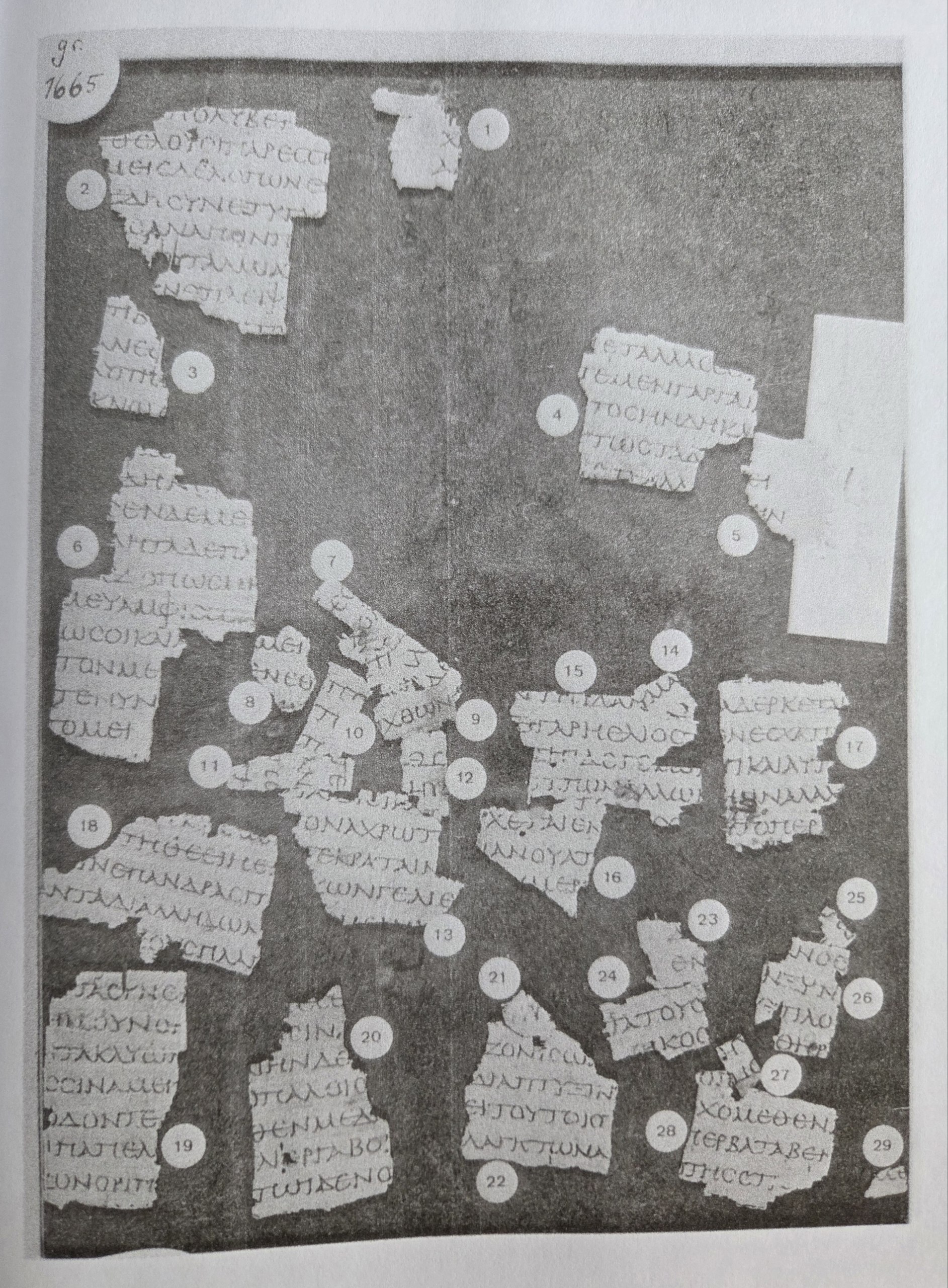
Sheet II: P. Strasb. Inv. 1666 (items 30-50)
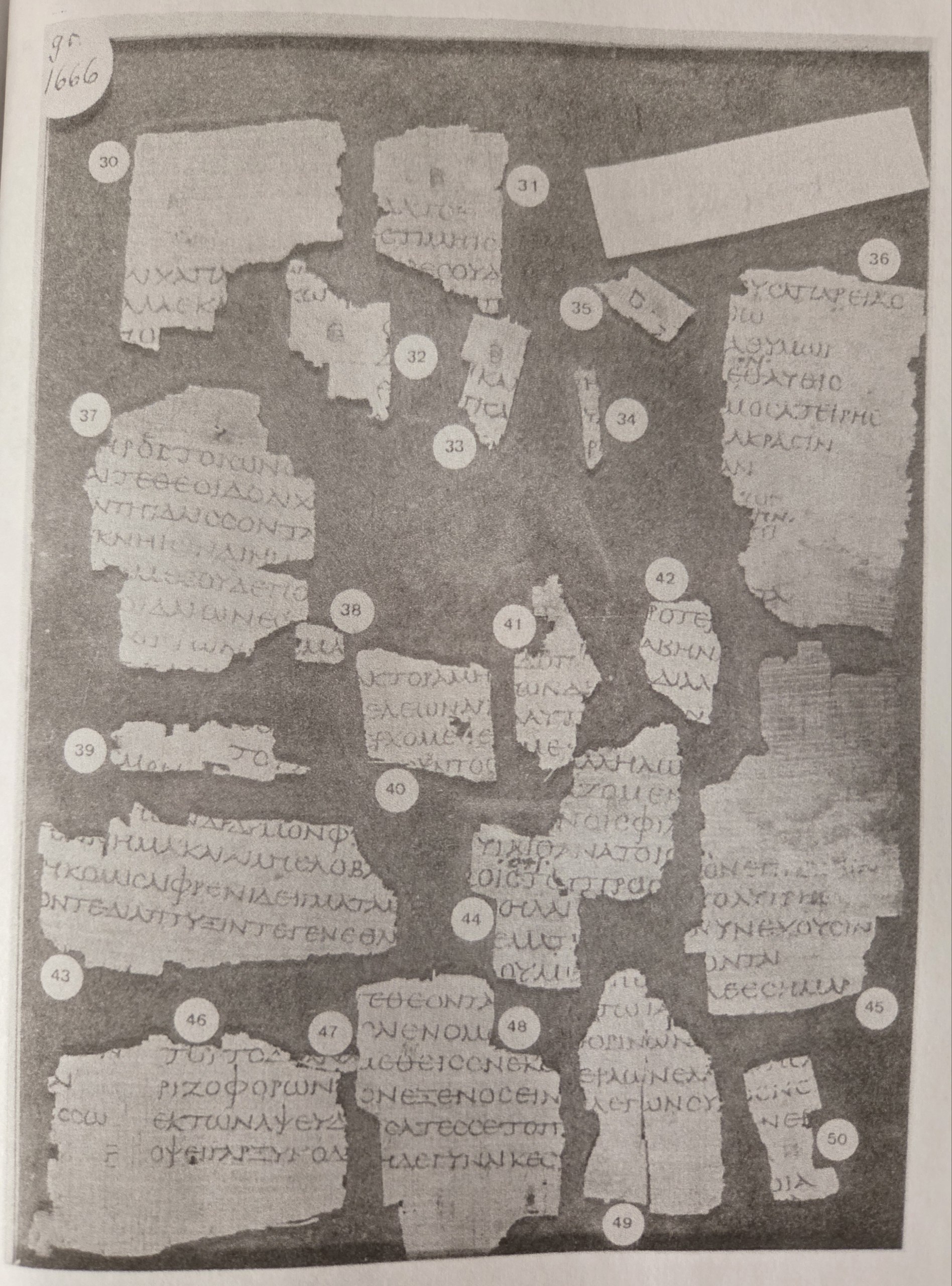
Sheet III: Set a

Sheet IV: Sets b and c
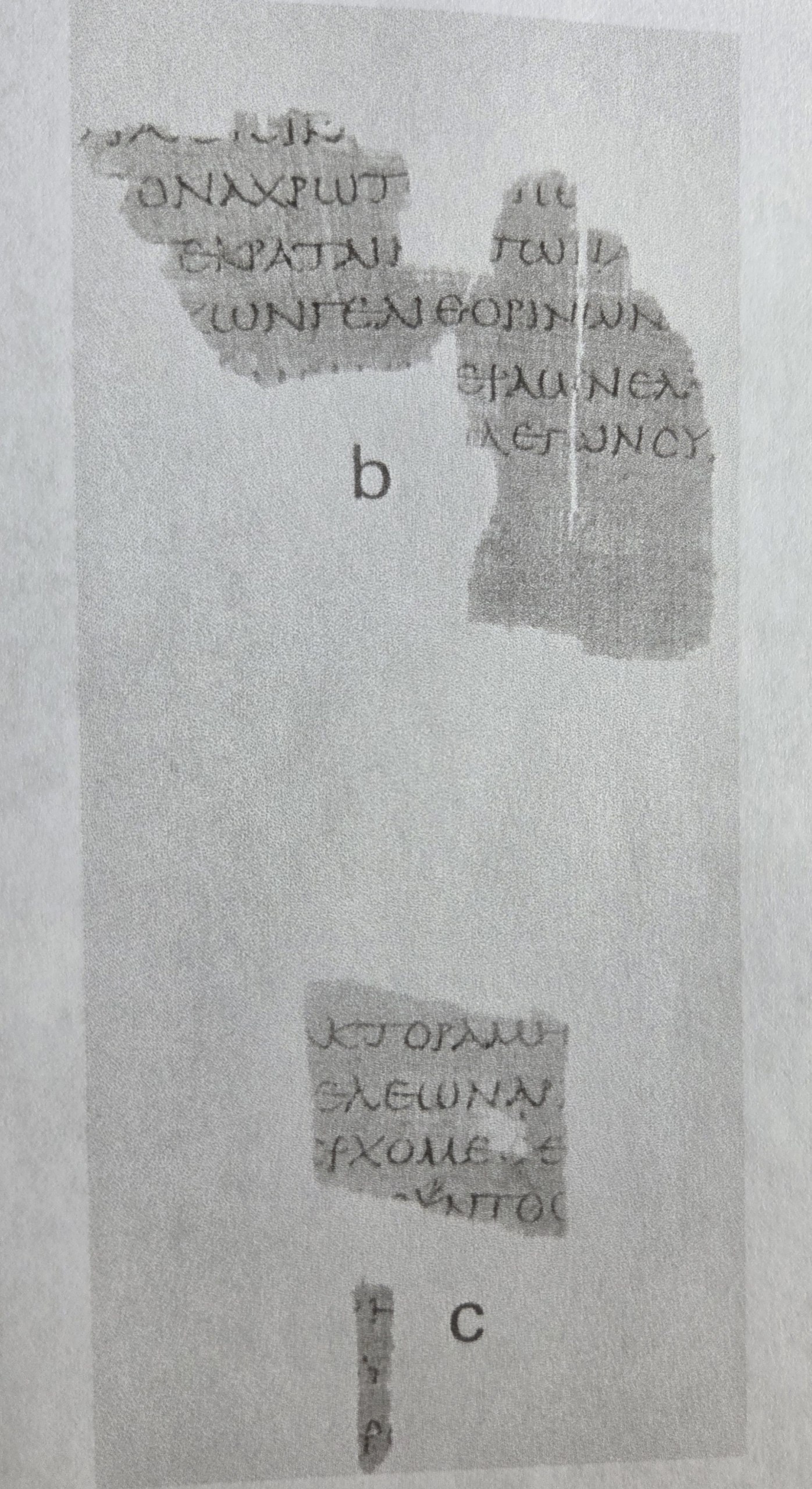
Sheet V: Set d
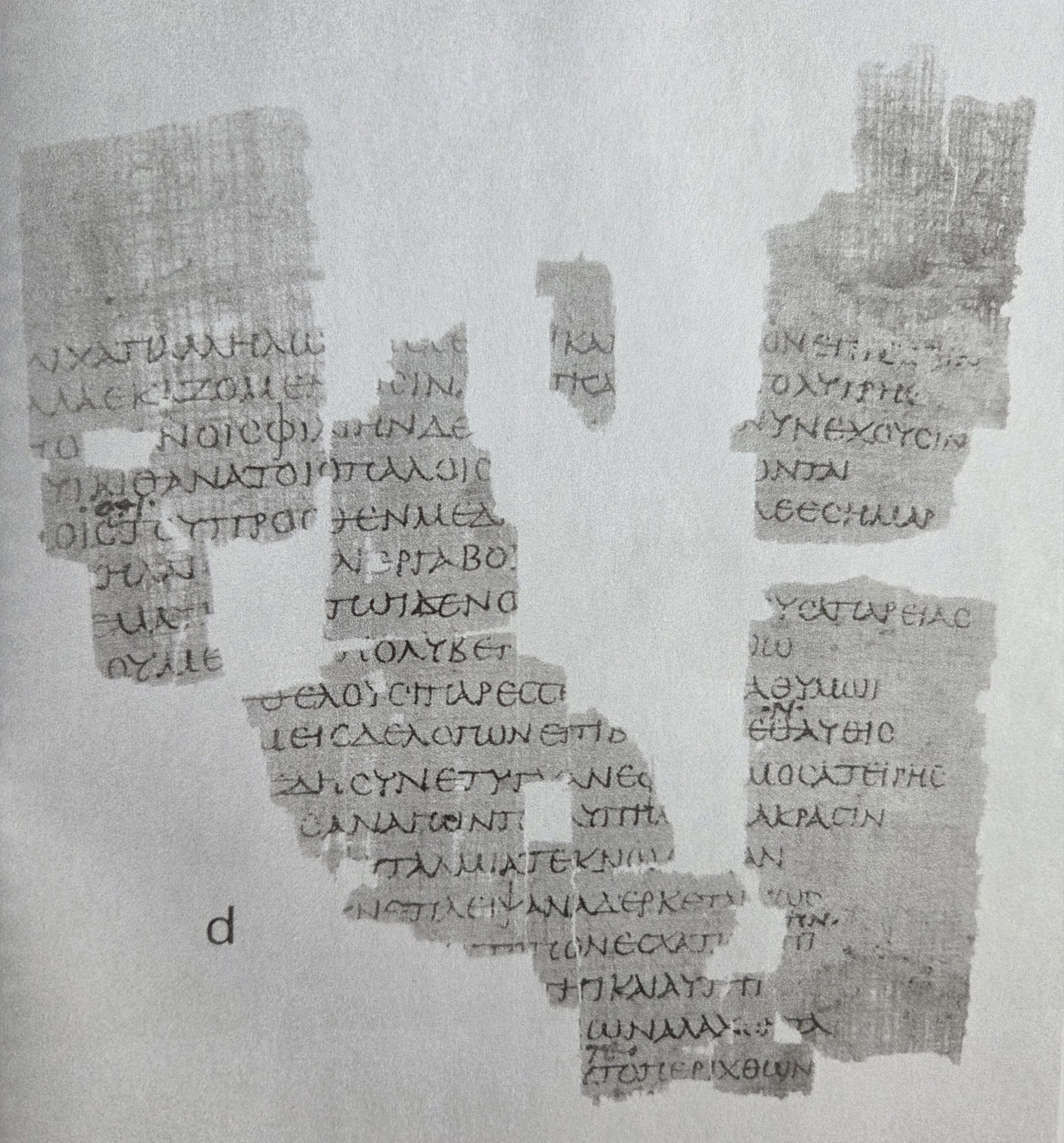
Sheet VI: Item e; sets f and g; items h, i, j, and k
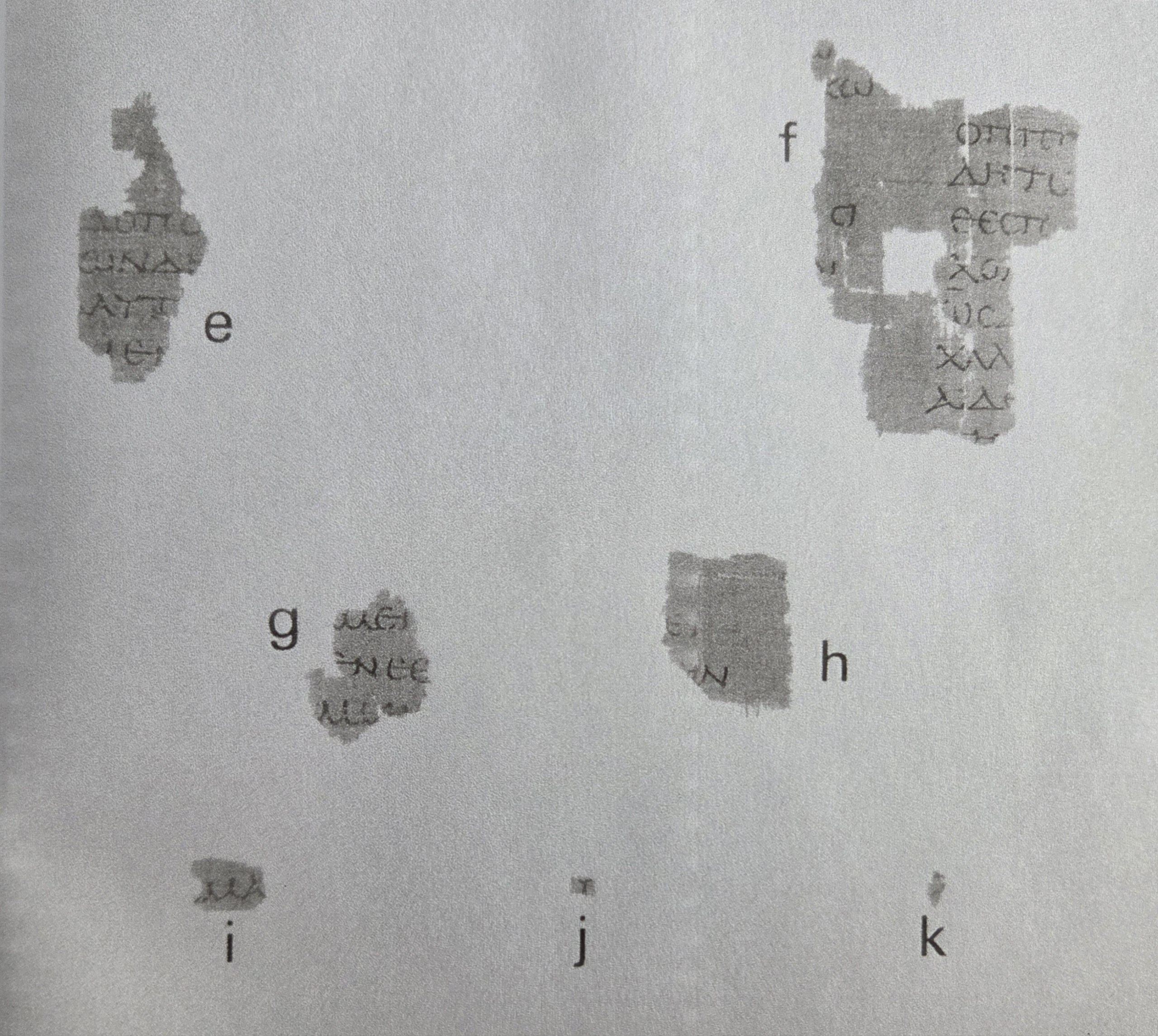
1.7 The Strasbourg Fragments (P. Strasb. gr. Inv. 1665–1666) Text
Text
A
Column I
(a i 1) ]ηcα[
(a i 2) ]. . ν . . [
(a i 3) ] .νερ .[
(a i 4) ] .εθεοντα
(a i 5) ]cαιενομοια
(a i 6) ]μεθειcενεκ . cμον
(a i 7) ]ονεξενοcειναι
(a i 8) ]ccατεccετοπ . ccω
(a i 9) ]ηδεγυναικεc
(a i 10) ]ηρο[ι]cτοιων . .[ ] . δατοθ . [
(a i 11) ]αιτεθεοιδολιχα[ ]εcτιμηιc[
(a i 12) ]ντηιδαιccοντα[ ] . ρεcουδ[
(a i 13) ] . κνηιcινδινηι .[ ]τ .[
(a i 14) ] . . εμεcουδεπο[
(a i 15) ]οιδαιωνεc .ροτερ[
(a i 16) ] . ουτωνμε . αβην .[
(a i 17) ]ντηιδαιcc . .[ ] . διαμ[
(a i 18) ]τεγαρηελιοcτ[ ] . ν .[
(a i 19) ]μητηιδεγ . μ . . [
(a i 20) ]τετιτωναλλω .[
(a i 21) ] . . μεταλλαccο .[ ] . . κυκλω .[
(a i 22) ] τεμενγαργαι .[ ] . τηθεειηε .[
(a i 23) ]τοcηνδηκα[ ]υνεπανδραcιτ[
(a i 24) ] . τωcταδ[ ]ανταδιαλληλων[
(a i 25) ]υcτεαλλ[ ] . . . οπουcπλαγ[
(a i 26) ]τατουc .[ ] .χομεθεν .[
(a i 27) ] .δηνεικοc[ ]περβαταβεν[
(a i 28) δ[ ]cενδεμε .[ ]φ[ ]οτηccτρ . φ . [
(a i 29) εν[ ]δηταδεπα . ταcυνερχεταιεν[
(a i 30) ] .εδοπωcμημουνονανουατα[
(a i 31) ]μευαμφιcε . ντακλυων[ ] . μερτ[
(a i 32) ] .ωcοικαιανοccειναμειζονιcω . [
Column II
(a ii 1) ]ρωτονμενξυνοδοντεδιαπτυξιν . [
(a ii 2) . . [ ]ατενυνετιλοιπαπελειτουτοιοτ[
(a ii 3) το . τομεν[ ]θηρωνοριπλαγκτωνα . [
(a ii 4) τουτοδανα[ ]π . νδιδυμονφυμα[
(a ii 5) ριζοφορωνγ . ννημακαιαμπείλοβαμ[
(a ii 6) ] οψειγαρξυνοδοντεδιαπτυξιντεγενεθλ . [
(a ii 7) ] . . αι . ιcικα[
(a ii 8) ] . θοναχρωτ .[ ]π . [
(a ii 9) ] . εκραταιν[ ]τωνα[
(a ii 10) ]κωνγελιθοριν[ ]τωνα[
(a ii 11) ]κωνγελιθορινων .[
(a ii 12) ] . . . . . . . . εραωνελα[
(a ii 13) ] . λεγωνcυ .[
(a ii 14) ] . κτοραμη[
(a ii 15) ] . ελεωναρ . [
(a ii 16) ]ερχομεθε[
(a ii 17) ] . . [υ]ντοc[
(a ii 18) ]ρη
(a ii 19) ]θυ[
(a ii 20) ] . ρ . [
(a ii 21) ]διχαπαλληλω[ ] . εc . [ ] . και . [ ] . ονεπιcπ . ιν
(a ii 22) ]λλαεκαζομεν[ ]ιcινα[ ]γκα[ ] . ολυγρηc
(a ii 23) ]πο[ ]ενοιcφιλιηνδε[ ] . . [ ] . νυνεχουcιν
(a ii 24) ] . υιαιθανατοιοπαλοι . [ ]ονται
(a ii 25) ] . οιcτουπροcθενμεδ . [ ]λεεcημαρ
(a ii 26) ]χηλαι . [ ] . λιεργαβο . [ ] . . . [
(a ii 27) ]εματη[ ]τωι[γ]δενο . [ ] . υcαπαρειαc
(a ii 28) ] . ουμε[ ] . πολυβεν .[ ] . ιω
(a ii 29) ]εθελουcιπαρεccε[ ] . αθυμωι
(a ii 30) ]μειcδελογωνεπιβ[ ]εθαυθιc
(a ii 31) ]εδηcυνετυγχανεφ[ ]μοcατειρηc
(a ii 32) ] . cαναγωνπ[ ]λυπημ[ ]ακραcιν
(a ii 33) ],φυταλμιατεκνω . [ ] . αν
(a ii 34) ] . νετιλειψαναδερκεται . ωε
(a ii 35) ] . . cτοπονεcχατι . []ηι
(a ii 36) ] . ηικαιαυτηι
(a ii 37) ] . ωναλαχοντα
(a ii 38) ]υτοπεριχθων
Miscellaneous Fragments
] . δοπο[
] . ωνδη[
]δαυτ . [
]μεν[
] . . [
]χω
]
]
]σι
] . .
οππο . [
δητο[
θεσπε[
χο . [
ωσδί
χαλ[
αιδ . [
. η[
],μει,[
],ενεθ[
Ιμο, ,,[
] . μει .
] . ενεθ[
]μο . . [
] . ει
]ην
]εμα[
]υ[
]τ[
1.8 The Strasbourg Fragments (P. Strasb. gr. Inv. 1665–1666) Edits
Edition
A
Column I
(a i 1) ]ἤσα[
(a i 2) ]. . ν . . [
(a i 3) ] .νε[ῦ]ρ[α] .[
(a i 4) ] .εθεοντα
(a i 5) ]σαι ἐν ὁμοῖα
(a i 6) ]μεθείς ἐν ἑκ[.]σμον
(a i 7) ]ον ἐξ ἑνὸς εἶναι
(a i 8) ]σσα τεσσε[ρα ...]π[. .]σσω
(a i 9) ἤ]δε γυναῖκες
(a i 10) ἥρ[ω]σι τοίων . . [ ] . δατο θ . [
(a i 11) αἵ τε θεοὶ δολιχὰ[ίωνες ...] ἐστὶ μήνις
(a i 12) ν τῇ δαίссοντα [ ... ] . ρεσ οὐδ[
(a i 13) ] . κνήισιν δίνῃ [ ... ]τ . [
(a i 14) ] . . ε μεσου δε πο[
(a i 15) ]οι δ' αἰῶνές [ ... πρότεροι
(a i 16) ] . ου τῶν με[ ... αβην . [
(a i 17) ν τῇ δαίссοντα [ ... ] . διαμ[
(a i 18) τε γὰρ ἥλιος τ[ ... ] . ν . [
(a i 19) μητῇ δὲ γ[ ... μ . . [
(a i 20) τε τι τῶν ἄλλων
(a i 21) ] . . μεταλλάσσοντα [ ...] . . κύκλῳ
(a i 22) τε μέν γὰρ γαῖ[α ...] . τη θεείῃ ε[
(a i 23) τος ἤ]δη κα[ ... συνεπ' ἀνδράσι τ[
(a i 24) ] . τως ταδ[ ... ἄντα δι' ἀλλήλων
(a i 25) ]υστε ἀλλ[ ... ο πους πλαγ[
(a i 26) ]τα τους . [ ... χόμεθ' ἐν . [
(a i 27) ] . δην εἰκος [ ... περ βατὰ βεν[
(a i 28) δ[ ... ]σεν δε με[ ... ]φ[ ... ]οτησ στρ[ ... φ[
(a i 29) ἐν[ ... ]δη ταδε πα[ ... ]τα συνέρχεται ἐν[
(a i 30) ] . εδο πως μη μούν' ἀνουατα[
(a i 31) ]μευ ἀμφὶς ἑ[ ... ντα κλύων ... ] . μερτ[
(a i 32) ] . ως οἰ καὶ ἄνοσσειν ἀμείζονι σω[
Column II
(a ii 1) [π]ρῶτον μὲν ξύνοδόν τε διάπτυξίν
(a ii 2) α τε νῦν ἔτι λοιπὰ πέλει τούτοιο τ[
(a ii 3) το[ῦ]το μὲν [ ... θηρῶν ὀριπλάγκτων ἀ[
(a ii 4) τοῦτο δ' ἀνα[ ... π . ν δίδυμον φύμα[
(a ii 5) ῥιζοφόρων γ[ ... ννημα καὶ ἀμπέλοβαμ[
(a ii 6) ὄψει γὰρ ξύνοδόν τε διάπτυξίν τε γενέθλ[ης]
(a ii 7) ] . . αι . . ις ἰκα[
(a ii 8) ] . θον ἀχρωτ[ ... π[
(a ii 9) ] . ἐκ ῥαταιν[ ... των α[
(a ii 10) ]κων γε λιθοριν[ ... των α[
(a ii 11) ]κων γε λιθορινων .[
(a ii 12) ] . . . . . . . . ἐράων ἐλα[
(a ii 13) ] . λέγων συ .[
(a ii 14) ] . κτορα μη[
(a ii 15) ] . ἐλέων ἀρ . [
(a ii 16) ἐρχόμεθ' ε[
(a ii 17) ] . . [υ]ντος [
(a ii 18) ]ρη
(a ii 19) ]θυ[
(a ii 20) ] . ρ . [
(a ii 21) διχὰ π' ἀλλήλων [ ... ] . εσ . [ ] . καὶ . [ ] . ον ἐπισπεῖν
(a ii 22) ]λλα ἑκάζομεν[ ... ]ίσιν α[ ... γκα[ ... ]ολυγρῆς
(a ii 23) ]πο[ ... ]ενοις φιλίην δε[ ... ] . νυν ἔχουσιν
(a ii 24) ] . υιαι θανάτοιο παλαι[ ... ]ονται
(a ii 25) ] . οις τοῦ πρόσθεν μεδ[ ... ]λεες ἦμαρ
(a ii 26) χηλαὶ [ ... ] . λιεργὰ βο[ ... ] . . . [
(a ii 27) ]ε ματη[ ... τῷ γ]δε νο[ ... ] . υς ἀπαρειᾱς
(a ii 28) ] . ου με[ ... πολυβεν[ ... ] . ιω
(a ii 29) ἐθέλουσι παρέσσε[ ... ] . α θυμῷ
(a ii 30) ἡ[μ]εῖς δὲ λόγων ἐπιβ[ήσομ]εθ' αὖθις
(a ii 31) ]ε δὴ συνετύγχανε φ[ ... ]μος ἀτειρής
(a ii 32) ] . σ ἀναγων π[ ... λυπημ[ ... ]άκρασιν
(a ii 33) ]φυτάλμια τεκν[ ... ] . αν
(a ii 34) ] . νετι λείψανα δέρκεται . ωε
(a ii 35) ] . . σ τὸν πον ἐσχάτι[ ... ]ηι
(a ii 36) ] . ηι καὶ αὐτῇ
(a ii 37) ] . ων ἀλάχοντα
(a ii 38) ]υτο περὶ χθών
Miscellaneous Fragments
] . δοπο[
] . ωνδη[
]δαυτ . [
]μεν[
] . . [
]χω
]
]
]σι
] . .
οππο . [
δητο[
θεσπε[
χο . [
ωσδί
χαλ[
αιδ . [
. η[
],μει,[
],ενεθ[
Ιμο, ,,[
] . μει .
] . ενεθ[
]μο . . [
] . ει
]ην
]εμα[
]υ[
]τ[
1.9 The Strasbourg Fragments (P. Strasb. gr. Inv. 1665–1666) Reconstruction
Reconstruction
[Δίπλ’ ἐρέω· τοτὲ μὲν γὰρ ’ἐν ηὐξήθη μόνον εἶναι, [ἐκ πλεόνων, τοτὲ δ’ αὖ διέφυ πλέον’ ἐξ ἑνὸς εἶναι.] [Δοιὴ δὲ θνητῶν γένεσις, δοιὴ δ’ ἀπόλειψις·] [τὴν μὲν γὰρ πάντων ξύνοδος τίκτει τ’ ὀλέκει τε,] [ἡ δὲ πάλιν διαφυομένων θρεφθεῖσα διέπτη.] [Καὶ ταῦτ’ ἀλλάσσοντα διαμπερὲς οὐδαμὰ λήγει, [άλλοτε μὲν Φιλότητι συνερχόμεν’ εἰς ’ἐν ἅπαντα] [ᾶλλοτε δ’ αὖ δίχ’ ἕκαστα φορεύμενα Νείκεος ἔχθει.] [ Ἧι δὲ πάλιν διαφύντος ἑνὸς πλέον’ ἐκτελέθουσι,] [τῆι μὲν γίγνονταί τε καὶ οὔ σφισιν ἔμπεδος αἰών·] [ῆι δὲ διαλλάσσοντα διαμπερὲς οὐδαμὰ λήγει,] [ταύτηι δ’ αἰὲν ἔασιν ἀκίνητοι κατὰ κύκλον.] [Ἀλλ’ ἂγε μύθων Κλῡθῑ· μάθη γάρ τοι φρένας αὒξει·] [ὼς γὰρ Καὶ πρὶν ἐειπα πιφαύσκων πείρατα μύθων,] [δίπλ’ ἐρέω· τοτὲ μὲν γὰρ ’ἐν ηὐξήθη μόνον εἶναι,] [ἐκ πλεόνων, τοτὲ δ’ αὖ διέφυ πλέον’ ἐξ ἑνὸς εἶναι,] [πῦρ καὶ ὕδωρ καὶ γαῖα καὶ ἠέρος ἄπλετον ὕψος,] [Νεῖκός τ’ οὐλόμενον δίχα τῶν, ἀτάλαντον ἀπἀντηι,] [καὶ Φιλότης ὲν τοῖσιν, ’ίση μῆκός τε πλάτος τε·] [τὴν σὺ νόωι δέρκευ, μηδ’ ὄμμασιν ἦσο τεθηπώς·] [ἥτις καὶ θνητοῖσι νομίζεται ἔμφυτος ἂρθροις,] [τῆι τε φίλα φρονέουσι καὶ ἄρθμια ἔργα τελοῦσι,] [Γηθοσύνην καλέοντες ἐπώνυμον ἠδ’ Ἀφροδίτην·] [τὴν οὗ τις μετὰ τοῖσιν ἑλισσομένην δεδάηκε] [θνητὸς ἁνήρ· σὺ δ’ ἂκουε λόγου στόλον οὐκ ἀπατηλόν.] [Ταῦτα γὰρ ἶσά τε πάντα καὶ ἥλικα γένναν ἔασι,] [τιμῆς δ’ ἂλλης ἀλλο μέδει, πάρα δ’ ἦθος ἑκάστω ι,] [έν δὲ μέρει κρατέουσι περιπλομένοιο χρόνοιο.] [Καὶ πρὸς τοῖς οὔτ’ ἂρ τι ἐπιγίγνεται οὐδ’ ἁπολήγει·] [εῖτε γὰρ ἐφθείροντο διαμπερές, οὐκ ἂν ἐ]τ’ ἦσαιν.] [Τοῦτο δ’ ἐπαυξήσειε τὸ πᾶν τί κε; Καὶ πό]θεν ελ[θόν;] [Πῆι δέ κε κὰξαπόλοιτο, ἐπεὶ τῶνδ’ ούδ]ὲν ἑρῇιμον;] [Ἀλλ’ αὕτ’ ἐστιν ταῦτα, δι’ ἀλλήλων] γε θέοντα· [γίγνεται ἀλλοτε ἄλλα καὶ ἠνεκὲις αἰὲν ὁμοῖα. [Ἀλλ’ ἑν μὲν Φιλότητι ? συνερχό]μεθ’ εἰς ἕνα κὀσμον, [ἐν δ’ Ἐχθρηι γε πάλιν διέφυῖ πλέ]ον’ ἐξ ἑνὸς εἶναι, [ὲξ ὧν πάντ(α) ὅσα τ’ ἦν ὅσα τ’ ἐστ(ἱ) ὅ]σα τ’ ἔσσετ’ ὀπίσσω· [δένδρεά τ’ ἐβλάστησε καὶ ἀνέρες] ἠδὲ γυναῖκες, [θ]ῆρές τ’ οἰωνοι [τε καὶ] ύδατοθριέμμονες ἰχθῦς [κ]αί τε θεοὶ δολιχα[ίων]ες τιμῆισ[ι φέριστοι] [Ἑ]ν τῆι δ’ ἁΐσσοντα [διαμπ]ερὲς οὺδ[αμὰ λήγει] [π]υκνῆισιν δίνηισ[ιν … … ]τ . [ -χ ] [ν]ωλεμές, οὐδέ πο[τ’ … … … -χ ] [πολλ]οὶ δ’ αἰῶνες πρότερ[οι ? … … -χ ] [πρὶν] τούτων μεταβῆνᾳ[ι … … -χ ] [πά]ντηι δ’ ἁΐσσον[τ]α διαμ[περὲς οὐδαμὰ λήγει·] [οῦ]τε γὰρ ήέλιος τ[ … ] . ν . [ … … -χ ] [ὸρ?]μὴ τῆιδε γέμου[σα? … … … -χ ] [οῠ]τε τι τῶν ἄλλων [ … … … - χ ,] [ὰλ]λᾲ μεταλλάσσον[τ’ ἀΐσσ]ει κύκλωι [ὰπάντηι·] [δὴ τὀ?]τε μὲν γὰρ γαῖ(ᾳ) [ἀβ]ᾴτη θέει ἠέλ[ιός τε] [σφαῖρά?] τ’ ὅσην δὴ κα[ί ν]υν ἐπ’ ἀνδράσι τ[εκμήρασθαι?·] [ὣς δ’ α]ὗτως τάδ[ε π]άντα δι’ ἀλλήλων [τε θέεσκεν?] [κᾶλλο]υς τ(ε) ἂλλ[(α) ’ίκα]νε τόπους πλαγ[χθέντ’ ἰδίους τε ?] [αὺθάδη?] μεσάτους τ’ [εἰση]ρχόμεθ’ ’ἐν μ[όνον εἶναι.] [Ἀλλ’ ὅτ]ε δὴ Νεῖκος [μὲν ὑ]περβατὰ βέν[θε´ ἵκηται] δ[ίνη]ς, ἐν δὲ μέσ[ηι] Φ[ιλ]ότης στροφᾴ[λιγγι γένηται,] ἐν [τῆι] δὴ τάδε πάντα συνέρχεται ’ἐν [μόνον εἶναι] [Σπεῦ]δε δ’ ὅπως μὴ μοῦνον ἀν’ οὔατα [μῦθος ἵκηται?] [ἠδέ] μευ ἀμφὶς ἐόντα κλύων [ν]ῃμερτ[έα δέρκευ?] [δεί]ξω σοι καὶ ἀν’ ὄσσ(ε) ἵνα μείζονι σώμ[ατι κύρει?,] [π]ρῶτον μὲν ξύνοδόν τε διάπτυξίν τ[ε γενέθλης] ὂσ[σ]α τε νῦν ἔτι λοιπὰ πέλει τούτοιο τ[όκοιο?,] τοῦτο μὲν [ἂν] θηρῶν ὀριπλάγκτων ὰγ[ρότερ’ εἶδη?,] τοῦτο δ’ ἀν’ ἁ[νθρώ]πῳν δίδυμον φύμα, [τοῦτο δ’ ἀν’ ἀγρῶν?] ριζοφόρων γέννημα καὶ ἁμπελοβάμ[ονα βότρυν?] ἐκ τῶν ἀψευδῆ κόμισαι φρενὶ δείγματα μ[ύθων·] ὄψει γὰρ ξύνοδόν τε διάπτυξίν τε γενέθληις.] [τοῦτο μὲν ἐν κόγχαισι θαλασσονόμοις βαρυνώτοις] [ἠδ’ ἐν? πε]τραίοισι κα[ … … -χ ·] [ἔνθ’ ὄψει] χθόνα χρωτὸ[ς ὑ]πέ[ρτατα ναιετάουσαν·] [θώρηξ δ’ αὗ?]τε κραταιν[ώ]των α[ … -χ ,] [ναὶ μὴν κηρύ]κων γε λιθορίνων χιελύων τε] [ ] . μελίᾳι κεραῶν ἐλά[φων [ὰλλ(ὰ) οὐκ ἂν τελέσαιμ?]ι λέγων σύμ[παντα? [ … … ἔργα δι?]ᾴκτορα μη[τίσασθαι?,] [τοῦτο μὲν ἂν βροτέων] μελέων ὰρι[δείκετον ὁγκον·] [ἄλλοτε μὲν Φιλότητι συν]ερχόμεθ’ ε[ὶς ’ἐν ἅπαντα] [γυῖα, τὰ σῶμα λέλογχε βίου θη?]λοῦντος [ἐν ἀκμὴι] [ἄλλοτε δ’ αὖτε κακῆισι διατμηθὲντ’ Ἐρίδεσσι,] [πλὰζεται ἂνδιχ’ ἕκαστα περὶ] ρη[γμῖνι βίοιο·] [ὼς δ’ αὕτως θάμνοισι καὶ ἰχ]θύ[σιν ὑδρομελάθροις] [θηρσὶ τ’ ὸρειμελέεσσιν ἰδὲ πτ]ερο[βάμοσι κύμβαις] [ἂν]διχ’ ἀπ’ ἁλλήλω[ν] πεσέ[ει]ν καὶ π[ότ]Ιμον ἐπισπεῖν [πό]λλ’ ἁεκαζομέν[ο]ισιν ὰ[να]γκα[ίης ὕ]το λυγρῆς [ση]πο[μ]ένοις· Φιλίην δὲ [καὶ Ε]ὐν[οίη]ν νυν ἔχουσιν [”Αρ]’πύιαι θανάτοιο πάλοις [ἡμῖν παρέσ]ονται. [Οῖ]μοι ’ὅτ(ι)´ οὺ πρόσθεν με δι[ώλεσε νη]λεὲς ἦμαρ. [πρὶν] χηλαῖς [σχέ]τλι᾽ ἔργα βοριᾱς πέρι μητ]ίσᾳ[σθαι·] [νῦν δ]ὲ μάτη[ν ἐν] τὼιδε νότ[ωι κατὲδ]ευσα παρειάς· [ἐξικ]νούμε[θα γὰ]ρ πολυβενθ[έα Δῖνον?], ὀῖω, [μυρία? τ(ε) οὐκ] ἐθέλουσι παρέσσε[ται ἄλγ]εα θυμῶι [ὰνθρώποις?· ή]μεῖς δὲ λόγων <σ’> ἑπιβ[ήσομ]ε###‘ν’ αὖθις [κείνων· ὁππότ]ε δὴ συνετύγχανε φ[λογ]μὸς ἀτειρής [ … … ]ῳς ἀνάγων π[ο]λυπήμ[ον]α κρᾶσιν [ … … ζῶι?ᾳ φυτάλμια τεκνώθ[η]σαν [ … τῶν καὶ? ν]ῦν ἔτι λείψανα δέρκεται ῄώς [ … … … ] εῑς τόπον ἑσχάτιο[ν β]ῆ###‘ν’ [ … … … κλαγ]γῆι καὶ ἁυτῆι [ … … … ’Άτης? λει]μώνα [ … … … … α῏?]ὖ`τε´ περὶ χθών [ … … … … … -χ ] [ὡ]ς δ’ ὁπό[ταν? ] [ὲ]ξ ὧν δη[ [ἠ]δ’ αὐτῃ[ [ - ]μεν[ [ ] . . [ [ ] χω [ ] [ ] [ ]σι [ ]αι [ὁππότ[ε ] δὴ τό[τε ] θεσπε[σι χο .[ ώς δ[ χαλ[κ αιδε[ τη[ [ ] ᾲμείβ[ ] [ ] γενέθ[λη ] [ ἀ?]μοῑβ[ ] [ ] . ει [ ]ην [ ]εμαὶ[ ] [ ]υ[ ] [ ]τ[ ]
1.10 The Strasbourg Fragments (P. Strasb. gr. Inv. 1665–1666) ) Edits Arquette Translation
Edition
A
Column I
(a i 1)
(a i 2)
(a i 3) tendons
(a i 4) running
(a i 5) in similar things
(a i 6) having released
(a i 7) to be out of one
(a i 8) four
(a i 9) : and these women
(a i 10) heroes such as...watered
(a i 11) and long-lived gods...wrath
(a i 12) darting in it…not
(a i 13) in the vortex
(a i 14) but in the middle not
(a i 15) the ages…earlier
(a i 16) of these not
(a i 17) in it rushing...through
(a i 18) for the sun
(a i 19) mother...
(a i 20) and something of the others
(a i 21) changing...in a cycle
(a i 22) for earth indeed...divine
(a i 23) already...with men
(a i 24) thus these...opposite through one another
(a i 25) but...feet sideways
(a i 26)
(a i 27) likely...stepping
(a i 28) but…twisting
(a i 29) these things come together in
(a i 30) how not alone...ears
(a i 31) hearing around...desirable
(a i 32) as also to rule in greater
Column II
(a ii 1) first the coming-together and unfolding
(a ii 2) and as many as still remain of this
(a ii 3) this...of mountain-wandering beasts
(a ii 4) this...twin growth
(a ii 5) of root-bearing...offspring and vine-climbing
(a ii 6) for you will see the union and separation of generation
(a ii 7)
(a ii 8) skin-colour
(a ii 9) strong
(a ii 10) stone-throwing
(a ii 11) stone-throwing
(a ii 12) of desires drive
(a ii 13) of words, you
(a ii 14) slayer not
(a ii 15) of mercy
(a ii 16) we come
(a ii 17) being
(a ii 18)
(a ii 19)
(a ii 20)
(a ii 21) apart from one another…to follow
(a ii 22) each...miserable
(a ii 23) friendly love...now they have
(a ii 24) of death ancient
(a ii 25) of the previous...day
(a ii 26) claws...evil works ox
(a ii 27) cheeks
(a ii 28) much
(a ii 29) willing to be present...in spirit
(a ii 30) but we will embark again upon the tale
(a ii 31) happened...unyielding
(a ii 32) leading up...blending
(a ii 33) nurturing offspring
(a ii 34) remains beholds
(a ii 35) to the furthest place
(a ii 36) and itself
(a ii 37) having obtained by lot
(a ii 38) around the earth
Miscellaneous Fragments
] . δοπο[
] . ωνδη[
]δαυτ . [
]μεν[
] . . [
]χω
]
]
]σι
] . .
οππο . [
δητο[
θεσπε[
χο . [
ωσδί
χαλ[
αιδ . [
. η[
],μει,[
],ενεθ[
Ιμο, ,,[
] . μει .
] . ενεθ[
]μο . . [
] . ει
]ην
]εμα[
]υ[
]τ[
1.11 The Strasbourg Fragments (P. Strasb. gr. Inv. 1665–1666) ) Reconstruction Arquette Translation
Reconstruction
I shall tell a double tale: at one time it grew to be one alone, out of many; at another again it sprang apart to be many out of one. Double is the birth of mortal things, and double their passing away; for the coming together of all things both begets and destroys the one, while the other, nourished as things separate again, flies apart. And these never cease continually changing, now all coming together into one through Love, now again each borne apart through the hatred of Strife. Insofar as many come forth again from one, in that respect they come to be, and their life is not enduring; but insofar as they never cease changing continuously, in that respect they always remain unmoved in the cycle. But come, listen to my words; for learning will increase your understanding. For as I said before, revealing the limits of my discourse, I shall tell a double tale: at one time it grew to be one alone, out of many; at another again it sprang apart to be many out of one, fire and water and earth and the boundless height of air, and destructive Strife apart from them, equal in every direction, and Love among them, equal in length and breadth. Look upon her with your mind, and do not sit astonished with your eyes. She is thought by mortals to be implanted in their limbs, and through her they think loving thoughts and perform harmonious deeds, calling her Joy and also Aphrodite. No mortal man has perceived her whirling among them, but do you hear the course of my argument, which is not deceptive. For all these are equal and alike in age, though each possesses a different prerogative and its own character, and each prevails in turn as time revolves. Besides these, nothing comes into being nor passes away. For if they perished completely, they would no longer exist. And what could increase this whole? And whence could it come? And where could it perish, since none of these is empty? Rather, these things themselves are, running through one another; becoming now one thing, now another, yet always alike. Through Love we come together into one ordered world, but through Strife we again become many out of one, from which arise all things that were, are, and shall be, trees that sprang up, and men and women, beasts and birds and water-dwelling fish, and long-lived gods, highest in honors. Yet in their rushing they never cease, in dense whirlings... ceaselessly... and many ages before... before these passed over... and everywhere rushing they never cease continuously; neither the sun... nor the impulse filled with this... nor any of the other things... but changing, it rushes in a circle on every side; then indeed earth and the sun move... and the sphere...such as men may still discern now; thus all these things moved through one another; and attained different places and proper stations; entering the middle and becoming one. But when Strife reaches the deepest depths of the vortex, and Love comes to be in the center of the whirl, then all these things come together into one, Hasten, so that the tale may not reach only your ears, but hearing me, behold the truth around you, I shall show it also to your eyes, that it may meet a greater body. First, the coming together and separation of birth, whatever offspring of this process still remains now, one part among the wandering wild beasts, another among human beings, a double growth, another among rooted plants and vine-bearing clusters, from these bring into your mind true proofs of my account; for you shall see the union and separation of generation. One may see it among heavy-shelled sea creatures, and among rocky creatures... There you will see earth dwelling upon the outermost surface of flesh; and the breastplate of mighty creatures... and indeed of stone-shelled herald-shells and tortoises; and horned deer... Yet I could not accomplish it by recounting everything. ...the works devised by the Craftsman... ...the conspicuous bulk of mortal limbs. At one time they come together through Love into one whole, limbs which the body possesses in the flowering of life, at another time cut apart by grievous Strife, each wanders separately around the boundary of life. Likewise among shrubs and water-dwelling fish, and mountain-ranging beasts and wing-moving birds, they fall apart from one another and hasten toward their destiny, suffering much under grievous necessity, but now they possess Friendship and Goodwill. Shall the Harpies of death stand near us? Alas that pitiless day did not destroy me earlier, before I devised cruel deeds concerning nourishment, but now in vain I have drenched my cheeks with tears; for we are approaching the deep vortex, I think, and countless pains will come upon the heart, but we shall return again to those arguments. when the unwearied flame happened... raising a much-suffering mixture... living offspring were generated... of which even now some traces may be seen... went to the furthest place... with its cry and itself... the meadow of Ate... again around the earth...
1.12 The Cairo Fragments (P. Fouad inv. 218) Gallery
Cairo Papyrus Sheet Legend
Sheet I Inventory book of the Fouad collection, pp. 24-25 (© IFAO, Cairo) Sheet II Inventory book of the Fouad collection, pp. 28-29 (© IFAO, Cairo) Sheet III Envelope that contained P. Fouad inv. 239 (© IFAO, Cairo) Sheet IV P. Fouad inv. 218, verso (© IFAO, Cairo) Sheet V P. Fouad inv. 218, recto (© IFAO, Cairo) Sheet VI P. Fouad inv. Sheet VII, P. Fouad, inv. 218, verso [infrared filter photograph] (© IFAO, Cairo) Sheet VIII, P. Strasbourg, inv. gr. 1665-1666, set a (© Coll. et photogr. BNU de Strasbourg) Sheet IX, P. Strasbourg, inv. gr. 1665-1666, sets d + f, as compared by R. Janko (2004) (© Coll. et photogr. BNU de Strasbourg)
Sheet I: Inventory book of the Fouad collection, pp. 24-25 (© IFAO, Cairo)
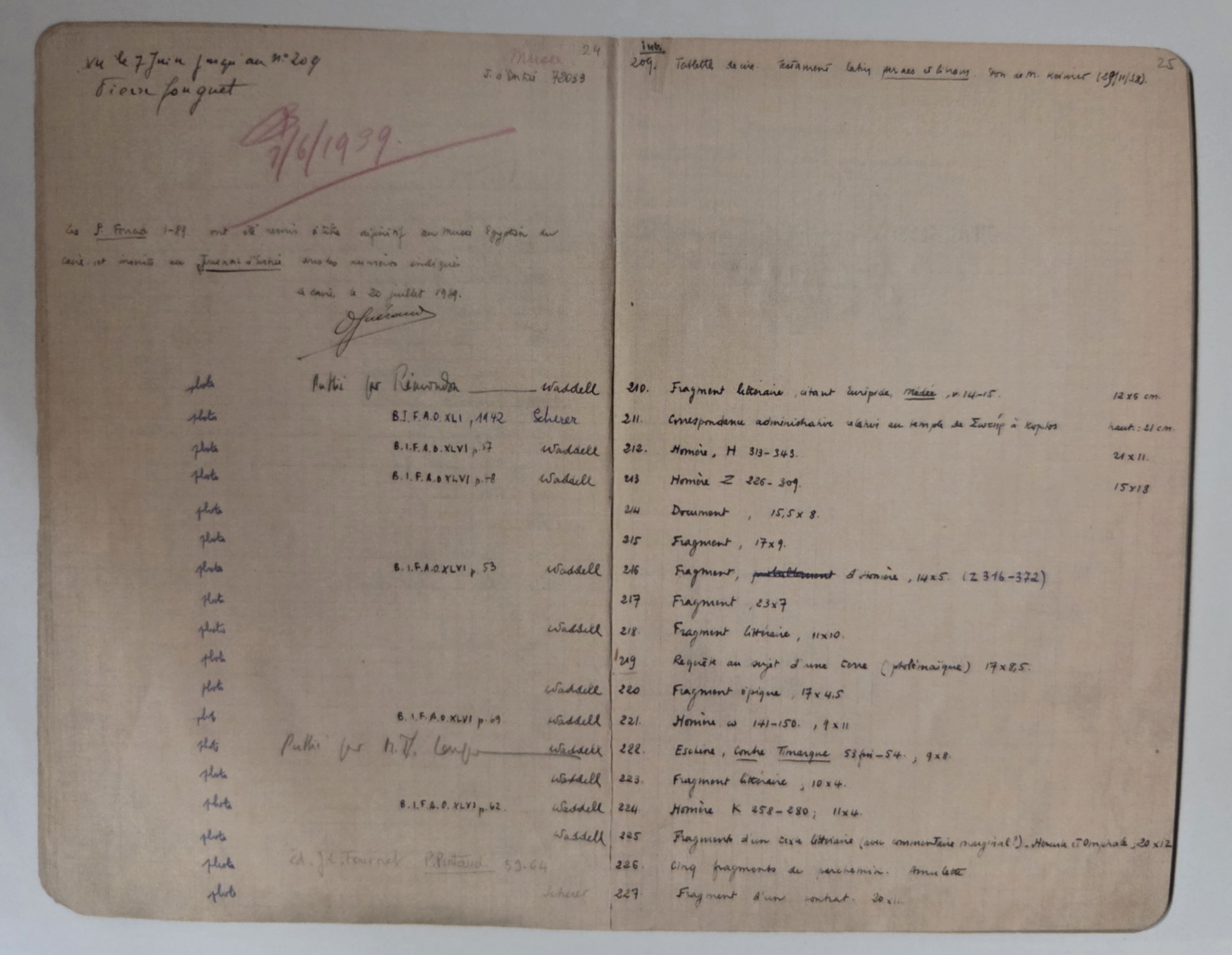
Sheet II: Inventory book of the Fouad collection, pp. 28-29 (© IFAO, Cairo)
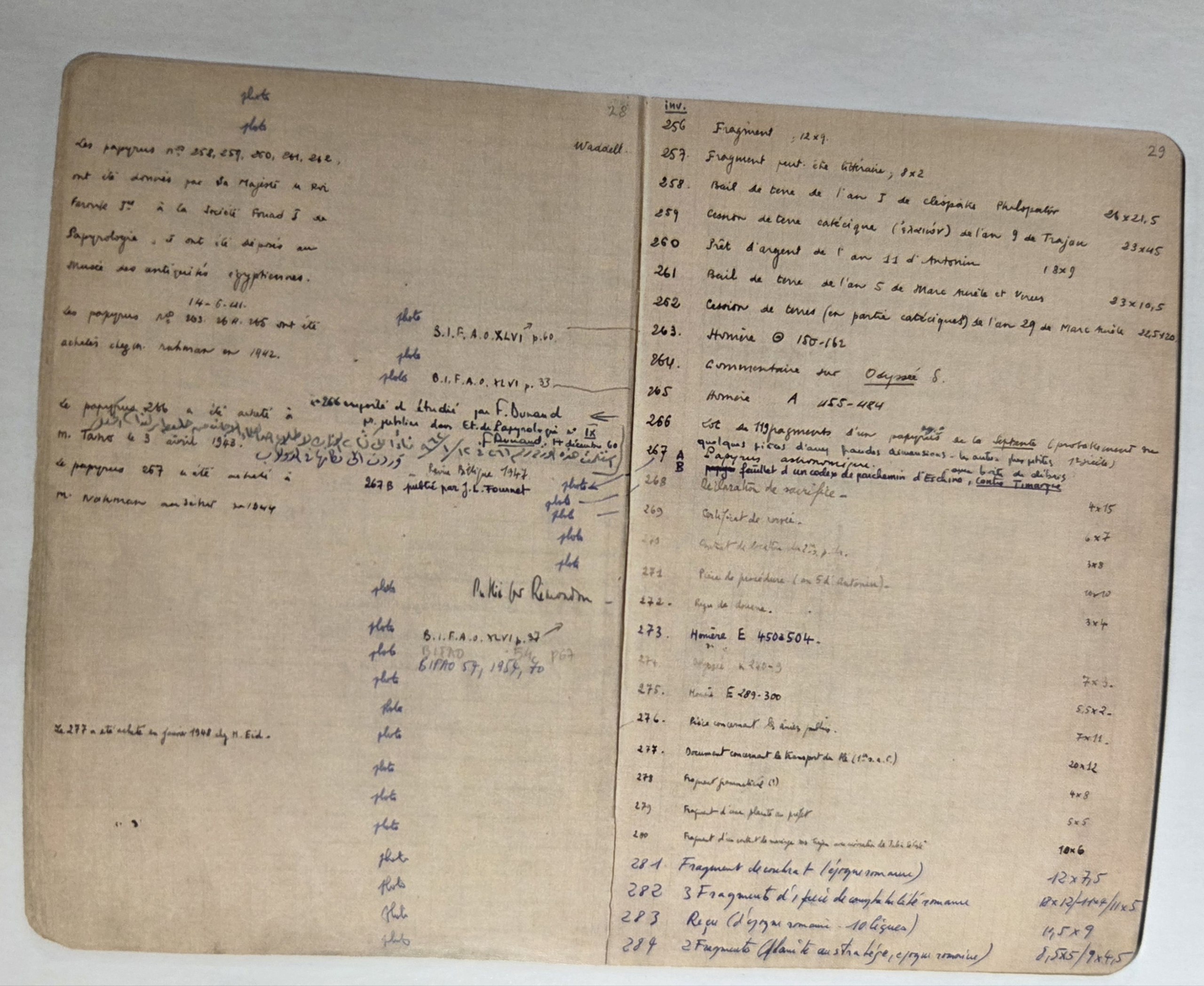
Sheet III: Envelope that contained P. Fouad inv. 239 (© IFAO, Cairo)
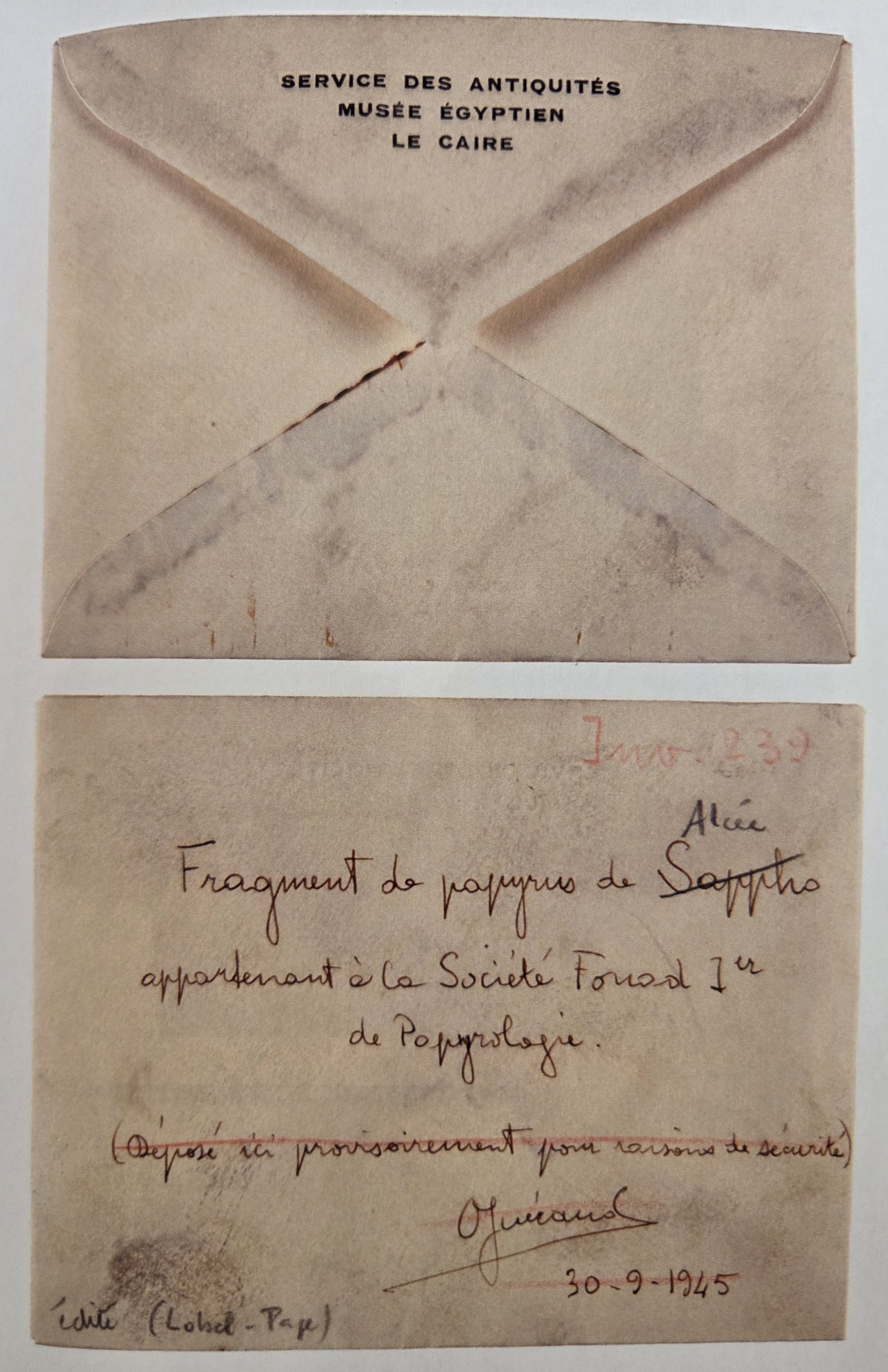
Sheet IV: P. Fouad inv. 218, verso (© IFAO, Cairo)
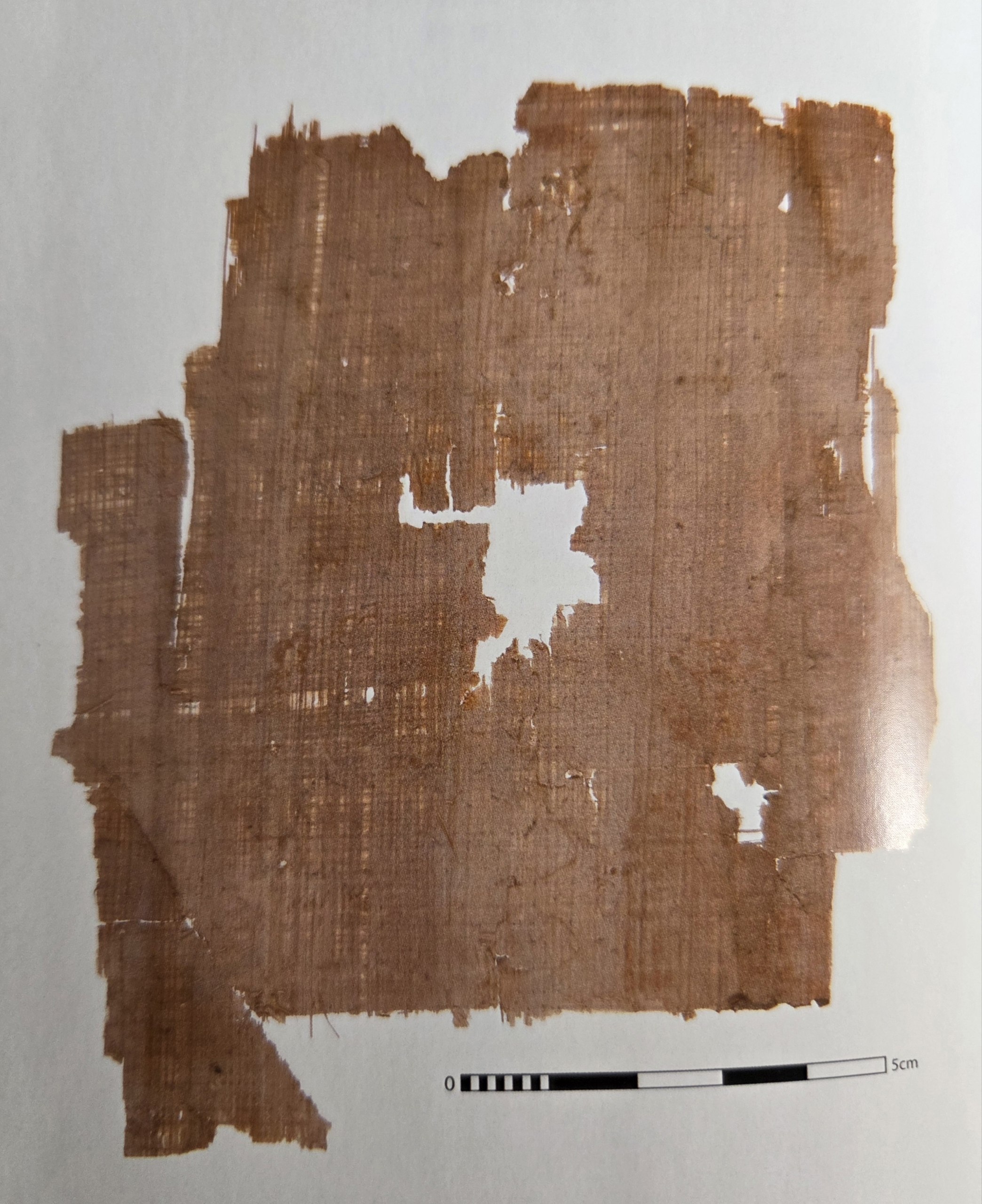
Sheet V: P. Fouad inv. 218, recto (© IFAO, Cairo)
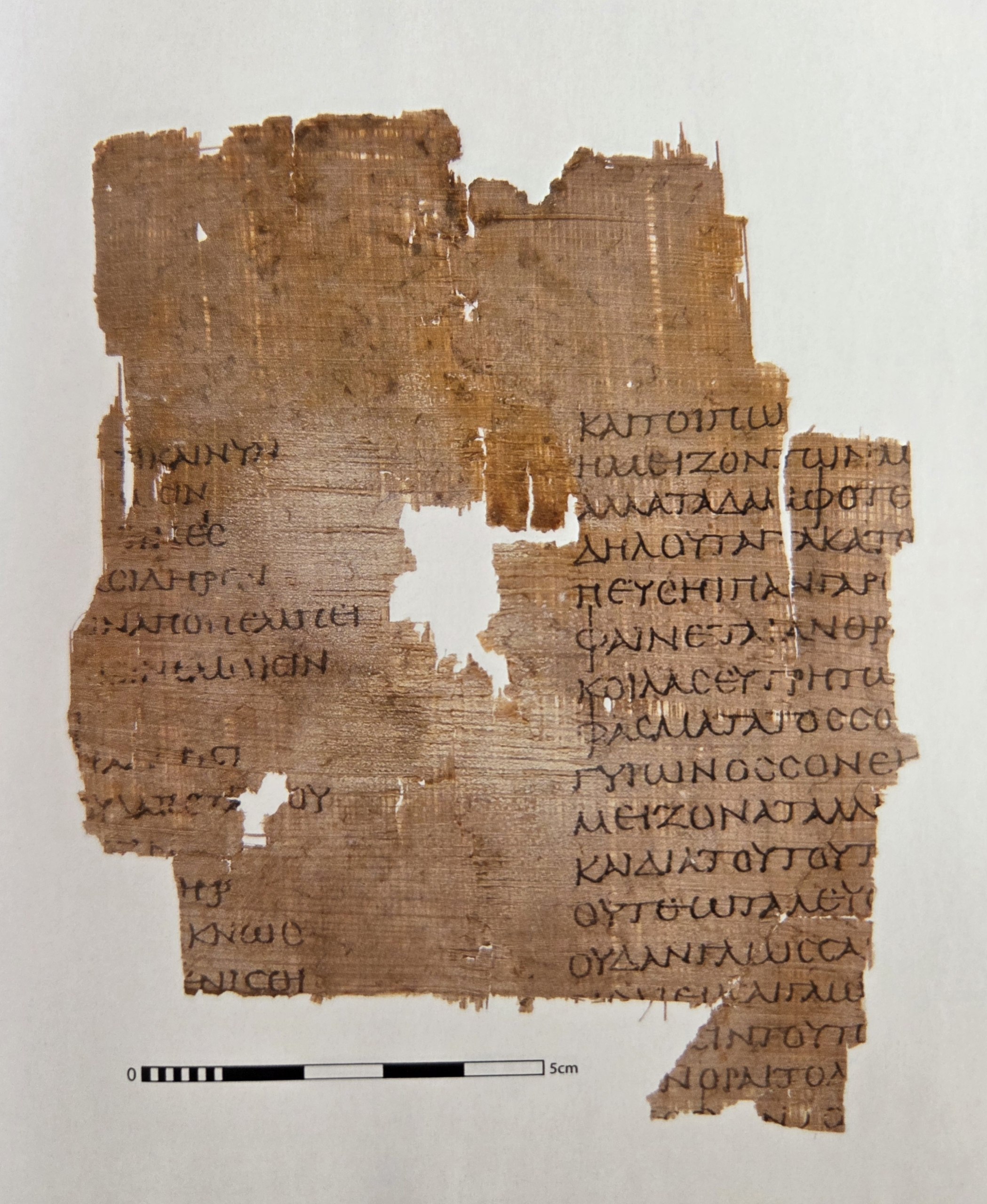
Sheet VI: P. Fouad inv. Sheet VII, P. Fouad, inv. 218, verso [infrared filter photograph] (© IFAO, Cairo)
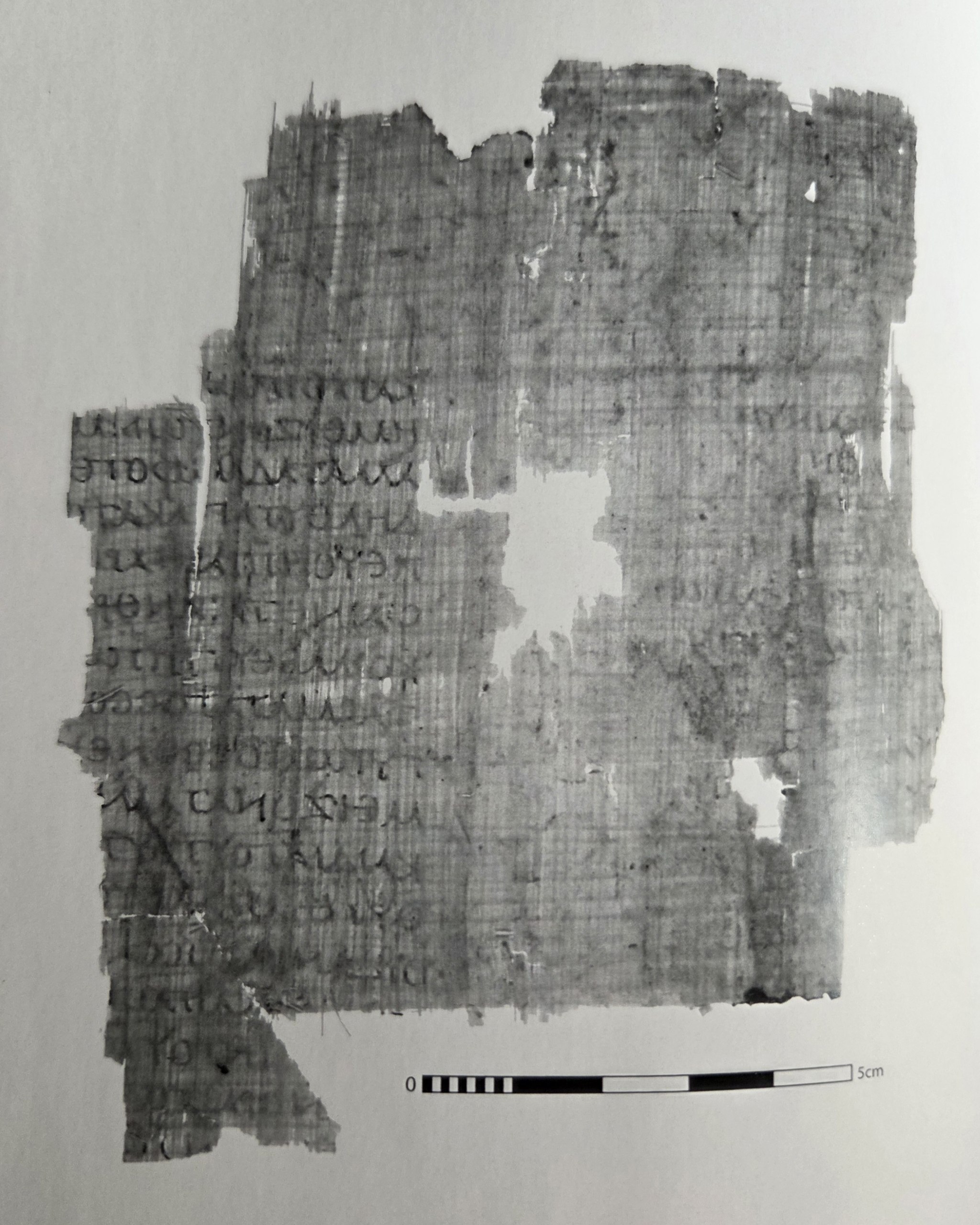
Sheet VII, P. Fouad, inv. 218, verso [infrared filter photograph] (© IFAO, Cairo)
![Sheet VII, P. Fouad, inv. 218, verso [infrared filter photograph] (© IFAO, Cairo)](img/13.jpeg)
Sheet VIII, P. Strasbourg, inv. gr. 1665-1666, set a (© Coll. et photogr. BNU de Strasbourg)
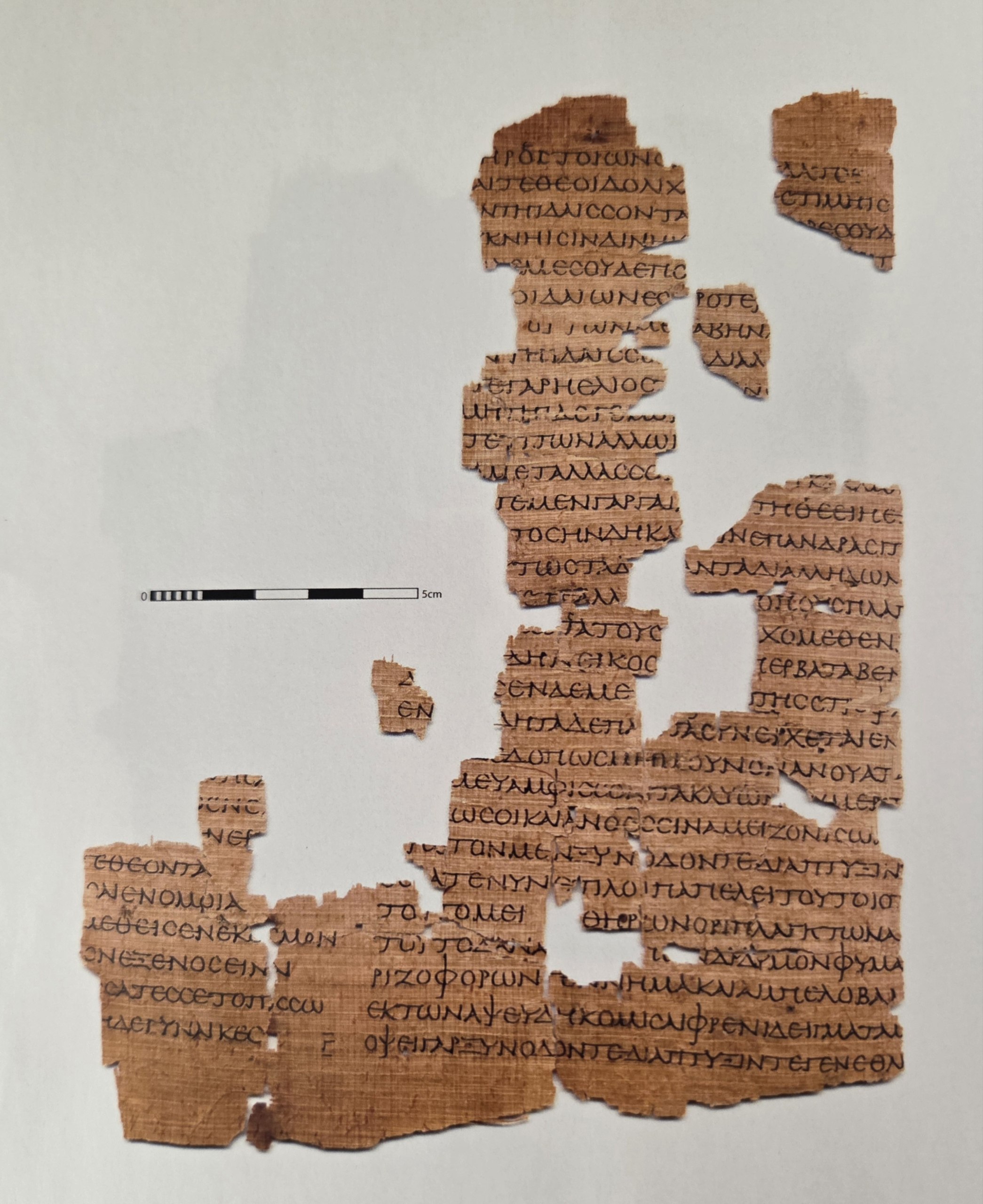
Sheet IX, P. Strasbourg, inv. gr. 1665-1666, sets d + f, as compared by R. Janko (2004) (© Coll. et photogr. BNU de Strasbourg)
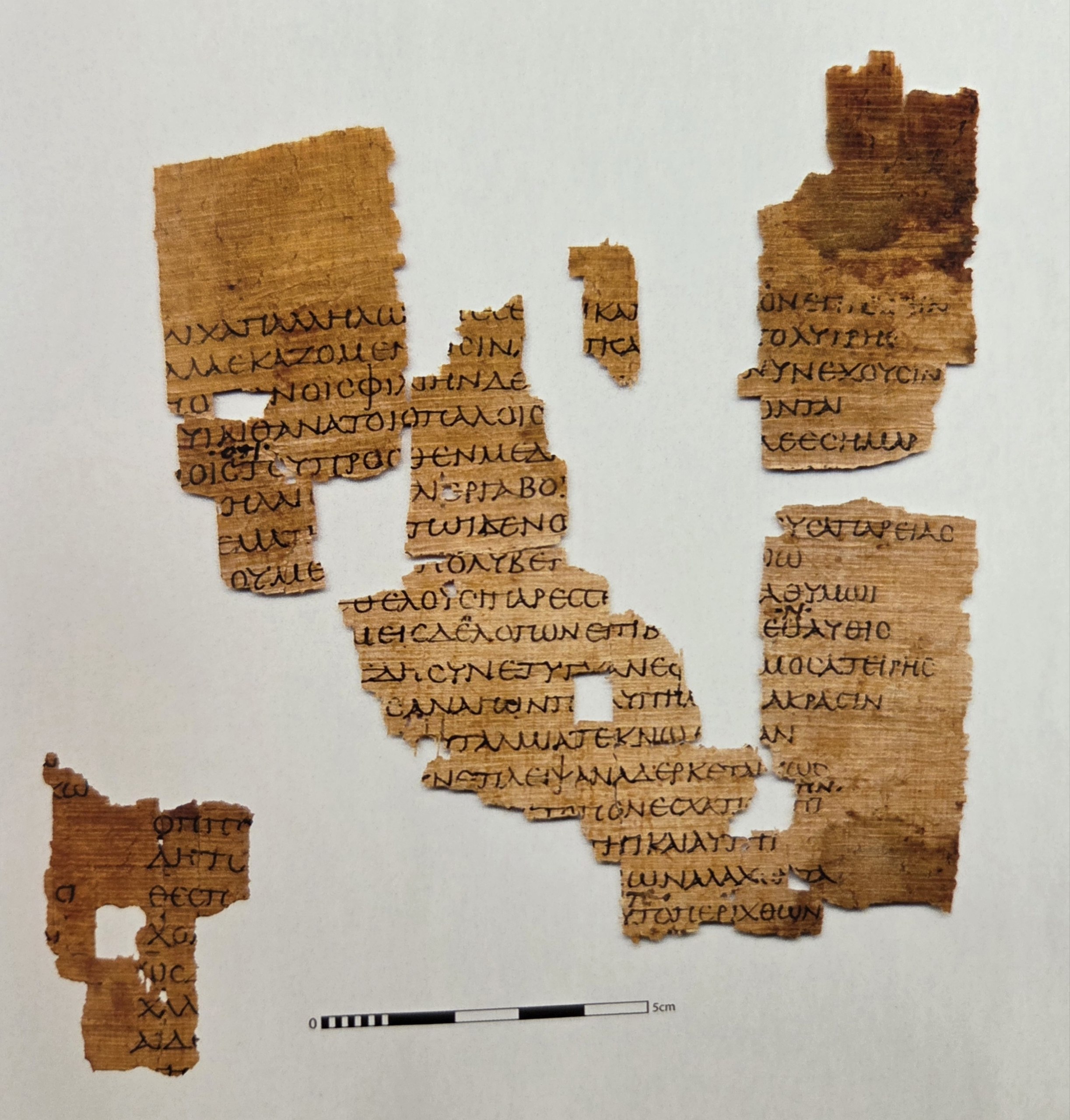
1.13 The Cairo Fragments (P. Fouad inv. 218) Text
Text
Column I
(i) 1 ]. τικαινυν
(i) 2 ]. ωcιν
(i) 3].... ε⸌ι⸍c
(i) 4 ]. cιδηρον
(i) 5]. ναποπεμπει
(i) 6].... νεμοιcιν
(i) 7].. vac.
(i) 8 ]φρα. . . .
(i) 9 ]ουδαποτ. [. ] . ου
(i) 10 ]τ . ν
(i) 11 ]ηρ
(i) 12 ]κνωc
(i) 13]. νιcθι
Column II
(ii) 31 καιτοιπω[
(ii) 32 ημειζοντωνμ[
(ii) 33 αλλαταδαμφοτε[
(ii) 34 δηλουταιτακατο[
(ii) 35 πευcηιπανγαρ .[
(ii) 36 φαινεταιανθρ .[
(ii) 37 κοιλαcευτρητω[
(ii) 38 φαcματατοcco .[
(ii) 39 γυιωνοccοvεκ[
(ii) 40 μειζοvαταλλη[
(ii) 41 καιδιατουτουτ[
(ii) 42 ουτεωταλευ .[
(ii) 43. ουδανγλωcca .[
(ii) 44. . .c. . εικαιγλω[
(ii) 45 [ ]. cιντουτ .[
(ii) 46 [ ]. νοραιτοδ[
(ii) 47 [ ].. φ[ ]ντο[
1.14 The Cairo Fragments (P. Fouad inv. 218) Edits
Edition
Column I
(i) 1 ] ἔτι καὶ νῦν
(i) 3 τ]ε θυήε⸌ι⸍ς
(i) 4 ]α σίδηρον
(i) 5 ]ων ἀποπέμπει
(i) 6 ]οισιν ἐμοῖσιν
(i) 6].... νεμοιcιν
(i) 7 ] . . vac.
(i) 8 ἀ]φραδίηισι
(i) 9 ] οὐδ’ ἀπὸ τη[κ]τοῦ
(i) 10 εσ]τιν
(i) 11 αἰθ]ήρ
(i) 12 πυ]κνῶς
(i) 13 ]εν ἴσθι
Column II
(ii) 31 καίτοι πῶ[ς
(ii) 32 ἢ μεῖζον τῶν μ[
(ii) 33 ἀλλὰ τάδ’ ἀμφοτε[ρ
(ii) 34 δηλοῦται τὰ κατ’ ὁ[
(ii) 35 πεύσηι · πᾶν γὰρ .[
(ii) 36 φαίνεται ἀνθρώ[ποισιν
(ii) 37 κοίλας εὐτρήτω[ν
(ii) 38 φάσματα τόσσον [
(ii) 39 γυίων ὅσσον εκ[
(ii) 40 μείζονά τ’ ἄλλη[λων
(ii) 41 καὶ διὰ τοῦτ’ οὔτ’ [
(ii) 42 οὔτ(ε) ὦτα λεύσ[σει
(ii) 43 οὐδ’ ἂν γλῶσσαν [
(ii) 44 οἷς αἰεὶ καὶ γλῶ[σσα
(ii) 45]. σιν τοὐτω[ν
(ii) 46 ] ἂν ὁρᾶι τόδ[ε
(ii) 47]. σφ[ῶ]ν το[
1.15 The Cairo Fragments (P. Fouad inv. 218) Reconstruction
Reconstruction
Column I
(i) 1 ] ἔτι καὶ νῦν
(i) 2 ὅταν ἰδρ]ώωσιν
(i) 3 σμύρνη λίβανός τ]ε θυήε⸌ι⸍ς
(i) 4 αἴθων]α σίδηρον
(i) 5 ]ων ἀποπέμπει
(i) 6 μύθ]οισιν ἐμοῖσιν
(i) 7 ] . . vac.
(i) 8 ἀ]φραδίηισι
(i) 9 [οὐ γὰρ ἀπ’ ἀκρήτου | σμύρνης μόνον] οὐδ’ ἀπὸ τη[κ]τοῦ
(i) 10 [χαλκοῦ ῥεύματ’ ἄπεισιν, | ἀτὰρ παντοῖα πάρεσ]τιν
(i) 11 αἰθ]ήρ
(i) 12 πυ]κνῶς
(i) 13 ]εν ἴσθι
Column II
(ii) 31 Καίτοι πῶ[ς … ἔλασσον]
(ii) 32 ἢ μεῖζον τῶν μ[
(ii) 33 Ἀλλὰ τάδ’ ἀμφοτε[ρωθεν | ἀφ’ ὕδατος ἡελίου τε]
(ii) 34° δηλοῦται, τὰ κατ’ ὄ[ψιν | ἀθρῆται.]
(ii) 34b [Νῦν δ’ ἔτι πλεῖον]
(ii) 35 πεύσηι· πᾶν γὰρ σ[ῶμα | διὰ μερέων μάλα λεπτῶν]
(ii) 36 φαίνεται ἀνθρώ[ποισιν, | ἅ περ χοάνας δι#ίκηται]
(ii) 37 κοίλας εὐτρήτω[ν | κουρῶν. Παλάμῃι δ’ ἄρα πάσῃι]
(ii) 38 φάσματα τοσσοῦ[δε | μέρεος φέρεται δι’ ἑκάστων]
(ii) 39 γυίων, ὅσσον ἑκ[άστοτ’ | ἁρμότα τρήματ’ ἐσέλθῃι,]
(ii) 40 μείζονά τ’ ἄλλή[λων περ | ἐόντ’ ὀλίγον καὶ ἐλάσσω.]
(ii) 41 Καὶ διὰ τοῦτ’ οὔτ’ [ὄσσε | κλύει μελίγηρυν ἀοιδήν]
(ii) 42 οὔτ(ε) ὦτα λεύσ[σει | λαμπρὸν φάος ἡελίοιο]
(ii) 43 οὐδ’ ἂν γλῶσσαν [
(ii) 44 οἷς αἰεὶ καὶ γλῶ[σσα
(ii) 45 [αἴσθ]ησιν τούτω[ν
(ii) 46 [εὖτ’] ἂν ὁρᾷι τόδ[ε
(ii) 47 [ ] . σφ[ῶ]ν το[
1.16 The Cairo Fragments (P. Fouad inv. 218) ) Edits Arquette Translation
Edition Translation
Column I
(i) 1 … still even now
(i) 2 …
(i) 3 … and … fragrant …
(i) 4 … the iron
(i) 5 … emits
(i) 6 … by my …
(i) 7 …
(i) 8 … by foolishness …
(i) 9 … and from the … molten no more
(i) 10 …
(i) 11 … the air
(i) 12 … with sagacity
(i) 13 … know
Column II
(ii) 31 Yet how …
(ii) 32 or the greatest of these (two) …
(ii) 33 well, these things …
(ii) 34 are made manifest, those which by virtue of …
(ii) 35 You will learn: everything, in fact, …
(ii) 36 appears to men …
(ii) 37 hollows of … well pierced ….
(ii) 38 the impressions of … of such a size …
(ii) 39 organs … that …
(ii) 40 and larger than each other …
(ii) 41 and because of this, neither …
(ii) 42 nor the ears see …
(ii) 43 not even on the tongue …
(ii) 44 by which constantly also the tongue …
(ii) 45 … of those …
(ii) 46 … he sees this …
(ii) 47 … their …
1.17 The Cairo Fragments (P. Fouad inv. 218) Reconstruction Arquette Translation
Reconstruction Translation
Column I
(i) 1 … even now
(i) 2 … whenever they perspire
(i) 3 … myrrh and fragrant frankincense
(i) 4 … glowing iron
(i) 5 … emits
(i) 6 … by my words
(i) 7 …
(i) 8 … by foolishness
(i) 9 for it is not only from pure myrrh, nor from
(i) 10 molten copper that the fragrances come, but fragrances of every kind are present
(i) 11 … the air
(i) 12 … with wisdom
(i) 13 … know
Column II
(ii) 31 Yet how… which is the smallest
(ii) 32 or the greatest among these (two)…?
(ii) 33 Now, these things, coming from both, from water and fire,
(ii) 34 are made manifest, (namely) those things which are perceived by virtue of sight.
(ii) 34b And now, you will learn even more
(ii) 35: every body, in fact, by means of very fine particles,
(ii) 36 appears to men, particles which pass through the pores
(ii) 37 hollows of well-pierced eyes. But, for each sense,
(ii) 38 the impressions are carried through the organs concerned, provided
(ii) 39 that, as the case may be, they enter into perfectly adapted perforations,
(ii) 40 which are obviously a little larger or smaller than one another.
(ii) 41 and because of this, neither the eyes hear a sweet-sounding song,
(ii) 42 nor the ears see the bright sunlight,
(ii) 43 not even on the tongue…
(ii) 44 by which constantly also the tongue…
(ii) 45 the perception of those…
(ii) 46 each time he sees this…
(ii) 47… their…
1.18 Glossary
Alphabetical Glossary (Greek alphabet order) English
ἀγένητα: the ungenerated ones; ἄγ’: come; ἀγαθὸν: a good; ἀγαθῶν: of good; ἀγάλμασιν: images; ἀγροτέρων: wild; ἀδαήμων: without knowledge; ἀδινῇσιν: dense-in-wisdom; ἀείρας: lifting-up; ἀέξεται: augments-itself; ἀέρος: of air; ἀέντων: of the blowing; ἀήθεα: unaccustomed; ἀήρ: air; Ἀθάνατ’: immortal; ἀθάνατα: immortal-things; ἀθανάτοις: immortals; ἀθρεῖ: gazes; ἀθρήσαντες: having glimpses, having beheld; Ἀίδαο: Hades; Ἀιδωνεύς: Aidoneus; αἱματόεσσα: bloody; αἷμα: blood, the blood; αἵματος: of blood; αἰεὶ: always; αἰὲν: eternally, forever; αἰγιόχοιο: of aegis-bearing; αἰθήρ / αἰθὴρ / αἰθέρα / αἰθέρι / αἰθέρος / αἰθέριον: aether, of aether, by aether, for the aether; αἴθρῃ: through the pure-sky; αἴης: of earth; αἴγλης: of the radiance; αἴσιμον: the allotted, the destined; αἶσαν: a portion, a share; αἶψα: quickly; ἀκηδείῃσι: in the carelessness; ἀκίνητοι: unmoved, fixed; ἀκοήν: hearing; ἀκούειν: to hear; ἀκούσας: having heard; ἄκουε: hear, listen; ἀκρήτου / ἀκρήτοισι: pure, with the pure; ἄκρα: the extremities, the heights-of-the-citadel; ἀκτῆς: elder-tree; ἀκτίνεσσιν: rays; ἀλαώπιδος: blind-eyed; ἀλάλησθαι: to wander; ἀλήθεια: truth; ἀλήτης: a vagabond; ἀλίγκια: resemblances; ἀλλὰ: but, but-rather; ἀλλάσσοντα: alternating; ἀλλάξαντα: having-changed; ἄλληλα: one-another; ἀλλήλοις: by one-another; ἀλλήλων: through one-another, of one-another; ἄλλο: another thing; ἄλλοθεν: from-elsewhere, from-other-places; ἄλλοισιν: with the other; ἄλλοτε / ἄλλοτε δ’ / ἄλλοτε ἄλλα: at-one-time, at another time, now this now that; ἄλλος / ἄλλου / ἄλλα: one, another, many others, others; ἀλοίτην: the roaming-destroyer; ἄλφιτον: meal; ἅλς: the salt; ἀλύοντες: roaming-in-distress; ἀμβλύνουσι: blunt, dull; ἄμβροτος / ἀμβροτέων: ambrosial, mortal; ἀμείβει: alters; ἀμείβων: exchanging; ἀμεμφέως / ἄμεμφέος: irreproachably, of blameless; ἄμεικτ’: unmixed; ἀμήχανόν: unfeasible, impossible; ἀμοιβαῖος: alternating-in-turn; ἀμοργούς: warding-off; ἀμφ’: with; ἀμφὶ: two-sided, around, about; ἀμφιβρότην: man-enveloping; ἀμφιναέντος: flowing-around; ἀμφιπρόσωπα: with double-faces; ἀμφίστερνα: with double-chests; ἀμνίον: amnionic sac; ἀμπλακίῃσι: through sins; ἀναβλαστοῦσι: they spring-forth-into-new-growth; ἀναθήματα: votive-tablets; ἀναίσιμος: improper; ἀναπνεῖ: breathe-in; ἀναστρέφομαι: I roam-about; ἀναύχενες: without-necks; ἀναθρῴσκῃ: it leaps-up; ἀνελέσθαι: to accept; ἄνεμον / ἀνέμων: wind, winds; ἀνήγαγε: brought-up-into-life; ἀνήνυστον: impossible; ἀνὴρ / ἀνέρες / ἄνδρες / ἀνδράσι / ἀνδράσιν / ἀνδρῶν / ἀνδρός / ἀνδρομέη / ἀνδροφυῆ / ἀνδρόπρῳρα / ἀνδρωδέστεροι / ἀνδρείων: man, men, of men, to men, by men, human, human-natured, with human-fronts, manly, human; ἄνθρωποί / ἀνθρώποις / ἀνθρώποισι / ἀνθρώποισιν / ἀνθρώπων: men, for men, by humans, of men; ἀνιῶνται: they are grieved; ἀνόπαιον: upward; ἀνόρουσε: leapt-up; ἀνταυγεῖ: reflects-back; ἄνθεα: flowers; ἀντιάσαντα: encountering; ἀντιθορόντος: back-leaping; ἄντρον / ἄντροισιν: cave, caves; ἄξις / ἄξεις: you will lead; ἀπαΐξῃ / ἀπαΐξειε: darts-away, should back-rush; ἀπαὶ: from; ἁπαλῆι: the tender; ἀπάτη: deception; ἄπειροι: unacquainted-with; ἀπείρονα / ἀπείρων: infinite; ἀπέλειπε: left-behind; ἀπεσκνίφωσε: cast-a-shadow-over; ἀπέπταν: they drift away, they flew away; ἀπέπτυσε: spat-out; ἀπέστεγον: kept-off; ἄπλετον / ἀπλέτου: boundless; ἀπὸ / ἀπ’: from, away, away-from, issuing-out-of; ἀποκρινθῶσι: they are separated-apart; ἀπολήγει: perishes; ἀπόλειψις: perishing; ἀποπλαχθέντα: scattered, driven apart; ἀπορραίσαντας / ἀπορραίσαντες: tearing-out, having-torn-out; ἀπορροαί: Effluvia; ἀποστεγάσῃ: she uncovers; ἀπόσκοπος: aimless; ἀποτρέψατε: turn-away; ἄπυστον: unheard-of; ἄρ: moreover; ἀραιότατα: the most-subtle-things; ἀργαλέας / ἀργαλέη: grievous, troublesome; ἀργὴς: bright, gleaming; ἀργυφέοιο: into the silvery; Ἄρης: Ares; ἀρηρότα: fitted, joined; ἅρμα / ἅρματος: chariot, of a chariot; ἁρμονίῃ / Ἁρμονίης / Ἁρμονίη: in harmony, of Harmony, Harmonia; ἁρμοσθέντα: by being-fit-together-in-harmony; ἄρουρας: the fields; ἄρρενα / ἄρσενος: males, of the male; ἀρθέντες: having risen up; ἄρθμια / ἄρθροις / ἄρθρον: harmonious, in the limbs, the joint; ἀρύσας: having-drawn; Ἀσάφεια: Uncertainty; ἀσκήσασα: artfully-fashioning; ἄσπετα / ἄσπετος: innumerable, boundless; Ἀστεμφής: Steadfastness; ἄστυ / ἄστεα: city, cities; ἀσυνήθεα: the unfamiliar; ἀταρβήτοισι: with undaunted; ἀτάλαντον: in equipoise; ἀτερπέα: joyless; ἀτειρέα / ἀτειρέσιν / ἀτειρεῖς / ἀτειρέϊ: the unwearied, with unwearied, forever-unwearied, lasting; Ἄτης: of Ate; αὖ / αὖτε: again; αὐγάς / αὐγὴ / αὐγῇ / αὐγῆς: the rays, a sunray, in a ray-of-light, radiance; αὐλός / αὐλοῦ: of the pipe; αὐτά / αὐτὰ / αὐτός / αὐτῶν / ἑαυτῶν / ἑαυτῷ: these-same-things, these-very-things, they-themselves, myself, their-own, to itself; αὐτὰρ: but-then, however; αὔτως: in-the-same-way, for-that-same-reason; αὐχμὸν / αὐχμοῖο: drought; αὐχμηραί: shriveled; αὔξει / αὔξεται: augments, augment; ἀφθονίῃσι: with abundances; Ἀφροδίτην / Ἀφροδίτης: Aphrodite, of Aphrodite; ἄφαρ: immediately; βάθη: the depths; βάξιν: utterance; βάπτῃσι: she dips; βαρυνώτοις: heavy-backed; βασιλεὺς / βασίλεια: king, queen; βαυβώ: womb; βένθος / βένθεα / βένθεσσι: depth, in the depths; βηλὸν: the threshold; βιήσεται: tempt, overpower; βίοιο / βίου / βιότοιο / βίοτον / βιῶσι: of life, of biological-life, life, are alive; βουγενῆ / βούκρανα: ox-natured, ox-headed; βορᾶς: of eating; βραχίονες: arms; βροτείη / βροτοί / βρότειον / βροτέῳ: mortal, brosial-beings, brosial, by the mortal; βύσσῳ: with flax; βωμός: the altar; γαῖα / γαῖαν / γαίης / γαίῃ / γῆς / χθών / χθόνα / χθονὸς: earth, the earth, of earth, by earth, soil, the ground, from the earth, earthen-ground, earthen-crust; γάλα: milk; γαστήρ: the womb; γε: indeed; γεγάασι: have-come-into-being; γένεσις / γένναν / γέννῃ / γένος: genesis, in origin, their genesis, in genesis, genus, race; γενέσθαι / γένηται / γένοντο / γέντο / γενοίατο / γενόμην / ἐγένεσθε / ἐγένοντο: to have come-into-being, comes-to-be, came-into-being, self-become, I have come-into-being, you came-into-being, came-to-be; γεννήεντα: reproductive; γῆρας: senescence; Γηθοσύνην: Delight; γίγνεται / γίγνονται / γίγνονταί / γίνεται: becomes, they become, come-into-being, comes-to-be; γλαυκῆς / γλαυκώπιδος: of the blue-green, of the blue-eyed; γλώσσης: tongue, by the tongues; γλυκὺ: sweet; γνῶθι / γνούς: know, knowing; γόμφοις: with bolts; γοῦνα: knees; γραπτοῖς: painted; γραφέες: painters; γυῖα / γυίων / γυῖον / γυίοις: limbs, of limbs, a limb, with limbs; γυμνοὶ: bare; γυναῖκες / γυναικῶν / γυναιξί / γυναικοφυῆ: women, of women, and women, female-natured; δαερὸν: hot; δαίμονες / δαίμων: the daemons, daemon; δακρύοις: with tears; δάπτοντες: the devouring; δαψιλὸς: abundant; δάφναι / δάφνης: bay-laurels, of the laurel; δεδάηκε: has perceived; δεδαῶτε: skilled; δεῖ: ought-to-be-said; δείλ’ / δειλὰ / δειλαίων / δειλὸν / δειλοί / δειλὸς: wretched, dreadful things, from wretched, wretched; δεκάτῃ: on the tenth; δέκ’: ten; δέμας: physical-form, physique, body; δένδρεα / δένδρεσιν / δενδρεόθρεπτα: trees, tree-nourishing; δέρκευ: gaze; δεύετο: was wet; δὴ: indeed; δηρὸν: long; δῆλα / δῆλ’ / δῆλον: visible, clear, evident; Δῆρίς: Battle; δι’ / διά / διὰ: through, because-of, throughout; διαθρῷσκον: leaping-through; διαλλάξαντα: having exchanged; διάλλαξις: interchange, separation; διαμπερὲς: without-interruption, continuously, clean-through; διάμορφα: distinctly-shaped; διασκιδνᾶσιν: scatter; διασσηθέντος: having been sifted; διατμηθέντ’: torn apart; διαφύντος / διαφυομένων: divides, as-they-get-separated; διείδεται: are discerned; διειπετέος: of gleaming; διέπτη: flies-apart; διέσπασται: is divided; διέφυ: separated, grew-apart; διέχουσι: they stand-apart; δίγονοι: twice-bearing; δίκην: like (in καπνοῖο δίκην); δίναις / δίνης: into the whirls, of the vortex; διόδοισι: through the openings; διώκει: drives; δίπλ’ / δὶς / δίχα / δίχ’: twofold, twice, apart; δνοφόεντά: dark; δόμοι: halls; δόξα: opinion; δοιὴ: twofold; δυσηχέος: of the harsh-sounding, from harsh-sounding; δυσδαίμονα: wretched; δύσζηλος: begrudging; δυσάνολβον: ill-fated; δύστλητον: hard-to-bear; δύω / δύο: two; δῶκε: gave; ἐβλάστησε / ἐβλάστησαν: sprouted; ἐγὼ: I; ἐδέδμεναι: even to eat; ἔδησε: binds-like-glue; εἰ / εἴπερ / εἴτ’ / εἴτε: if, if-indeed, whether, or; εἶδος / εἴδεα / εἴδεσιν / ἰδέῃσιν: shapes, of shapes, of forms; εἶμι: am; εἶναι: to be; εἰνάλιοι: sea-dwelling; εἴργει: holds-back; εἰς / ἐς: into, onto, at, out of; εἰσίν: they are; εἰσόκ’ / εἰσόκεν / εἰσόκε: until; εἶσι: comes; ἐκ / ἔκ: from, out of; ἕκαστα / ἕκαστον / ἑκάστῳ: each, each-thing, for each; ἐκκέχυται: has-been-poured-out; ἐκλείψουσι: they will abandon; ἐκμάκτοισι: molded; ἐκπνεῖ / ἐκπνέει: breathe-out, it breathes-out; ἐκτελέθουσι: come-forth; ἐκτήσατο / ἐκτήσεαι: self-acquired, you will acquire; ἐλαίῳ: oil; ἐλαῖαι: olive-trees; ἐλαυνόμενοι: driven; ἐλάσσω / ἐλάσσων: less; ἐλθόν / ἐλθεῖν: having come, self-enter; ἐλιάσθης: you have come, arrived; ἑλισσομένην / ἑλίσσεται / εἱλισθεὶς: whirling, revolves-itself, while revolving; ἔλλοπος: mute, voiceless; ἐλπίζουσιν: they suppose; ἔμβαλε: casts; ἐμίσγετο: was mixed; ἔμπαλιν: on the contrary, the reverse; ἔμπεδος: lasting; ἐμπεδόκαρπα: perennial-fruit; ἐμπεδόφυλλα: with evergreen-leaves; ἔμπαια: blows, strikes; ἐμπίπτοντος: falling-in; ἔμφυτος: inborn; ἐν / ἐνὶ / ἐννυχίους: in, within, among, nocturnal; ἐναλλάξ: alternatingly; ἐνάρθμιον: compatible; ἐναντίον: face-to-face; ἕνεκέν: for the-sake; ἐνέρτατον: the lowest; ἐνέμιμνε: remained-within; ἐνιαυτόν: year; ἐνισπεῖν: to say; ἔνθ’ / ἔνθα: there, where; ἔνθεν: from-which; ἐννεσίῃσιν: through the counsels; ἐνοπὴν: a voice; ἐξ / ἐξανατέλλειν / ἐξανέτελλον / ἐξεβεβήκει / ἐξεγένοντο / ἐξερέοντες / ἐξόλλυσθαι / ἐξαπολέσθαι / ἐξέστηκεν: from, spring-up, sprang-up, had gone-out, were generated, asking, to be destroyed, to utterly-perish, withdrawn; ἑξείης: one-after-another; ἔοικα: seem; ἔοργεν: has fathered; ἐὸν / ἐόντος / ἐόντες / ὄντα / ὄντων: what exists, from what-is-not-at-all, being, the existing-things; ἐπακουστά: audible; ἐπαρκέα: suitable, more fitted; ἐπαυξήσειε: could increase; ἐπεὶ / ἐπεί: when, since; ἔπειθ’ / ἔπειτα: then, afterwards; ἐπέλθοι: enter; ἐπί / ἐπ’ / ἐπὶ: upon, against, to, over; ἐπιδερκτὰ: visible; ἐπιήρανος: a master; ἐπίκειμ’: do I insist; ἐπιπεφρίκασιν: have-bristled-upon; ἐπίφημι: I agree; ἐπιχθονίοισι: among ground-dwelling; ἐπιχώριον: native; ἐπομόσσῃ: swears; ἐποπτεύσῃς: you be-watching-over; ἐπορέξεαι: reach-out; ἐποχεῖτο: rode upon; ἐπύθοντο: sought-out; ἐπώνυμον: by name; ἔργα / ἔργων: works, of works, deeds; ἐρείδηι: fixes; ἐρείσας: fixing; ἐρευνῶν: searching; ἐρημαίης: lonely; Ἔριδεσσι: by the daemons-of-turmoil; ἐρίδουπον: resounding; ἐρίδων: quarrels; ἔρυκε: withhold, hold-itself-with-self-restraint; ἐρύκει: holds-back; ἐσορᾶτε / ἐσορῶμεν: see, we see; ἔστ’ / ἔστερκται / ἕστηκε: until, are beloved, remained; ἔσται / ἔσσεται: will-be, it-will-be; ἐστὶ / ἐστιν / ἔστι / ἔστιν: there-is, is, are, there is, it-is; ἑτέρας / ἑτέρῃσι: different, to different-ones; ἔτι / ἔτ’: still, longer; εὖ: well; εὐδόξοιο: illustrious; εὐειδεῖ: her fair; εὐηκέα: a healing; εὐήνιον: well-reined; εὐμενέως: kindly; εὐπορίην: a clear-passage; Εὐσεβίης / εὐσεβέεσσιν: Piety, Eusebeia, with pious; εὐστέρνοις: ample-breasted; εὖτε / εὖτ’: when, whenever; εὐχομένῳ: as I am offering-vows-in-prayer; εὑρεῖν: to have found; ἐφ’ ᾧ θ’: in exchange for which; ἐφημερίων / ἐφημερίοισιν: ephemeral-things, for ephemeral-beings; ἐφικτὸν: attainable; ἐφθείροντο: were perishing; ἐφύοντο: they self-grew, came-to-be; ἔχθει: by the alienness, enmity; ἐχθρὰ: more hostile; ἐχίνοις: on hedgehogs; ἔχειν / ἔχῃ / ἔχοντες / ἔχων / ἔχεσθαι: have, she holds, possessing, relying on, to keep-oneself, keep; ἐχύθη: poured; Ζεὺς / Διὸς: Zeus, of Zeus; ζείδωρος: life-giving; ζωῆς: of spiritual-life, of life; ζωρά: mixed; ζώονθ’ / ζώων / ζώιοισι: the living-ones, living-beings, living-creatures; ἤ / ἢ / ἢν / ἦ / ᾗ / ἧι / ἧιπερ: than, or, of, if, truly, in the way that, that-way, insofar-as, by-which; ἧπαρ: liver; Ἥρη: Hera; Ἠελίοιο / ἠελίου / ἥλιος / ἠέλιον: of Helios, of sun, Helios, the sun; ἠέρα / ἠέρος: the air, of Air; ἤδη: by now; ἦθος: character; ἦμαρ: day; ἡμέρας: of the day; ἡμετέρας / ἡμετέροις: our; ἦν / ἦσαν: were, there-was, was-there, they would exist; ἠνεκὲς / ἠνεκέως: continuously; ἠπιόφρων: gentle-minded; Ἡφαίστοιο / Ἡφαίστῳ: of Hephaestus, with Hephaestus; ἠσκημένα: equipped; ἠυκόμοισιν: with fair-foliage; ἠλιτόποινον: that punishes-sin; θάλασσα / θάλασσαν: sea; θαλασσονόμων: sea-dwelling; θάμνων / θάμνοισι / θάμνος: of bushes, among shrubs, a bush; θανάτοιο: of death; θαλεῖοις / θαλέθοντος: flowering, blooming; θάρσεϊ: with boldness; θαῦμα: a wonder; θελημὰ: willingly; θεμείλια: foundations; θέμις: Themis, divinely-lawful, divine Law; θεμερῶπις: grave-eyed; θεοί / θεοῦ / θεῶν / θεόθεν / θεοῖο: gods, of a god, of the gods, from the gods, of God; θερμόν / θερμοτέρῳ / θερμοῦ: radiating-with-heat, warmer, the hot; θέοντα / θέων: running, coursing, rushing, as it rushed-along; θέλον: wishing; θηρείων / θῆρες / θηρῶν / θηρσί / θῆρεσσι: of wild-beasts, beasts, of beasts, among beasts, wild-animals; θνήτ’ / θνητός / θνητῶν / θνητοῖσι / θνητοῖσιν: mortal, of mortals, of mortal-things, for mortals, in the mortal-world; θοὰ / θοάζειν / θοῷ / θοῇσιν: agile, to enthrone oneself, to swift, with swift; Θόωσά: Thoosa; θρεφθεῖσα: once-nourished; τρίχες: hairs; θυμός / θυμὸν: the life, the spirit, the heart; θυσίαις: sacrifices; θύοντα: sacrificing; ἰητροὶ: healers; ἰδέσθαι: to behold; ἴδεος: heat; ἴηι: would go; ἱερὴ: a sacred; ἱλάειρα: gentle, delicate; ἱλάσκοντο: propitiated; Ἶρις: Iris; ἶσά / ἴση / ἶσος / ἶσον: equal, in-equal-measure; ἴσθι: know; ἰχθύς / ἰχθῦς / ἰχθύσιν: fish, fishes, among fish; καθαροῖσι / καθαρὴν / καθαρῇσιν: into pure, pure, with pure; καθύπερθεν: over; καὶ: also, too, and; καινύτω: illude; καίεται: burn; καίριον: a timely; κακοῖς / κακῶν / κακότητος / κακότησιν / κακῇσι / κακὴν: for the base, against evils, evil, in evils, by evil, an evil; καλέουσι / καλέοντες: they call, calling; Καλλιόπεια / Καλλιστώ: Calliope, Callisto; καλόν: worthwhile; καμασῆνες / καμασήνων: fishes; καπνοῖο δίκην: like smoke; καρπαλίμως: swiftly; καρπῶν: of fruits; κατὰ / κατ’: throughout, along, down-by, into the form of, according to, down-into, to, among, down, through, over; καταΐσσουσα / καταΐσσεται: darting-through, rushes-down; καταμίσγεται: is blended; καταστόργοις: full-of-affection; καταθνῄσκειν: to utterly-perish; καταφθιμένου / καταφθινύθουσιν: having-been-wasted-away, wither-down; κατεσφρηγισμένον: being-sealed-down; κατέλεξα: I recounted; κατέρχεται: comes-down; κελαινοῦ: black; κέλεται: is proclaimed; κελεύθους: paths, their paths; κενεόν / κενεώσεται: void, will be emptied; κέν: hypothetically; κεραιομένοισιν: among-those-that-were-being-blended; κέρδος: the profit; κέρματα: the traces; κεύθειν: to keep-concealed; κεφαλῇ: head; κηρύκων: of the trumpet-shell-fish; κικλήσκεται: gets-called; Κινώ: Movement; κιρναμένων: from the mixing; κλαδασσόμενον: tossing; κλάδοι: branches, arms; κλαῦσά: I wept; κλεψύδρῃ: with a water-clock; κλύ’ / κλύειν / κλῦθι: hear, to hear, listen; κοίλοισιν: in hollow; κόκκος: the berry; κολλήσας / κόλλῃσιν: having glued, glues; κόγχαισι: shells; κόρη / κοῦρός: a girl, a boy; κορυφὰς: summits; κόρσαι: heads; κόσμον: cosmos; Κότος / Κότῳ: Kótos, in violent-Kotos; κούρην: pupil; κρανέω: will accomplish; κρᾶσιν / κρῆσις / κρήσει: for blending, blending, in blend; κρατέουσι / κρατέουσιν / κρατύνων / κρατῦναι: they rule, the mighty, controlling, to make-firm; κρηνάων: fountains; κρούνωμα: fountain; κρυφῷ: secret-recess; κτίζοντε / κτίλα: creating, tame; κυάμων: beans; Κυδοιμός: Kydoimos; κύκλον / κύκλοιο / κύκλου / κυκλοτερὲς: cycle, of the circle, a cycle, the globe, disk, round, rounded; κύμβαις: among birds; Κύπρις / Κύπριδος: Kypris, of Kypris; κώδων: a bell; κώκυσα: I wailed; λαβεῖν: to grasp; λάχε: got-as-share; λαχνήεντα / λαχνήεντες: tufted, hairy; λάμπεσκεν / λαμπρὸν / λαμπτῆρας: shone, bright, lanterns; λάσιον: hairy; λεπτῇσιν: fine; λεπίδες: scales; λευκὸν / λευκὰ / λευκώλενε: white, white-armed; λέοντες: lions; λέλογχε / λελάχασι / λελόγχασι: has obtained as its share, have-obtained-as-their-lot, have-obtained-a-share; λέξω: I will tell; λεύσσεσκεν: he could-see; λήγει: ceases, cease; λιθοῤῥίνων: stony-hided; λιμένες / λιμένεσσιν: harbors; λιπόξυλον / λιπόξυλος: left-incomplete; λίφαιμοι: bloodless; λόγον / λόγου / λόγοιο / μύθοις / μῦθον / μύθων / μῦθος: word, of the words, of the word, of the account, in the stories, the mythos, of stories, of mythos, of tales; λοχάζετο: lay-hidden; λυγρά / λυγρῷ: most miserable, to ruinous; λύθεν: are dissolved; λύχνον: a lamp; λωφήσετε: lighten; μακρὰ / μακραίωνος / μακρῆισι / μακάρων: tall, lofty, long-aged, deep-stretching, the blessed-ones; μάλα / μάλιστα: exceedingly, especially, mostly; μανὰ: sparse; μανίην: madness; μάντεις: seers; μαντοσυνέων: prophecies; μαντεύσαιτο: would divine; μαρτύριον: testimony; μάρπτε / μάρψωσι: seized, they take; ματαίως: idly; μέγα / μέγαν / μεγίστη / μέγιστον: mighty, the mighty, the great, some great, the broadest, the greatest; Μεγιστώ: Majesty; μεθείς: having released; μεθῇ: she lets go; μεῖζον / μείζων: a greater-degree, greater; μέλας / μέλανες: the black, dark; μελάγκουρός: black-haired; μέλε: may-it-be-a-concern; μελεδήμονες: stewards; μελέτῃσιν / μελέτας: affections, efforts; μελέων / μελέεσσιν / μέλεσσιν: of limbs, of the body-parts, in its limbs, body-parts, on sturdy body-parts; μελίτων: of golden honey; μέλει: it concerns; μέμηλεν: care; μεμάθηκε: has learned, is accustomed; μὲν: on the one hand, indeed; μένος: strength, the force, the might, the life-force; μέρεσσιν / μερέων / μέρει: with their parts, portions, turn; μέρος: portion, part; μέσῃ: middle; μετά / μετὰ: among, in-the-midst-of, with; μεταλλάσσοντα: exchanging; μετάρσιον: aloft; μετέφυν: they transform; μετώπων: of foreheads; μηδέ: and may not; μῆκος / μήκεος: length, height; μῆλα: apples; μηνὸς: month; μήνιγξιν: membranes; μητίσασθαι: having-devised; μήτιος: of wisdom; μῆτις: wisdom, intelligence; μία: one; μιγέντ’ / μιγέντων / μίξαντε / μιχθέντα / μισγομένων: having-been-mixed, of what-has-been-mixed, having mixed, mixed, by self-mixing, being-mixed; μίξις: mixture; μόνον / μοῦνον / μούνῳ: only, alone, One-Alone; μονίῃ: solitude; μορφή / μορφὴν: form; Μοῦσα: Muse; μουνομελῆ: the single-body-parts; μυχόνδε: inward; μυκτῆρσιν: with nostrils; μυρία / μυρίοι / μυρίας: countless, the countless; μύροισί: perfumes; μύσος: abomination; ναὶ: aye; ναιετάουσαν / ναιήσονται / ναίετ’: dwelling, will self-inhabit, you-all inhabit; νεκροείδε᾽: the cadaverous; νεῖκος / Νείκεος / Νείκεϊ: strife, of Strife, Strife; Νημερτής: Nemertes; νηλεὲς: the pitiless; νήκουστος: deaf; νήπιοι / νήπιος: fools, fool; Νῆστίς / Νήστιδος: Nestis, of Nestis; νηστεῦσαι: to abstain; νοέων / νόει / νοῆσαι / νόημα / νόῳ / νόοιο / νώματος: planning, grasp, to understand, thought, by the mind, with the mind, of the intellect, of mind; νομίζεται / νόμιμον / νόμῳ: is considered-by-law, the law, by convention; νούσων: of diseases; νῦν: now; νύκτα / νυκτὸς: night, of night; νώτοιο / νώτοις: its back, their backs; ξείνων: of strangers; ξανθοῦ / ξανθῶν: the golden, of golden; ξύλῳ: wood; ξὺμ / σὺν: together, together-with; ξυνέκυρσε: encounter-each-other; ὁ / ὃ / ἣ / οἳ / οἱ / οἵτ’ / οἷ’ / οἷα / οἵης / ὅσα / ὅσ’ / ὅσσα / ὅσσ’ / ὅσσον / ὅσον / ὅπηι / ὅπῃ / ὁπόταν / ὁππότε / ὅτε / ὅτι: he, that-which, the one, some, others, who, solitary, such as, what, which, as-many-as, as-much-as, to-the-degree-that, wherever, where-is, in-whatever-way, whenever, when, that; ὀγδοάτου: of the eighth; ὄγκον / ὄγκος: mass, the mass; ὀδύνῃσι: pains; ὄζος: shoot; οἶ / οἶδα / οἴμ’ / οἴνῳ / οἶνος / οἴω: to her, I know, woe-is-me, with wine, wine, I think; οἰωνοί / οἰωνός / οἰωνῶν: birds, a bird, of birds; ὀκτὼ: of the eight; ὄλβιος / ὄλβου: blessed, of bliss; Ὄλυμπον: Olympus; ὄμμασιν / ὄμματα / ὄμματ’: with eyes, eyes; Ὀμφαίη: Divine-Voice; ὁμοῖα / ὁμοῖον / ὁμοιωθέντ’: the same, its like, having-been-made-like-that; ὀξὺ / ὀξυβελὴς / ὀξυβελεῖς: sharp, sharp-darting; ὀπίσσω: behind; ὀπὸς: fig-juice; ὀπώπαμεν: we have seen; ὅπως: how; ὁρᾶν / ὁρᾶται / ὄψιν / ὄψιος / ὄψει: to look-at, it is seen, sight, you-will-see; ὄρειλεχέες / ὀρειλεχέεσσιν: mountain-lying, mountain-lair; ὅρκου / ὅρκοις: oath, oaths; ὄρπηκας: shoots; ὄρουσεν / ὀρνύμενοι: rushed, rushing; ὄρφνης: shade; ὄρωρεν: has been able to reach; ὀσμῶν: of smells; ὁσίων / ὁσίης: righteous, pious, holiness, what is right; ὀστέα: bones; οὐ / οὐκ / οὐδ’ / οὐδὲ / οὐδέ / οὔ / οὔτ’ / οὔτε / οὔποτε / οὐδαμὰ / οὐδὲν / οὐδενός / οὐδέ ποτ’ / οὐδάμ’ / οὐλομένου / οὐλοφυεῖς / οὐκέτι / οὐρανὸς / οὐρανὸν: not, no, nor, neither, never, nothing, none, baneful, whole-natured-ones, no-longer, sky, heaven; οὖδας: the surface, the floor; οὕνεκ’: on-account-of-which, that; οὕτω / οὕτως / ὧδε / ὣς / ὥσπερ / ὥστε: in this way, in-this-way, thus, just-as, so; ὄφαρ: all-at-once; ὀχετεύσατε: channel; πάγεν: were compacted-together; παῖς: a child; παίζῃσι: plays; παλαιόν: an ancient; παλάμαι / παλάμῃ / παλάμῃσι / παλάμῃσιν: palms, organs of perception, palm, hand, in the palms; πάλιν: again, back; παλίνορσος / παλίνορσον: return-back, backwardly; παλίντιτα: compensating; πάμπαν: pan-expansively, completely; πᾶν / πάντα / πάνθ’ / πάντ’ / πάντων / παντὸς / πάντοσ’ / πάντοθεν / πάντῃ / πάντες / παντοῖα / παντοίων / παντοίαις / πάσῃ / πᾶσι / πᾶσιν: the All, all, all-things, of all things, of the All, everywhere-in-all-directions, from all-sides, everywhere, into-all-kinds, against all-kinds, with all kinds, with every, for in all, in all-things; παρά / πάρα / παρ’: beside, from, there-are-present, along; παρεὸν: presence; παρέσονται: will be present; παρθένε: maiden; παρίσταται: presents-itself; πατὴρ / πατέρ’: the father, father; παῦρον: small, scant; παύσεις / παύσεσθε: you will calm, cease; πελάγεσσι / πελάγους: in the oceans, the ocean; πελάσασθαι: to bring-near; πέλει / πέλονται: is, become, exist, there-arise; πελεμίζετο: were shaken; πέμπε: send; πενητεύοντα: wanting; πέντε: from five; πεπαρμένοι: pierced-through; πεπήγασιν / πέπηγε / πέφυκεν: have been assembled, settle, has grown; περί / περὶ: around, over, about, with; περιηγέι: surrounding; περικάρδιόν: around-the-heart; περιληπτά: graspable, comprehensible; περιπλομένοιο: revolving, with the revolving; περισσόν: overflow, excess; περιστέλλουσα: wrapping-around; περίστεπτος: wreathed; περίειμι: I am transcendent; περιώσια: of exceeding; πεσὸν / πεσόντα / πεσὼν: having-fallen, at-their-falling, having fallen; πεύσεαι / πεύσῃ: you will learn, you will learn-by-inquiry; πῇ / πῆι: in-what-way, how; πηγήν: spring, fountain, a source; πικρὸν: bitter; πίστις / πίστει / πίστιν / πίστιος / πιστώματα / πίσυνος: faith, in trust, on faith, of belief, promises, pledges, trusting; πιφαύσκων: declaring; πλάδος: moisture; πλατέεσσι / πλατέος: with broad, broad; πλάτος: breadth; πλάζεται: wanders; πλεόν’ / πλέον / πλεόνων / πλεόνεσσιν / πλέω: many, more, from many, by-a-few-degrees; πνεῦμα / πνεύματος / πνοιῆς / πνοιαῖσι / πνεύματ’: the breath, breath, of breath, with their blasts-of-breath, breaths; ποδῶν / πόδες: by their feet, feet; πόθεν: from-where; ποίηι: herbage; ποικίλλωσιν: decorate-with-variegation; ποιπνύουσα: busily-working; πολλά / πολλαὶ / πολλάκι: many, often; πολυαίματον: blood-rich; πολυκλαύτων: of much-pitied; πολυκύμων: many-waved; πολυμνήστη: much-remembered; πολυσπερέων: of widely-spawning; πολυστέφανός: much-garlanded; πολυφθερέων: who-perish-many-times; πολύχροα: polychrome; πόντος / πόντονδε: sea, to the sea; πόρος / πόροιο / πορθμὸν / πορθμοῦ: pore, channel, the outlet, the opening, passage; πορσύνουσι: they draw-out; Ποσειδῶν: Poseidon; πόποι: alas; Πόθος: the god-of-Desire; ποθεῖται / ποθέοντα: they desire, longing; πραπίδων / πραπίδεσσιν: of heart, of understanding, the mind, with-all-his-heart; πράσσων: I were accomplishing; πρὶν: before; πρόμοι: leaders; πρόοδον: a journey; πρὸς: from, toward, according-to; προσάπτων: weaving; προσέκυρσεν: encountered, chanced upon; προσηνῆ: gentle; προσώποις: faces; προτέρων / προτέροισι / πρότερον: of former, the former, earlier; προρέουσι: streams-forth; πρῶθ’ / πρῶτα / πρῶτον / πρῶτ’: first, first-of-all; πτερὰ / πτεροβάμοσι: plumes, winged; πυκινῷ / πυκιναῖς / πυκνά / πυκινὸν: dense, with close-set, the close-set, the dense; πύλας: the gates; πῦον: milk; πῦρ / πυρὰ / πυρὶ / πυρὸς: Fire, fire, fires, by fire, of fire; πω: yet; ῥάχιν: spine; ῥεῖά: easily; ῥεῦμα / ῥεύματα / ῥόον / ῥοῆς: a flow, streams, flow, of the river-flow; ῥηγμῖνι: about the ruptured-cleft; ῥιγαλέον: cold; ῥιζώματα / ῥίζαις: first-roots, roots; ῥιπῇσιν: by flares; ῥηθέντα: has been said; σάρκας / σαρκός / σαρκῶν / σάρκινος: flesh, of flesh, bodily; σεβίζομαι: I am revered; σέ / σοι / σύ / σὺ / σφ’ / σφε / σφιν / σφισιν: you, for you, to you, them, to-them; σέλας: a blaze; σελήνη / σεληναίης / μήνης: Selene, of Selene, moon; σήψιες: putrefactions; σίδαι: pomegranates; σκιεροῖς: with secret-shadowy; σκοτόεσσα / σκότος: is a shadowy, the darkness; σοφίης / σοφῶν: of wisdom, of wise; σπλάγχνοισι: in the heart, in the inward parts; σπονδὰς: libations; στάσις: faction; στεγάσαι: to shelter, to cover; στενωποὶ: narrow-passages; στερεωπά: solid-things; στέφεσίν: garlands; στιβαροῖσι: on sturdy; στομάτων: mouths, of mouths; στοναχῶν: groanings; στοργὴν / στοργῇ: to affection, with affection; στόλον: march; στομίοις: at their outlets; στροφάλιγγι: of the eddy; στυγέει / στυγέουσι: abhors, hate; συναρμοσθέντ’: harmonized-together; συνέρχεται / συνερχόμεν’ / συνερχομένων: coalesce-together, coming-together, self-gathering, they synergize-together, assembling-together; συνέκυρσε / συνέκυρσεν: fell-together, met-together, happened-to-meet; συγγίνεσθαι: to come-together; συμφύντα: having-grown-together; σύνοδος: coming-together; συνιστάμεν’: meeting-each-other; σύριγγες: tubes; σφάζει / σφάξας: slaughters, having-slaughtered; Σφαῖρος: Sphairos, Sphere, a Sphere; σφέτερον: its own; σφίγγων: binding; σχεδύνην: bonding; σχέτλι’: the cruel; σχιστοὺς: the cloven; ταινίαις: with headbands; ταμόντ’: drawing-out; ταναῶπις: far-seeing; ταναώτερον: finer; ταύρων: of bulls; ταύτῃ: in-this-way; τε: both, while, and; τέγεοι / τέγος: the roofed, the house; τεθηπώς: bewildered; τέτανται: are stretched; τέλος: the fulfillment; τελέειν / τελέθουσι / τελειομένοιο / τελείοις: pursuing-to-the-end, turn-out-as, being fulfilled, terminal; τελευτή: end; τέρποι ἂν: would delight; τέρεν: the delicate, the soft; τέρματα: edges; τέρθρα: tips; τέσσερα / τέσσαρα: four; τετμῆσθαι / τέτρηνται / τετρήατο: pierced, they are pierced, had-been-pierced; τέχνης: of craft; τί / τις / τινος: why, any, someone, of any; τίθησιν: makes; τίκτει: bears; τιμάς / τιμῆς / τιμῇσι / τιμῇσιν: to its honours, of fame, of honour, domain, in honours; Τιτὰν: Titan; τοι / τοιγάρτοι / τοιῆσδε / τοῖσιν / τοῖσδ’: you, therefore, such, with these-things, on-these-things; τοκὰς: the bearer; τόφρα: during-that-time; τόσον / τόσσον: so-much, so-much-so, as much; τότε / τοτὲ / τότ’: then, at-one-time, at-another-time; τρανώματα: perforated-pores; τρήματα: perforations; τρίς: thrice; τυχόντα / τύχε / τύψασα: having-met-with, chanced-to-get, striking; Τύχης: of the goddess of Chance; ὑγρὸς: moist; ὕδωρ / ὕδατι / ὕδατος: Water, water, with water, of water; ὑδρομελάθροις / ὑδατοθρέμμονες: water-dwelling, hydro-nourished; υἱέ / υἱὸν / υἱὸς: son, the son; ὕμνων / ὕμνοπόλοι: of songs, hymn-singers; ὑπ’ / ὑπὸ / ὑπένερθε / ὑπεκθέει / ὑπεκπροθέοι / ὑπέρφλοια / ὑπέρτατα / ὑφισταμένοιο / ὑπόστεγον: under, inside, underlying, runs-out-from-under, would-slip-forward-from-beneath, exceedingly-succulent, on the outermost-surface, by obstructing, roofed; ὕψος: expanse; φαέθοντος: of the shining; φάεσσι: the sunrays; φάρμακα: potions, pigments, the drugs; φέρει: carries; φέριστοι: highest, most-excellent; φθίνει: waste-away; Φθιμένη: Perishing; φίλα / φίλην / φίλοι / Φιλίη / Φιλότητι / Φιλότητα / φιλοφροσύνη: loving-things, intimately-beloved, friends, Love, through Love, with Love, Lovingness, loving-conscientiousness; φλοιοῦ: the bark; φλὸξ: the flame; Φόνος / φόνῳ / φόνοις / φόνοιο / φόνον: Phonos, with bloodshed, blood, from slaughter, the blood; Φορύη: Filth; φορεύμενα / φορούμενοι: carried; φρήν / φρενὸς / φρένα / φρένας / φρεσὶ / φρονέουσι / φρονεῖν / φρόνησιν / φροντίδος / φροντίσι: the diaphragm-of-the-mind, breast, mind, into the mind, mind, in the mind, they think, consciousness, thought, your mindful-care, thoughts; φῦλον: shoal; φύλλα / φύλλων: leaves, the leaves; φύσις / φύεσθαι / φυγάς / φυόμενον: birth, nature, to spring-into-life, to grow-into-being, grow, a fugitive, self-growing; φῶς: light; Φυσώ: Physó; χαίρετ’: greetings; χαῖται: hairs; χαλκόν / χαλκοῦ / χαλκοῖο / χαλκῷ: copper, of the bronze’s, of gleaming bronze, by-means-of the bronze, bronze; χαμαιεῦναι: ground-sleeping; Χάρις: Charis; χεῖρας / χερὶ / χερσὶ / χερσίν / χείλεσι: your hands, with her hand, with hands, in their hands, my lips; χεῖτ’ / χεῖται: poured-forth, pour-forth; χελύων: turtles; χιτῶνι: tunic; χνοίη: nave; χοάνοισι / χοάνῃσι: melting-pots, funnels; χρῆμα / χρῆμά: a decree, affair; χρόνοιο / χρόνου: of time, time; χρώς / χρωτὸς / χροῒ / χροῖαί: color, of the skin, skin, colours; ψήφισμα: resolution; ψυχὴν: the soul; ψύχεος: cold; ὦ / ὧδε / ὧν / ᾧ / ὧρας: O, here, in this way, these, whose, seasons; ὠγύγιον: the ancient; ὠιοτοκεῖ: are oviparous; ὠκέα / ὠκύμοροι: swift, swift-doomed; ὦμος / ὤμων: of shoulders; ὦψ: vision
Alphabetical Glossary (Greek alphabet order) Italiano
ἀγένητα: gli ingenerati; ἄγ’: su, via; ἀγαθὸν: un bene; ἀγαθῶν: di beni; ἀγάλμασιν: immagini; ἀγροτέρων: selvatici; ἀδαήμων: senza conoscenza; ἀδινῇσιν: densi di sapienza; ἀείρας: sollevando; ἀέξεται: si accresce; ἀέρος: dell’aria; ἀέντων: dei soffianti; ἀήθεα: insoliti; ἀήρ: aria; Ἀθάνατ’: immortale; ἀθάνατα: cose immortali; ἀθανάτοις: immortali; ἀθρεῖ: contempla; ἀθρήσαντες: avendo scorto, avendo contemplato; Ἀίδαο: di Ade; Ἀιδωνεύς: Aidoneo; αἱματόεσσα: sanguinosa; αἷμα: sangue; αἵματος: di sangue; αἰεὶ: sempre; αἰὲν: eternamente, per sempre; αἰγιόχοιο: egìoco; αἰθήρ / αἰθὴρ / αἰθέρα / αἰθέρι / αἰθέρος / αἰθέριον: etere, dell’etere, con l’etere, per l’etere; αἴθρῃ: attraverso il cielo puro; αἴης: della terra; αἴγλης: dello splendore; αἴσιμον: destinato, assegnato; αἶσαν: una porzione, una parte; αἶψα: subito; ἀκηδείῃσι: nella noncuranza; ἀκίνητοι: immobili, fissi; ἀκοήν: udito; ἀκούειν: udire; ἀκούσας: avendo udito; ἄκουε: ascolta; ἀκρήτου / ἀκρήτοισι: puro, con i puri; ἄκρα: le estremità, le altezze della cittadella; ἀκτῆς: del sambuco; ἀκτίνεσσιν: con raggi; ἀλαώπιδος: cieca; ἀλάλησθαι: vagare; ἀλήθεια: verità; ἀλήτης: un vagabondo; ἀλίγκια: somiglianze; ἀλλὰ: ma, bensì; ἀλλάσσοντα: alternandosi; ἀλλάξαντα: avendo cambiato; ἄλληλα: gli uni gli altri; ἀλλήλοις: gli uni dagli altri; ἀλλήλων: gli uni attraverso gli altri; ἄλλο: un’altra cosa; ἄλλοθεν: da altrove, da altri luoghi; ἄλλοισιν: con gli altri; ἄλλοτε / ἄλλοτε δ’ / ἄλλοτε ἄλλα: ora, un’altra volta, ora questo ora quello; ἄλλος / ἄλλου / ἄλλα: uno, un altro, molti altri; ἀλοίτην: il distruttore errante; ἄλφιτον: farina; ἅλς: il sale; ἀλύοντες: errando in angoscia; ἀμβλύνουσι: ottundono; ἄμβροτος / ἀμβροτέων: immortale, mortali; ἀμείβει: muta; ἀμείβων: scambiando; ἀμεμφέως / ἄμεμφέος: ineccepibilmente, di irreprensibile; ἄμεικτ’: non mescolati; ἀμήχανόν: impossibile; ἀμοιβαῖος: alterno; ἀμοργούς: che tengono lontani; ἀμφ’: con; ἀμφὶ: intorno, circa; ἀμφιβρότην: che avvolge l’uomo; ἀμφιναέντος: che scorre intorno; ἀμφιπρόσωπα: a doppia faccia; ἀμφίστερνα: a doppio petto; ἀμνίον: sacco amniotico; ἀμπλακίῃσι: per colpe; ἀναβλαστοῦσι: germogliano di nuovo; ἀναθήματα: offerte votive; ἀναίσιμος: indebita; ἀναπνεῖ: inspira; ἀναστρέφομαι: mi aggirо; ἀναύχενες: senza collo; ἀναθρῴσκῃ: salta su; ἀνελέσθαι: accettare; ἄνεμον / ἀνέμων: vento, venti; ἀνήγαγε: fece salire alla vita; ἀνήνυστον: impossibile; ἀνὴρ / ἀνέρες / ἄνδρες / ἀνδράσι / ἀνδράσιν / ἀνδρῶν / ἀνδρός / ἀνδρομέη / ἀνδροφυῆ / ἀνδρόπρῳρα / ἀνδρωδέστεροι / ἀνδρείων: uomo, uomini, degli uomini, agli uomini, umana, di natura umana, con fronte umana, più virili, umani; ἄνθρωποί / ἀνθρώποις / ἀνθρώποισι / ἀνθρώποισιν / ἀνθρώπων: uomini, per gli uomini, dagli uomini; ἀνιῶνται: si affliggono; ἀνόπαιον: in alto; ἀνόρουσε: balzò su; ἀνταυγεῖ: riflette; ἄνθεα: fiori; ἀντιάσαντα: incontrando; ἀντιθορόντος: che salta indietro; ἄντρον / ἄντροισιν: caverna, caverne; ἄξις / ἄξεις: condurrai; ἀπαΐξῃ / ἀπαΐξειε: scatta via, dovrebbe scattare indietro; ἀπαὶ: da; ἁπαλῆι: tenera; ἀπάτη: inganno; ἄπειροι: inesperti di; ἀπείρονα / ἀπείρων: infinito; ἀπέλειπε: lasciò dietro; ἀπεσκνίφωσε: gettò ombra su; ἀπέπταν: se ne volarono; ἀπέπτυσε: sputò fuori; ἀπέστεγον: tenevano lontano; ἄπλετον / ἀπλέτου: immenso; ἀπὸ / ἀπ’: da, via da; ἀποκρινθῶσι: si separano; ἀπολήγει: perisce; ἀπόλειψις: perimento; ἀποπλαχθέντα: dispersi, scacciati; ἀπορραίσαντας / ἀπορραίσαντες: strappando, avendo strappato; ἀπορροαί: effluvi; ἀποστεγάσῃ: scopre; ἀπόσκοπος: senza mira; ἀποτρέψατε: allontanate; ἄπυστον: inaudito; ἄρ: inoltre; ἀραιότατα: le cose più rarefatte; ἀργαλέας / ἀργαλέη: penose, molesta; ἀργὴς: brillante; ἀργυφέοιο: argenteo; Ἄρης: Ares; ἀρηρότα: congiunti; ἅρμα / ἅρματος: carro, del carro; ἁρμονίῃ / Ἁρμονίης / Ἁρμονίη: in armonia, di Armonia, Armonia; ἁρμοσθέντα: essendo stati armonizzati; ἄρουρας: i campi; ἄρρενα / ἄρσενος: maschi, del maschio; ἀρθέντες: essendosi sollevati; ἄρθμια / ἄρθροις / ἄρθρον: armoniosi, nelle membra, l’articolazione; ἀρύσας: avendo attinto; Ἀσάφεια: Incertezza; ἀσκήσασα: plasmandо artigianalmente; ἄσπετα / ἄσπετος: innumerevoli, sconfinato; Ἀστεμφής: Fermezza; ἄστυ / ἄστεα: città; ἀσυνήθεα: insolito; ἀταρβήτοισι: intrepidi; ἀτάλαντον: in equilibrio; ἀτερπέα: senza gioia; ἀτειρέα / ἀτειρέσιν / ἀτειρεῖς / ἀτειρέϊ: inestinguibile, con inestinguibili, sempre infaticabili, durevole; Ἄτης: di Ate; αὖ / αὖτε: di nuovo; αὐγάς / αὐγὴ / αὐγῇ / αὐγῆς: i raggi, un raggio di sole, in un raggio di luce, splendore; αὐλός / αὐλοῦ: del tubo; αὐτά / αὐτὰ / αὐτός / αὐτῶν / ἑαυτῶν / ἑαυτῷ: queste stesse cose, essi stessi, me stesso, i loro, a se stesso; αὐτὰρ: ma poi, tuttavia; αὔτως: allo stesso modo; αὐχμὸν / αὐχμοῖο: siccità; αὐχμηραί: inaridite; αὔξει / αὔξεται: accresce, si accresce; ἀφθονίῃσι: con abbondanze; Ἀφροδίτην / Ἀφροδίτης: Afrodite, di Afrodite; ἄφαρ: subito; βάθη: le profondità; βάξιν: parola; βάπτῃσι: immerge; βαρυνώτοις: dal dorso pesante; βασιλεὺς / βασίλεια: re, regina; βαυβώ: grembo; βένθος / βένθεα / βένθεσσι: profondità, nelle profondità; βηλὸν: la soglia; βιήσεται: forzerebbe; βίοιο / βίου / βιότοιο / βίοτον / βιῶσι: di vita, della vita biologica, vita, vivono; βουγενῆ / βούκρανα: di natura bovina, con testa di bue; βορᾶς: del mangiare; βραχίονες: braccia; βροτείη / βροτοί / βρότειον / βροτέῳ: mortale, esseri mortali, mortale, dalla pelle mortale; βύσσῳ: con il lino; βωμός: l’altare; γαῖα / γαῖαν / γαίης / γαίῃ / γῆς / χθών / χθόνα / χθονὸς: terra, la terra, della terra, con la terra, suolo, il suolo, dalla terra, suolo terroso, crosta terrosa; γάλα: latte; γαστήρ: il ventre; γε: certo; γεγάασι: sono venuti all’essere; γένεσις / γένναν / γέννῃ / γένος: genesi, nell’origine, la loro genesi, nella genesi, genere, razza; γενέσθαι / γένηται / γένοντο / γέντο / γενοίατο / γενόμην / ἐγένεσθε / ἐγένοντο: venire all’essere, viene all’essere, vennero all’essere, divennero, io sono divenuto, voi siete nati, nacquero; γεννήεντα: riproduttivi; γῆρας: vecchiaia; Γηθοσύνην: Letizia; γίγνεται / γίγνονται / γίγνονταί / γίνεται: diviene, diventano, vengono all’essere; γλαυκῆς / γλαυκώπιδος: glauco, dagli occhi glauchi; γλώσσης: della lingua, dalle lingue; γλυκὺ: dolce; γνῶθι / γνούς: conosci, conoscendo; γόμφοις: con chiodi; γοῦνα: ginocchia; γραπτοῖς: dipinte; γραφέες: pittori; γυῖα / γυίων / γυῖον / γυίοις: membra, delle membra, un membro, con membra; γυμνοὶ: nudi; γυναῖκες / γυναικῶν / γυναιξί / γυναικοφυῆ: donne, delle donne, e donne, di natura femminile; δαερὸν: caldo; δαίμονες / δαίμων: i dèmoni, dèmone; δακρύοις: con lacrime; δάπτοντες: divorando; δαψιλὸς: abbondante; δάφναι / δάφνης: allori, dell’alloro; δεδάηκε: ha compreso; δεδαῶτε: esperti; δεῖ: bisogna dire; δείλ’ / δειλὰ / δειλαίων / δειλὸν / δειλοί / δειλὸς: miseri, cose terribili, dai miseri, misero, miseri; δεκάτῃ: nel decimo; δέκ’: dieci; δέμας: forma fisica, corpo; δένδρεα / δένδρεσιν / δενδρεόθρεπτα: alberi, che nutrono alberi; δέρκευ: guarda; δεύετο: era bagnato; δὴ: davvero; δηρὸν: a lungo; δῆλα / δῆλ’ / δῆλον: evidenti, chiaro; Δῆρίς: Battaglia; δι’ / διά / διὰ: attraverso, a causa di, per; διαθρῷσκον: balzando attraverso; διαλλάξαντα: avendo scambiato; διάλλαξις: interscambio, separazione; διαμπερὲς: senza interruzione, continuamente, da parte a parte; διάμορφα: di forma distinta; διασκιδνᾶσιν: disperdono; διασσηθέντος: essendo stato vagliato; διατμηθέντ’: dilaniati; διαφύντος / διαφυομένων: dividendosi, mentre si separano; διείδεται: si discernono; διειπετέος: di bronzo lucente; διέπτη: vola via; διέσπασται: è divisa; διέφυ: si separò, crebbe separata; διέχουσι: stanno discosti; δίγονοι: che partoriscono due volte; δίκην: a guisa di (fumo); δίναις / δίνης: nei vortici, del vortice; διόδοισι: attraverso i passaggi; διώκει: insegue; δίπλ’ / δὶς / δίχα / δίχ’: duplice, due volte, separatamente; δνοφόεντά: tenebroso; δόμοι: dimore; δόξα: opinione; δοιὴ: duplice; δυσηχέος: di suono aspro, dal suono aspro; δυσδαίμονα: sventurato; δύσζηλος: invidioso; δυσάνολβον: sfortunato; δύστλητον: difficile da sopportare; δύω / δύο: due; δῶκε: diede; ἐβλάστησε / ἐβλάστησαν: germogliò, germogliarono; ἐγὼ: io; ἐδέδμεναι: persino mangiare; ἔδησε: lega come colla; εἰ / εἴπερ / εἴτ’ / εἴτε: se, se davvero, sia, oppure; εἶδος / εἴδεα / εἴδεσιν / ἰδέῃσιν: forme, di forme; εἶμι: sono; εἶναι: essere; εἰνάλιοι: marini; εἴργει: trattiene; εἰς / ἐς: in, su, a, fuori da; εἰσίν: sono; εἰσόκ’ / εἰσόκεν / εἰσόκε: finché; εἶσι: viene; ἐκ / ἔκ: da, fuori da; ἕκαστα / ἕκαστον / ἑκάστῳ: ciascuno, ogni cosa, per ciascuno; ἐκκέχυται: è stato versato; ἐκλείψουσι: abbandoneranno; ἐκμάκτοισι: modellati; ἐκπνεῖ / ἐκπνέει: espira, espira; ἐκτελέθουσι: vengono fuori; ἐκτήσατο / ἐκτήσεαι: acquistò, acquisirai; ἐλαίῳ: olio; ἐλαῖαι: olivi; ἐλαυνόμενοι: spinti; ἐλάσσω / ἐλάσσων: meno; ἐλθόν / ἐλθεῖν: essendo venuto, entrare; ἐλιάσθης: sei giunto; ἑλισσομένην / ἑλίσσεται / εἱλισθεὶς: vorticoso, si avvolge, avvolgendosi; ἔλλοπος: muto; ἐλπίζουσιν: suppongono; ἔμβαλε: getta; ἐμίσγετο: si mescolava; ἔμπαλιν: al contrario, al rovescio; ἔμπεδος: durevole; ἐμπεδόκαρπα: dai frutti perenni; ἐμπεδόφυλλα: dalle foglie sempreverdi; ἔμπαια: colpi; ἐμπίπτοντος: che cade dentro; ἔμφυτος: innato; ἐν / ἐνὶ / ἐννυχίους: in, fra, notturni; ἐναλλάξ: alternativamente; ἐνάρθμιον: compatibile; ἐναντίον: di fronte; ἕνεκέν: a causa di; ἐνέρτατον: il più basso; ἐνέμιμνε: rimaneva dentro; ἐνιαυτόν: anno; ἐνισπεῖν: dire; ἔνθ’ / ἔνθα: là, dove; ἔνθεν: da cui; ἐννεσίῃσιν: per i consigli; ἐνοπὴν: una voce; ἐξ / ἐξανατέλλειν / ἐξανέτελλον / ἐξεβεβήκει / ἐξεγένοντο / ἐξερέοντες / ἐξόλλυσθαι / ἐξαπολέσθαι / ἐξέστηκεν: da, germogliare, germogliarono, era uscito, furono generati, chiedendo, essere distrutto, perire del tutto, si è ritirato; ἑξείης: uno dopo l’altro; ἔοικα: sembro; ἔοργεν: ha generato; ἐὸν / ἐόντος / ἐόντες / ὄντα / ὄντων: ciò che è, da ciò che non è affatto, essendo, le cose esistenti; ἐπακουστά: udibili; ἐπαρκέα: adatti; ἐπαυξήσειε: potrebbe accrescere; ἐπεὶ / ἐπεί: quando, poiché; ἔπειθ’ / ἔπειτα: poi, in seguito; ἐπέλθοι: entrerebbe; ἐπί / ἐπ’ / ἐπὶ: su, contro, verso; ἐπιδερκτὰ: visibili; ἐπιήρανος: un maestro; ἐπίκειμ’: insisto; ἐπιπεφρίκασιν: si sono rizzati sopra; ἐπίφημι: acconsento; ἐπιχθονίοισι: tra gli abitanti della terra; ἐπιχώριον: nativo; ἐπομόσσῃ: giura; ἐποπτεύσῃς: tu vegli; ἐπορέξεαι: tendi; ἐποχεῖτο: cavalcava sopra; ἐπύθοντο: cercarono; ἐπώνυμον: per nome; ἔργα / ἔργων: opere, delle opere, azioni; ἐρείδηι: fissa; ἐρείσας: fissando; ἐρευνῶν: cercando; ἐρημαίης: solitaria; Ἔριδεσσι: dalle Eridi; ἐρίδουπον: risuonante; ἐρίδων: di contese; ἔρυκε: trattiene, si trattiene; ἐρύκει: trattiene; ἐσορᾶτε / ἐσορῶμεν: vedete, vediamo; ἔστ’ / ἔστερκται / ἕστηκε: finché, sono amati, rimase; ἔσται / ἔσσεται: sarà; ἐστὶ / ἐστιν / ἔστι / ἔστιν: è, ci è, sono; ἑτέρας / ἑτέρῃσι: diverse, ad altre; ἔτι / ἔτ’: ancora, più a lungo; εὖ: bene; εὐδόξοιο: illustre; εὐειδεῖ: bella; εὐηκέα: salutare; εὐήνιον: ben governato; εὐμενέως: benevolmente; εὐπορίην: un libero passaggio; Εὐσεβίης / εὐσεβέεσσιν: Pietà, con pii; εὐστέρνοις: dal petto ampio; εὖτε / εὖτ’: quando, ogni volta che; εὐχομένῳ: mentre faccio voti; εὑρεῖν: aver trovato; ἐφ’ ᾧ θ’: in cambio di cui; ἐφημερίων / ἐφημερίοισιν: cose effimere, per esseri effimeri; ἐφικτὸν: raggiungibile; ἐφθείροντο: perivano; ἐφύοντο: nacquero, vennero all’essere; ἔχθει: per inimicizia; ἐχθρὰ: più ostili; ἐχίνοις: sui ricci; ἔχειν / ἔχῃ / ἔχοντες / ἔχων / ἔχεσθαι: avere, tiene, possedendo, confidando, tenersi lontani; ἐχύθη: fu versato; Ζεὺς / Διὸς: Zeus, di Zeus; ζείδωρος: datrice di vita; ζωῆς: di vita spirituale; ζωρά: mescolati; ζώονθ’ / ζώων / ζώιοισι: i viventi, esseri viventi, creature viventi; ἤ / ἢ / ἢν / ἦ / ᾗ / ἧι / ἧιπερ: o, di, se, davvero, nel modo in cui, in quanto, per cui; ἧπαρ: fegato; Ἥρη: Era; Ἠελίοιο / ἠελίου / ἥλιος / ἠέλιον: di Elio, del sole, Elio, il sole; ἠέρα / ἠέρος: l’aria, dell’Aria; ἤδη: ormai; ἦθος: carattere; ἦμαρ: giorno; ἡμέρας: del giorno; ἡμετέρας / ἡμετέροις: nostri; ἦν / ἦσαν: erano, c’era; ἠνεκὲς / ἠνεκέως: continuamente; ἠπιόφρων: dal mite animo; Ἡφαίστοιο / Ἡφαίστῳ: di Efesto, con Efesto; ἠσκημένα: attrezzati; ἠυκόμοισιν: dal bel fogliame; ἠλιτόποινον: che punisce il peccato; θάλασσα / θάλασσαν: mare; θαλασσονόμων: abitatori del mare; θάμνων / θάμνοισι / θάμνος: di cespugli, tra i cespugli, un cespuglio; θανάτοιο: di morte; θαλεῖοις / θαλέθοντος: fiorenti, fiorente; θάρσεϊ: con audacia; θαῦμα: una meraviglia; θελημὰ: volentieri; θεμείλια: fondamenta; θέμις: Temi, legge divina; θεμερῶπις: dallo sguardo grave; θεοί / θεοῦ / θεῶν / θεόθεν / θεοῖο: dèi, di un dio, degli dèi, dagli dèi, di Dio; θερμόν / θερμοτέρῳ / θερμοῦ: caldo, più caldo, del caldo; θέοντα / θέων: correndo, scorrendo; θέλον: volendo; θηρείων / θῆρες / θηρῶν / θηρσί / θῆρεσσι: di belve, belve, di belve, tra le belve, animali selvatici; θνήτ’ / θνητός / θνητῶν / θνητοῖσι / θνητοῖσιν: mortale, di mortali, di cose mortali, per i mortali, nel mondo mortale; θοὰ / θοάζειν / θοῷ / θοῇσιν: agili, innalzarsi, a rapido, con rapidi; Θόωσά: Thoosa; θρεφθεῖσα: una volta nutrita; τρίχες: peli; θυμός / θυμὸν: la vita, lo spirito, il cuore; θυσίαις: sacrifici; θύοντα: sacrificando; ἰητροὶ: guaritori; ἰδέσθαι: contemplare; ἴδεος: calore; ἴηι: andrebbe; ἱερὴ: sacra; ἱλάειρα: mite, delicata; ἱλάσκοντο: placavano; Ἶρις: Iride; ἶσά / ἴση / ἶσος / ἶσον: uguali, uguale, in egual misura; ἴσθι: sappi; ἰχθύς / ἰχθῦς / ἰχθύσιν: pesce, pesci, tra i pesci; καθαροῖσι / καθαρὴν / καθαρῇσιν: in puri, pura, con pure; καθύπερθεν: sopra; καὶ: e, anche; καινύτω: illuda; καίεται: bruciano; καίριον: tempestiva; κακοῖς / κακῶν / κακότητος / κακότησιν / κακῇσι / κακὴν: per i vili, contro i mali, di male, in mali, da cattive, un male; καλέουσι / καλέοντες: chiamano, chiamando; Καλλιόπεια / Καλλιστώ: Calliope, Callisto; καλόν: bello; καμασῆνες / καμασήνων: pesci; καπνοῖο δίκην: a guisa di fumo; καρπαλίμως: velocemente; καρπῶν: di frutti; κατὰ / κατ’: attraverso, lungo, giù per, nella forma di, secondo, giù in, a, tra, attraverso, sopra; καταΐσσουσα / καταΐσσεται: scagliandosi attraverso, si precipita giù; καταμίσγεται: si mescola; καταστόργοις: pieni di affetto; καταθνῄσκειν: perire del tutto; καταφθιμένου / καταφθινύθουσιν: consumato, fanno appassire; κατεσφρηγισμένον: sigillato; κατέλεξα: raccontài; κατέρχεται: scende; κελαινοῦ: nero; κέλεται: è proclamato; κελεύθους: sentieri, i loro sentieri; κενεόν / κενεώσεται: vuoto, sarà svuotato; κέν: ipoteticamente; κεραιομένοισιν: tra quelli che si mescolavano; κέρδος: il guadagno; κέρματα: le tracce; κεύθειν: nascondere; κεφαλῇ: testa; κηρύκων: dei tritoni; κικλήσκεται: è chiamato; Κινώ: Movimento; κιρναμένων: dalla mescolanza; κλαδασσόμενον: scosso; κλάδοι: rami, braccia; κλαῦσά: piansi; κλεψύδρῃ: con una clessidra; κλύ’ / κλύειν / κλῦθι: ascolta, udire, ascolta; κοίλοισιν: in cave; κόκκος: la bacca; κολλήσας / κόλλῃσιν: avendo incollato, collanti; κόγχαισι: conchiglie; κόρη / κοῦρός: una fanciulla, un fanciullo; κορυφὰς: vette; κόρσαι: teste; κόσμον: cosmo; Κότος / Κότῳ: Cotos, in Cotos violento; κούρην: pupilla; κρανέω: compirò; κρᾶσιν / κρῆσις / κρήσει: per la mescolanza, mescolanza, nella mescolanza; κρατέουσι / κρατέουσιν / κρατύνων / κρατῦναι: dominano, i potenti, controllando, rendere saldo; κρηνάων: di fonti; κρούνωμα: fonte; κρυφῷ: recesso segreto; κτίζοντε / κτίλα: creando, mansueti; κυάμων: di fave; Κυδοιμός: Cydoimos; κύκλον / κύκλοιο / κύκλου / κυκλοτερὲς: ciclo, del cerchio, un ciclo, il globo, disco, rotondo, arrotondato; κύμβαις: tra gli uccelli; Κύπρις / Κύπριδος: Cipride, di Cipride; κώδων: una campana; κώκυσα: ululai; λαβεῖν: afferrare; λάχε: ottenne in sorte; λαχνήεντα / λαχνήεντες: pelosi, più pelosi; λάμπεσκεν / λαμπρὸν / λαμπτῆρας: splendeva, luminoso, lanterne; λάσιον: irsuto; λεπτῇσιν: sottili; λεπίδες: scaglie; λευκὸν / λευκὰ / λευκώλενε: bianco, bianchi, dalle bianche braccia; λέοντες: leoni; λέλογχε / λελάχασι / λελόγχασι: ha ottenuto in sorte, hanno ottenuto in sorte, hanno ottenuto una parte; λέξω: dirò; λεύσσεσκεν: poteva vedere; λήγει: cessa; λιθοῤῥίνων: dalla pelle di pietra; λιμένες / λιμένεσσιν: porti; λιπόξυλον / λιπόξυλος: lasciato incompleto; λίφαιμοι: esangui; λόγον / λόγου / λόγοιο / μύθοις / μῦθον / μύθων / μῦθος: discorso, del discorso, della parola, nei racconti, il mito, di racconti, di miti, di storie; λοχάζετο: stava nascosto; λυγρά / λυγρῷ: miserevoli, a rovinoso; λύθεν: sono dissolti; λύχνον: una lampada; λωφήσετε: allevierete; μακρὰ / μακραίωνος / μακρῆισι / μακάρων: alti, di lunga vita, che si estendono in profondità, dei beati; μάλα / μάλιστα: molto, soprattutto; μανὰ: radi; μανίην: follia; μάντεις: veggenti; μαντοσυνέων: di profezie; μαντεύσαιτο: divinerebbe; μαρτύριον: testimonianza; μάρπτε / μάρψωσι: afferrò, afferrano; ματαίως: vanamente; μέγα / μέγαν / μεγίστη / μέγιστον: grande, il grande, la più ampia, il massimo; Μεγιστώ: Maestà; μεθείς: avendo rilasciato; μεθῇ: lascia andare; μεῖζον / μείζων: in maggior grado, maggiore; μέλας / μέλανες: il nero, scuri; μελάγκουρός: dai capelli neri; μέλε: sia a cuore; μελεδήμονες: custodi; μελέτῃσιν / μελέτας: cure, sforzi; μελέων / μελέεσσιν / μέλεσσιν: delle membra, delle parti del corpo, nelle membra, sulle membra robuste; μελίτων: di miele dorato; μέλει: importa; μέμηλεν: cura; μεμάθηκε: ha imparato, è abituato; μὲν: da un lato, certo; μένος: forza, la forza, la potenza, la forza vitale; μέρεσσιν / μερέων / μέρει: con le loro parti, porzioni, a turno; μέρος: porzione, parte; μέσῃ: media; μετά / μετὰ: tra, in mezzo a, con; μεταλλάσσοντα: scambiando; μετάρσιον: in alto; μετέφυν: si trasformano; μετώπων: di fronti; μηδέ: e non; μῆκος / μήκεος: lunghezza, altezza; μῆλα: mele; μηνὸς: del mese; μήνιγξιν: membrane; μητίσασθαι: avendo escogitato; μήτιος: di sapienza; μῆτις: sapienza, intelligenza; μία: una; μιγέντ’ / μιγέντων / μίξαντε / μιχθέντα / μισγομένων: essendosi mescolati, di ciò che è stato mescolato, avendo mescolato, mescolati, mentre si mescolano; μίξις: mescolanza; μόνον / μοῦνον / μούνῳ: soltanto, solo, Uno Solo; μονίῃ: solitudine; μορφή / μορφὴν: forma; Μοῦσα: Musa; μουνομελῆ: le parti del corpo isolate; μυχόνδε: verso l’interno; μυκτῆρσιν: con le narici; μυρία / μυρίοι / μυρίας: innumerevoli; μύροισί: profumi; μύσος: abominio; ναὶ: sì; ναιετάουσαν / ναιήσονται / ναίετ’: abitando, abiteranno, abitate; νεκροείδε᾽: cadaverici; νεῖκος / Νείκεος / Νείκεϊ: Contesa, di Contesa, Contesa; Νημερτής: Nemerte; νηλεὲς: spietato; νήκουστος: sordo; νήπιοι / νήπιος: stolti, stolto; Νῆστίς / Νήστιδος: Nestis, di Nestis; νηστεῦσαι: astenersi; νοέων / νόει / νοῆσαι / νόημα / νόῳ / νόοιο / νώματος: progettando, cogli, comprendere, pensiero, con la mente, dell’intelletto, di mente; νομίζεται / νόμιμον / νόμῳ: è considerato per legge, la legge, per convenzione; νούσων: di malattie; νῦν: ora; νύκτα / νυκτὸς: notte, di notte; νώτοιο / νώτοις: del dorso, sui dorsi; ξείνων: di stranieri; ξανθοῦ / ξανθῶν: dorato, di dorati; ξύλῳ: legno; ξὺμ / σὺν: insieme, insieme con; ξυνέκυρσε: si incontrano; ὁ / ὃ / ἣ / οἳ / οἱ / οἵτ’ / οἷ’ / οἷα / οἵης / ὅσα / ὅσ’ / ὅσσα / ὅσσ’ / ὅσσον / ὅσον / ὅπηι / ὅπῃ / ὁπόταν / ὁππότε / ὅτε / ὅτι: egli, ciò che, quella, alcuni, altri, che, solitari, quali, quanti, quanto, ovunque, dove, in qualunque modo, ogni volta che, quando, che; ὀγδοάτου: dell’ottavo; ὄγκον / ὄγκος: massa; ὀδύνῃσι: con dolori; ὄζος: germoglio; οἶ / οἶδα / οἴμ’ / οἴνῳ / οἶνος / οἴω: a lei, so, ahi me, con vino, vino, penso; οἰωνοί / οἰωνός / οἰωνῶν: uccelli, un uccello, di uccelli; ὀκτὼ: degli otto; ὄλβιος / ὄλβου: beato, di beatitudine; Ὄλυμπον: Olimpo; ὄμμασιν / ὄμματα / ὄμματ’: con occhi, occhi; Ὀμφαίη: Voce Divina; ὁμοῖα / ὁμοῖον / ὁμοιωθέντ’: le stesse, il suo simile, resi simili; ὀξὺ / ὀξυβελὴς / ὀξυβελεῖς: acuto, dai dardi acuti; ὀπίσσω: indietro; ὀπὸς: succo di fico; ὀπώπαμεν: abbiamo visto; ὅπως: come; ὁρᾶν / ὁρᾶται / ὄψιν / ὄψιος / ὄψει: guardare, si vede, vista, vedrai; ὄρειλεχέες / ὀρειλεχέεσσιν: che giacciono sui monti, di tana montana; ὅρκου / ὅρκοις: giuramento, con giuramenti; ὄρπηκας: germogli; ὄρουσεν / ὀρνύμενοι: si precipitò, precipitandosi; ὄρφνης: ombra; ὄρωρεν: è riuscita a raggiungere; ὀσμῶν: di odori; ὁσίων / ὁσίης: pii, santità, ciò che è giusto; ὀστέα: ossa; οὐ / οὐκ / οὐδ’ / οὐδὲ / οὐδέ / οὔ / οὔτ’ / οὔτε / οὔποτε / οὐδαμὰ / οὐδὲν / οὐδενός / οὐδέ ποτ’ / οὐδάμ’ / οὐλομένου / οὐλοφυεῖς / οὐκέτι / οὐρανὸς / οὐρανὸν: non, né, mai, nulla, di nessuno, banale, di natura intera, non più, cielo; οὖδας: la superficie, il suolo; οὕνεκ’: perché, che; οὕτω / οὕτως / ὧδε / ὣς / ὥσπερ / ὥστε: così, in questo modo, proprio come, sicché; ὄφαρ: tutto in una volta; ὀχετεύσατε: incanalate; πάγεν: furono compattati; παῖς: un fanciullo; παίζῃσι: gioca; παλαιόν: antico; παλάμαι / παλάμῃ / παλάμῃσι / παλάμῃσιν: palme, organi di percezione, palmo, mano, nelle palme; πάλιν: di nuovo, indietro; παλίνορσος / παλίνορσον: di ritorno, all’indietro; παλίντιτα: compensatori; πάμπαν: del tutto; πᾶν / πάντα / πάνθ’ / πάντ’ / πάντων / παντὸς / πάντοσ’ / πάντοθεν / πάντῃ / πάντες / παντοῖα / παντοίων / παντοίαις / πάσῃ / πᾶσι / πᾶσιν: il Tutto, tutte le cose, di tutte le cose, del Tutto, da ogni parte, dappertutto, tutti, di ogni genere, contro ogni genere, con ogni genere, con ogni, in tutti, in tutte le cose; παρά / πάρα / παρ’: presso, da, sono presenti, lungo; παρεὸν: presenza; παρέσονται: saranno presenti; παρθένε: fanciulla; παρίσταται: si presenta; πατὴρ / πατέρ’: il padre, padre; παῦρον: scarso; παύσεις / παύσεσθε: calmerai, cesserete; πελάγεσσι / πελάγους: negli oceani, del mare; πελάσασθαι: avvicinare; πέλει / πέλονται: è, diventano, esistono, sorgono; πελεμίζετο: erano scosse; πέμπε: manda; πενητεύοντα: bisognosi; πέντε: da cinque; πεπαρμένοι: trafitti; πεπήγασιν / πέπηγε / πέφυκεν: sono stati assemblati, si solidificano, è cresciuto; περί / περὶ: intorno, sopra, riguardo a, con; περιηγέι: circostante; περικάρδιόν: intorno al cuore; περιληπτά: comprensibili; περιπλομένοιο: che gira, col tempo che gira; περισσόν: eccesso; περιστέλλουσα: avvolgendo; περίστεπτος: coronato; περίειμι: sono superiore; περιώσια: straordinaria; πεσὸν / πεσόντα / πεσὼν: caduto, nel loro cadere, essendo caduto; πεύσεαι / πεύσῃ: imparerai, imparerai indagando; πῇ / πῆι: in che modo, come; πηγήν: sorgente, una fonte; πικρὸν: amaro; πίστις / πίστει / πίστιν / πίστιος / πιστώματα / πίσυνος: fede, nella fiducia, di fede, di credenza, promesse, fiducioso; πιφαύσκων: dichiarando; πλάδος: umidità; πλατέεσσι / πλατέος: ampi, ampio; πλάτος: larghezza; πλάζεται: vaga; πλεόν’ / πλέον / πλεόνων / πλεόνεσσιν / πλέω: molti, più, da molti, di pochi gradi; πνεῦμα / πνεύματος / πνοιῆς / πνοιαῖσι / πνεύματ’: il respiro, respiro, di respiro, con i loro soffi, respiri; ποδῶν / πόδες: con i loro piedi, piedi; πόθεν: da dove; ποίηι: erba; ποικίλλωσιν: decorano con varietà; ποιπνύουσα: affaccendandosi; πολλά / πολλαὶ / πολλάκι: molti, spesso; πολυαίματον: ricco di sangue; πολυκλαύτων: molto compianti; πολυκύμων: dalle molte onde; πολυμνήστη: molto ricordata; πολυσπερέων: che generano diffusamente; πολυστέφανός: dalle molte corone; πολυφθερέων: che periscono molte volte; πολύχροα: policromi; πόντος / πόντονδε: mare, verso il mare; πόρος / πόροιο / πορθμὸν / πορθμοῦ: poro, canale, l’uscita, l’apertura, passaggio; πορσύνουσι: preparano; Ποσειδῶν: Poseidone; πόποι: ahi; Πόθος: il dio del Desiderio; ποθεῖται / ποθέοντα: desiderano, anelando; πραπίδων / πραπίδεσσιν: del cuore, dell’intelletto, della mente, con tutto il cuore; πράσσων: compiendo; πρὶν: prima; πρόμοι: capi; πρόοδον: un viaggio; πρὸς: da, verso, secondo; προσάπτων: intrecciando; προσέκυρσεν: incontrò; προσηνῆ: miti; προσώποις: volti; προτέρων / προτέροισι / πρότερον: di precedenti, i precedenti, prima; προρέουσι: scorrono fuori; πρῶθ’ / πρῶτα / πρῶτον / πρῶτ’: prima, per primi; πτερὰ / πτεροβάμοσι: piume, alati; πυκινῷ / πυκιναῖς / πυκνά / πυκινὸν: denso, con fitti, i fitti, il denso; πύλας: le porte; πῦον: latte; πῦρ / πυρὰ / πυρὶ / πυρὸς: Fuoco, fuoco, fuochi, col fuoco, di fuoco; πω: ancora; ῥάχιν: spina dorsale; ῥεῖά: facilmente; ῥεῦμα / ῥεύματα / ῥόον / ῥοῆς: un flusso, corsi d’acqua, flusso, della corrente; ῥηγμῖνι: intorno alla fenditura; ῥιγαλέον: freddo; ῥιζώματα / ῥίζαις: radici prime, radici; ῥιπῇσιν: con bagliori; ῥηθέντα: è stato detto; σάρκας / σαρκός / σαρκῶν / σάρκινος: carni, di carne, di carni, carnoso; σεβίζομαι: sono venerato; σέ / σοι / σύ / σὺ / σφ’ / σφε / σφιν / σφισιν: te, a te, tu, loro, a loro; σέλας: una fiamma; σελήνη / σεληναίης / μήνης: Selene, di Selene, luna; σήψιες: putrefazioni; σίδαι: melograni; σκιεροῖς: ombrosi; σκοτόεσσα / σκότος: ombrosa, le tenebre; σοφίης / σοφῶν: di sapienza, di sapienti; σπλάγχνοισι: nelle viscere; σπονδὰς: libagioni; στάσις: fazione; στεγάσαι: riparare; στενωποὶ: stretti passaggi; στερεωπά: solidi; στέφεσίν: corone; στιβαροῖσι: su robuste; στομάτων: bocche, di bocche; στοναχῶν: di gemiti; στοργὴν / στοργῇ: ad affetto, con affetto; στόλον: marcia; στομίοις: alle loro aperture; στροφάλιγγι: del vortice; στυγέει / στυγέουσι: aborrisce, odiano; συναρμοσθέντ’: armonizzati insieme; συνέρχεται / συνερχόμεν’ / συνερχομένων: si riuniscono, riunendosi, radunandosi; συνέκυρσε / συνέκυρσεν: si incontrarono, si incontrò; συγγίνεσθαι: unirsi; συμφύντα: essendosi uniti; σύνοδος: unione; συνιστάμεν’: incontrandosi; σύριγγες: tubi; σφάζει / σφάξας: sgozza, avendo sgozzato; Σφαῖρος: Sfero, Sfera; σφέτερον: il proprio; σφίγγων: stringendo; σχεδύνην: legame; σχέτλι’: crudeli; σχιστοὺς: fessi; ταινίαις: con bende; ταμόντ’: attingendo; ταναῶπις: dallo sguardo lungo; ταναώτερον: più sottile; ταύρων: di tori; ταύτῃ: in questo modo; τε: e, sia; τέγεοι / τέγος: i tetti, la casa; τεθηπώς: stupefatto; τέτανται: sono tesi; τέλος: il compimento; τελέειν / τελέθουσι / τελειομένοιο / τελείοις: portare a termine, risultano, compiendosi, terminali; τελευτή: fine; τέρποι ἂν: delizierebbe; τέρεν: delicato, molle; τέρματα: confini; τέρθρα: estremità; τέσσερα / τέσσαρα: quattro; τετμῆσθαι / τέτρηνται / τετρήατο: essere forati, sono forati, erano stati forati; τέχνης: di arte; τί / τις / τινος: perché, qualcuno, di qualcuno; τίθησιν: pone; τίκτει: genera; τιμάς / τιμῆς / τιμῇσι / τιμῇσιν: agli onori, di fama, di onore, dominio, in onori; Τιτὰν: Titano; τοι / τοιγάρτοι / τοιῆσδε / τοῖσιν / τοῖσδ’: a te, perciò, di tale, con queste cose, su queste cose; τοκὰς: la partoriente; τόφρα: durante quel tempo; τόσον / τόσσον: tanto, altrettanto, quanto; τότε / τοτὲ / τότ’: allora, ora... ora; τρανώματα: pori perforati; τρήματα: fori; τρίς: tre volte; τυχόντα / τύχε / τύψασα: avendo incontrato, ebbe in sorte, colpendo; Τύχης: di Tuche; ὑγρὸς: umido; ὕδωρ / ὕδατι / ὕδατος: Acqua, acqua, con acqua, di acqua; ὑδρομελάθροις / ὑδατοθρέμμονες: abitatori delle acque, nutriti dalle acque; υἱέ / υἱὸν / υἱὸς: figlio, il figlio; ὕμνων / ὕμνοπόλοι: di canti, cantori di inni; ὑπ’ / ὑπὸ / ὑπένερθε / ὑπεκθέει / ὑπεκπροθέοι / ὑπέρφλοια / ὑπέρτατα / ὑφισταμένοιο / ὑπόστεγον: sotto, all’interno, sottostante, scorre via da sotto, scivolerebbe avanti da sotto, estremamente succosi, sulla superficie più esterna, intercettando, coperto; ὕψος: estensione; φαέθοντος: dello splendente; φάεσσι: ai raggi; φάρμακα: pozioni, pigmenti, i farmaci; φέρει: porta; φέριστοι: eccelsi, i più eccellenti; φθίνει: decade; Φθιμένη: Pereunte; φίλα / φίλην / φίλοι / Φιλίη / Φιλότητι / Φιλότητα / φιλοφροσύνη: cose amate, intimamente amata, amici, Amore, per Amore, con Amore, Amorevolezza, amichevolezza; φλοιοῦ: della corteccia; φλὸξ: la fiamma; Φόνος / φόνῳ / φόνοις / φόνοιο / φόνον: Fonos, con strage, sangue, da strage, il sangue; Φορύη: Sporcizia; φορεύμενα / φορούμενοι: portati; φρήν / φρενὸς / φρένα / φρένας / φρεσὶ / φρονέουσι / φρονεῖν / φρόνησιν / φροντίδος / φροντίσι: il diaframma della mente, petto, mente, nella mente, pensano, coscienza, pensiero, della tua cura mentale, pensieri; φῦλον: schiera; φύλλα / φύλλων: foglie, delle foglie; φύσις / φύεσθαι / φυγάς / φυόμενον: nascita, natura, nascere, crescere, un fuggiasco, crescendo; φῶς: luce; Φυσώ: Physó; χαίρετ’: salve; χαῖται: peli; χαλκόν / χαλκοῦ / χαλκοῖο / χαλκῷ: rame, del bronzo, di bronzo lucente, con il bronzo; χαμαιεῦναι: che dormono a terra; Χάρις: Carite; χεῖρας / χερὶ / χερσὶ / χερσίν / χείλεσι: le mani, con la mano, con le mani, nelle mani, con le labbra; χεῖτ’ / χεῖται: si versa, si versa; χελύων: tartarughe; χιτῶνι: tunica; χνοίη: mozzo; χοάνοισι / χοάνῃσι: crogioli, imbuti; χρῆμα / χρῆμά: un decreto, affare; χρόνοιο / χρόνου: del tempo, tempo; χρώς / χρωτὸς / χροῒ / χροῖαί: colore, della pelle, pelle, colori; ψήφισμα: risoluzione; ψυχὴν: l’anima; ψύχεος: freddo; ὦ / ὧδε / ὧν / ᾧ / ὧρας: o, qui, in questo modo, di questi, a cui, stagioni; ὠγύγιον: antico; ὠιοτοκεῖ: sono ovipari; ὠκέα / ὠκύμοροι: rapidi, di breve destino; ὦμος / ὤμων: di spalle; ὦψ: visione
Alphabetical Glossary (Greek alphabet order) Français
ἀγένητα: les non-engendrés; ἄγ’: allons, viens; ἀγαθὸν: un bien; ἀγαθῶν: de biens; ἀγάλμασιν: images; ἀγροτέρων: sauvages; ἀδαήμων: sans connaissance; ἀδινῇσιν: denses de sagesse; ἀείρας: soulevant; ἀέξεται: s’accroît; ἀέρος: de l’air; ἀέντων: des soufflants; ἀήθεα: inhabituels; ἀήρ: air; Ἀθάνατ’: immortel; ἀθάνατα: choses immortelles; ἀθανάτοις: immortels; ἀθρεῖ: contemple; ἀθρήσαντες: ayant aperçu, ayant contemplé; Ἀίδαο: d’Hadès; Ἀιδωνεύς: Aidôneus; αἱματόεσσα: sanglante; αἷμα: sang; αἵματος: de sang; αἰεὶ: toujours; αἰὲν: éternellement, pour toujours; αἰγιόχοιο: égiochos; αἰθήρ / αἰθὴρ / αἰθέρα / αἰθέρι / αἰθέρος / αἰθέριον: éther, de l’éther, par l’éther, pour l’éther; αἴθρῃ: à travers le ciel pur; αἴης: de la terre; αἴγλης: de l’éclat; αἴσιμον: destiné, assigné; αἶσαν: une portion, une part; αἶψα: aussitôt; ἀκηδείῃσι: dans l’insouciance; ἀκίνητοι: immobiles, fixes; ἀκοήν: ouïe; ἀκούειν: entendre; ἀκούσας: ayant entendu; ἄκουε: écoute; ἀκρήτου / ἀκρήτοισι: pur, avec les purs; ἄκρα: les extrémités, les hauteurs de la citadelle; ἀκτῆς: du sureau; ἀκτίνεσσιν: avec des rayons; ἀλαώπιδος: aveugle; ἀλάλησθαι: errer; ἀλήθεια: vérité; ἀλήτης: un vagabond; ἀλίγκια: ressemblances; ἀλλὰ: mais, plutôt; ἀλλάσσοντα: en alternant; ἀλλάξαντα: ayant changé; ἄλληλα: les uns les autres; ἀλλήλοις: les uns par les autres; ἀλλήλων: les uns à travers les autres; ἄλλο: une autre chose; ἄλλοθεν: d’ailleurs, d’autres lieux; ἄλλοισιν: avec les autres; ἄλλοτε / ἄλλοτε δ’ / ἄλλοτε ἄλλα: tantôt, une autre fois, tantôt ceci tantôt cela; ἄλλος / ἄλλου / ἄλλα: un, un autre, beaucoup d’autres; ἀλοίτην: le destructeur errant; ἄλφιτον: farine; ἅλς: le sel; ἀλύοντες: errant dans l’angoisse; ἀμβλύνουσι: émoussent; ἄμβροτος / ἀμβροτέων: immortel, mortels; ἀμείβει: change; ἀμείβων: en échangeant; ἀμεμφέως / ἄμεμφέος: irréprochablement, d’irréprochable; ἄμεικτ’: non mélangés; ἀμήχανόν: impossible; ἀμοιβαῖος: alternatif; ἀμοργούς: qui écartent; ἀμφ’: avec; ἀμφὶ: autour, au sujet de; ἀμφιβρότην: qui enveloppe l’homme; ἀμφιναέντος: qui coule autour; ἀμφιπρόσωπα: à double face; ἀμφίστερνα: à double poitrine; ἀμνίον: sac amniotique; ἀμπλακίῃσι: par des fautes; ἀναβλαστοῦσι: germent à nouveau; ἀναθήματα: offrandes votives; ἀναίσιμος: injuste; ἀναπνεῖ: inspire; ἀναστρέφομαι: je me promène; ἀναύχενες: sans cou; ἀναθρῴσκῃ: bondit; ἀνελέσθαι: accepter; ἄνεμον / ἀνέμων: vent, vents; ἀνήγαγε: fit monter à la vie; ἀνήνυστον: impossible; ἀνὴρ / ἀνέρες / ἄνδρες / ἀνδράσι / ἀνδράσιν / ἀνδρῶν / ἀνδρός / ἀνδρομέη / ἀνδροφυῆ / ἀνδρόπρῳρα / ἀνδρωδέστεροι / ἀνδρείων: homme, hommes, des hommes, aux hommes, humaine, de nature humaine, à front humain, plus virils, humains; ἄνθρωποί / ἀνθρώποις / ἀνθρώποισι / ἀνθρώποισιν / ἀνθρώπων: hommes, pour les hommes, par les hommes; ἀνιῶνται: s’affligent; ἀνόπαιον: vers le haut; ἀνόρουσε: s’élança; ἀνταυγεῖ: réfléchit; ἄνθεα: fleurs; ἀντιάσαντα: rencontrant; ἀντιθορόντος: qui bondit en arrière; ἄντρον / ἄντροισιν: caverne, cavernes; ἄξις / ἄξεις: tu conduiras; ἀπαΐξῃ / ἀπαΐξειε: s’élance au loin, devrait s’élancer en arrière; ἀπαὶ: de; ἁπαλῆι: tendre; ἀπάτη: tromperie; ἄπειροι: inexpérimentés de; ἀπείρονα / ἀπείρων: infini; ἀπέλειπε: laissa derrière; ἀπεσκνίφωσε: jeta une ombre sur; ἀπέπταν: s’envolèrent; ἀπέπτυσε: cracha; ἀπέστεγον: tenaient à l’écart; ἄπλετον / ἀπλέτου: immense; ἀπὸ / ἀπ’: de, loin de; ἀποκρινθῶσι: se séparent; ἀπολήγει: périt; ἀπόλειψις: disparition; ἀποπλαχθέντα: dispersés, chassés; ἀπορραίσαντας / ἀπορραίσαντες: arrachant, ayant arraché; ἀπορροαί: effluves; ἀποστεγάσῃ: découvre; ἀπόσκοπος: sans but; ἀποτρέψατε: détournez; ἄπυστον: inouï; ἄρ: de plus; ἀραιότατα: les choses les plus rares; ἀργαλέας / ἀργαλέη: pénibles, gênante; ἀργὴς: brillant; ἀργυφέοιο: argenté; Ἄρης: Arès; ἀρηρότα: joints; ἅρμα / ἅρματος: char, du char; ἁρμονίῃ / Ἁρμονίης / Ἁρμονίη: en harmonie, d’Harmonie, Harmonie; ἁρμοσθέντα: ayant été harmonisés; ἄρουρας: les champs; ἄρρενα / ἄρσενος: mâles, du mâle; ἀρθέντες: s’étant élevés; ἄρθμια / ἄρθροις / ἄρθρον: harmonieux, dans les membres, l’articulation; ἀρύσας: ayant puisé; Ἀσάφεια: Incertitude; ἀσκήσασα: façonant avec art; ἄσπετα / ἄσπετος: innombrables, sans bornes; Ἀστεμφής: Fermeté; ἄστυ / ἄστεα: cité, cités; ἀσυνήθεα: inhabituel; ἀταρβήτοισι: intrépides; ἀτάλαντον: en équilibre; ἀτερπέα: sans joie; ἀτειρέα / ἀτειρέσιν / ἀτειρεῖς / ἀτειρέϊ: inlassable, avec inlassables, toujours inlassables, durable; Ἄτης: d’Até; αὖ / αὖτε: de nouveau; αὐγάς / αὐγὴ / αὐγῇ / αὐγῆς: les rayons, un rayon de soleil, dans un rayon de lumière, éclat; αὐλός / αὐλοῦ: du tube; αὐτά / αὐτὰ / αὐτός / αὐτῶν / ἑαυτῶν / ἑαυτῷ: ces mêmes choses, eux-mêmes, moi-même, leurs, à lui-même; αὐτὰρ: mais ensuite, cependant; αὔτως: de la même façon; αὐχμὸν / αὐχμοῖο: sécheresse; αὐχμηραί: desséchées; αὔξει / αὔξεται: accroît, s’accroît; ἀφθονίῃσι: avec des abondances; Ἀφροδίτην / Ἀφροδίτης: Aphrodite, d’Aphrodite; ἄφαρ: aussitôt; βάθη: les profondeurs; βάξιν: parole; βάπτῃσι: plonge; βαρυνώτοις: au dos lourd; βασιλεὺς / βασίλεια: roi, reine; βαυβώ: ventre; βένθος / βένθεα / βένθεσσι: profondeur, dans les profondeurs; βηλὸν: le seuil; βιήσεται: forcerait; βίοιο / βίου / βιότοιο / βίοτον / βιῶσι: de vie, de la vie biologique, vie, vivent; βουγενῆ / βούκρανα: de nature bovine, à tête de bœuf; βορᾶς: du manger; βραχίονες: bras; βροτείη / βροτοί / βρότειον / βροτέῳ: mortelle, êtres mortels, mortel, par la peau mortelle; βύσσῳ: avec le lin; βωμός: l’autel; γαῖα / γαῖαν / γαίης / γαίῃ / γῆς / χθών / χθόνα / χθονὸς: terre, la terre, de la terre, par la terre, sol, le sol, de la terre, sol terreux, croûte terreuse; γάλα: lait; γαστήρ: le ventre; γε: certes; γεγάασι: sont venus à l’être; γένεσις / γένναν / γέννῃ / γένος: genèse, dans l’origine, leur genèse, dans la genèse, genre, race; γενέσθαι / γένηται / γένοντο / γέντο / γενοίατο / γενόμην / ἐγένεσθε / ἐγένοντο: venir à l’être, vient à l’être, vinrent à l’être, devinrent, je suis devenu, vous êtes nés, naquirent; γεννήεντα: reproducteurs; γῆρας: vieillesse; Γηθοσύνην: Allégresse; γίγνεται / γίγνονται / γίγνονταί / γίνεται: devient, deviennent, viennent à l’être; γλαυκῆς / γλαυκώπιδος: glauque, aux yeux glauques; γλώσσης: de la langue, par les langues; γλυκὺ: doux; γνῶθι / γνούς: sache, connaissant; γόμφοις: avec des chevilles; γοῦνα: genoux; γραπτοῖς: peintes; γραφέες: peintres; γυῖα / γυίων / γυῖον / γυίοις: membres, des membres, un membre, avec des membres; γυμνοὶ: nus; γυναῖκες / γυναικῶν / γυναιξί / γυναικοφυῆ: femmes, des femmes, et femmes, de nature féminine; δαερὸν: chaud; δαίμονες / δαίμων: les démons, démon; δακρύοις: avec des larmes; δάπτοντες: dévorant; δαψιλὸς: abondant; δάφναι / δάφνης: lauriers, du laurier; δεδάηκε: a compris; δεδαῶτε: habiles; δεῖ: il faut dire; δείλ’ / δειλὰ / δειλαίων / δειλὸν / δειλοί / δειλὸς: misérables, choses terribles, des misérables, misérable, misérables; δεκάτῃ: au dixième; δέκ’: dix; δέμας: forme physique, corps; δένδρεα / δένδρεσιν / δενδρεόθρεπτα: arbres, qui nourrissent les arbres; δέρκευ: regarde; δεύετο: était mouillé; δὴ: vraiment; δηρὸν: longtemps; δῆλα / δῆλ’ / δῆλον: évidents, clair; Δῆρίς: Bataille; δι’ / διά / διὰ: à travers, à cause de, par; διαθρῷσκον: bondissant à travers; διαλλάξαντα: ayant échangé; διάλλαξις: échange, séparation; διαμπερὲς: sans interruption, continuellement, de part en part; διάμορφα: de forme distincte; διασκιδνᾶσιν: dispersent; διασσηθέντος: ayant été criblé; διατμηθέντ’: déchirés; διαφύντος / διαφυομένων: se divisant, tandis qu’ils se séparent; διείδεται: se discernent; διειπετέος: de bronze éclatant; διέπτη: s’envole; διέσπασται: est divisée; διέφυ: se sépara, crût séparée; διέχουσι: se tiennent éloignés; δίγονοι: qui enfantent deux fois; δίκην: à la manière de (fumée); δίναις / δίνης: dans les tourbillons, du tourbillon; διόδοισι: à travers les passages; διώκει: poursuit; δίπλ’ / δὶς / δίχα / δίχ’: double, deux fois, séparément; δνοφόεντά: ténébreux; δόμοι: demeures; δόξα: opinion; δοιὴ: double; δυσηχέος: au son âpre, du son âpre; δυσδαίμονα: malheureux; δύσζηλος: jaloux; δυσάνολβον: infortuné; δύστλητον: difficile à supporter; δύω / δύο: deux; δῶκε: donna; ἐβλάστησε / ἐβλάστησαν: germa, germèrent; ἐγὼ: je; ἐδέδμεναι: même manger; ἔδησε: lie comme de la colle; εἰ / εἴπερ / εἴτ’ / εἴτε: si, si vraiment, soit, ou; εἶδος / εἴδεα / εἴδεσιν / ἰδέῃσιν: formes, de formes; εἶμι: je suis; εἶναι: être; εἰνάλιοι: marins; εἴργει: retient; εἰς / ἐς: dans, sur, à, hors de; εἰσίν: sont; εἰσόκ’ / εἰσόκεν / εἰσόκε: jusqu’à ce que; εἶσι: vient; ἐκ / ἔκ: de, hors de; ἕκαστα / ἕκαστον / ἑκάστῳ: chacun, chaque chose, pour chacun; ἐκκέχυται: a été versé; ἐκλείψουσι: abandonneront; ἐκμάκτοισι: modelés; ἐκπνεῖ / ἐκπνέει: expire, expire; ἐκτελέθουσι: viennent au jour; ἐκτήσατο / ἐκτήσεαι: acquit, tu acquerras; ἐλαίῳ: huile; ἐλαῖαι: oliviers; ἐλαυνόμενοι: poussés; ἐλάσσω / ἐλάσσων: moins; ἐλθόν / ἐλθεῖν: étant venu, entrer; ἐλιάσθης: tu es arrivé; ἑλισσομένην / ἑλίσσεται / εἱλισθεὶς: tourbillonnante, se déroule, en se déroulant; ἔλλοπος: muet; ἐλπίζουσιν: supposent; ἔμβαλε: jette; ἐμίσγετο: se mélangeait; ἔμπαλιν: au contraire, à l’envers; ἔμπεδος: durable; ἐμπεδόκαρπα: aux fruits perpétuels; ἐμπεδόφυλλα: aux feuilles toujours vertes; ἔμπαια: coups; ἐμπίπτοντος: qui tombe dedans; ἔμφυτος: inné; ἐν / ἐνὶ / ἐννυχίους: dans, parmi, nocturnes; ἐναλλάξ: alternativement; ἐνάρθμιον: compatible; ἐναντίον: en face; ἕνεκέν: à cause de; ἐνέρτατον: le plus bas; ἐνέμιμνε: restait dedans; ἐνιαυτόν: année; ἐνισπεῖν: dire; ἔνθ’ / ἔνθα: là, où; ἔνθεν: d’où; ἐννεσίῃσιν: par les conseils; ἐνοπὴν: une voix; ἐξ / ἐξανατέλλειν / ἐξανέτελλον / ἐξεβεβήκει / ἐξεγένοντο / ἐξερέοντες / ἐξόλλυσθαι / ἐξαπολέσθαι / ἐξέστηκεν: de, germer, germèrent, était sorti, furent engendrés, demandant, être détruit, périr complètement, s’est retiré; ἑξείης: l’un après l’autre; ἔοικα: je parais; ἔοργεν: a engendré; ἐὸν / ἐόντος / ἐόντες / ὄντα / ὄντων: ce qui est, de ce qui n’est pas du tout, étant, les choses existantes; ἐπακουστά: audibles; ἐπαρκέα: adaptés; ἐπαυξήσειε: pourrait accroître; ἐπεὶ / ἐπεί: quand, puisque; ἔπειθ’ / ἔπειτα: ensuite, après; ἐπέλθοι: entrerait; ἐπί / ἐπ’ / ἐπὶ: sur, contre, vers; ἐπιδερκτὰ: visibles; ἐπιήρανος: un maître; ἐπίκειμ’: j’insiste; ἐπιπεφρίκασιν: se sont hérissés dessus; ἐπίφημι: j’acquiesce; ἐπιχθονίοισι: parmi les habitants de la terre; ἐπιχώριον: natal; ἐπομόσσῃ: jure; ἐποπτεύσῃς: tu veilles; ἐπορέξεαι: tu tends; ἐποχεῖτο: chevauchait dessus; ἐπύθοντο: cherchèrent; ἐπώνυμον: par nom; ἔργα / ἔργων: œuvres, des œuvres, actions; ἐρείδηι: fixe; ἐρείσας: fixant; ἐρευνῶν: cherchant; ἐρημαίης: solitaire; Ἔριδεσσι: par les Érides; ἐρίδουπον: retentissant; ἐρίδων: de querelles; ἔρυκε: retient, se retient; ἐρύκει: retient; ἐσορᾶτε / ἐσορῶμεν: vous voyez, nous voyons; ἔστ’ / ἔστερκται / ἕστηκε: jusqu’à ce que, sont chéris, resta; ἔσται / ἔσσεται: sera; ἐστὶ / ἐστιν / ἔστι / ἔστιν: est, il y a, sont; ἑτέρας / ἑτέρῃσι: différentes, à d’autres; ἔτι / ἔτ’: encore, plus longtemps; εὖ: bien; εὐδόξοιο: illustre; εὐειδεῖ: belle; εὐηκέα: salutaire; εὐήνιον: bien gouverné; εὐμενέως: bienveillamment; εὐπορίην: un libre passage; Εὐσεβίης / εὐσεβέεσσιν: Piété, avec pieux; εὐστέρνοις: à large poitrine; εὖτε / εὖτ’: quand, chaque fois que; εὐχομένῳ: tandis que je fais des vœux; εὑρεῖν: avoir trouvé; ἐφ’ ᾧ θ’: en échange de quoi; ἐφημερίων / ἐφημερίοισιν: choses éphémères, pour êtres éphémères; ἐφικτὸν: accessible; ἐφθείροντο: périssaient; ἐφύοντο: naquirent, vinrent à l’être; ἔχθει: par inimitié; ἐχθρὰ: plus hostiles; ἐχίνοις: sur les hérissons; ἔχειν / ἔχῃ / ἔχοντες / ἔχων / ἔχεσθαι: avoir, tient, possédant, se fiant, se tenir éloignés; ἐχύθη: fut versé; Ζεὺς / Διὸς: Zeus, de Zeus; ζείδωρος: donneuse de vie; ζωῆς: de vie spirituelle; ζωρά: mélangés; ζώονθ’ / ζώων / ζώιοισι: les vivants, êtres vivants, créatures vivantes; ἤ / ἢ / ἢν / ἦ / ᾗ / ἧι / ἧιπερ: ou, de, si, vraiment, de la façon dont, en tant que, par quoi; ἧπαρ: foie; Ἥρη: Héra; Ἠελίοιο / ἠελίου / ἥλιος / ἠέλιον: d’Hélios, du soleil, Hélios, le soleil; ἠέρα / ἠέρος: l’air, de l’Air; ἤδη: désormais; ἦθος: caractère; ἦμαρ: jour; ἡμέρας: du jour; ἡμετέρας / ἡμετέροις: nos; ἦν / ἦσαν: étaient, il y avait; ἠνεκὲς / ἠνεκέως: continuellement; ἠπιόφρων: à l’esprit doux; Ἡφαίστοιο / Ἡφαίστῳ: d’Héphaïstos, avec Héphaïstos; ἠσκημένα: équipés; ἠυκόμοισιν: au beau feuillage; ἠλιτόποινον: qui punit le péché; θάλασσα / θάλασσαν: mer; θαλασσονόμων: habitants de la mer; θάμνων / θάμνοισι / θάμνος: de buissons, parmi les buissons, un buisson; θανάτοιο: de mort; θαλεῖοις / θαλέθοντος: florissants, florissant; θάρσεϊ: avec hardiesse; θαῦμα: une merveille; θελημὰ: volontiers; θεμείλια: fondations; θέμις: Thémis, loi divine; θεμερῶπις: au regard grave; θεοί / θεοῦ / θεῶν / θεόθεν / θεοῖο: dieux, d’un dieu, des dieux, des dieux, de Dieu; θερμόν / θερμοτέρῳ / θερμοῦ: chaud, plus chaud, du chaud; θέοντα / θέων: courant, en courant; θέλον: voulant; θηρείων / θῆρες / θηρῶν / θηρσί / θῆρεσσι: de bêtes sauvages, bêtes, de bêtes, parmi les bêtes, animaux sauvages; θνήτ’ / θνητός / θνητῶν / θνητοῖσι / θνητοῖσιν: mortel, de mortels, de choses mortelles, pour les mortels, dans le monde mortel; θοὰ / θοάζειν / θοῷ / θοῇσιν: agiles, s’élever, à rapide, avec rapides; Θόωσά: Thoosa; θρεφθεῖσα: une fois nourrie; τρίχες: poils; θυμός / θυμὸν: la vie, l’esprit, le cœur; θυσίαις: sacrifices; θύοντα: sacrifiant; ἰητροὶ: guérisseurs; ἰδέσθαι: contempler; ἴδεος: chaleur; ἴηι: irait; ἱερὴ: sacrée; ἱλάειρα: douce, délicate; ἱλάσκοντο: apaisaient; Ἶρις: Iris; ἶσά / ἴση / ἶσος / ἶσον: égaux, égale, à égale mesure; ἴσθι: sache; ἰχθύς / ἰχθῦς / ἰχθύσιν: poisson, poissons, parmi les poissons; καθαροῖσι / καθαρὴν / καθαρῇσιν: dans purs, pure, avec pures; καθύπερθεν: au-dessus; καὶ: et, aussi; καινύτω: trompe; καίεται: brûlent; καίριον: opportune; κακοῖς / κακῶν / κακότητος / κακότησιν / κακῇσι / κακὴν: pour les vils, contre les maux, de mal, dans les maux, par mauvaises, un mal; καλέουσι / καλέοντες: appellent, appelant; Καλλιόπεια / Καλλιστώ: Calliope, Callisto; καλόν: beau; καμασῆνες / καμασήνων: poissons; καπνοῖο δίκην: à la manière de fumée; καρπαλίμως: rapidement; καρπῶν: de fruits; κατὰ / κατ’: à travers, le long de, en bas de, sous forme de, selon, en bas dans, à, parmi, à travers, au-dessus; καταΐσσουσα / καταΐσσεται: se précipitant à travers, se précipite en bas; καταμίσγεται: se mélange; καταστόργοις: pleins d’affection; καταθνῄσκειν: périr complètement; καταφθιμένου / καταφθινύθουσιν: consumé, font dépérir; κατεσφρηγισμένον: scellé; κατέλεξα: j’ai raconté; κατέρχεται: descend; κελαινοῦ: noir; κέλεται: est proclamé; κελεύθους: chemins, leurs chemins; κενεόν / κενεώσεται: vide, sera vidé; κέν: hypothétiquement; κεραιομένοισιν: parmi ceux qui se mélangeaient; κέρδος: le profit; κέρματα: les traces; κεύθειν: cacher; κεφαλῇ: tête; κηρύκων: des tritons; κικλήσκεται: est appelé; Κινώ: Mouvement; κιρναμένων: du mélange; κλαδασσόμενον: secoué; κλάδοι: branches, bras; κλαῦσά: je pleurai; κλεψύδρῃ: avec une clepsydre; κλύ’ / κλύειν / κλῦθι: écoute, entendre, écoute; κοίλοισιν: dans creux; κόκκος: la baie; κολλήσας / κόλλῃσιν: ayant collé, colles; κόγχαισι: coquilles; κόρη / κοῦρός: une jeune fille, un jeune garçon; κορυφὰς: sommets; κόρσαι: têtes; κόσμον: cosmos; Κότος / Κότῳ: Cotos, dans Cotos violent; κούρην: pupille; κρανέω: j’accomplirai; κρᾶσιν / κρῆσις / κρήσει: pour le mélange, mélange, dans le mélange; κρατέουσι / κρατέουσιν / κρατύνων / κρατῦναι: dominent, les puissants, contrôlant, rendre ferme; κρηνάων: de sources; κρούνωμα: source; κρυφῷ: recoin secret; κτίζοντε / κτίλα: créant, apprivoisés; κυάμων: de fèves; Κυδοιμός: Cydoimos; κύκλον / κύκλοιο / κύκλου / κυκλοτερὲς: cycle, du cercle, un cycle, le globe, disque, rond, arrondi; κύμβαις: parmi les oiseaux; Κύπρις / Κύπριδος: Cypris, de Cypris; κώδων: une cloche; κώκυσα: je hurlai; λαβεῖν: saisir; λάχε: obtint en partage; λαχνήεντα / λαχνήεντες: velus, plus velus; λάμπεσκεν / λαμπρὸν / λαμπτῆρας: brillait, brillant, lanternes; λάσιον: poilu; λεπτῇσιν: fines; λεπίδες: écailles; λευκὸν / λευκὰ / λευκώλενε: blanc, blancs, aux bras blancs; λέοντες: lions; λέλογχε / λελάχασι / λελόγχασι: a obtenu en partage, ont obtenu en partage, ont obtenu une part; λέξω: je dirai; λεύσσεσκεν: pouvait voir; λήγει: cesse; λιθοῤῥίνων: à peau de pierre; λιμένες / λιμένεσσιν: ports; λιπόξυλον / λιπόξυλος: laissé incomplet; λίφαιμοι: exsangues; λόγον / λόγου / λόγοιο / μύθοις / μῦθον / μύθων / μῦθος: discours, du discours, de la parole, dans les récits, le mythe, de récits, de mythes, d’histoires; λοχάζετο: se tenait caché; λυγρά / λυγρῷ: misérables, à funeste; λύθεν: sont dissous; λύχνον: une lampe; λωφήσετε: vous allégerez; μακρὰ / μακραίωνος / μακρῆισι / μακάρων: hauts, de longue vie, qui s’étendent en profondeur, des bienheureux; μάλα / μάλιστα: très, surtout; μανὰ: rares; μανίην: folie; μάντεις: devins; μαντοσυνέων: de prophéties; μαντεύσαιτο: diviniserait; μαρτύριον: témoignage; μάρπτε / μάρψωσι: saisit, saisissent; ματαίως: vainement; μέγα / μέγαν / μεγίστη / μέγιστον: grand, le grand, la plus vaste, le plus grand; Μεγιστώ: Majesté; μεθείς: ayant relâché; μεθῇ: laisse aller; μεῖζον / μείζων: à un plus grand degré, plus grand; μέλας / μέλανες: le noir, sombres; μελάγκουρός: aux cheveux noirs; μέλε: qu’il tienne à cœur; μελεδήμονες: gardiens; μελέτῃσιν / μελέτας: soins, efforts; μελέων / μελέεσσιν / μέλεσσιν: des membres, des parties du corps, dans les membres, sur les membres robustes; μελίτων: de miel doré; μέλει: importe; μέμηλεν: soin; μεμάθηκε: a appris, est habitué; μὲν: d’une part, certes; μένος: force, la force, la puissance, la force vitale; μέρεσσιν / μερέων / μέρει: avec leurs parties, portions, à tour de rôle; μέρος: portion, partie; μέσῃ: moyenne; μετά / μετὰ: parmi, au milieu de, avec; μεταλλάσσοντα: en échangeant; μετάρσιον: en haut; μετέφυν: se transforment; μετώπων: de fronts; μηδέ: et ne pas; μῆκος / μήκεος: longueur, hauteur; μῆλα: pommes; μηνὸς: du mois; μήνιγξιν: membranes; μητίσασθαι: ayant médité; μήτιος: de sagesse; μῆτις: sagesse, intelligence; μία: une; μιγέντ’ / μιγέντων / μίξαντε / μιχθέντα / μισγομένων: s’étant mélangés, de ce qui a été mélangé, ayant mélangé, mélangés, en se mélangeant; μίξις: mélange; μόνον / μοῦνον / μούνῳ: seulement, seul, Un Seul; μονίῃ: solitude; μορφή / μορφὴν: forme; Μοῦσα: Muse; μουνομελῆ: les parties du corps isolées; μυχόνδε: vers l’intérieur; μυκτῆρσιν: avec les narines; μυρία / μυρίοι / μυρίας: innombrables; μύροισί: parfums; μύσος: abomination; ναὶ: oui; ναιετάουσαν / ναιήσονται / ναίετ’: habitant, habiteront, vous habitez; νεκροείδε᾽: cadavériques; νεῖκος / Νείκεος / Νείκεϊ: Discorde, de Discorde, Discorde; Νημερτής: Nemertès; νηλεὲς: impitoyable; νήκουστος: sourd; νήπιοι / νήπιος: sots, sot; Νῆστίς / Νήστιδος: Nestis, de Nestis; νηστεῦσαι: s’abstenir; νοέων / νόει / νοῆσαι / νόημα / νόῳ / νόοιο / νώματος: projetant, saisis, comprendre, pensée, par l’esprit, de l’intellect, d’esprit; νομίζεται / νόμιμον / νόμῳ: est considéré par loi, la loi, par convention; νούσων: de maladies; νῦν: maintenant; νύκτα / νυκτὸς: nuit, de nuit; νώτοιο / νώτοις: du dos, sur les dos; ξείνων: d’étrangers; ξανθοῦ / ξανθῶν: doré, de dorés; ξύλῳ: bois; ξὺμ / σὺν: ensemble, avec; ξυνέκυρσε: se rencontrent; ὁ / ὃ / ἣ / οἳ / οἱ / οἵτ’ / οἷ’ / οἷα / οἵης / ὅσα / ὅσ’ / ὅσσα / ὅσσ’ / ὅσσον / ὅσον / ὅπηι / ὅπῃ / ὁπόταν / ὁππότε / ὅτε / ὅτι: il, ce qui, celle, les uns, les autres, qui, solitaires, tels que, combien, autant que, où que, où, de quelque façon que, chaque fois que, quand, que; ὀγδοάτου: du huitième; ὄγκον / ὄγκος: masse; ὀδύνῃσι: avec des douleurs; ὄζος: rejeton; οἶ / οἶδα / οἴμ’ / οἴνῳ / οἶνος / οἴω: à elle, je sais, hélas, avec du vin, vin, je pense; οἰωνοί / οἰωνός / οἰωνῶν: oiseaux, un oiseau, d’oiseaux; ὀκτὼ: des huit; ὄλβιος / ὄλβου: bienheureux, de félicité; Ὄλυμπον: Olympe; ὄμμασιν / ὄμματα / ὄμματ’: avec des yeux, yeux; Ὀμφαίη: Voix Divine; ὁμοῖα / ὁμοῖον / ὁμοιωθέντ’: les mêmes, son semblable, rendus semblables; ὀξὺ / ὀξυβελὴς / ὀξυβελεῖς: aigu, aux dards aigus; ὀπίσσω: en arrière; ὀπὸς: suc de figue; ὀπώπαμεν: nous avons vu; ὅπως: comment; ὁρᾶν / ὁρᾶται / ὄψιν / ὄψιος / ὄψει: regarder, se voit, vue, tu verras; ὄρειλεχέες / ὀρειλεχέεσσιν: qui couchent sur les montagnes, de tanière montagneuse; ὅρκου / ὅρκοις: serment, avec des serments; ὄρπηκας: rejetons; ὄρουσεν / ὀρνύμενοι: se précipita, se précipitant; ὄρφνης: ombre; ὄρωρεν: a pu atteindre; ὀσμῶν: d’odeurs; ὁσίων / ὁσίης: pieux, sainteté, ce qui est juste; ὀστέα: os; οὐ / οὐκ / οὐδ’ / οὐδὲ / οὐδέ / οὔ / οὔτ’ / οὔτε / οὔποτε / οὐδαμὰ / οὐδὲν / οὐδενός / οὐδέ ποτ’ / οὐδάμ’ / οὐλομένου / οὐλοφυεῖς / οὐκέτι / οὐρανὸς / οὐρανὸν: ne, ni, jamais, rien, de personne, funeste, de nature entière, non plus, ciel; οὖδας: la surface, le sol; οὕνεκ’: parce que, que; οὕτω / οὕτως / ὧδε / ὣς / ὥσπερ / ὥστε: ainsi, de cette façon, tout comme, de sorte que; ὄφαρ: tout d’un coup; ὀχετεύσατε: canalisez; πάγεν: furent compactés; παῖς: un enfant; παίζῃσι: joue; παλαιόν: ancien; παλάμαι / παλάμῃ / παλάμῃσι / παλάμῃσιν: paumes, organes de perception, paume, main, dans les paumes; πάλιν: de nouveau, en arrière; παλίνορσος / παλίνορσον: de retour, en arrière; παλίντιτα: compensateurs; πάμπαν: complètement; πᾶν / πάντα / πάνθ’ / πάντ’ / πάντων / παντὸς / πάντοσ’ / πάντοθεν / πάντῃ / πάντες / παντοῖα / παντοίων / παντοίαις / πάσῃ / πᾶσι / πᾶσιν: le Tout, toutes choses, de toutes choses, du Tout, de toutes parts, partout, tous, de toute sorte, contre toute sorte, avec toute sorte, avec toute, en tous, en toutes choses; παρά / πάρα / παρ’: auprès, de, sont présents, le long de; παρεὸν: présence; παρέσονται: seront présents; παρθένε: jeune fille; παρίσταται: se présente; πατὴρ / πατέρ’: le père, père; παῦρον: peu; παύσεις / παύσεσθε: tu calmeras, vous cesserez; πελάγεσσι / πελάγους: dans les océans, de la mer; πελάσασθαι: approcher; πέλει / πέλονται: est, deviennent, existent, surgissent; πελεμίζετο: étaient ébranlés; πέμπε: envoie; πενητεύοντα: indigents; πέντε: de cinq; πεπαρμένοι: percés; πεπήγασιν / πέπηγε / πέφυκεν: ont été assemblés, se solidifient, a poussé; περί / περὶ: autour, au-dessus, au sujet de, avec; περιηγέι: environnant; περικάρδιόν: autour du cœur; περιληπτά: compréhensibles; περιπλομένοιο: qui tourne, avec le temps qui tourne; περισσόν: excès; περιστέλλουσα: enveloppant; περίστεπτος: couronné; περίειμι: je suis supérieur; περιώσια: extraordinaire; πεσὸν / πεσόντα / πεσὼν: tombé, dans leur chute, étant tombé; πεύσεαι / πεύσῃ: tu apprendras, tu apprendras en interrogeant; πῇ / πῆι: de quelle façon, comment; πηγήν: source, une source; πικρὸν: amer; πίστις / πίστει / πίστιν / πίστιος / πιστώματα / πίσυνος: foi, dans la confiance, de foi, de croyance, promesses, confiant; πιφαύσκων: déclarant; πλάδος: humidité; πλατέεσσι / πλατέος: larges, large; πλάτος: largeur; πλάζεται: erre; πλεόν’ / πλέον / πλεόνων / πλεόνεσσιν / πλέω: beaucoup, plus, de beaucoup, de quelques degrés; πνεῦμα / πνεύματος / πνοιῆς / πνοιαῖσι / πνεύματ’: le souffle, souffle, de souffle, avec leurs souffles, souffles; ποδῶν / πόδες: avec leurs pieds, pieds; πόθεν: d’où; ποίηι: herbe; ποικίλλωσιν: décorent avec variété; ποιπνύουσα: s’affairant; πολλά / πολλαὶ / πολλάκι: beaucoup, souvent; πολυαίματον: riche en sang; πολυκλαύτων: très plaints; πολυκύμων: aux nombreuses vagues; πολυμνήστη: très rappelée; πολυσπερέων: qui engendrent largement; πολυστέφανός: aux nombreuses couronnes; πολυφθερέων: qui périssent plusieurs fois; πολύχροα: polychromes; πόντος / πόντονδε: mer, vers la mer; πόρος / πόροιο / πορθμὸν / πορθμοῦ: pore, canal, la sortie, l’ouverture, passage; πορσύνουσι: préparent; Ποσειδῶν: Poséidon; πόποι: hélas; Πόθος: le dieu du Désir; ποθεῖται / ποθέοντα: désirent, aspirant; πραπίδων / πραπίδεσσιν: du cœur, de l’entendement, de l’esprit, de tout son cœur; πράσσων: accomplissant; πρὶν: avant; πρόμοι: chefs; πρόοδον: un voyage; πρὸς: de, vers, selon; προσάπτων: entrelaçant; προσέκυρσεν: rencontra; προσηνῆ: doux; προσώποις: visages; προτέρων / προτέροισι / πρότερον: de précédents, les précédents, auparavant; προρέουσι: s’écoulent; πρῶθ’ / πρῶτα / πρῶτον / πρῶτ’: d’abord, en premier; πτερὰ / πτεροβάμοσι: plumes, ailés; πυκινῷ / πυκιναῖς / πυκνά / πυκινὸν: dense, avec denses, les denses, le dense; πύλας: les portes; πῦον: lait; πῦρ / πυρὰ / πυρὶ / πυρὸς: Feu, feu, feux, par le feu, de feu; πω: encore; ῥάχιν: colonne vertébrale; ῥεῖά: facilement; ῥεῦμα / ῥεύματα / ῥόον / ῥοῆς: un flux, cours d’eau, flux, du courant; ῥηγμῖνι: autour de la faille; ῥιγαλέον: froid; ῥιζώματα / ῥίζαις: racines premières, racines; ῥιπῇσιν: avec des éclats; ῥηθέντα: a été dit; σάρκας / σαρκός / σαρκῶν / σάρκινος: chairs, de chair, de chairs, charnel; σεβίζομαι: je suis vénéré; σέ / σοι / σύ / σὺ / σφ’ / σφε / σφιν / σφισιν: toi, à toi, tu, eux, à eux; σέλας: une flamme; σελήνη / σεληναίης / μήνης: Séléné, de Séléné, lune; σήψιες: putréfactions; σίδαι: grenades; σκιεροῖς: ombragés; σκοτόεσσα / σκότος: ombreuse, les ténèbres; σοφίης / σοφῶν: de sagesse, de sages; σπλάγχνοισι: dans les entrailles; σπονδὰς: libations; στάσις: faction; στεγάσαι: abriter; στενωποὶ: passages étroits; στερεωπά: solides; στέφεσίν: couronnes; στιβαροῖσι: sur robustes; στομάτων: bouches, de bouches; στοναχῶν: de gémissements; στοργὴν / στοργῇ: à affection, avec affection; στόλον: marche; στομίοις: à leurs orifices; στροφάλιγγι: du tourbillon; στυγέει / στυγέουσι: abhorre, haïssent; συναρμοσθέντ’: harmonisés ensemble; συνέρχεται / συνερχόμεν’ / συνερχομένων: se réunissent, se réunissant, s’assemblant; συνέκυρσε / συνέκυρσεν: se rencontrèrent, se rencontra; συγγίνεσθαι: s’unir; συμφύντα: s’étant unis; σύνοδος: union; συνιστάμεν’: se rencontrant; σύριγγες: tubes; σφάζει / σφάξας: égorge, ayant égorgé; Σφαῖρος: Sphairos, Sphère; σφέτερον: le sien; σφίγγων: serrant; σχεδύνην: lien; σχέτλι’: cruels; σχιστοὺς: fendus; ταινίαις: avec des bandelettes; ταμόντ’: puisant; ταναῶπις: au regard allongé; ταναώτερον: plus fin; ταύρων: de taureaux; ταύτῃ: de cette façon; τε: et, soit; τέγεοι / τέγος: les toits, la maison; τεθηπώς: stupéfait; τέτανται: sont tendus; τέλος: l’accomplissement; τελέειν / τελέθουσι / τελειομένοιο / τελείοις: mener à terme, résultent, s’accomplissant, terminaux; τελευτή: fin; τέρποι ἂν: réjouirait; τέρεν: délicat, tendre; τέρματα: extrémités; τέρθρα: bouts; τέσσερα / τέσσαρα: quatre; τετμῆσθαι / τέτρηνται / τετρήατο: être percés, sont percés, avaient été percés; τέχνης: d’art; τί / τις / τινος: pourquoi, quelqu’un, de quelqu’un; τίθησιν: place; τίκτει: engendre; τιμάς / τιμῆς / τιμῇσι / τιμῇσιν: aux honneurs, de renommée, d’honneur, domaine, en honneurs; Τιτὰν: Titan; τοι / τοιγάρτοι / τοιῆσδε / τοῖσιν / τοῖσδ’: à toi, c’est pourquoi, de telle, avec ces choses, sur ces choses; τοκὰς: la parturiente; τόφρα: pendant ce temps; τόσον / τόσσον: autant, autant, autant que; τότε / τοτὲ / τότ’: alors, tantôt... tantôt; τρανώματα: pores perforés; τρήματα: trous; τρίς: trois fois; τυχόντα / τύχε / τύψασα: ayant rencontré, eut en partage, frappant; Τύχης: de Tyché; ὑγρὸς: humide; ὕδωρ / ὕδατι / ὕδατος: Eau, eau, avec de l’eau, d’eau; ὑδρομελάθροις / ὑδατοθρέμμονες: habitants des eaux, nourris par les eaux; υἱέ / υἱὸν / υἱὸς: fils, le fils; ὕμνων / ὕμνοπόλοι: de chants, chanteurs d’hymnes; ὑπ’ / ὑπὸ / ὑπένερθε / ὑπεκθέει / ὑπεκπροθέοι / ὑπέρφλοια / ὑπέρτατα / ὑφισταμένοιο / ὑπόστεγον: sous, à l’intérieur, sous-jacent, s’écoule de dessous, glisserait en avant de dessous, extrêmement juteux, à la surface la plus extérieure, interceptant, couvert; ὕψος: étendue; φαέθοντος: du brillant; φάεσσι: aux rayons; φάρμακα: potions, pigments, les remèdes; φέρει: apporte; φέριστοι: excellents, les plus excellents; φθίνει: dépérit; Φθιμένη: Périssante; φίλα / φίλην / φίλοι / Φιλίη / Φιλότητι / Φιλότητα / φιλοφροσύνη: choses aimées, intimement chérie, amis, Amour, par Amour, avec Amour, Amabilité, amitié; φλοιοῦ: de l’écorce; φλὸξ: la flamme; Φόνος / φόνῳ / φόνοις / φόνοιο / φόνον: Phonos, avec meurtre, sang, de meurtre, le sang; Φορύη: Saleté; φορεύμενα / φορούμενοι: portés; φρήν / φρενὸς / φρένα / φρένας / φρεσὶ / φρονέουσι / φρονεῖν / φρόνησιν / φροντίδος / φροντίσι: le diaphragme de l’esprit, poitrine, esprit, dans l’esprit, pensent, conscience, pensée, de ton soin mental, pensées; φῦλον: troupe; φύλλα / φύλλων: feuilles, des feuilles; φύσις / φύεσθαι / φυγάς / φυόμενον: naissance, nature, naître, croître, un fugitif, croissant; φῶς: lumière; Φυσώ: Physó; χαίρετ’: salut; χαῖται: poils; χαλκόν / χαλκοῦ / χαλκοῖο / χαλκῷ: cuivre, du bronze, de bronze éclatant, avec le bronze; χαμαιεῦναι: qui dorment à terre; Χάρις: Charis; χεῖρας / χερὶ / χερσὶ / χερσίν / χείλεσι: les mains, avec la main, avec les mains, dans les mains, avec les lèvres; χεῖτ’ / χεῖται: se verse, se verse; χελύων: tortues; χιτῶνι: tunique; χνοίη: moyeu; χοάνοισι / χοάνῃσι: creusets, entonnoirs; χρῆμα / χρῆμά: un décret, affaire; χρόνοιο / χρόνου: du temps, temps; χρώς / χρωτὸς / χροῒ / χροῖαί: couleur, de la peau, peau, couleurs; ψήφισμα: résolution; ψυχὴν: l’âme; ψύχεος: froid; ὦ / ὧδε / ὧν / ᾧ / ὧρας: ô, ici, de cette façon, de ceux-ci, à qui, saisons; ὠγύγιον: antique; ὠιοτοκεῖ: sont ovipares; ὠκέα / ὠκύμοροι: rapides, de courte destinée; ὦμος / ὤμων: d’épaules; ὦψ: vision
2. Commentary
2.1 Introduction
Introduction: Empedoclean First Principles and Gnoseology by Robi Arquette
Before delving into textual analysis to re-construct the sense of Empedocles’ fragments, it’s important to understand his language, which is both poetic and highly technical, resisting linear interpretations[1]. In this book, Empedoclean Physics, one first has to understand the meaning of each of the terms involved—for the example, the definition of μίξις (míxis) and its full significance—in order to delve into deeper layers of Empedoclean philosophy, eventually arriving at analogous concepts like Harmony and even Aeon. The individual words and concepts, above all, have to be contextualized in Empedocles’ whole cosmovision. Empedocles’ longest poem is entitled Περὶ φύσεως, On Nature, a subject so vast that it supersedes our conception of physics today, covering the entire cosmos, the All (τὸ πᾶν)[2], the what-is (τὸ ἐόν)[3] and Nature’s intricate relationship with Mind (φρήν) through Míxis[4].
As such, to understand the terms mind (φρήν), thought (νόημα)[5], and to-be-mindful (φρονέω)[6], it will be important to carefully analyze how Nature opens to Mind and then mixes with it. Then to understand Nature better, see how Mind informs Nature. This introduction will therefore begin with a gloss of definitions necessary to read the subsequent arguments; that will allow an opening up into a description of the Empedoclean first principles, namely Love and Hate, the four elements, Míxis and Phúsis but with a look at common threads, how they relate, and how they form a whole. Once the whole is established we can then delve into the heart of arguments on gnoseology and physics to see how they mix: and in turn how they bear fruit in his second poem, On Purifications.
The term Mixture or μίξις (míxis) is at the center of Empedoclean physics and serves as a cause even if, according to Aristotelian physics, it would technically occur as an effect of the forces of Love and Hate.[7] In Empedocles, it is a concept that takes a few steps to uncover as one has to peel back layers of causes—Love and Hate, the scattering of the One in Phúsis, the Holy Mind, and the material elements themselves that paint the lush Empedoclean world into existence. In the Analogy of the Painter,[8] Mîxis is both the harmonious mixing (μιγνύντες ἁρμονίην[9]) of paints and the subsequent swirling, multi-dimensional forms (εἴδεα παντοῖα[10]) that result. One has to look deep into the painting, past the elements themselves and the subsequent “world with trees, and men and women, beasts and birds, and fishes nourished in deep waters, aye, and long-lived gods in honors excellent”[11] to see the way “the oozy poisons pied and red and gold” are mixing locally and globally; and more, see a reflection of the painter who mixes them. Regardless of the forces of Love and Hate or the Holy Mind, Míxis is a fundamental first cause of Empedocles, manifesting as a mixing action and a physical Mixture of elements, both inherent in the nature of the elements themselves. This double-edged Míxis, verb and noun, serves as a glue joining together the various two-fold truths, contraries and dualities in Empedocles[12].
The Dictionnaire étymologique de la langue grecque offers various senses of the word Míxis (μίξις), claiming that it is an action noun, coming from to mix or meígnumi (μείγνυμι).[13] However it can also be used metaphorically to describe a physical union of persons “referring to…relations,” emphasizing intentionality, openness to possibility and conscious choice, in love. Chantraine also describes it as a mechanical cause, in the coming together of two different things and the resulting combination, or specifically in the Empedoclean sense, namely the “confluence” of the four elements, contraposed to separation (διάλλαξις);[14] the Empedoclean sense emphasizing abundance and transformation in the riscontro. The specific entry is “‘To mix with, to join,’ notably in [Homer] in a military sense, but also with a general meaning; in the passive voice, ‘to be mixed, to be brought into contact, mixed,’"[15] Indeed Empedocles insists that what men call birth, φύσις (phúsis), is in reality only a Míxis of the eternal elements.[16] Building on this definition, the Míxis is a fusion of verb and noun, action and state of being; this fusionary balance of action and effect occurs in the elements, allowing the elements to form a balanced yet dynamic whole, different in property from each particular root, yet drawing out further the inherent properties of each element, fire through fire, water through water, air through air, and earth through earth.
Mîxis is a different cause than the particular elements themselves yet interdependent on them; there is less of a sense of a hierarchical mechanical cause here, with more emphasis on overlapping, mutual feedbacks.[17] The various feedbacks in fusion spark changes of the whole while drawing out new, hidden properties of the elements as seen in fragment 23 when two painters “take polychrome potions in their hands, having mixed them in harmony, some more, others less, [as they] draw-out from these shape resemblances to all-things.”[18] Phúsis, the leaping act of generation, results from this elemental fusion as an extension the mixing action. Yet once Phúsis occurs as a result of the Mixture, this is now a unique cause. Intrinsic to the fusion of various elements, of verb and state of being, of Mind and Nature, of design and spontaneity, is the outward fusing of a stronger new cause, Phúsis, existing with and mixing against the material cause of Mîxis.
Based on this comprehensive definition we can conclude that Mîxis exists as a phenomenon in Nature both locally and globally. It is local, particular, individualized and inward-facing as seen in specific cases of the combination of elements becoming “trees…men and women…beasts and birds…fishes nourished in deep waters…and long-lived gods,”[19] and then global, re-grouping, outward-facing and even transcendent as these species progenate into tribes that populate the Earth through more Phúsis: “the erstwhile pure and sheer were mixed, exchanging highways of new life, and from their mingling thence are poured abroad the multitudinous tribes of mortal things, knit in all forms and wonderful to see.”[20] Mîxis is therefore multi-directional, starting as a mixture of elements like paints, turning into a lush world full of life, and then taking a leap outward as more expansive life. Yet it remains a global phenomenon in nature because the totality of nature, not just the local instances or the larger groups of tribes, exist in an environment of mixing, as Mixture, seen in the case of fish swimming through rivers of water, mixing with rawer elements in the environment.
Because of the centrifugal and centripetal oscillations of the Mîxis, with their multidirectional and eddying movements, many forms can cross paths by Chance (Τύχης).[21] There are various points of encounter in the Mîxis, at the micro and macro levels, locally and globally, evident when Empedocles speaks of hybridity in fragments 57–61, seen in the case of “the face of man on bovine stock…or man’s form beneath a bovine head.”[22]
Nature therefore exists in the context of Mîxis of elements and forces; and Mîxis is churning at its heart, participating in its Phúsis, regardless of the phase of the cosmic cycle or how exactly Love and Hate are running through the elements at any given moment. Mîxis therefore is essential in forming a definition of Empedoclean Nature. Like Mîxis, Nature has both a noun and a verb form, and its verb translates into birth. Also like Mîxis, the noun and verb components of Nature are intrinsic, inter-related and cannot be entirely divorced from each other, in the sense that there can be no nature without birth nor birth without nature. One sense of Nature mixes harmoniously with the other, creating an openness toward more mixing, an inherent compatibility with more Mîxis, and a stable dynamism as “enduring change”[23] within Nature in the changing of particular shapes and globally in the periodic cycles. These two senses, the noun and verb, are consistent with Empedocles’ “two-fold truth”[24] and his “twice-bearing,”[25] twice-speaking[26] doubling logic.
Because of Nature’s near all-encompassing expansiveness, including an openness to more nature and more Mîxis, it is difficult to pinpoint a definition. Globally it acts as an environment where local, individual natures unfold, allowing one to see a conceptual contrast and the beginnings of a definition. Yet each individual has its own specific environment and can give birth to more nature through Phúsis, rendering an exact, delimited definition elusive. According to the Dictionnaire étymologique de la langue grecque, Nature or Phúsis (φύσις) is “‘the (actualized) accomplishment of a becoming,’ ‘nature insofar as it is realized, with all its properties’…For the main meanings, we will follow LSJ here: ‘origin’ (Emp., Pl., Arist., etc.)…‘birth’…‘growth’…‘natural form’…‘nature’ (Hom. [only ex. Od. 10, 303])…‘external form’…‘nature of mind, character’…‘natural order’ (Démocr., Pi., etc.)…‘creative nature’ among the philosophers.”[27] The first part of the definition contains the double-tension of noun and verb mentioned above, yet presenting ancient Greek nature as a near-contradictory phenomenon, as actualized in its becoming, as a stable being in the act of birth. The second part adds that Nature is a collection of all of the properties underneath the umbrella of what is actualized. Applied to Empedocles, this would include the four roots serving as fundamental building blocks, each with their own properties, and then mixtures of those roots, creating “wholes” that have their own properties.
Without many specific differences to delimit the edges of the expansive term Nature, let’s look at On Nature for synonyms or some signature marker that allows us to grasp the concept. Fragment 8 uses the verb form, Phúsis, whose sense directly derives from phúomai, meaning “to cause to grow, to bring forth, to produce,”[28] but in the context of Empedocles who frequently uses the middle voice philosophically to capture the sense of a cause’s self-movement, the form phúoma (φύομα) may be more accurate, meaning “to grow on, to attach oneself to… to be born, to be naturally.”[29] From the effects of birth’s presence, perhaps we can see its underlying corresponding nature: there is (ἐστί) “but mingling only and interchange of mixed.”[30] The there-is opens to the word mónon or only, becoming an “only there-is,” implying that there is nothing outside of it, consistent with Fragment 12, which reads, “From what-is-not (μὴ ἐόντος) what-is (τὸ ἐόν) can ne’er become.”[31] The verb there-is (ἐστί) applies globally to all that is; it gets contrasted with an equally as general mingling action. Therefore, all that is, mingles. However the active verb, to mingle, is used in conjunction with the passive verb, mixed: “an interchange of what has been mixed (μιγέντων).” Greek nature therefore is both a verb and noun but also active and passive; the two senses of the verb mix, encounter, overlap, form a stable yet dynamic relationship and communicate in a riscontro.
Therefore, a provisional definition of Empedoclean nature is: all and only that which mingles and is mingled with; that which has the capacity to mingle and also receive what is mixed. What this definition looks like in practice is mingling and then more mingling of what has already been mixed because the two verb forms, active and passive, caught in a dynamic yet stable balance, cause the noun form of nature to act, give birth in Phúsis, give birth to more nature. This definition harmonizes being with becoming, the mixture of the inner life mixing with a greater life-force, even the mind with the cosmos. It also corresponds to the Chantraine definition in the Dictionnaire étymologique, where nature is the “accomplissement (effectué) d’un devenir.”[32] To avoid self-contradiction, for example of inside and out or of the particular and the global, the fixed accomplishment is a dynamic “becoming”; Phusis issues from a dynamic mingling while remaining poised against [itself in Mixis], stabilizing that mingling action. Thanks to the nominally open and verbally unfolding essence of Nature, there are perpetual unfolding feedbacks of Nature against birth, Nature against more Nature, birth against more birth, more birth against more Nature and so-on-and-so-forth until Nature grows “together into one…completely absorbed” in the Empedoclean All, only to start over again.[33]
Nature’s openness to being mixed and to more Nature is also an openness to the other causes that work within the Mixis, namely Love and Hate, which separate and then collect the mixtures both locally in the case of individual beings and globally as seen in the cycles. Nature includes a propensity to coalesce so deeply in centripetal force[34] and so far outward in centrifugal force[35] that it engenders an All and then an originary scattering in Phúsis of the Nature, where the origin mingles with the end or teleutḗ [36]. As seen in Homer, Nature is also receptive to mind just as the natural body of man is physically open to letting thought infuse in the blood[37]. In Iliad 3.246, “οἶνον ἐύφρονα, καρπὸν ἀρούρης”[38] metaphorically translates into “gladdening wine” but literally it means wine, the fruit of the earth, that enters into the mind to make it glad: eudaimonia combines with Mind or phrḗn (φρήν).[39] Phrḗn is the cause that is closest to Nature after Mixis; in fact it has many of the same descriptive qualities as Nature in that it is global and particular, ubiquitous, originary and destinatary, able to follow the flow of elements in Love and Hate, comprehending them.
The definition of Nature has two aspects, the noun describing being and the verb describing the act of birth, while Mîxis serves as the cause and even essence of both; the cause indeed pervades both the physical nature and the act of birth. Empedocles openly states that mind has a strict correspondence with Nature in DK 31 B 106, B 107 and B 108, but more importantly than these admissions, the Mind is described in similar terms as Nature, in essence and functionality. Nature per its definition is receptive to an intrinsic cause mingling intimately with it, able to delimit its unfolding, its dynamic perpetuity through comprehension, underlining and reinforcing its essence: indeed the vast potentiality of nature, described in this way, can only be matched by mind.
Empedocles uses three different terms to describe mind, namely mind (φρήν)[40], thought (νόημα)[41], to-be-mindful (φρονέω; φρονέουσιν),[42] which correspond to the senses of nature: with mind as a noun, thought as the verb form, and thinking as a mixture of both in a stable yet dynamic contemplation using the whole mind. Similarly, Curd speaks of the different senses of Empedoclean Mind, seeking “to answer the question why Aristotle, Theophrastus, and those following them say that Empedocles equates sensation, perception, and thinking.”[43] Mind with its function, thinking, coalesces around the heart as understanding. Therefore the noun and verb forms of mind have three distinct components just like we saw in the definition of nature.
There is the individual mind of man (φρήν) present in his blood as thought and then a global Holy Mind (φρήν ἱερή). The mind of man is described in Fragment 105, which reads, “In the streams of blood, where the heart is nourished as it leaps back and forth, there especially is what men call mind (φρονέει); for the blood around the heart is thought (νόημα) for men.”[44] The fact that mindfulness is used in the verb form here and thought as a noun only further enriches the dynamicity of Mind’s ability to mix, bidirectionally, in layered feedbacks. Here, Empedocles makes a clear distinction between the action of thinking and state of mindfulness; together they produce more mental material, namely more thought in a type of mingling that resembles the birth or Phúsis of Nature. Therefore the Phusis of Mind re-doubles the logic of the cosmic Holy Mind, phrḗn hierḗ, which already compliments the vastness of elemental Nature; the Holy Mind is a force propelling and guiding the riscontrary processes of Mind that reinforce its own life.
Just like Nature transcends itself, the Holy Mind is open, mixing intimately with the All. In the All, “there is neither void nor excess” yet it remains in an fragile and intimate balance called Harmony, dwelling in “the recesses of Harmony.”[45] There is no void because its depths gets filled with Mind; there is no excess because the expansive All delimits the edges of mind perfectly: “But he is equal on every side and completely without limit, a rounded Sphere.”[46] Here, one can argue that the Holy Mind in the All exists in its mingled state, the Phronéo, a state of contemplation but also a completed understanding of that same contemplation, itself existing in a perfect mingling, intimate with the All’s mingling.
Given the intimate closeness of Nature and Mind, we can reference the definition of Empedoclean Nature to establish a definition of Mind. Above it was defined as all and only that which mingles and is mingled with; that which has the capacity to mingle and also receive mingling. The fragment on the Holy Mind confirms Mind’s pervasive and pervading essence, existing in and through all that is, “through the whole cosmos, driving through the All.”[47] Therefore, it corresponds to the there-is and only there-is, which is the same language Empedocles uses to describe Nature. Given the fact that Mind emotionally and intimately mingles with Nature and the All in order to live, its essence is a fundamental “mingling with”, similar to the Mîxis of Nature. Mind, following nature, can mingle and be mingled with; it has the capacity to actively mingle and receive mingling. The difference between Mind and Nature is subtle, and can only be seen through a careful study of Empedocle’s poems.
Mind is always presented alongside Nature; The phronéo or mindfulness of man comes from a commingling of the elements as “through these men think (φρονέουσιν)” or reflect with their whole mind, phronéo.[48] The desire of Mind to be embodied gains traction through the riscontrary mixture of sight with hearing. This is seen in fragment 3 when “Empedocles admonishes Pausanias not only to hear his account but also to look at the evidence with his eyes…These are unerring sensory evidence that he should then carry to his mind. This echoes the claim of B3 that the senses are channels for information to be collected in the mind,”[49] a collection of various phàsmata[50] that is consistent with his emanation theory. Mortal mind in particular is its own mixture, beginning as a mixed concept, mind-in-thought, a combination of mind (φρήν) and thought (νόημα), [resulting from the Mîxis of Nature, which carefully undergoes a process of combination to arrive at its specific Mixture.]
Therefore Mîxis would act as a bridge between the Phúsis of Nature and the Phúsis of Mind. At that point of convergence, both are complete, but they touch from different angles, move from complimentary directions. Moreover, the Mîxis, when it manifests as “blood around the heart” is already a complete thought (νόημα),[51] a new mixture that combines specific Nature and Mind. Sense perception internalizes so that seeing and knowing coalesce intimately, even as mind and being in a new Mîxis. Sedley explains, “the combination of elements that makes up the blood…in turn constitutes the seat of thought. Each element in the blood ‘sees’ its like, but in the sense of grasping or comprehending it, rather than literally seeing it.”[52] The phronéo, mindfulness, a combinatory concept, is a complete thought that complements a complete mind a complete nature; phronéo is caught in the flux of moving and stability of being, eddying around the heart as blood. Embedded in the action of streaming, phronéo is a noun stabilizing the flux of elements in blood. Through Phúsis, this new Mîxis serves as bridge that joins together Mind and Nature while allowing Mind and Nature to overlap and re-double: bear fruit as gnoseological understanding and physics. The correspondence of Mind and Nature continues from the point of departure of mindfulness, phronéo, leading to a clearer conception of Mind, phrḗn: both the Holy Mind (phrḗn hierḗ) in the cosmos[53] and the individual mortal mind of man, phrénas[54]. Mindfulness becomes a point of view to see Mind with clarity. The intrinsic mixability of phrén with phronéo is more accentuated in the accusative case, a phrénas that points to phronéo or mindfulness.
Picot and Berg comment, “When we encounter verse 5 in the text (…darting through the whole cosmos with its swift concerns) it looks as if Empedocles had chosen the term φρήν, rather than νόος or νόημα, in order to get to the word φροντίσι, which is cognate with φρήν.”[55] Essentially it is phrḗn which more closely corresponds to Nature even if there is a gnoseological process involving feedbacks between thought (νόημα), mindfulness (φρονέω), and mind (φρήν). Phrên is that concept which is both global and individual, just as Nature exists as a Mîxis in the Cosmos and in individual beings. Phronéo or mindfulness occurs in Phrên as a stable yet dynamic action of mind comprehending a global thought. The three terms are inter-dependent, the Holy Mind, the individual mind and mindfulness. Phrên is the word that corresponds to the “where” they meet as a locus to then receive and reinforce Nature, complimenting it. A definition of Phrên, then, is that which mingles with itself and Nature while letting nature mingle with it.
Phrên is that which chases nature in all its aspects, penetrates it, lives in it, is animated by it and therefore comprehends it. In the very act of comprehension, it has a re-doubling unificatory effect, tracing over Nature, re-creating Phúsis in the birth of knowledge; this is what renders Phrên a first cause. As O'Brien contends, "In several other passages Love and Strife, or Love alone, are named alongside mind as examples of a moving cause. This regular association of Love, or Love and Strife, with mind would make it surprising if, in the passage where Aristotle explicitly considers the innovation of the moving cause, Empedocles were not to have been credited with the discovery, if in fact he had written earlier than Anaxagoras.”[56] Due to the deeply harmonious relationship between Mind and Love in a way that precedes the physical mixture of the four roots, this book will begin with an analysis of the forces of Love and Hate as a point of departure. Given that these forces govern the unfolding of the material elements, both in the internal dynamics of Mîxis and also teleologically in the cyclical unfolding of the cosmos, Love leads us into the center of the Mixture.
At this point, the verb synérchetai (συνέρχεται) will be discussed in attempting to deepen a definition of Mixture. In the Phúsis of mortal man, one is able to see synérchetai at work in a particular way, as phronéo (φρονέω) or mindfulness, which will then self-illuminate the entire process of the cosmos as if from the inside. Following this structure, this book aims to uncover the correspondence between Nature and Mind by way of the Mîxis, uncovering many effects along the way such as Harmony and ambrosial Desire that act secretly in the backdrop of Empedocle’s poems.
[1] G. A. Seeck, Empedokles bei Aristoteles, in Hermes, 95 (1967) p. 28-33: “Die Empedokleische Sprache ist nicht immer ein eindeutiger Vermittler naturphilosophischer Vorstellungen.” [2] DK 31 B 17; DK 31 B 13. [3] DK 31 B 12. [4] DK 31 B 105; DK 31 B 134. [5] DK 31 B 105. [6] DK 31 B 107; DK 31 B 17. [7] Aristotele, Physics II.3: "Empedocles, however, posits four material elements, but only two principles of motion, Love and Strife.” [8] DK 31 B 23. [9] Id. [10] Id. [11] Id. [12] DK 31 B 96; DK 31 B 24. [13] P. Chantraine, Dictionnaire étymologique de la langue grecque. Histoire des mots, Paris, Klincksieck, 2009. [14] Id. [15] Id. [16] Id. [17] DK 31 B 21. [18] DK 31 B 23. [19] Id. [20] DK 31 B 35. [21] DK 31 B 103; DK 31 B 85. [22] DK 31 B 61. [23] DK 31 B 21. [24] DK 31 B 17. [25] DK 31 B 69. [26] DK 31 B 25. [27] Chantraine, Dictionnaire étymologique. [28] Id. [29] Id. [30] DK 31 B 8. [31] DK 31 B 12. [32] Chantraine, Dictionnaire étymologique. [33] DK 31 B 26. [34] Primavesi, Empedocles’ Cosmic Cycle, 5-29. [35] Id. [36] DK 28 B 9. [37] DK 31 B 105. [38] Iliad 3.246. [39] E. H. Difabio, Calificativos aplicados al vino en Ilíada y Odisea, in Synthesis, 18 (2011) p. 23-24. p. 23-24: “…εὔφρων, regocijante, que inspira alegría, que anima, equivalente latino lactus, se halla en Ilíada referido a vino en una única ocasión: en 3. 246; en los demás casos describe estados de ánimo, con referencia a personas, con idea de buen humor, risueño, jovial.” [40] DK 31 B 105; B 134. [41] DK 31 B 105. [42] DK 31 B 17; B 107. [43] P. Curd, Empedocles on Sensation, Perception, and Thought, in K. Ierodiakonou - P. S. Hasper (eds.), Ancient Epistemology, Paderborn, Mentis Verlag, 2016. [44] DK 31 B 105. [45] DK 31 B 27. [46] DK 31 B 28. [47] DK 31 B 135. [48] DK 31 B 107. [49] R. Kamtekar, Knowing by Likeness in Empedocles, in Phronesis, 54 (2009) p. 215-238. [50] N. Carlig - A. Martin - O. Primavesi (a cura di), L’Empédocle du Caire. P. Fouad inv. 218, Papyrologica Bruxellensia, 44, Bruxelles, Association Égyptologique Reine Élisabeth – Peeters, 2025. [51] DK 31 B 105. [52] D. Sedley, Empedocles’ Theory of Vision and Theophrastus’ De Sensibus, in D. Gutas - W. W. Fortenbaugh (eds.), Theophrastus. His Psychological, Doxographical, and Scientific Writings, New Brunswick NJ, Transaction, 1992, p. 20-31. [53] DK 31 B 134. [54] DK 31 B 17. [55] J.-C. Picot - W. Berg, Apollo, Eros, and Epic Allusions in Empedocles, frr. 134 and 29 DK, in American Journal of Philology, 139 (2018) p. 365-396. [56] D. O’Brien, The Relation of Anaxagoras and Empedocles, in The Journal of Hellenic Studies, 88 (1968) p. 93-113.
3. Bibliography
ANCIENT SOURCES LATTIMORE, R. (trans.), The Iliad of Homer, Chicago, University of Chicago Press, 1951. LATTIMORE, R. (trans.), The Odyssey of Homer, New York, Harper & Row, 1967. LEONARD, W. E., The Fragments of Empedocles, in The Monist, 17 (1907) p. 451-474. ROSS, W. D. (ed.), Aristotle’s Metaphysics, 2 vols., Oxford, Clarendon Press, 1924. ROSS, W. D. (ed.), Aristotle’s Physics, Oxford, Clarendon Press, 1936. SIMPLICIUS, In Aristotelis Physicorum libros commentaria, ed. H. Diels. ENCYCLOPEDIAS AND LEXICAS CHANTRAINE, P., Dictionnaire étymologique de la langue grecque. Histoire des mots, Paris, Klincksieck, 2009. LIDDELL, H. G. – SCOTT, R. – JONES, H. S., A Greek-English Lexicon, 9th edition, Oxford, Clarendon Press, 1940. MODERN EDITIONS AND TRANSLATIONS CARLIG, N. – MARTIN, A. – PRIMAVESI, O. (a cura di), L’Empédocle du Caire: P. Fouad inv. 218. Introduction, texte, commentaire, Papyrologica Bruxellensia, 44, Bruxelles, Association Égyptologique Reine Élisabeth – Peeters, 2026. INWOOD, B., The Poem of Empedocles: A Text and Translation with an Introduction, Revised edition, Toronto, University of Toronto Press, 2001. MACKENZIE, T., Poetry and Poetics in the Presocratic Philosophers: Reading Xenophanes, Parmenides and Empedocles as Literature, Cambridge, Cambridge University Press, 2022. MARTIN, A. – PRIMAVESI, O., L’Empédocle de Strasbourg (P. Strasb. gr. Inv. 1665-1666). Introduction, édition et commentaire, Berlin – New York, Walter de Gruyter, 1999. CRITICAL STUDIES AND INTERPRETATIONS AFTYKA, K., Empedocles’s Epistemology: The Interconnections of Perception, Thought, and Love, in J. E. Decker – J. Ferriss-Hill – H. L. Reid (eds.), Empedocles in Sicily, Parnassos Press – Fonte Aretusa, 2024, p. 105-110. ALVAREZ, J., Empedocles’s Ethics on the Daimones and their Purification, in J. E. Decker – J. Ferriss-Hill – H. L. Reid (eds.), Empedocles in Sicily, Parnassos Press – Fonte Aretusa, 2024, p. 85. CASELLA, F., Speaking with Images: The Rhetoric of Metaphors and Similes in Empedocles and Gorgias, in J. E. Decker – J. Ferriss-Hill – H. L. Reid (eds.), Empedocles in Sicily, Parnassos Press – Fonte Aretusa, 2024, p. 208-213. CORNFORD, F. M., From Religion to Philosophy: A Study in the Origins of Western Speculation, London, Edward Arnold / New York, Longmans, Green and Co., 1912. CROWLEY, T. J., Aristotle, Empedocles, and the Reception of the Four Elements Hypothesis, in C. C. Harry – J. Habash (eds.), Brill’s Companion to the Reception of Presocratic Philosophy, Leiden/Boston, Brill, 2021, p. 358. CURD, P., Empedocles on Sensation, Perception, and Thought, in K. Ierodiakonou – P. S. Hasper (eds.), Ancient Epistemology, Logical Analysis and History of Philosophy 19, Paderborn, Mentis Verlag, 2016, p. 55. DIFABIO, E. H., Calificativos aplicados al vino en Ilíada y Odisea, in Synthesis, 18 (2011) p. 23-24. EDWARDS, M. J., Being and Seeming: Empedocles' Reply, in Hermes, 119 (1991) p. 282-293. FERELLA, C., Empedocles and the Birth of Trees, in The Classical Quarterly, n.s. 69 (2019) p. 75-86. FREEMAN, K., Anaxagoras, in Greece & Rome, 4 (1935) p. 65-75. GRAHAM, D. W., Symmetry in the Empedoclean Cycle, in The Classical Quarterly, 38 (1988) p. 297-312. HERSHBELL, J. P., Empedoclean Influences on the Timaeus, in Phoenix, 28 (1974) p. 145-166. KAMTEKAR, R., Knowing by Likeness in Empedocles, in Phronesis, 54 (2009) p. 215-238. KINGSLEY, P., Empedocles’ Sun, in The Classical Quarterly, 44 (1994) p. 316-324. KINGSLEY, K. S. – PARRY, R., Empedocles, Stanford Encyclopedia of Philosophy, first published 2019, substantive revision 2024. https://plato.stanford.edu/entries/empedocles. LONGRIGG, J., The “Roots of All Things”, in Isis, 67 (1976) p. 420-438. LOVEJOY, A. O., The Meaning of Φύσις in the Greek Physiologers, in The Philosophical Review, 18 (1909) p. 369-383. MEILLET, A., De quelques inscriptions lyciennes, in Mémoires de la Société de Linguistique de Paris, 23 (1935) p. 249-258. MOTTE, A., Prairies et jardins de la Grèce antique: De la religion à la philosophie, Bruxelles, Palais des Académies, 1973. O’BRIEN, D., The Relation of Anaxagoras and Empedocles, in The Journal of Hellenic Studies, 88 (1968) p. 93-113. O’BRIEN, D., Empedocles Revisited, in Ancient Philosophy, 15 (1995) p. 403-470. OWENS, J., Aristotle on Empedocles Fr. 8, in Canadian Journal of Philosophy, Supplementary Volume 2 (1976) p. 90. PALMER, J., Elemental Change in Empedocles, in Rhizomata, 4 (2016) p. 30-54. PICOT, J.-C. – BERG, W., Apollo, Eros, and Epic Allusions in Empedocles, frr. 134 and 29 DK, in American Journal of Philology, 139 (2018) p. 365-396. PRIMAVESI, O., Empedocles’ Cosmic Cycle and the Pythagorean Tetractys, in Rhizomata, 4 (2016) p. 5-29. RANGOS, S., Empedocles on Divine Nature, in Revue de Métaphysique et de Morale, 3 (2012) p. 315-338. SEECK, G. A., Empedokles bei Aristoteles, in Hermes, 95 (1967) p. 28-33. SEDLEY, D., Empedocles’ Theory of Vision and Theophrastus’ De Sensibus, in D. Gutas – W. W. Fortenbaugh (eds.), Theophrastus: His Psychological, Doxographical, and Scientific Writings, New Brunswick NJ, Transaction, 1992, p. 20-31. SNELL, B., Die Ausdrücke für den Begriff des Wissens in der vorplatonischen Philosophie, Berlin, Weidmann, 1924. TRÉPANIER, S., Empedocles, On Nature 1.273-287: Place, the Elements, and Still No ‘We’, in Mnemosyne, 70 (2017) p. 562-584. VAN DER BEN, N., The Strasbourg Papyrus of Empedocles: Some Preliminary Remarks, in Mnemosyne, 52 (1999) p. 525-544. WILFORD, F. A., Embryological Analogies in Empedocles' Cosmogony, in Phronesis, 13 (1968) p. 108-118. ZANICHELLI, Essere Greci, Sezione A, Unità 1, §6 «Parole enclitiche e proclitiche».
4. History
The primary source that we have to understand the mind of Empedocles and by extension the most intimate autobiographical details comes from the poem itself. What does he say about himself, even near-invisibly like the Effluvia? First of all, when he says that he is a "fugitive and vagabond from heaven," that is indeed a poetic metaphor for a man who is caught in the midst of this natural world of changing flux but also alludes to the fact that he was literally in exile from his home city, Akragas.
Apart from specific autobiographical mentions, we can also see a general passion and an intricate knowledge of medicine always present in the background of the poem: it gets channeled into a visionary knowledge that is so detailed that one can deduce simply from the text that he was a doctor. Historical sources confirm that. The fact that his medical practice became a medical philosophy, Empedoclean medicine by nature takes a leap into new, unexplored territory, delving into the deepest layers of biology until he arrives at the mysteries surrounding life and birth. Understanding this medical context allows you to reflect on the form itself of the poem: he is teaching his young disciple, Pausinians, his medicine, needing by extension to impart his worldview to arrive at purpose cosmic in scope, which is to give life and surpass even the limits of death. Not stopping at the limits of death, he seeks to conquer human frailty ultimately with the philosophy of being underneath all of the other natural philosophies; the end, after surpassing the limit, can only be discovered through his words and by living them out, which he encourages.
5. Articles
6. News
30.08.2026: the official translations by Robi Arquette can be downloaded on Internet Archive
25.09.2026: a new article by Robi Arquette will be published on Medium.com
30.09.2026: the reference text, Arquette, R. (2026) The Empedocles Encyclopedia. Milano: Solsbury Publishing. ISBN 979-8285803577, will be available on Amazon.
03.10.2026: Robi Arquette will give a conference on Empedocles at Princeton University at the McCosh Courtyard at 14:00 EST, live-streamed on Youtube
About the Author, Robi Arquette
Robi Arquette is a perennial student of philosophy. His journey began at a young age but then flourished after taking Phil001: Introduction to the Problems of Philosophy taught by Dr. Lawrence Crocker during his first semester at Dartmouth College. From there he expanded into modern philosophy, specifically post-structuralism taught by Klaus J. Milich in the courses COLT070 and COLT073. His post graduate studies took place in Europe, where he received a second bachelor's degree specifically in philosophy as well as his master's. During this time, immersing himself in the Greek and Latin languages, he began to specialize in Presocratics as well as neoplatonism. He currently works translating ancient Greek texts, and as such, his field often blends into papyrology and classics studies; he is currently working on his Doctorate in Philosophy.
ABOUT THE EMPEDOCLES ACADEMY
The Empedocles Academy is a group based in Sicily whose purpose is to preserve Sicily's cultural patrimony by cultivating the most central part of that patrimony: the text. It also seeks to rediscover the past through many other means, including ancient artifacts, while also branching into modern studies, including modern Empedoclean physics, an emerging discipline that looks at the birth of life from a scientific perspective. The Empedocles Academy analyzes poetry for its own literary merits but also to see how that specific methodological tool can contribute to the scientific method and then in communicating physics, essentially studying how to bridge the gap between humanities and science. For Empedocles, Word choice and even word creation through combination is an important feature of his science, not just his poetry.